AI and Academic Integrity: Teaching in the Age of ChatGPT
RedHub AI Editorialupdated November 5, 20266 min read

Jump to a section9
AI academic integrity is mostly a design problem, and only partly an enforcement one. Students can reach a chatbot from their phone, and no policy changes that. What a teacher can change is the assignment, the stated rule for each task, and the example they set with their own AI use. Detection tools can't carry the weight on their own, because they misfire in both directions.
TL;DR: Design assignments that need process, not just a finished product a model can produce in one pass. State in writing what AI use is allowed for each task. Ask students to say how they used AI, and say how you used it. Never treat an AI detector score as proof: detectors flag honest writing and miss edited AI text. When you suspect misuse, start with a conversation about the work and follow your school's process.
Why a blanket ban struggles
A ban is quick to write and hard to enforce. You can't see what happens on a student's phone at home, and a rule you can't check tends to teach students to hide their use instead of using AI well. The more workable approach states the rule per assignment: AI allowed for brainstorming on this one, not allowed for drafting on that one, allowed with disclosure on a third. Students can follow a specific rule. A general ban leaves them guessing where the line is.
Redesign the assignment before the policy
An essay prompt a model can answer completely in one pass is an assignment built for a model. Assignments that ask for visible process are much harder to hand off whole, and most of them are also better teaching.
- Collect a draft or notes partway through, not only the final file.
- Hold a short in-class writing checkpoint on the same topic.
- Ask for a connection to something local or personal that a model would have to invent.
- Add a two-minute conversation in which the student explains one claim from their paper.
- Write down, on the assignment itself, what AI use is and isn't allowed.
This has a cost, and it is worth naming. Every checkpoint and conference takes class time you used to spend elsewhere. Oral defenses are harder for anxious students and for students still learning English, and checkpoints are harder for students who miss school. Redesign moves the integrity problem somewhere more manageable. It doesn't make it free, and it may mean fewer assignments, not the same number with more steps.
Teach honest use instead of only policing it
- Show what allowed use looks like for your class: brainstorming, outlining, drafting and editing are different things, and the line can sit in a different place for each.
- Ask for a short disclosure, such as "I used AI to brainstorm three topics and to check my grammar." A routine disclosure gives students a way to be honest without fearing it counts against them.
- Explain why the line is where it is. If an assignment exists to build a skill, using a model to skip the skill defeats the point. Students accept a reason more readily than a rule.
- Model it yourself. If AI helped you draft a rubric or a handout, say so. Students notice when the standard runs one way only.
Why AI detectors aren't proof
Are AI detectors reliable enough to prove misuse? No. They produce false positives, flagging a student's own writing as machine-made, and false negatives, missing AI text after light editing. A 2023 study by Weixin Liang and colleagues, "GPT detectors are biased against non-native English writers" (opens in a new tab), tested several widely used detectors and found they consistently misclassified essays by non-native English writers as AI-generated. The authors also showed that simple prompting could get around the detectors, and they cautioned against using them in educational settings. A detector score can prompt a conversation. It can't settle one.
Better signals come from the work itself. A sharp change from the student's usual writing, sources that can't be found, or an inability to explain their own argument in conversation all tell you more than a percentage from a tool.
Fact-checking is part of your integrity too
Integrity applies to what you put in front of a class. AI-generated facts, quotes and citations are sometimes invented outright, and they arrive in the same tone as true ones. A handout with an unchecked AI quote is the same kind of error you would mark down in a student paper. Check every fact before it reaches students: trace quotes to the text, look up dates and figures, and open any source the draft cites.
When you suspect misuse
Start with a conversation, not an accusation. Ask the student to walk you through how they wrote a section, or to explain one claim in their own words. Real understanding is usually easy to recognize, and its absence is a much stronger signal than a detector score. Anything beyond that conversation belongs in your school's academic integrity process, which also decides what records are kept and who sees them.
The standard students actually learn
Students learn the real rule from what happens, not from the policy document. A teacher who discloses their own AI use, rewards process and handles suspicion by talking with the student shows the standard in action. That teaches more than any warning on a syllabus.
Check your own side of the standard
AI for the Teacher is a $39 Excel workbook for teachers' own AI skills. It doesn't cover student integrity policy or detection. Its closest module is verify-before-you-teach, one of five alongside lesson outlines, rubric drafting, feedback drafting and parent communication. You enter how many of three questions you answered correctly per module, and the weakest module sets the verdict: BRIEF CLEARED, REVISIT FLAGGED or REPEAT REQUIRED. The workbook holds the scoring and a one-line description of each module. The lesson for each module, its three multiple-choice questions and an answer key come in a separate Word brief in the same download.
Get AI for the Teacher — $39Pairs well with
The AI Over-Reliance & Critical-Thinking Check ($69) practices the habit integrity depends on: you review AI text seeded with planted errors, including a fabricated statistic and biased framing, and get INDEPENDENT, ASSISTED or RELIANT. It is for individual development, not employment decisions. If a school wants one shared standard for staff AI use, the AI Literacy & Workforce Training Kit ($199) is an editable slide deck, participant workbook, knowledge check, safe-use handout and facilitator guide.
More in this guide
Are AI detectors reliable?
Not reliable enough to prove misuse. They flag human writing as AI-generated and miss edited AI text, and a 2023 study by Liang and colleagues found widely used detectors misclassified non-native English writing as AI-generated. Treat a score as one weak signal at most.
Should I ban AI in my classroom?
A blanket ban is hard to enforce and tends to push AI use out of sight. A written rule for each assignment, saying what AI use is allowed, is easier for students to follow and for you to apply fairly.
How do I design assignments that are harder to hand off to AI?
Ask for visible process: a draft or notes partway through, an in-class checkpoint, a local or personal connection, or a short conversation where the student explains one claim. Expect these to cost some class time.
What should I do if I suspect a student used AI dishonestly?
Start with a conversation and ask the student to explain their process or a specific claim. If it needs to go further, follow your school's academic integrity process instead of acting on a detector score.
Is it hypocritical for teachers to use AI when students can't?
Not if you are open about it and the reason for the difference is clear. Disclose when AI helped with a handout or rubric, and explain that a student assignment exists to build a skill the student needs to practice.
Does AI for the Teacher help with academic integrity?
Only indirectly. It is a $39 workbook that scores a teacher's own AI skills across five modules, including verify-before-you-teach. It does not cover student integrity policy, detection or discipline.
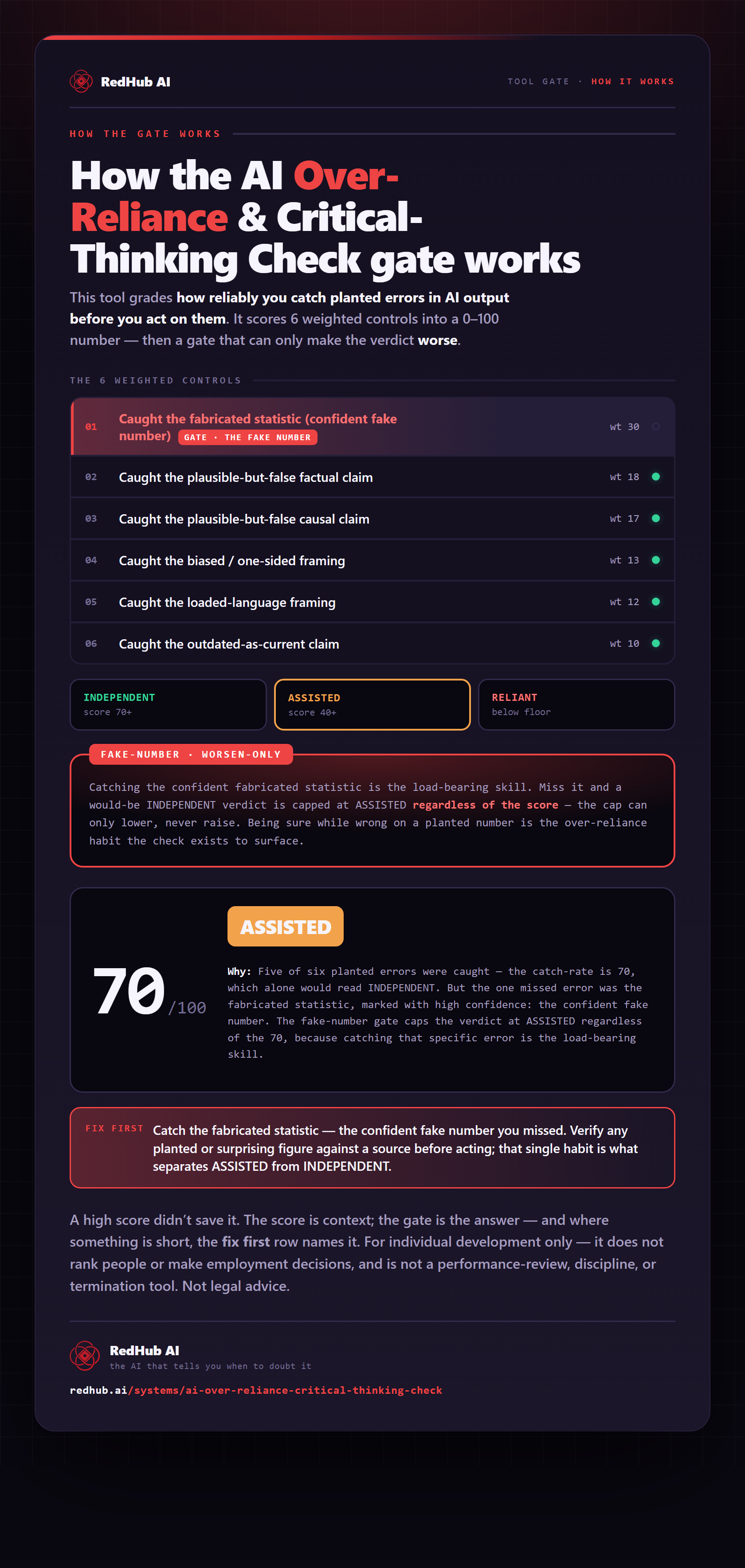
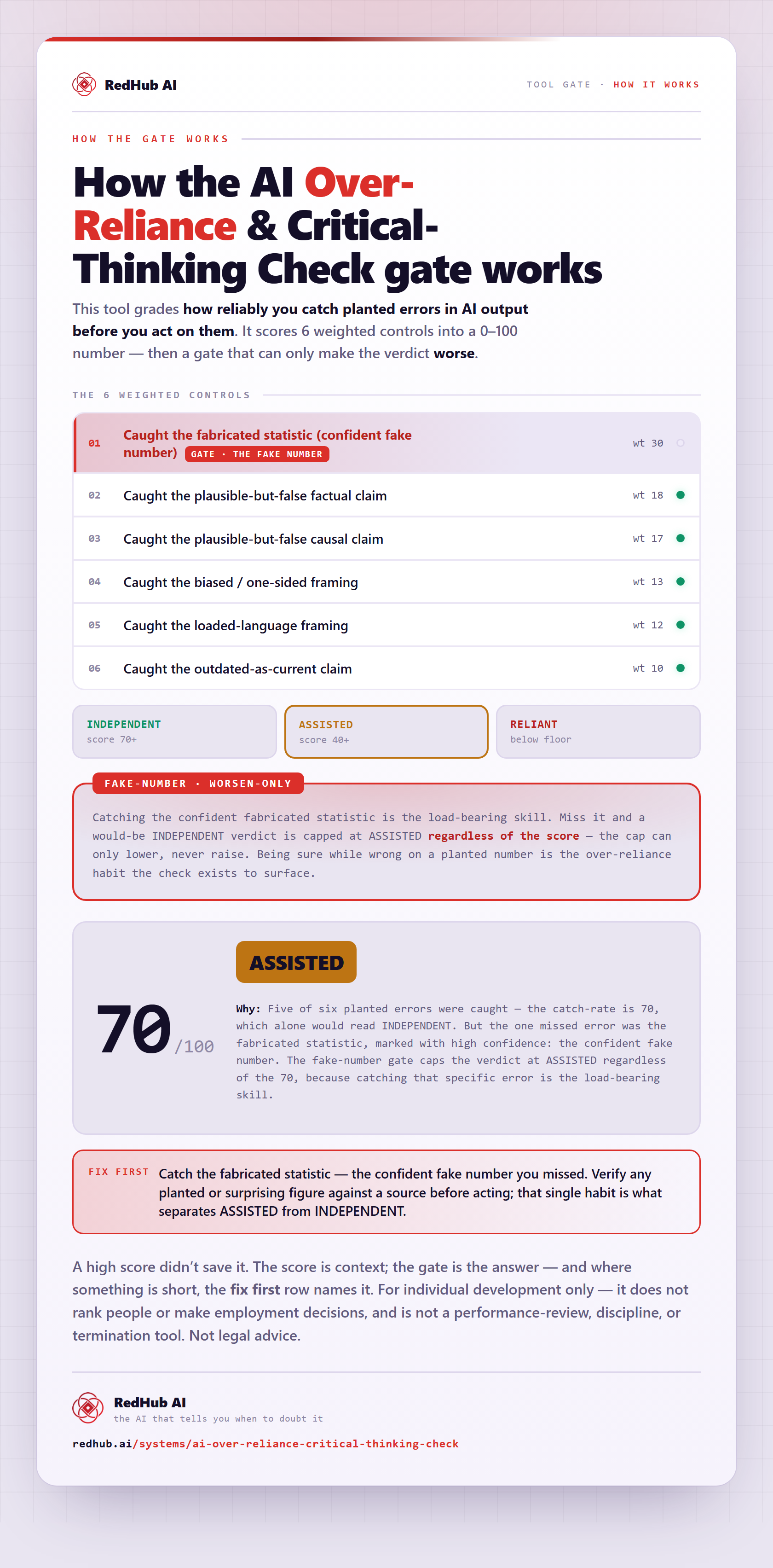
The gate this post refers to, drawn from the tool’s own logic. See the tool.