AI for Executives: A Practical Briefing for Leadership Teams
RedHub AI Editorialupdated November 5, 20268 min read

Jump to a section8
AI for executives is a set of decisions, not a set of tool skills. A leadership team has to decide what AI is for in the business, what it spends and gets back, what exposure it carries, whether its people can use the tools, and what competitors are doing with them. Most teams answer those five questions confidently in meetings and have very little written down. A useful briefing makes the team put a mark on each question, out loud, and reads the five marks back as one verdict. The Exec AI Briefing & Decision Course ($99) does exactly that. It grades the leadership team's preparedness as a group. It scores no individual, and it is not for any hiring, performance or other employment decision.
TL;DR: Five questions decide whether a leadership team is ready to make AI calls: strategy, spend and return, risk and regulatory exposure, team capability, and competitive awareness. The Exec AI Briefing scores each 0 to 5 in a 60-minute session and weights them into a 0 to 100 total: LEADING at 75 or more, CATCHING UP from 50 to 74, BLINDSIDED below 50. A 0 on risk or on competitive awareness forces BLINDSIDED whatever the total. Deep dives: AI in decisions, aligning the team, board questions and readiness.
The job is deciding about AI, not using it
A common assumption is that an executive who is "good at AI" is hands-on with the tools. That helps, but it is not the job. An operator needs to use AI well. A leader needs to decide well about it: which bets to fund, which risks to accept, and which claims from a vendor or a direct report to believe. Those calls improve with a clear picture of where the business stands. They do not improve with another prompt tutorial.
How skilled your people are with AI is a separate question, and it is about individuals. The AI Fluency Diagnostic ($79) scores a person's AI working practices across six skills, for development and never for hiring. This guide stays at the leadership-team level: what the team as a whole knows, has decided and has written down.
The five questions a leadership team has to answer
The briefing turns each question into a dimension with a fixed weight. The weights add up to 100. Two dimensions carry a gate, explained below.
| The question | Dimension | Weight | Gate |
|---|---|---|---|
| What is AI for in this business? | D1 Strategy & business case | 20 | No |
| What do we spend, and what comes back? | D2 Spend & ROI visibility | 20 | No |
| Do we know our obligations and exposure? | D3 Risk & regulatory exposure | 25 | A 0 forces BLINDSIDED |
| Can the organization actually execute? | D4 Team capability & adoption | 20 | No |
| What are competitors shipping with AI? | D5 Competitive & market awareness | 15 | A 0 forces BLINDSIDED |
Each question has its own deep dive. Using AI in executive decisions covers how to work with AI output without handing it the call. Aligning your leadership team covers what to do when the room disagrees on a mark. The board's AI questions maps these five onto what a board asks, and is your company ready for AI walks through scoring them.
How five marks become one verdict
The room scores each dimension 0 to 5. Each mark is divided by 5 and multiplied by its weight, and the five results are added and rounded to a whole number. Then three bands apply: LEADING at 75 or more, CATCHING UP from 50 to 74, BLINDSIDED below 50.
The sample read that ships with the product shows the arithmetic. The team marked strategy 4, spend 3, risk 0, capability 4 and competitors 3:
- Strategy: 4/5 x 20 = 16
- Spend: 3/5 x 20 = 12
- Risk: 0/5 x 25 = 0
- Capability: 4/5 x 20 = 16
- Competitors: 3/5 x 15 = 9
The total is 53, which on the bands reads CATCHING UP. The engine prints BLINDSIDED instead, because the team scored 0 on risk and regulatory exposure. The dimension to fix first is the lowest mark, which is risk. Raise that one mark from 0 to 1 and the total becomes 58, the gate clears, and the verdict reads CATCHING UP. One point on the right dimension moved the verdict further than any amount of work on strategy would have.
The gate is the opinion inside the model
The gate is the part worth arguing about. A team that marks 5 on everything except risk, where it marks 0, totals exactly 75. The bands call that LEADING. The verdict is BLINDSIDED. The product's view is that a leadership team with no picture of its exposure, or no idea what competitors are shipping, is not leading anything, however good the rest looks.
The gate fires only on a 0. A team that marks risk at 1, meaning it has barely looked, does not trip it. A read of 3, 3, 1, 3 and 2 totals 47 and reads BLINDSIDED on the bands alone, with risk named first, but a read of 4, 4, 1, 4 and 4 totals 65 and reads CATCHING UP, with risk still named first. Weak is not the same as zero in this model, and you may think it should be. The weights, bands and gate are written in the engine's config file and in the workbook's formulas, so you can read exactly what you are agreeing to.
There is a second limit. The facilitator playbook defines a 5 as "we could brief the board on this today" and treats "we have not looked" on risk, or "no idea" on competitors, as a 0. Marks 1 through 4 have no written definitions. Two teams can give the same reality different marks, so the score is most useful against your own next score, not against another company's.
What the 60 minutes look like
The facilitator playbook runs the session to the minute. Invite the people who make AI calls: the founder or CEO, the operations or finance lead, and whoever owns risk or legal. Open the workbook's Briefing Calculator tab and set one rule: score honestly, not aspirationally.
- Strategy, 10 minutes. Is there a written AI thesis tied to the business, or only enthusiasm?
- Spend and return, 10 minutes. Can anyone state what the company spends on AI this quarter and what it returns?
- Risk and regulatory exposure, 12 minutes. Does leadership know its obligations and exposure?
- Team capability, 10 minutes. Can the organization execute, or is it shadow use and confusion?
- Competitors, 8 minutes. Does leadership know what rivals are shipping?
- Read the verdict, 10 minutes. Read the total, the verdict and the dimension to fix first.
Afterward, the fix-first dimension gets an owner and a 30-day checkpoint, and the briefing is re-run a quarter later. The five-lesson Decision Course covers one dimension per lesson, and each lesson ends in a decision you can make that week. Examples include writing a one-paragraph AI thesis tied to a business metric, pulling this quarter's actual AI line items, and naming your largest AI regulatory exposure and who owns it.
What the briefing does not do
It records one agreed mark per dimension, so it does not capture who in the room disagreed. That conversation happens in the session, and the alignment guide covers how to run it. The marks are your own, and nothing checks them against evidence. Risk and regulatory exposure asks whether leadership knows its exposure. It does not tell you what any law requires, and it is not legal, financial, investment or compliance advice, so confirm any exposure with qualified counsel. The engine and workbook are fixed arithmetic with no AI inside, and nothing is uploaded anywhere.
Put five honest marks on your leadership team
The Exec AI Briefing & Decision Course is a runnable Python engine, a workbook that gives the same verdict, a facilitator playbook for the 60-minute session, a five-lesson Decision Course and a sample read. It returns LEADING, CATCHING UP or BLINDSIDED, says whether the gate fired, and names the dimension to fix first where one is short.
Get the Exec AI Briefing & Decision Course — $99Pairs well with
If capability is your weak dimension, the AI Literacy & Workforce Training Kit ($199) is a role-based training program with a slide deck, participant workbook and facilitator guide. The AI Fluency Diagnostic ($79) measures individual AI working practices for development, never for hiring. If risk is your weak dimension, the AI Governance & Acceptable Use Starter Kit ($39) gives you editable starting templates, including an acceptable use policy and an incident response playbook. They are templates, not legal advice.
More in this guide
What does "AI for executives" actually mean?
It means making sound decisions about AI as a leadership team: what it is for in the business, what it costs and returns, what exposure it creates, whether people can use it, and what competitors are doing. Being hands-on with the tools helps, but the executive's job is the decisions.
How does the Exec AI Briefing score a leadership team?
The team marks five dimensions from 0 to 5: strategy, spend and ROI visibility, risk and regulatory exposure, team capability, and competitive awareness. Weighted 20, 20, 25, 20 and 15, they add up to a 0 to 100 total. LEADING is 75 or more, CATCHING UP is 50 to 74, and BLINDSIDED is below 50.
Why can a high score still read BLINDSIDED?
In the Exec AI Briefing, a 0 on risk and regulatory exposure or on competitive awareness forces BLINDSIDED regardless of the total. A team that marks 5 everywhere except a 0 on risk totals 75 and still reads BLINDSIDED. The gate fires only on a 0, not on a 1.
Does the briefing score individual executives?
No. The Exec AI Briefing records one mark per dimension for the organization and grades the leadership team's preparedness as a group. It does not score, rank or assess any person, and it is not for any hiring, performance or other employment decision.
Is this the same as measuring my team's AI skills?
No. Measuring how well individual people use AI is a separate question, which the AI Fluency Diagnostic answers for development purposes. The Exec AI Briefing asks what the leadership team knows and has decided about AI, with a single mark for the organization's capability as one of five dimensions.
Is a readiness verdict legal or compliance advice?
No. The Exec AI Briefing's risk dimension asks whether leadership knows its AI obligations and exposure. It does not say what any law requires and is not legal, financial, investment or compliance advice. Confirm any regulatory exposure with qualified counsel.
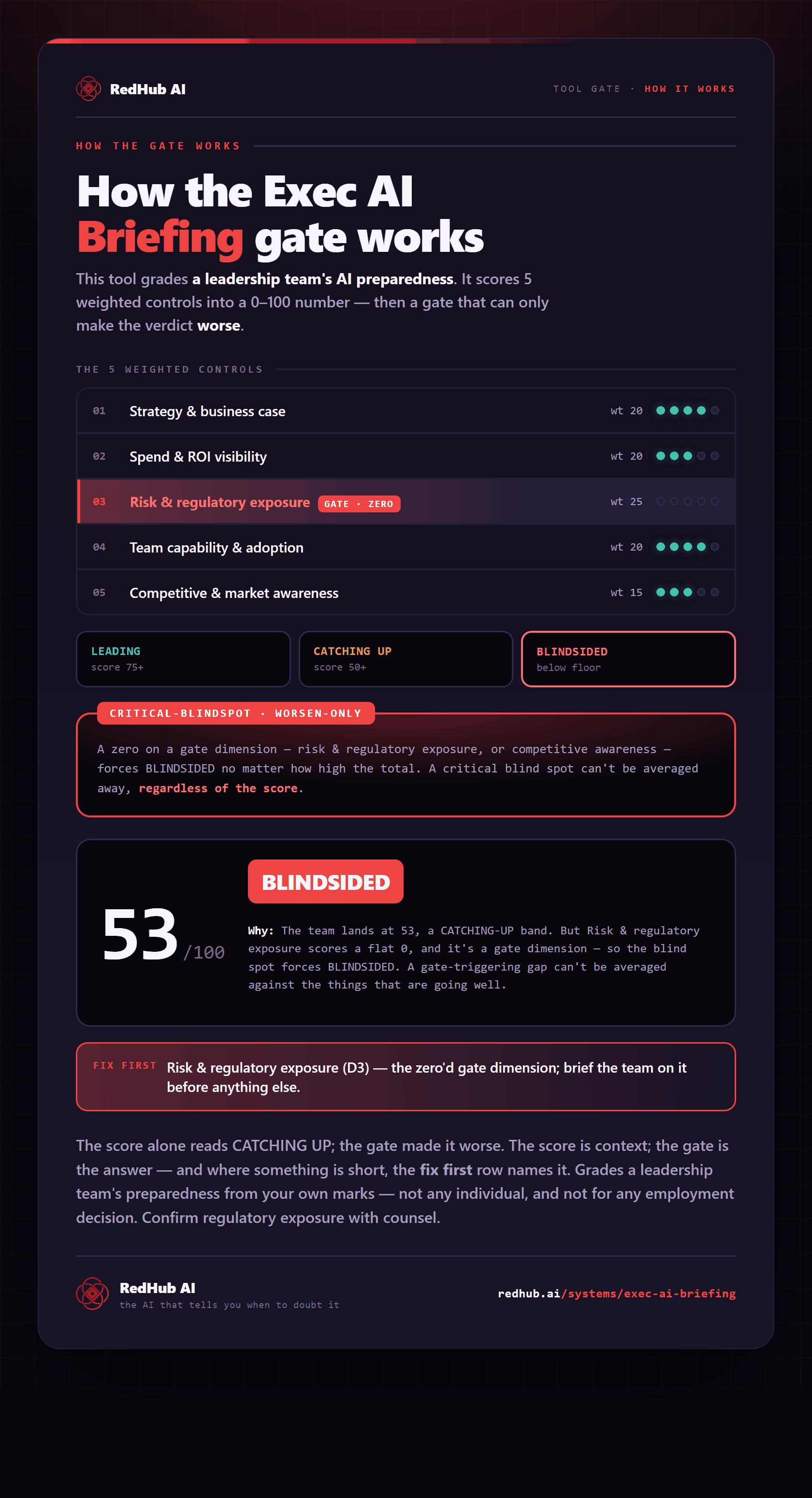
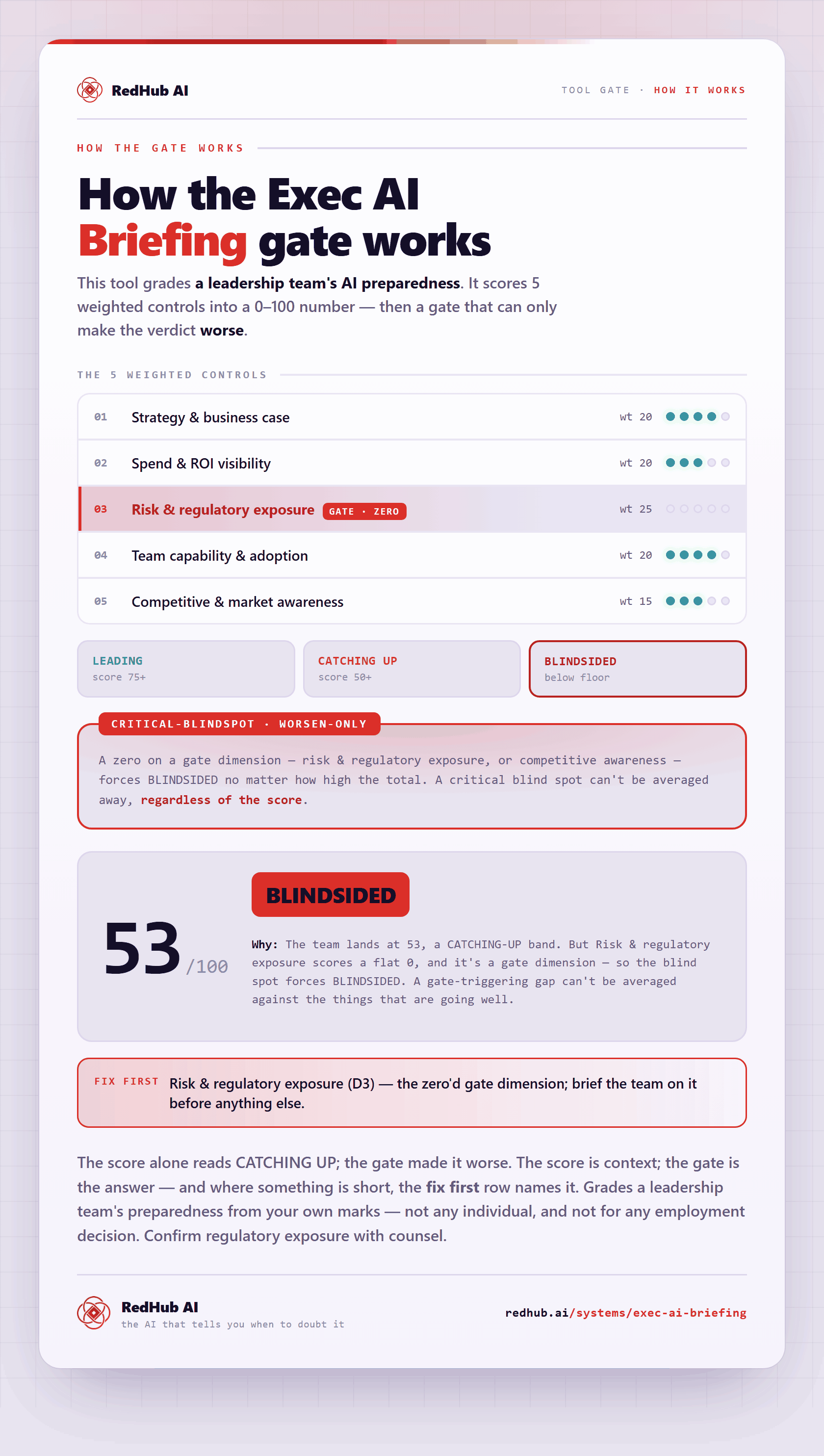
The gate this post refers to, drawn from the tool’s own logic. See the tool.