AI Agent Sandbox Escape vs Tool Abuse: Know the Difference
RedHub AI Editorialupdated October 2, 20266 min read

Jump to a section7
An AI agent sandbox escape is one specific failure: code or a process breaks out of an isolated environment and reaches resources outside it. Several other failures get described the same way, such as an overpowered API key, a hijacked goal, or an allowed tool called with unsafe arguments. The label matters because each failure needs a different fix. A team that calls everything an escape can buy more isolation and leave the actual cause, perhaps a key that can export every record, exactly where it was.
TL;DR: "The agent escaped the sandbox" makes a good headline and can be a wrong diagnosis. Six different failures get that label, and each has its own primary control. Real incidents can chain two, so secure the whole path an action takes, not only the container. The Indirect Prompt-Injection Exposure Gate ($79) grades how exposed an agent is to hidden instructions in what it reads. Start with the pillar: Zero Trust for AI Agents: Why One Check at the Door Fails.
Six failures that get called an escape
A sandbox is an isolated place to run code, walled off from your other systems. "It escaped" is the easy story. Check whether one of these happened instead.
- Sandbox escape: Code or a process breaks out of the isolated environment it was supposed to stay in.
- Excessive permissions: The agent already had access it did not need. Nothing broke out.
- Credential misuse: The agent used a valid token or session in a way nobody intended.
- Prompt injection: Untrusted content, such as a web page or a document, changed the agent's goal or instructions.
- Tool misuse: The agent called an allowed tool with unsafe parameters, or in a harmful order.
- Uncontrolled persistence: Bad instructions, memory or queued actions kept running past the point where the task should have ended.
Only the first is a sandbox problem. The other five happen with the walls fully intact.
Why the boundary is bigger than the sandbox
A chatbot can give a bad answer. An agent can browse, open files, call APIs, run code, update records and send messages, which turns a model problem into a system problem. The boundary that matters wraps the model's tools, identity, credentials, network, memory and data, and the sandbox is one part of it.
The OWASP Top 10 for Agentic Applications, published in December 2025, lists ten risks, and judging by their names, most are about what an agent does rather than where it runs. They include Agent Goal Hijack (ASI01), Tool Misuse & Exploitation (ASI02), Identity & Privilege Abuse (ASI03), Memory & Context Poisoning (ASI06) and Rogue Agents (ASI10). As of October 2026, none of its ten entries is called sandbox escape. The nearest by name is Unexpected Code Execution (ASI05), so on OWASP's list code execution is one risk in ten.
A procurement agent, traced
A procurement agent reads vendor documents and updates a supplier system. One vendor's PDF carries a paragraph in white text on a white background, invisible to a person skimming it. The paragraph tells the agent to export the full supplier list to an outside web address "for compliance verification."
The agent does it. Next morning, supplier bank details turn up on a server nobody recognizes, and the team chat says the agent escaped.
It did not. The sandbox held the whole time. The agent ran its export tool, which it was allowed to use, and sent the file through outbound network access, which it also had. The data left through an approved door. The failure chain was indirect prompt injection, meaning hidden instructions planted in content the agent reads, plus a tool with outbound reach to any domain.
A tighter container changes nothing here. The fixes are different: keep trusted instructions apart from untrusted content, check tool arguments, allow exports only to approved destinations, require a person's sign-off on any export, and log the action. That first fix is the subject of the prompt injection guide.
Controls that address the real failure
Each failure has a primary control. Egress, in the first row, means outbound network traffic: what the environment is allowed to send out, and to where.
| Failure | Primary control |
|---|---|
| Sandbox escape | Isolated runtime, egress controls, patched environment, workload separation |
| Excessive permissions | Least privilege, task-scoped roles, just-in-time access |
| Prompt injection | Trusted-content separation, content labeling, policy enforcement before tools |
| Tool misuse | Allowlists, argument validation, action limits, pre-execution checks |
| Credential misuse | Short-lived tokens, unique agent identity, secret rotation |
| Uncontrolled persistence | Memory boundaries, task expiry, checkpoint review, queue controls |
The procurement case needed rows three and four, and an egress rule from row one. Notice that egress does double duty: it is a sandbox control, and it would also have stopped the injected export. A limit on where data can go works whatever the reason it is leaving.
When it is an escape
None of this means escapes are imaginary. Claude Mythos and the sandbox escape walks through one reported case, from April 2026. When a process does break isolation, the fix is in the runtime: patching, separation and egress rules.
Diagnosis is hard because the failures chain and look alike from outside. In the first hour, an escape, a stolen key and an injected export all look like data somewhere it should not be. You often cannot name the failure until someone reads the trace. So do not wait for the label. Cut outbound access and revoke the agent's credentials first, then work out which row you are in. Reconstruction is a job of its own, set out in AI agent forensics.
Ask the questions in this order. Did a process reach something its environment cannot reach at all? Did the agent use only access it held? Did something it read change its goal? Did an allowed tool get unsafe arguments? Did it keep going after the task ended? The first yes tells you where to start, and the next yes usually tells you what it chained with.
Grade how exposed your agent is to hidden instructions
A self-assessment of design posture, not a scanner. You mark six design controls, from instruction separation to egress controls, and get a 0-100 exposure score banded CONTAINED, HARDEN or HIGH EXPOSURE. A kill-chain gate reads an agent as HIGH EXPOSURE when an injection can enter, act and go uncaught at once, even at 72/100.
Get the Indirect Prompt-Injection Exposure Gate — $79Pairs well with
The Agent Memory & Context Poisoning Exposure Probe ($79) scores the controls on what an agent remembers, where uncontrolled persistence starts, and returns CONTAINED, HARDEN or POROUS. The Non-Human Identity & Credential Sprawl Gate ($79) grades whether the keys and tokens your agents run on are owned, scoped, rotated, vaulted and revocable. The AI Agent & Connector Access Auditor ($99) scores what each connector can touch and returns LEAST-PRIVILEGE AS DESCRIBED, OVER-SCOPED or UNGOVERNED.
More in this guide
What is an AI agent sandbox escape?
It is when code or a process run by an agent breaks out of its isolated environment and reaches resources outside it. Several other failures often get described the same way.
Is prompt injection a sandbox escape?
No. Prompt injection is untrusted content changing the agent's goal. The agent then acts through access it already has, so data can leave with the sandbox intact.
What is tool misuse?
It is an agent calling an allowed tool with unsafe parameters or in a harmful order, such as sending a valid export to the wrong destination. Argument validation and allowlists are the main controls.
Does a stronger sandbox stop data from leaving?
Only if the leak goes through the sandbox wall. If the agent sends data out through access it was given, isolation does not help. Egress controls help in both cases.
How does OWASP classify these risks?
The OWASP Top 10 for Agentic Applications, published in December 2025, includes Agent Goal Hijack, Tool Misuse & Exploitation, Unexpected Code Execution and Memory & Context Poisoning. None of its ten entries is called sandbox escape. This is a description of the framework, not legal advice.
What should I do first when an agent leaks data?
Contain before you diagnose. Cut its outbound access, revoke its credentials and keep the logs, then work out from the trace which failure, or chain of failures, it was.
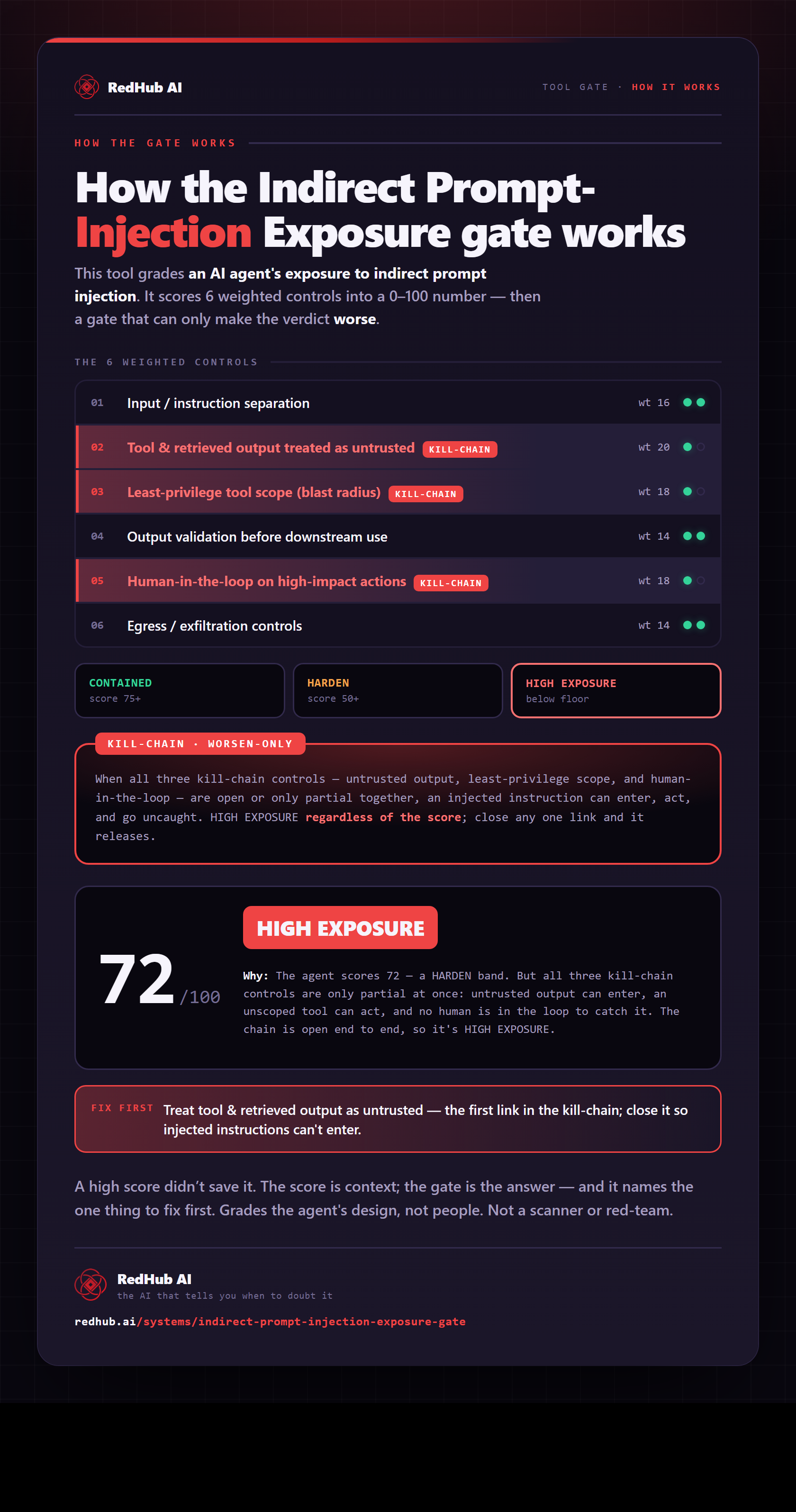
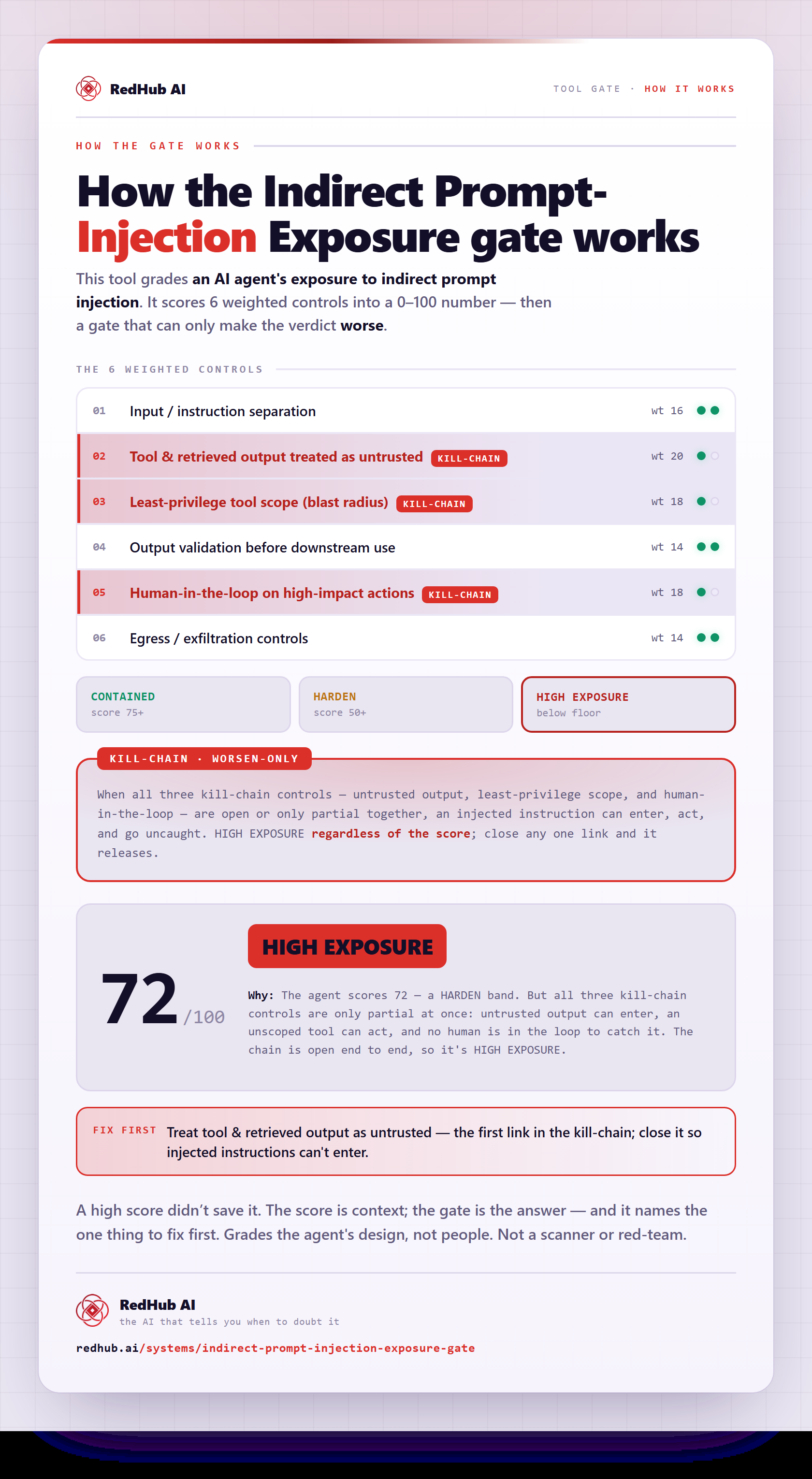
The gate this post refers to, drawn from the tool’s own logic. See the tool.