How to Measure AI Fluency: A Practical Assessment for Your Team
RedHub AI Editorialupdated October 7, 20266 min read

Jump to a section7
To measure AI fluency on a team, ask three questions about each person. Can they get a useful result from AI? Can they tell when that result is wrong? Do they know which tasks to keep away from AI altogether? A quiz about prompt-writing covers only the first question, and the first is the easy part. Someone who ships whatever the tool produced is less fluent than someone who catches its mistakes, even when the first person works faster. So score the judgment, and use the result as a map for training. It should never become a grade.
TL;DR: AI fluency is three things: getting a useful result, catching it when it is wrong, and knowing when to skip AI. Measure the last two harder than the first. Read the weakest skill, because an average hides it. Keep the result off reviews, or people will answer to protect themselves. A self-marked score has a blind spot, so check it against real work. The AI Fluency Diagnostic ($79) scores six skills from a person's own marks and reports the weakest one. This guide covers literacy vs fluency, running an assessment, finding the skills gap, and what fluency looks like.
Three questions worth asking
- Can they get a useful result? They can give AI a clear task and shape the output into something usable. This is a real skill, and it is the floor.
- Can they catch a wrong one? AI writes mistakes in the same confident voice as everything else: an invented fact, a wrong total, a quote nobody said. A fluent person checks the parts that matter before the work leaves their desk.
- Do they know when to skip it? Some tasks need a guaranteed answer or a named person who is accountable for it. A fluent person keeps those tasks.
Score only the first question and the results come out backwards. The fast, careless user rates as fluent. The careful one, who checks every figure and so finishes later, rates as behind.
An average hides the weak skill
The AI Fluency Diagnostic splits those three questions into six skills, each marked 0 to 5 and turned into a score out of 100. Its sample team includes a learner marked 5 of 5 on five skills and 2 of 5 on verification. The average of that person's six scores is 90, which looks excellent.
The diagnostic does not report the average as the result. Its headline is the lowest of the six, which here is 40. Verification is also one of two skills it treats as essential, along with safe data handling. With either one below 3 of 5, the tier is held at AWARE, the lowest of its three. So a person with a 90 average reads AWARE, because the one skill they are missing is the one that puts an invented number in front of a client.
Why the result is a map and never a grade
Once a score can affect someone's standing, they stop answering honestly. They mark up what they know and leave out what they don't, and the numbers stop meaning anything. Say the purpose out loud before anyone starts: "This shows us what to teach. It does not go on your review." Then keep that promise. One mention of a fluency score in a performance conversation is enough to spoil every assessment you run afterward.
The promise is harder to keep than it sounds. The diagnostic's team roll-up reports the tier of the least fluent member. In its six-person sample, two learners land at AWARE and so the team reads AWARE. On a team that small, everyone can guess who. One option is to share only the most common weak skill (verification, for 3 of the 6 in the sample) and leave the tier with whoever plans the training. That hides the detail a manager most wants to see, and we have not found a way around the trade.
A self-marked score has a blind spot
The diagnostic is self-marked. Each skill has five statements, and a person counts the ones that are true today. One of the verification statements reads, "Asks the tool for its sources and then actually opens them." That is harder to inflate than "rate your AI skills from 1 to 5," but it is still the person's own word.
Two checks help. First, the diagnostic lets a person enter a self-rating for each skill before they count. Where the rating is more than one point above the counted marks, it flags that skill as overconfident. In the sample, one learner rates their own verification 5 and counts 3 true statements. Second, look at real work, which the diagnostic does not do. Give someone a small task and an AI tool, then read what they hand back. Our post on running an AI skills assessment covers how to set that up without it feeling like a trap.
From diagnosis to a plan
A result is only useful if it changes what you teach. Where a skill is short of 5 of 5, the diagnostic names the weakest one and a kit to start with. When every skill is at 5 of 5, it names none. From there the order is teach, practice, apply. Someone who cannot explain why AI gets things wrong needs teaching first. Someone who understands it but writes one vague line and hopes needs practice, not a lecture. Someone who uses AI well for one task and nowhere else needs to see more places it fits. One course for the whole team gives all three people the same hour, and two of them did not need it.
Find the weakest skill before you buy training
The AI Fluency Diagnostic scores six skills from each person's own 0 to 5 marks: foundational understanding, verification, prompting, workflow integration, safety and role-specific use. The headline is the lowest skill, tiered FLUENCY PRACTICES SHOWN AS DESCRIBED, CAPABLE or AWARE, and a team roll-up reports the most common gap. It ships as a Python engine and a workbook that return the same result. It is for development and training planning, not for hiring, reviews or any employment decision.
Get the AI Fluency Diagnostic — $79Pairs well with
The AI Literacy & Workforce Training Kit ($199) is the teaching step: a 28-slide deck, a workbook, a knowledge check, a certificate and a completion log. The Prompt Practice Lab ($69) is the practice step. It scores each prompt you write on six criteria and brings the weak drills back on a spaced schedule. The AI Over-Reliance & Critical-Thinking Check ($69) goes deeper on verification. You review a piece of AI text seeded with six planted problems and mark the ones you caught.
More in this guide
What is AI fluency?
It is the ability to get a useful result from AI, catch that result when it is wrong, and know which tasks to keep away from AI. The second and third matter more than prompt-writing. A careful person who checks the output is more fluent than a fast one who does not.
How do you measure AI fluency?
Score the judgment, not just the prompting. Have each person mark concrete statements about what they do today, compare that with how they rated themselves beforehand, and then look at one piece of real AI-assisted work. Read the weakest skill, not the average.
Should I use an AI fluency score to evaluate employees?
No. Once a score affects someone's standing, they answer to protect themselves and the result stops being accurate. Use it only to decide what to teach, and say so before anyone starts. The AI Fluency Diagnostic is built for development and training planning, not for hiring, reviews or other employment decisions.
Is self-assessment reliable for AI skills?
Only partly. A self-rating can miss high or low, and the person giving it cannot see which. Counting concrete statements is tighter than a 1 to 5 rating, but it is still self-reported. Pair it with a look at real work.
Why read the weakest skill and not the average?
Because an average hides the skill that fails. In the AI Fluency Diagnostic's sample, a learner with five skills at 5 of 5 and verification at 2 of 5 averages 90 across the six scores. The headline score is 40 and the tier is AWARE.
What do I do after measuring fluency?
Match the training to the gap. Teach the people who do not understand how AI fails, give practice to the people who understand it but use it loosely, and show narrow users where else it fits. Then measure again later to see whether anything moved.
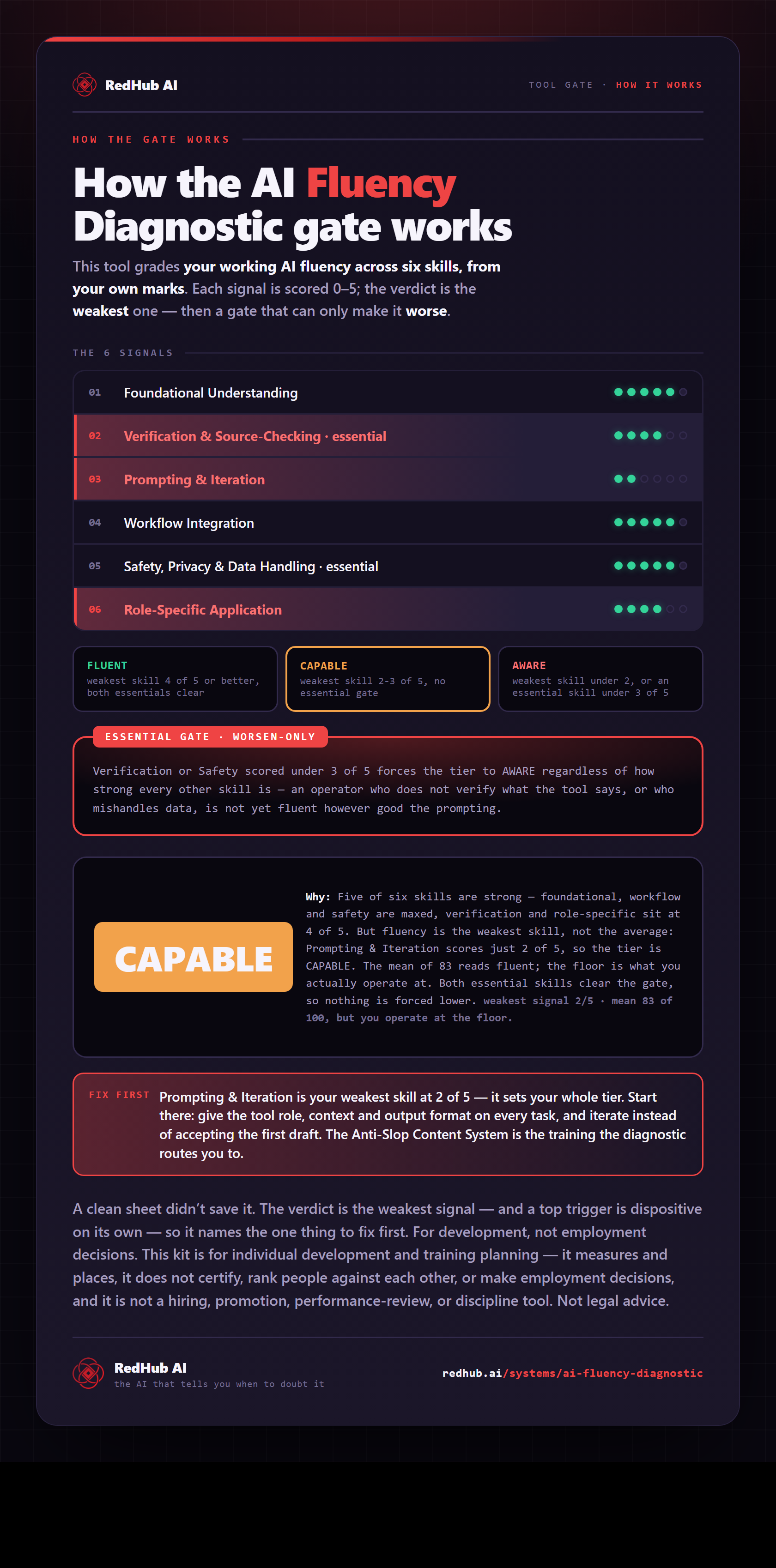
The gate this post refers to, drawn from the tool’s own logic. See the tool.