AI Literacy vs. AI Fluency: What's the Difference?
RedHub AI Editorialupdated October 7, 20265 min read

Jump to a section7
AI literacy vs AI fluency comes down to knowing versus doing. Literacy is understanding what AI is, how it works, and where it fails. Fluency is the working skill: getting a good result, catching the mistakes, and leaving AI out of tasks it should not touch. The two are built differently. Literacy comes from learning, and fluency comes from repetition on real work. A person can explain why a language model invents facts and still paste an unchecked answer into a client email. Teams need both, and a budget spent on the wrong one changes nothing.
TL;DR: Literacy is knowledge about AI. Fluency is skill with it, including the habit of checking output. A course builds literacy. Practice with feedback builds fluency. A person can have either one without the other, so find out which is missing before paying for training. The AI Fluency Diagnostic ($79) scores six skills from a person's own marks, and foundational understanding is one of them. For the full method, see How to Measure AI Fluency.
Literacy: knowing what AI is
A literate person holds a few plain facts. A language model generates likely text. It does not look answers up in a database. It has a knowledge cutoff, so it can be out of date. The same prompt can return different answers on different days. And whatever goes into the prompt box may be stored somewhere, so some things should never be typed there.
Those facts prevent the basic mistakes: trusting a statistic the model made up, or pasting a customer list into a public tool. You build literacy by teaching it. Our post on AI literacy training covers how to run that for a whole team.
Fluency: using AI well
Fluency shows up in the work itself. The fluent person gives the tool a role, the background, and the format they want back. They treat the first answer as a draft. They notice when a number looks off, and they check it against the source before anyone else sees it. They also know which steps of a job to hand over and which to keep.
None of that can be memorized. A person can recite "always verify" and still skip the check at 4:45 on a Friday. The habit forms by doing the task, getting it wrong where it is cheap, and doing it again.
One without the other
The two come apart in both directions. A careful skeptic can explain exactly why AI is unreliable and have almost no hands-on skill, because the same caution kept them from practicing. A fast adopter can turn out polished work every day without understanding why the model errs. That second person misses the errors a little understanding would have caught, and their output looks like the strongest on the team.
The skeptic is the harder case to call. In a role where every sentence carries legal or financial weight, staying away from AI may be the right decision and not a gap at all. An outside observer cannot tell a considered refusal from plain avoidance. You have to ask the person why.
Where the line blurs
The clean split in this post is a teaching aid. In practice the two overlap. The AI Fluency Diagnostic scores six skills, and the first, foundational understanding, is literacy by another name. One of its five statements reads, "Understands that outputs are generated, not retrieved from a database of facts." So that rubric treats literacy as one part of fluency, and not as a separate thing sitting beside it.
Both views hold up. Keeping the two words separate helps you choose the fix, which is a course or practice. Scoring them on one sheet shows that a person strong on five skills can still be weak on the sixth.
How to build each
- To build literacy, teach. Give plain explanations of how AI works, where it fails, and what must stay out of a prompt. Finish with a short knowledge check, so you know it landed.
- To build fluency, practice. Set real tasks, give feedback, and repeat until checking the output stops being a decision.
Running an "AI 101" seminar and expecting people to use AI well afterward is the usual mismatch. The seminar fixes a literacy gap. If the gap was fluency, the team now understands more and works the same.
See which one your team is missing
The AI Fluency Diagnostic scores six skills from each person's own 0 to 5 marks: foundational understanding, verification, prompting, workflow integration, safety and role-specific use. The headline is the lowest skill, tiered FLUENCY PRACTICES SHOWN AS DESCRIBED, CAPABLE or AWARE. Where a skill is short of 5 of 5, it names the weakest one to develop next. It is for development and training planning, not for hiring, reviews or any employment decision.
Get the AI Fluency Diagnostic — $79Pairs well with
The AI Literacy & Workforce Training Kit ($199) covers the literacy side with a 28-slide deck, a workbook, a knowledge check, a certificate and a completion log. The Prompt Practice Lab ($69) covers the practice side. It scores each prompt you write on six criteria and returns STRONG, WORKABLE or WEAK. The Claude Project Blueprint Library ($79) gives the practice somewhere to go: ten Claude Project blueprints, one per business function, each with custom instructions and starter prompts.
More in this guide
What is the difference between AI literacy and AI fluency?
Literacy is understanding what AI is and how it works. Fluency is using it well in practice, which includes catching its errors and knowing when to leave it alone. Literacy is built by learning, and fluency is built by doing.
Can you be AI literate but not fluent?
Yes. A careful skeptic may explain exactly why AI is unreliable and have little hands-on skill. The reverse also happens: someone produces polished output every day without understanding why the model gets things wrong, and so misses the errors.
Which should my team build first?
Whichever one is missing, and you find that out by measuring. A seminar will not fix a fluency gap, and practice drills will not help someone who does not yet understand why AI output needs checking.
Why doesn't an "AI 101" course make people use AI well?
A course builds understanding. Using AI well is a habit, and habits come from repeating real tasks with feedback. After the course, people know more. They work differently only after practice.
Is knowing when not to use AI part of fluency?
Yes. A fluent person knows which tasks need a guaranteed answer or a named accountable person, and keeps those tasks. Avoiding AI everywhere is different, and you usually have to ask someone their reasons to tell the two apart.
Is literacy part of fluency or separate from it?
It depends on what you need the words for. Keeping them separate helps you choose between a course and practice. The AI Fluency Diagnostic scores foundational understanding as one of six fluency skills, which treats literacy as a part of fluency.
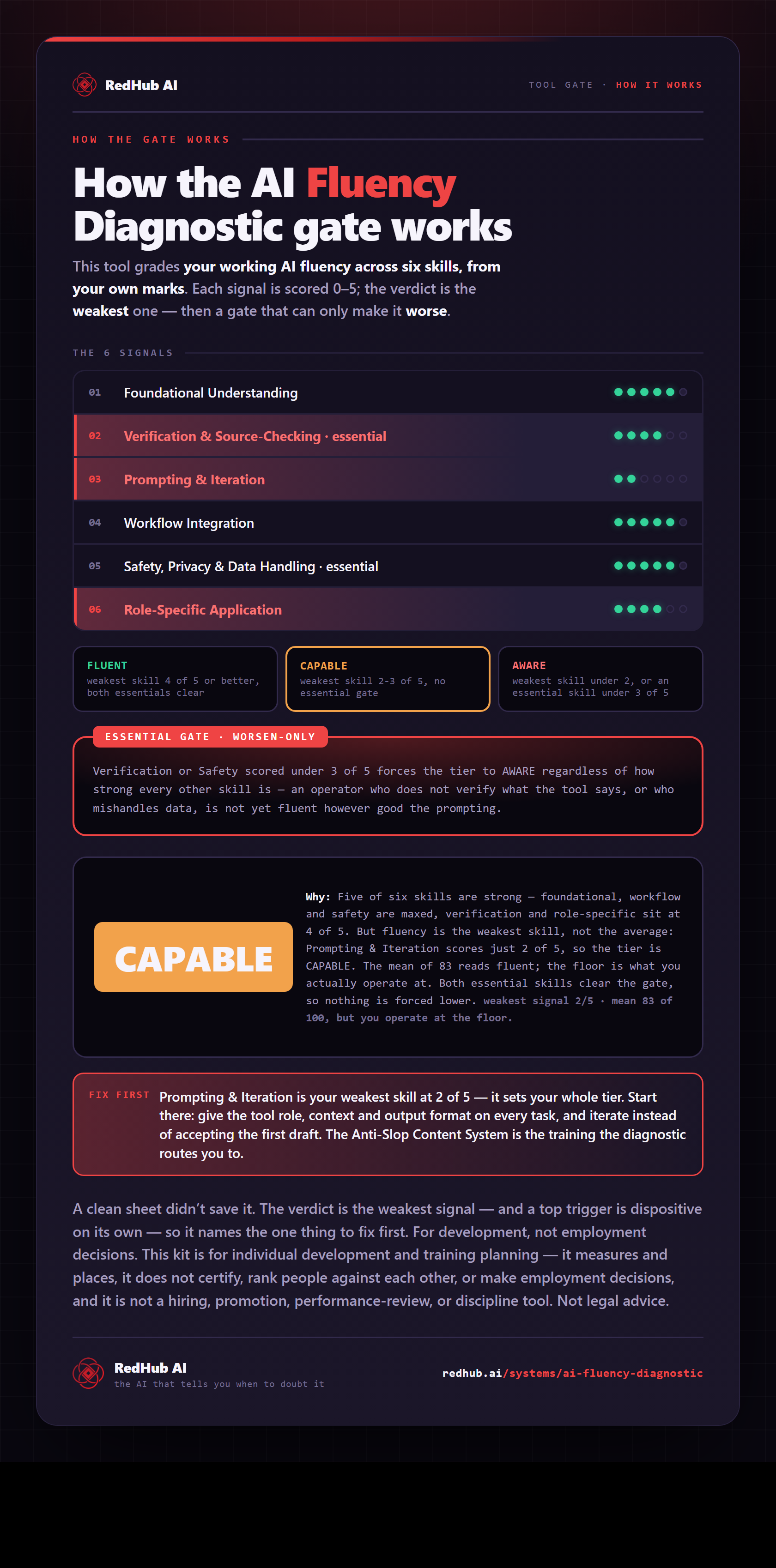
The gate this post refers to, drawn from the tool’s own logic. See the tool.