How to Run an AI Skills Assessment (Without It Backfiring)
RedHub AI Editorialupdated October 7, 20265 min read

Jump to a section7
An AI skills assessment backfires when a score can hurt the person giving it. People mark themselves up, leave their gaps off the sheet, and hand you tidy numbers that are wrong in the direction you can't see. So the job is mostly about safety. Tell people up front that the result decides what gets taught and nothing else. Keep it off performance reviews. Then check what people say against one piece of real work, because a self-rating measures confidence. With those three things in place, the mechanics are simple.
TL;DR: State the purpose before anyone starts: this decides training, not standing. Tell people who will see their individual marks. Pair a short self-marked sheet with one real task that has a planted mistake in it, and compare the two. Share the results as a group finding and a training plan. If nothing visible follows, the next assessment gets guarded answers. The AI Fluency Diagnostic ($79) is the self-marked half. For the full method, see How to Measure AI Fluency.
Say the purpose out loud first
Before the first question, tell people why you are doing this and what happens to the answers. Something like: "We are working out which AI training would help, so nobody sits through what they already know. This does not go on your review, and nobody is being ranked." Leave that out and people supply their own explanation, which is that this is a review in disguise.
Then be exact about who sees what. A team roll-up needs every person's marks in one file, so at least one person will read them. Name that person. "Only the enablement lead sees individual sheets, and the rest of us see the group result" is a promise people can hold you to. "It's confidential" is not.
Measure what people do, and what they say
A self-rating is a useful input and a poor only source. A person can rate themselves too high or too low, and they cannot tell which. Use three parts.
- A short self-marked sheet. Concrete statements work better than a 1 to 5 scale. "Checks load-bearing facts against a primary source before acting on them" is either true of your week or it is not.
- One small real task. Give a realistic job and an AI tool. Read the result for quality, and for whether the person caught what the tool got wrong.
- The gap between the two. Someone who marks themselves high on checking and then passes along a wrong figure has shown you the exact thing to train.
The planted mistake, and its catch
The clearest test of verification is a task where the AI output contains a believable error: a statistic that does not exist, or a column that does not add up. Whoever catches it has the habit. Whoever forwards it does not, however polished the rest of their work looks.
The trouble is that a planted mistake is a small deception, and you just promised people this was safe. There are two ways to run it, and each one costs something. Tell people in advance that one error is hidden, and nobody feels tricked, but now they are hunting. You learn whether they can find an error. You learn less about whether they check when nobody has warned them. Or say nothing and see the real habit, then spend trust explaining it afterward. We lean toward telling people. A slightly weaker measurement is cheaper than a team that reads the next assessment as a trap.
Keep it short
An assessment people dread gets rushed or skipped, and rushed answers are worse than none. Aim for one sitting. The AI Fluency Diagnostic's sheet is 30 statements, five for each of six skills, and a person counts the true ones. Add one task of about fifteen minutes. That is a snapshot for planning, not a certification, so honest and finished beats thorough and half-completed.
Close the loop
People told you where they are weak. If no training follows, they learn that admitting a gap bought them nothing, and next time they will say they are fine. Report back within a couple of weeks, as a group finding with no names: "We are solid at getting results and thin on checking them, so the next two sessions are on verification." The AI skills gap post covers matching each kind of gap to its fix.
One limit on how far "no names" goes. On a team of five, "one of us has not started using AI yet" names somebody. For a small group, report the skill, not the headcount.
Start with the self-marked half
The AI Fluency Diagnostic scores six skills from each person's own 0 to 5 marks, counted from 30 concrete statements. The headline is the lowest skill, tiered FLUENCY PRACTICES SHOWN AS DESCRIBED, CAPABLE or AWARE. An optional self-rating, entered first, flags any skill where confidence runs more than a point ahead of the count. It does not watch anyone work, so pair it with a real task. It is for development and training planning, not for hiring, reviews or any employment decision.
Get the AI Fluency Diagnostic — $79Pairs well with
The AI Over-Reliance & Critical-Thinking Check ($69) is a ready-made planted-mistake exercise. It is a piece of AI text seeded with six problems, including a fabricated statistic, and each person marks the ones they caught. The AI Literacy & Workforce Training Kit ($199) is the training to promise when you announce the assessment: a 28-slide deck, a workbook and a knowledge check, with a completion log. The Prompt Practice Lab ($69) gives people graded prompt drills to repeat after the results come back.
More in this guide
How do I run an AI skills assessment?
Say up front that it decides training and stays off reviews. Name who will see individual marks. Pair a short self-marked sheet with one small real task, compare the two, and report the result to the group with a training plan.
Why do skills assessments backfire?
Because once a score can hurt someone, they answer to protect themselves. They mark strengths up and leave gaps out, and the numbers look clean while being wrong. Keeping the result away from reviews and rankings is what keeps the answers honest.
Are self-ratings enough to assess AI skills?
No. A self-rating measures confidence, and a person can be off in either direction without knowing it. Add one real task, and look at the distance between how people marked themselves and what they did.
Should I tell people there is a planted mistake in the task?
We lean toward yes. Telling them means they hunt for it, so you learn less about their unprompted habit. Not telling them gives a truer reading and costs trust when you explain it later. For a first assessment, trust is worth more.
How long should the assessment take?
One sitting. A sheet of concrete statements plus one task of about fifteen minutes is enough to plan training. It is a snapshot, not a certification, so a finished honest answer is worth more than a long careful one that half the team skipped.
What do I do with the results?
Share the group finding and the plan without naming anyone, then deliver the training. On a small team, report the weak skill and leave out how many people have it, since a count of one identifies a person.
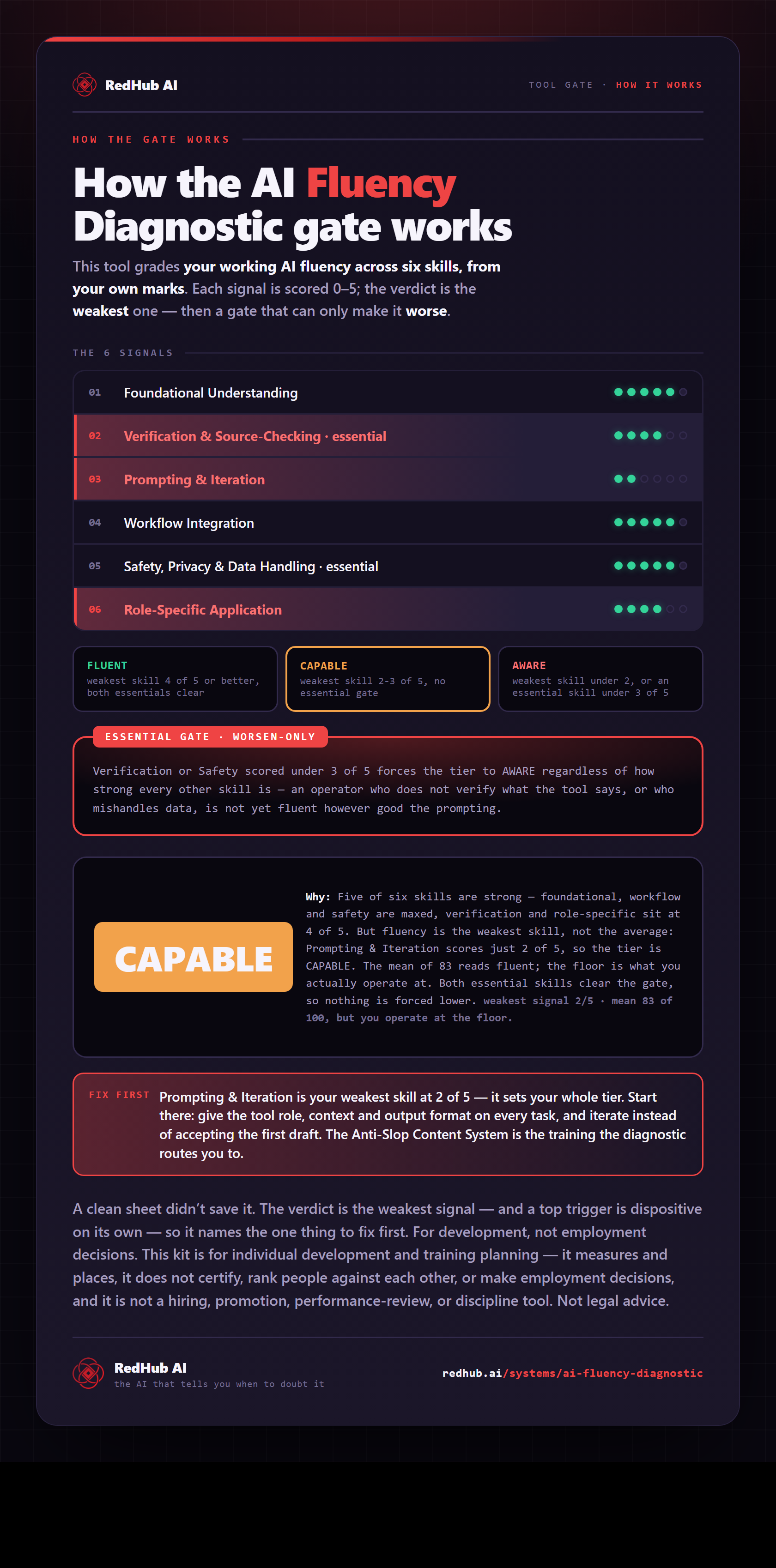
The gate this post refers to, drawn from the tool’s own logic. See the tool.