The AI Skills Gap: How to Find It and What to Do About It
RedHub AI Editorialupdated October 7, 20266 min read

Jump to a section7
The AI skills gap is the distance between how a team uses AI today and how it would use AI if everyone on it were fluent. On a team that already has the tools, that distance is rarely about operating them. Chat tools are built to be easy. The gap is usually a gap in judgment: people who take the first answer and send it, people who avoid AI everywhere, and people who use it well for one task and nowhere else. Each of those needs a different fix, so the first step is to measure which ones you have.
TL;DR: Look for four kinds of gap: not checking output, avoiding AI, using it for one narrow thing, and not understanding how it fails. Find them by comparing what people say with what they do on a real task. Then match the fix: teaching for understanding, practice for skill, a required check step for verification, and worked setups for narrow use. Measure again after training, with a task and not just a form. The AI Fluency Diagnostic ($79) reports each person's weakest of six skills. For the full method, see How to Measure AI Fluency.
Four gaps that look alike from a distance
- The confident non-verifier gets results fast and sends them unchecked. This one is the easiest to miss, because the mistakes arrive looking like productivity.
- The avoider distrusts AI in general and does not use it, including on tasks where it would save an hour.
- The one-trick user has one good use, often rewriting emails, and has never tried a second.
- The literacy gap belongs to someone who does not know why AI gets things wrong, so they cannot predict where it will.
A manager who sees "uneven AI use" and books one workshop treats all four the same. The non-verifier leaves that workshop with more ways to produce unchecked work.
Find it by measuring
Usage numbers will not show you these gaps. The confident non-verifier can be the heaviest user on the team, and they feel skilled, so they will not raise a hand. You find them by looking at one piece of their work and asking whether they caught what the tool got wrong.
A per-skill score helps with the rest. The AI Fluency Diagnostic's sample team includes a learner marked 5, 4, 5, 5 and 4 out of 5 on five skills, and 2 on prompting. The average of the six scores is 83.3. The diagnostic's headline is the lowest skill, 40, which lands in CAPABLE, the middle of its three tiers, and it names prompting as the place to start. "Our AI use is uneven" has become one named skill for one person. Our post on running an AI skills assessment covers getting honest marks in the first place.
Match the fix to the gap
- Literacy gap: teach. People who do not understand how AI works or fails need plain instruction, then a short knowledge check to confirm it stuck.
- Skill gap: practice. People who understand it but write loose prompts need repetition on real tasks with a score each time.
- Verification gap: change the workflow. Show the non-verifier one convincing wrong answer from their own field. Then add a check step the work cannot skip, such as a second name on anything with a number going to a client.
- Narrow-use gap: show a second setup. The one-trick user needs a working example in their own role. A pep talk about possibilities does little.
The avoider might be right
Three of those four gaps are safe to close. The avoider needs a second look before you try. Someone who signs off on contract language, or files numbers a regulator will read, may be staying away from AI because the cost of a confident error in that job is high and falls on them. That is a decision about risk, and it can be the most fluent call on the team.
From the outside it looks identical to the person who tried a chatbot once in 2023 and gave up. Usage data cannot separate them, and neither can a low score. You have to ask. Even then the answer can be mixed: a sound reason for avoiding AI in the core of the job, and no reason at all for avoiding it when drafting the meeting notes.
Close it, then measure again
Run the training, give it a few weeks, and measure a second time. A before-and-after reading tells you whether anything moved.
Be careful what you read into a higher score, though. If the first reading came from self-marked statements, the second one can rise after a course whether or not the work changed, because people now know which answers sound right. Someone who has sat through an hour on verification will tick "checks facts against a primary source" more readily, whether or not Tuesday's report was checked. So repeat the real task as well. The form shows what people believe about themselves. The task shows what changed.
Name the gap for each person
The AI Fluency Diagnostic scores six skills from each person's own 0 to 5 marks: foundational understanding, verification, prompting, workflow integration, safety and role-specific use. The headline is the lowest skill, tiered FLUENCY PRACTICES SHOWN AS DESCRIBED, CAPABLE or AWARE. Where a skill is short of 5 of 5, it names the weakest one, and a team roll-up reports the most common gap. It is for development and training planning, not for hiring, reviews or any employment decision.
Get the AI Fluency Diagnostic — $79Pairs well with
For a literacy gap, the AI Literacy & Workforce Training Kit ($199) is a 28-slide deck with a workbook, a knowledge check, a certificate and a completion log. For a skill gap, the Prompt Practice Lab ($69) scores each prompt on six criteria and schedules the weak drills to come back. For a narrow-use gap, the Claude Project Blueprint Library ($79) has ten Claude Project blueprints, one per business function, so a one-trick user can open the one for their own job.
More in this guide
What is the AI skills gap?
It is the distance between how a team uses AI now and how it would if everyone were fluent. On a team that already has the tools, it is usually a judgment gap, such as not checking output or avoiding AI where it would help.
How do I find my team's AI skills gap?
Compare what people say about their skills with what they do on one real task. The two often disagree. The person who feels skilled and does not check their output will not report a gap, so you have to see the work.
Why is a heavy AI user sometimes a risk?
High output with no checking means more unverified work leaving the team. That person can look like the strongest user in any usage report. The gap only shows when you look at whether they catch the tool's mistakes.
Should I run one AI training for the whole team?
Usually not. A literacy gap needs teaching, a skill gap needs practice, a verification gap needs a workflow change, and a narrow-use gap needs an example. One course gives everyone the same hour, and some of them needed a different one.
Is someone who avoids AI always behind?
No. In a job where a confident error is costly and lands on them, staying away can be a sound decision. It looks the same as plain avoidance from the outside, so ask the person for their reasons before sending them to training.
How do I know if training worked?
Measure again, and repeat the real task as well as the form. Self-marked scores can rise after a course because people learn which answers sound right. The task shows whether their work changed.
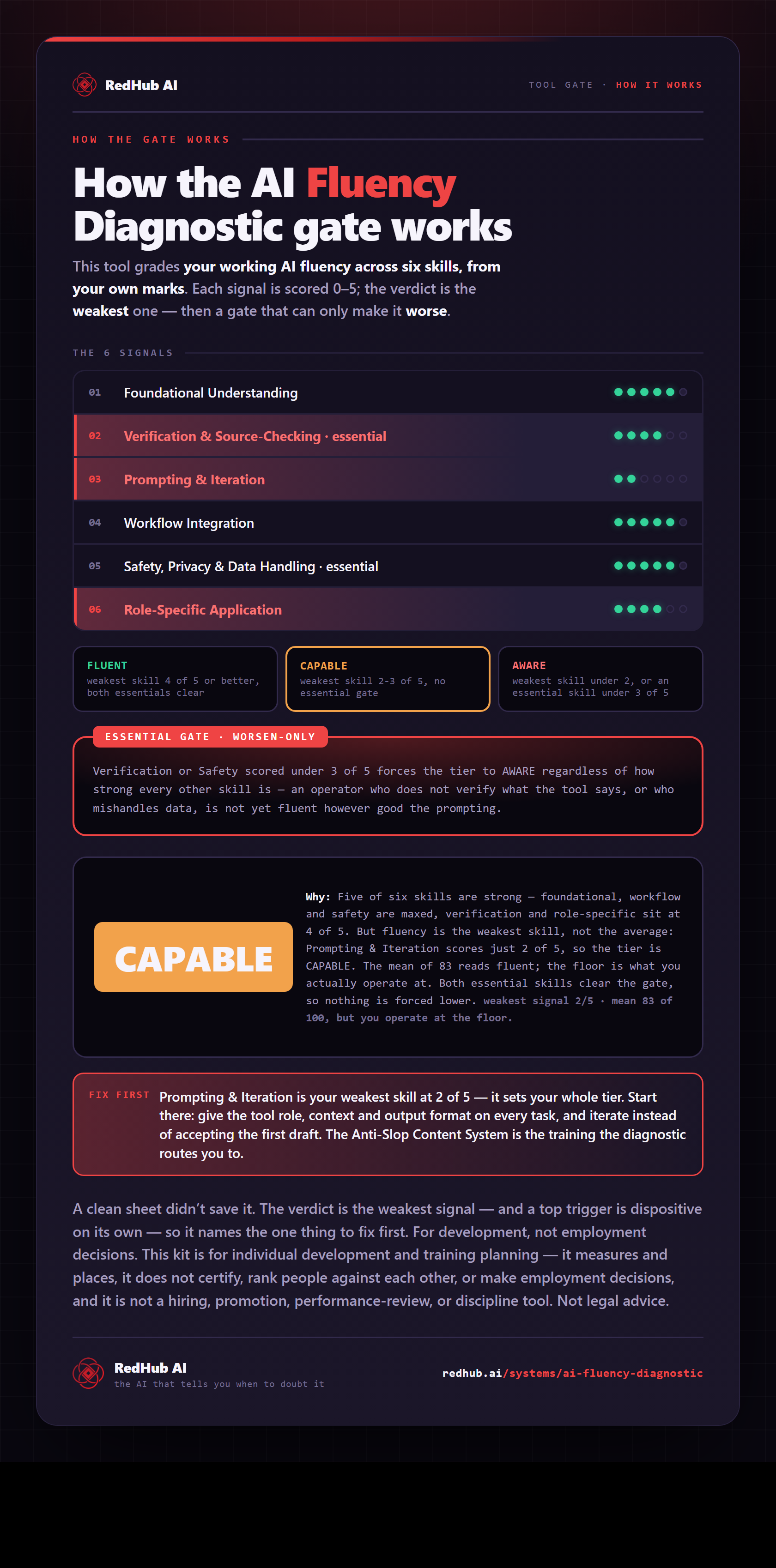
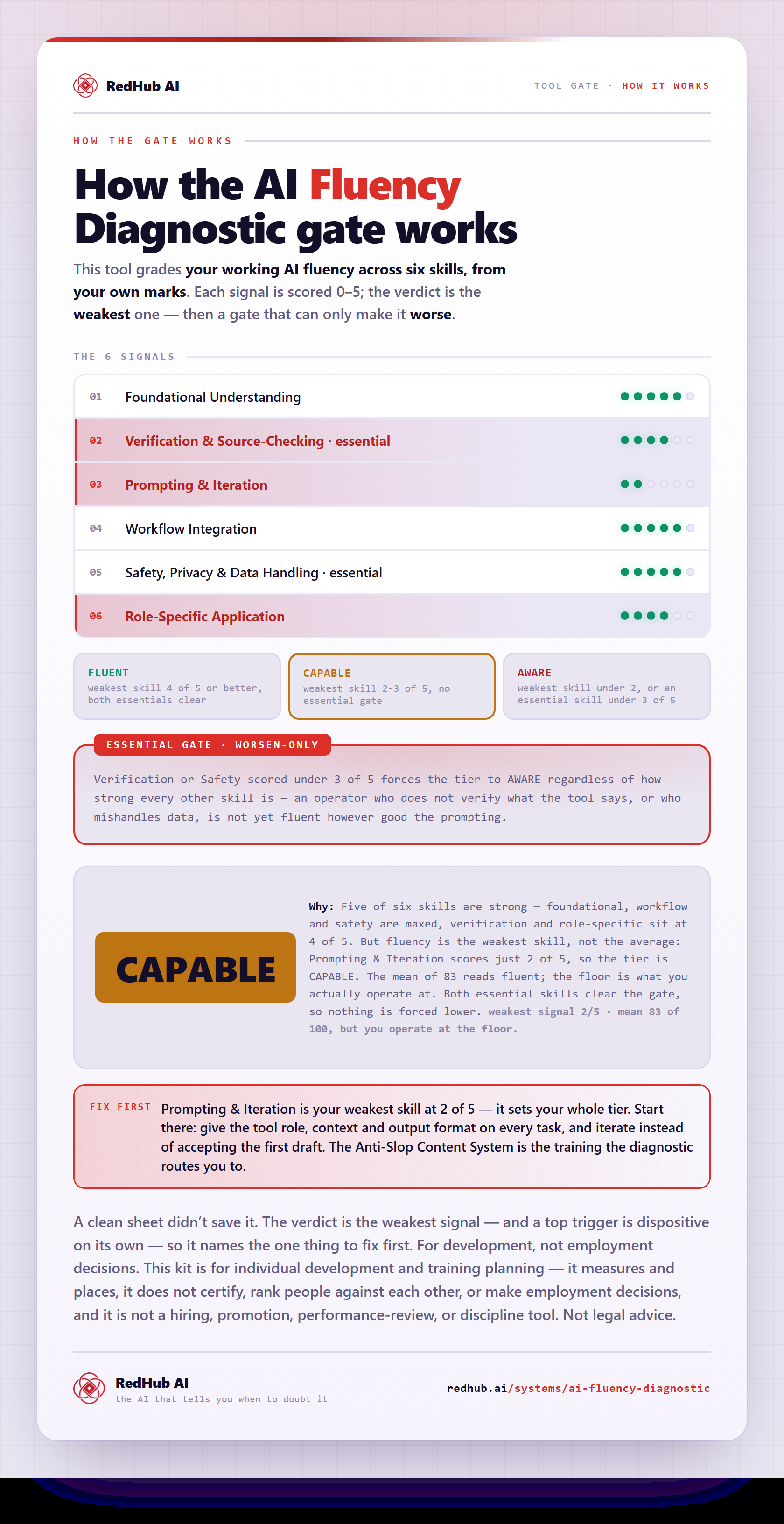
The gate this post refers to, drawn from the tool’s own logic. See the tool.