What Does AI Fluency Actually Look Like? The Signs to Look For
RedHub AI Editorialupdated October 7, 20266 min read

Jump to a section8
There are five signs of AI fluency, and none of them is speed. A fluent person checks AI output by habit, knows when to skip AI, gives the tool real context, works past the first draft, and does not take a confident tone as evidence. What that produces is faster work with fewer mistakes. It does not produce the most output on the team or the longest list of tools. The awkward part is that most of these signs are things that did not happen: the wrong figure that never reached the client, the task that never went into a chatbot. You have to know where to look.
TL;DR: Fluency looks like faster work with fewer mistakes. The five signs: verifying by reflex, knowing when to skip AI, giving good context, iterating past the first answer, and not being fooled by a confident wrong one. Volume, speed, tool count and enthusiasm are not signs. Most of the real ones are invisible in activity reports, and a careful person can look slow. The AI Fluency Diagnostic ($79) turns these habits into 30 statements a person marks for themselves. For the full method, see How to Measure AI Fluency.
The five signs
- They verify by reflex. Facts, numbers, names and quotes get checked before the work goes out. They do it every time, without deciding to.
- They know when to skip AI. Some tasks need a guaranteed answer or a person who is accountable for it. They keep those. Restraint counts as skill here.
- They give good context. Their prompt carries the background, the limits and the format they want back. They do not type one vague line and hope.
- They iterate. The first output is a draft. They push back on it and reshape it.
- They are not fooled by confidence. A smooth, well-written wrong answer gets the same check as a clumsy one. They judge the content and ignore the tone.
The order matters. Signs three and four make the output better. Signs one, two and five decide whether it is safe to use.
What fluency is not
Four things get mistaken for it. Volume is not fluency. Forty AI-drafted pages a week helps only if someone checked the forty pages. Collecting tools is not fluency either: one tool used with judgment beats fifteen used loosely. Speed is not, because fast and wrong can cost more than slow and right once the correction is counted. And enthusiasm is not. The most excited adopter on a team can also be the one who checks least.
One test for the fifth sign
Hand someone an AI answer with one believable error in it, a made-up statistic or a total that is off by a row, and see what they do. The person with the habit stops on it. The person without it forwards the document, however quick and keen they are.
Nobody passes this every time. A wrong figure that happens to match what the reader already believed can get past careful people too. So the fifth sign describes a practice, the confident tone earning no credit, and not a guarantee that every error is caught. One of the AI Fluency Diagnostic's verification statements puts it this way: "Treats a confident tone as no evidence of correctness."
Why the fluent person can look slow
Most of the signs leave no trace. A caught error produces nothing: no incident, no apology email, no rework ticket. A task wisely kept away from AI looks, in a usage report, exactly like a task done by someone who never learned the tool. Meanwhile the checking takes time that shows. The person who opens the source behind every number finishes after the person who does not.
So a manager who goes looking for fluency in activity data will tend to find the opposite of it. The heaviest user tops the chart, and the careful one sits in the middle. We do not have a tidy metric to offer in its place. What works is slower: read a sample of finished work, count what had to be corrected after it shipped, and ask people which tasks they chose not to give to AI and why.
On a team
A fluent team gets faster and its error rate does not climb. A team that is only busy with AI also gets faster, and its mistakes surface a month later in someone else's inbox. Both look productive in week one. A second marker is how people talk. On a fluent team someone will say, "Don't use it for the pricing table, it made up a tier last time," and nobody treats that as resistance to the tool.
Building the signs
These are habits, and habits come from repetition with feedback. Telling people to "verify more" does little. Having them find planted errors in a real-looking document, and seeing which ones they missed, does more. So does scoring their prompts on whether they asked the model to check its own work. Our post on confidently wrong AI explains why the confident tone is so persuasive in the first place.
Check yourself against the signs
The AI Fluency Diagnostic scores six skills from your own 0 to 5 marks, counted from 30 concrete statements such as "Iterates on a weak answer instead of accepting the first draft." The headline is your lowest skill, tiered FLUENCY PRACTICES SHOWN AS DESCRIBED, CAPABLE or AWARE, and verification or safety below 3 of 5 holds the tier at AWARE. It is self-marked, so it shows what you believe about your habits. It is for development and training planning, not for hiring, reviews or any employment decision.
Get the AI Fluency Diagnostic — $79Pairs well with
The AI Over-Reliance & Critical-Thinking Check ($69) is the test for the fifth sign in a box. You review AI text seeded with six planted problems, mark the ones you caught, and get INDEPENDENT, ASSISTED or RELIANT. The Prompt Practice Lab ($69) drills the third sign. It scores each prompt on six criteria, and a prompt that never asks the model to check its work cannot reach STRONG. The Claude Project Blueprint Library ($79) gives good context a permanent home: ten Claude Project blueprints, each with custom instructions and a knowledge-base map.
More in this guide
What does AI fluency look like in practice?
Faster work with fewer mistakes. The fluent person checks output by habit, knows when to skip AI, gives good context, iterates on the first draft, and does not treat a confident answer as a correct one. Most of it is quiet.
Is producing lots of AI output a sign of fluency?
No. Volume helps only when the output was checked. A person producing a great deal of unverified work is sending out more errors, faster. The heaviest user on a team can be the least fluent.
What is the clearest sign someone is AI-fluent?
They stop on a believable error in an AI answer when others would forward it. Nobody catches every one, so read it as a habit: the confident tone gets no credit, and the facts get checked.
Is knowing lots of AI tools a sign of fluency?
Not really. One tool used with judgment beats fifteen used loosely. Fluency is about how the output gets checked and where the tool gets used, and neither depends on the size of the toolkit.
Why can a fluent person look slower than a careless one?
Checking takes visible time, and its results are invisible. A caught error leaves no incident behind. In a usage report the careful person sits mid-table and the heavy, unchecked user sits at the top.
Can AI fluency be learned?
Yes. Verifying by habit, catching bad output and knowing when to skip AI all come from practice with feedback. Instructions alone do little. Finding planted errors and seeing which ones you missed does more.
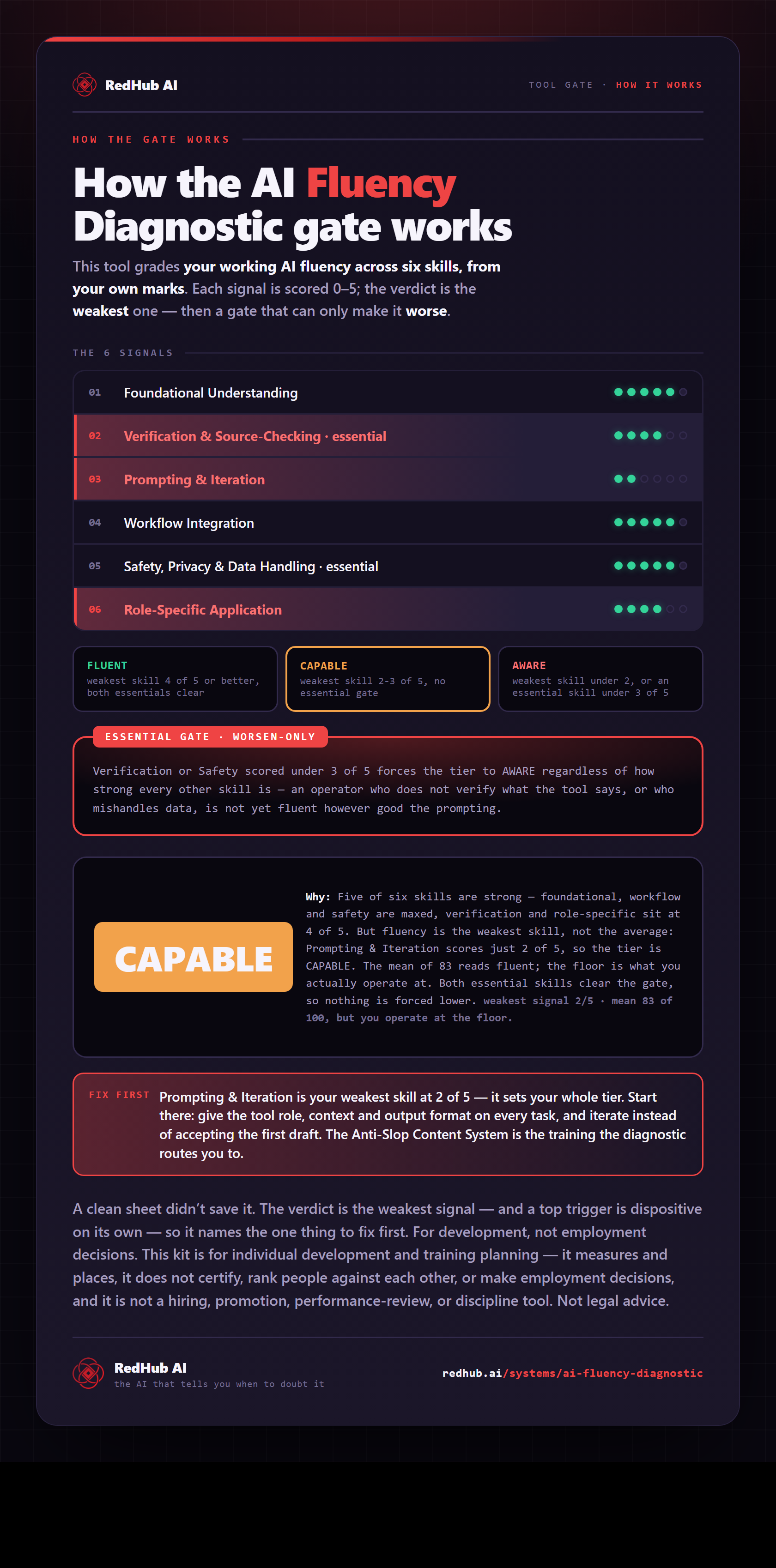
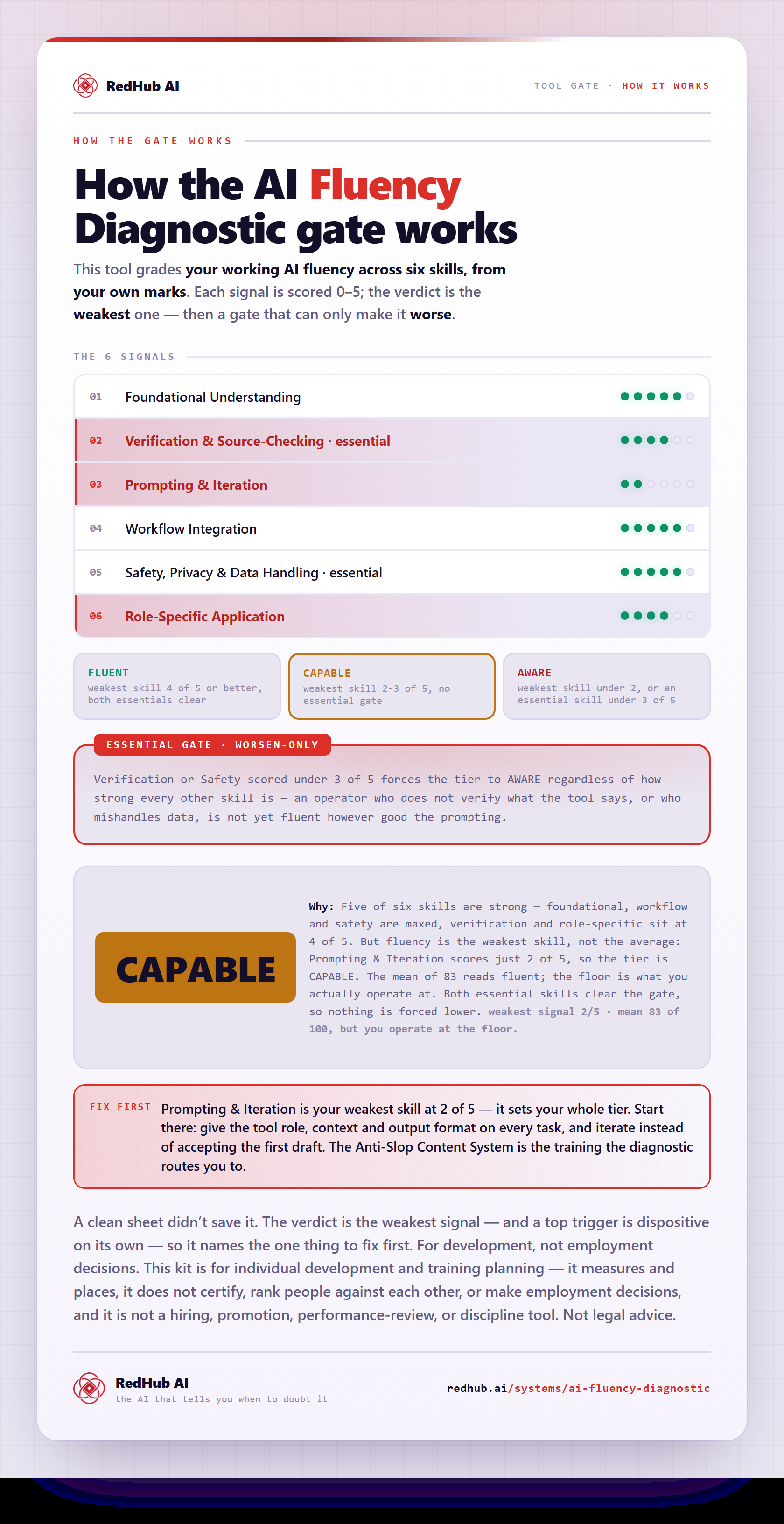
The gate this post refers to, drawn from the tool’s own logic. See the tool.