MCP Model Portability: Why Model Retirement Matters
RedHub AI Editorialupdated October 2, 20267 min read
Jump to a section7
MCP model portability means building the tools and data connections your AI uses as Model Context Protocol servers, so you can change the model underneath without rebuilding them. Model retirement is what makes that worth the effort. As of October 2026, Anthropic's model deprecations page (opens in a new tab) lists Claude Sonnet 4.5 (claude-sonnet-4-5-20250929) as deprecated on September 30, 2026 and retiring on November 30, 2026, after which requests to it fail. A workflow wired into one model's habits may have to be rebuilt by that date. One whose tools sit behind a stable tool layer only has to be retested.
TL;DR: Models retire on the provider's schedule. The MCP project describes MCP as "an open-source standard for connecting AI applications to external systems," and building your tools that way keeps them in place when the model changes. Put the layers in order: workflow, then policy and identity, then the MCP tool layer, then model routing, then the model. A stable tool layer does not make models interchangeable, so the tests still have to run, and it is not a security control on its own. The MCP Server & Connector Builder Kit ($99) covers building servers that are safe by default, as security guidance rather than a security audit. Start with the pillar: Enterprise AI Control Plane: When Agents Skip the Checkpoint.
What a retirement date breaks
A hypothetical plumbing-supply wholesaler runs an order-status assistant on Claude Sonnet 4.5. It has three tools: an inventory lookup, an order-history query against the company's ordering system, and a carrier tracking check. Each tool is a function inside the app, in one provider's tool format. Over months, someone tuned the tool descriptions and the prompt until the model picked the right tool almost every time.
Anthropic's deprecations page says the company gives "at least 60 days' notice before model retirement for publicly released models," and it names claude-sonnet-5-5 as the recommended replacement for Sonnet 4.5. Sixty days is plenty to move a workflow you can test. It is short for one you must rebuild, and the wholesaler's assistant is the second kind, because its tools, prompt and parsing were all shaped around one model.
Two more details on that page matter here. The dates apply to Anthropic-operated platforms, while partner platforms such as Amazon Bedrock and Google Cloud "set their own retirement schedules," so check the date wherever you call the model. And the Usage page in Claude Console can export a CSV broken down by API key and model, which shows what still calls Sonnet 4.5. Our Claude Sonnet 4.5 retirement checklist walks through the move step by step, and our post on model deprecation covers the wider pattern.
What MCP changes
MCP, short for Model Context Protocol, is a shared way for an AI application to reach tools and data. The project's documentation (opens in a new tab) compares it to "a USB-C port for AI applications." An MCP server exposes tools and resources through one consistent interface, and any application that speaks MCP, with the model behind it, can use them.
For the wholesaler, the three functions become one MCP server: inventory, order history and tracking, each with its own description and input format. The business logic for "where is my order" now lives in that server, not in one model's prompt. When a new model arrives, you point it at the same tool environment and run your tests. The model changes. The connections to the ordering system and the carrier do not.
Put the layers in order
We suggest an order that runs in one direction: business workflow, then policy and identity, then the MCP tool layer, then model routing, then the model. The table is our own guidance on where each decision should live, not a standard published by the MCP project or any vendor. The workflow sets the goal. Policy decides what is allowed. The tool layer exposes approved capabilities. Routing picks a model per job. The model reasons.
| Layer | What it decides | Should it change when the model retires? |
|---|---|---|
| Business workflow | The goal, the steps and who owns the result | No |
| Policy and identity | What each agent may do, as whom | No |
| MCP tool layer | Which tools and data are available, and in what format | Rarely |
| Model routing | Which model handles which job, and the fallback | Yes, one setting |
| Model | How the work gets reasoned through | Yes |
A retirement should only touch the bottom two rows. If it reaches the top three, business logic has leaked into the model layer.
What portability does not cover
A stable tool layer does not make models interchangeable. A new model can pick a different tool for the same question, pass arguments in a different shape, call tools more or fewer times, or read a tool description differently from the model it was tuned for. Even the recommended replacement changes behavior here: Anthropic reports (opens in a new tab) that early testers saw Sonnet 5.5 batch tool calls together more than Sonnet 5, "leading to fewer steps."
So the tests still have to run. Run a set of real past questions through the old model and the new one against the same MCP server, and compare which tools each called, what each returned and how often the answer was right. Our guide to LLM regression testing covers building that test set, and our post on AI agent reliability covers the quiet failures to look for. MCP makes that comparison fair, because the tools are identical. It does not make the comparison unnecessary.
Tool descriptions pull in two directions. Descriptions tuned closely to one model work better today and travel worse. Neutral ones travel well and may work a little worse on any single model. A team that changes models once a year can afford to tune hard; a team that routes jobs across three providers every week cannot.
MCP is not a security shortcut
A standard connection is not automatically a safe one. Each tool still needs its own identity, scoped permissions, input checks, output checks, logging and approval rules. Portability adds one more reason for care: a server that many models can reach is a server where one permission mistake is open to every model behind it. If the wholesaler's order-history tool returns any customer's orders instead of only the caller's, every model it serves can leak them. If you install servers someone else wrote, our guide to MCP security covers how to vet one before it gets near your data.
Build the tool layer that outlives the model
The MCP Server & Connector Builder Kit walks through a four-phase build (research and plan, implement, review and test, evaluate) with tool-design and security patterns, a tool-inventory and security-checklist workbook, and a Pass/Fix/Block tool linter. A leaked secret, an over-broad scope or a dangerous capability is a hard Block. Security guidance, not a security audit.
Get the MCP Server & Connector Builder Kit — $99Pairs well with
The AI Agent & Connector Access Auditor ($99) audits what your AI agents, MCP servers and OAuth connectors can actually touch, scoring each on scope, data sensitivity, write capability and staleness, and returns LEAST-PRIVILEGE AS DESCRIBED, OVER-SCOPED or UNGOVERNED per connector. The Agent Reliability Harness ($149) evaluates agents at the trajectory level: tool choice, argument validity, step efficiency, cost and policy. The AI Vendor Reliability & Spend-Justification Scorecard ($79) scores each AI vendor on reliability and value and returns RENEW, RENEGOTIATE or DO NOT RENEW.
More in this guide
What is MCP model portability?
It means building the tools and data connections your AI uses as Model Context Protocol servers, so they stay in place when you change the model. When a model retires, you test the replacement against the same tools instead of rebuilding them.
What is the Model Context Protocol?
The MCP project describes it as an open-source standard for connecting AI applications to external systems such as files, databases and tools. Its documentation compares it to a USB-C port for AI applications: one standard way to plug in.
When does Claude Sonnet 4.5 retire?
As of October 2026, Anthropic's model deprecations page lists Claude Sonnet 4.5 as deprecated on September 30, 2026 and retiring on November 30, 2026 on Anthropic-operated platforms, with claude-sonnet-5-5 as the recommended replacement. Amazon Bedrock and Google Cloud set their own retirement schedules.
Does MCP make AI models interchangeable?
No. It keeps the tools the same, but a new model can still choose different tools, pass different arguments or read tool descriptions differently. You still need to run real tasks through the old and new models and compare the results before switching.
Is MCP secure by default?
No. MCP standardizes how tools connect, not who may use them. Each tool still needs scoped permissions, input and output checks, logging and approval rules, and third-party servers should be vetted before you install them.
How do I find which workflows still call a retiring Claude model?
Anthropic's deprecations page points to the Usage page in Claude Console, where Export produces a CSV broken down by API key and model. Any key still calling the retiring model ID is a workflow to migrate. If you call the model through a partner platform, check that platform's usage records too.
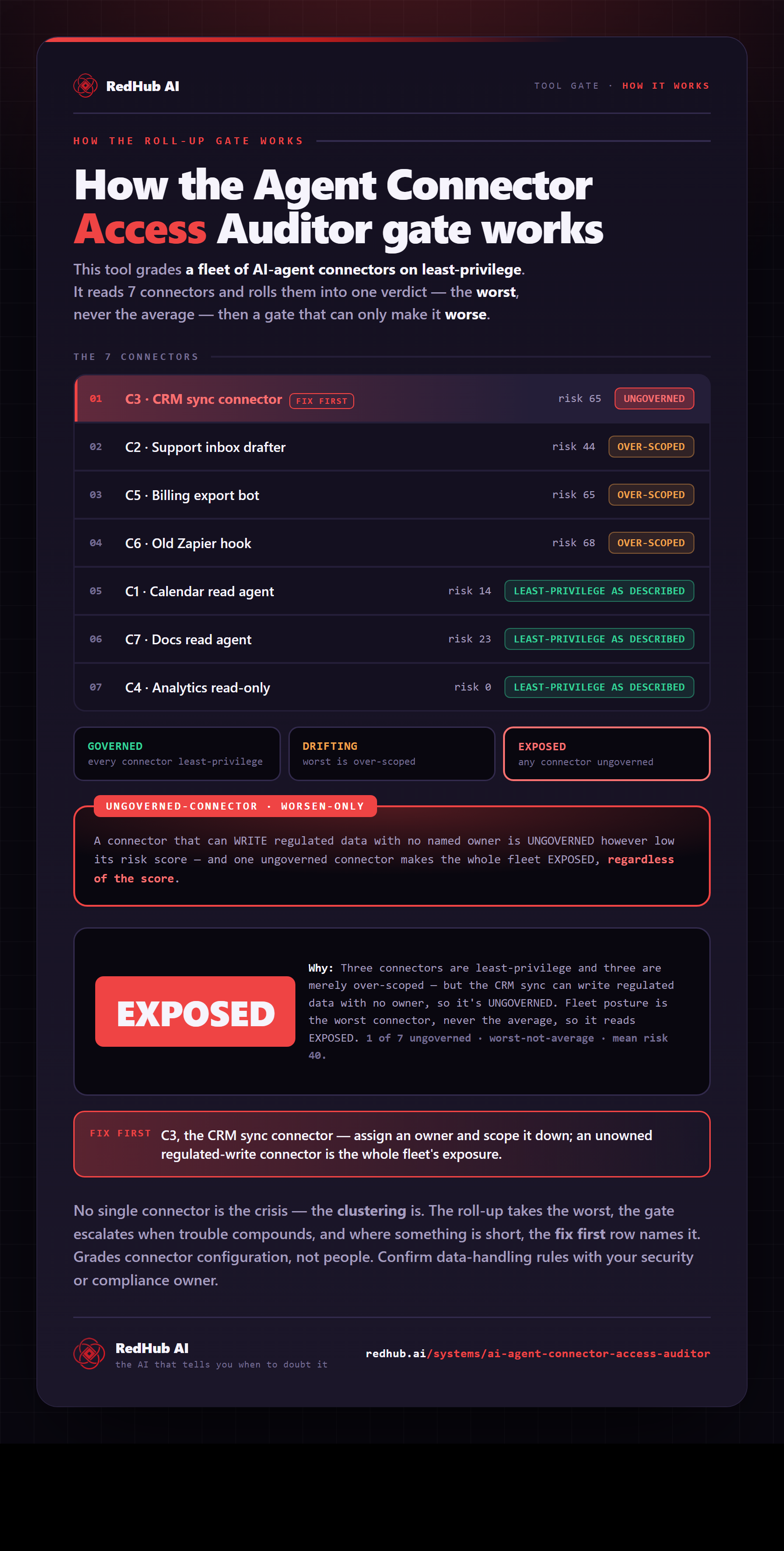
The gate this post refers to, drawn from the tool’s own logic. See the tool.