How to Answer the AI Section of a Security Questionnaire
RedHub AI Editorialupdated September 7, 20265 min read

Jump to a section7
You answer the AI section of a security questionnaire honestly from whatever inventory of AI tools you actually have — even an incomplete one — rather than guessing at an answer or claiming a level of control you can't back up, because a customer or insurer who finds a gap later is a far worse outcome than an honest "here's what we found and here's what we're doing about it" today.
TL;DR: A security questionnaire's AI questions are really asking one thing: do you know what AI tools touch data in your business, and do you have a process for it? The honest answer starts with an inventory, not a guess — see the full discovery sequence in the Shadow AI pillar guide, then use the Shadow AI Discovery & Risk-Triage Kit — $69 to build one.
What These Questions Are Actually Asking
Customer and vendor security questionnaires increasingly include a section on AI use — "Do you use AI tools that process our data?", "What controls govern employee use of AI tools?", "Do you have a policy for generative AI?" These questions aren't really testing whether you use AI. They're testing whether you know what's happening inside your own business, and whether you have a repeatable process for finding out — not whether you've achieved some perfect, static state of control.
That distinction matters, because the honest answer for most businesses right now isn't "we have zero unsanctioned AI use." It's "we've run an inventory, we know what we found, and here's our process for triaging and governing it." A reviewer reading a questionnaire response can usually tell the difference between a company that's actually looked and one that's reciting a hopeful answer.
Why Guessing Is the Riskier Answer
The temptation when facing a questionnaire is to answer from the policy document instead of from reality — to say "we prohibit unapproved AI tools" because that's what the acceptable-use policy says, not because you've verified it's true. That answer feels safe in the moment and becomes a liability the moment it's wrong: if a customer's own audit, a breach disclosure, or a future incident reveals shadow AI you didn't disclose, the gap between what you claimed and what was actually happening is a far bigger problem than the original tool ever was.
How to Build an Honest Answer
- Run the inventory first, if you haven't. You can't answer a question about what AI tools touch your data until you've actually asked your team — see how to take an honest inventory of your AI tools for the specific asks that surface a real list.
- Score what you found. Note which tools touch sensitive or customer data and how widely they're used, so your answer reflects actual exposure, not a guess. What ungoverned AI tools expose covers how to think through that scoring.
- Describe your process, not a static claim. "We run a recurring inventory of AI tool use, triage findings by data sensitivity, and route tools into governance or replacement accordingly" is a defensible answer regardless of what the inventory turns up.
- Note what's already governed. If you have a written acceptable-use policy for the tools you've approved, cite it — this is where the AI Governance & Acceptable Use Starter Kit becomes the thing you point to.
- Note vendor data-flow tracking, if you have it. A questionnaire that asks about sub-processors or data-flow mapping is answered directly by a maintained Vendor & Sub-Processor Data-Flow Register.
What If the Inventory Is Incomplete?
Most first-pass inventories are incomplete — that's normal, not disqualifying. An honest answer acknowledges the stage you're at: "we've run an initial amnesty-based inventory, identified N tools in use, and are actively triaging and governing them" is a true, defensible statement even if you know there's more shadow AI you haven't surfaced yet. It's a materially better answer than either silence or a false claim of complete control.
Questionnaires ask what you have arranged. The free GenAI Security Assessment (opens in a new tab) asks the same ground in 24 questions and is candid that arranged is not tested, which makes it a cheap way to find the answers you cannot give yet before a customer finds them for you. Self-declared, not an audit.
Answer From Evidence, Not From Hope
The Shadow AI Discovery & Risk-Triage Kit exists to put real evidence behind this section of any questionnaire — a Dashboard tab showing your live exposure rate and a Shadow AI Triage tab showing exactly how each declared tool was scored and what you're doing about the highest-priority one. It's a starting inventory and triage, not a finished governance program or a certification — pair it with the governance kit once you know what needs a policy, and don't present it as more than what it is. This is general operational guidance, not legal advice; questionnaire language and regulatory obligations vary by industry and customer, so confirm your specific answers with qualified counsel where the stakes are high.
Pairs well with
Answer the discovery questions from the anchor kit's inventory, then point to the AI Governance & Acceptable Use Starter Kit ($39) for your policy questions and the Vendor & Sub-Processor Data-Flow Register ($89) for any sub-processor or data-flow question. Start from the Shadow AI pillar guide for the full sequence.
More in this guide
What is a security questionnaire's AI section actually testing?
Whether you know what AI tools touch data in your business and whether you have a repeatable process for finding and governing them — not whether you've achieved a perfect, static state with zero unsanctioned use.
Is it safe to just say "we prohibit unapproved AI tools" on the questionnaire?
Only if you've verified it's true. Answering from the policy document instead of from an actual inventory creates a bigger liability if a gap surfaces later than an honest, evidence-based answer would have.
What if my inventory is incomplete when the questionnaire is due?
Answer honestly about the stage you're at — describing an active inventory and triage process is a defensible answer even if you know there's more shadow AI you haven't found yet.
Does this kit help me pass a specific compliance audit or certification?
No — it's a discovery and triage tool, not a certification or compliance program. It gives you real evidence to answer honestly; pair it with a governance policy and, where regulated data is involved, qualified counsel.
What should I cite if the questionnaire asks about sub-processors?
A maintained vendor and data-flow record — the Vendor & Sub-Processor Data-Flow Register is built specifically to answer that category of question.
Should I mention the tools my inventory found even if they're unflattering?
Generally yes, framed around your process for addressing them — reviewers read "we found issues and are actively fixing them" as more credible than a suspiciously clean answer with no evidence behind it.
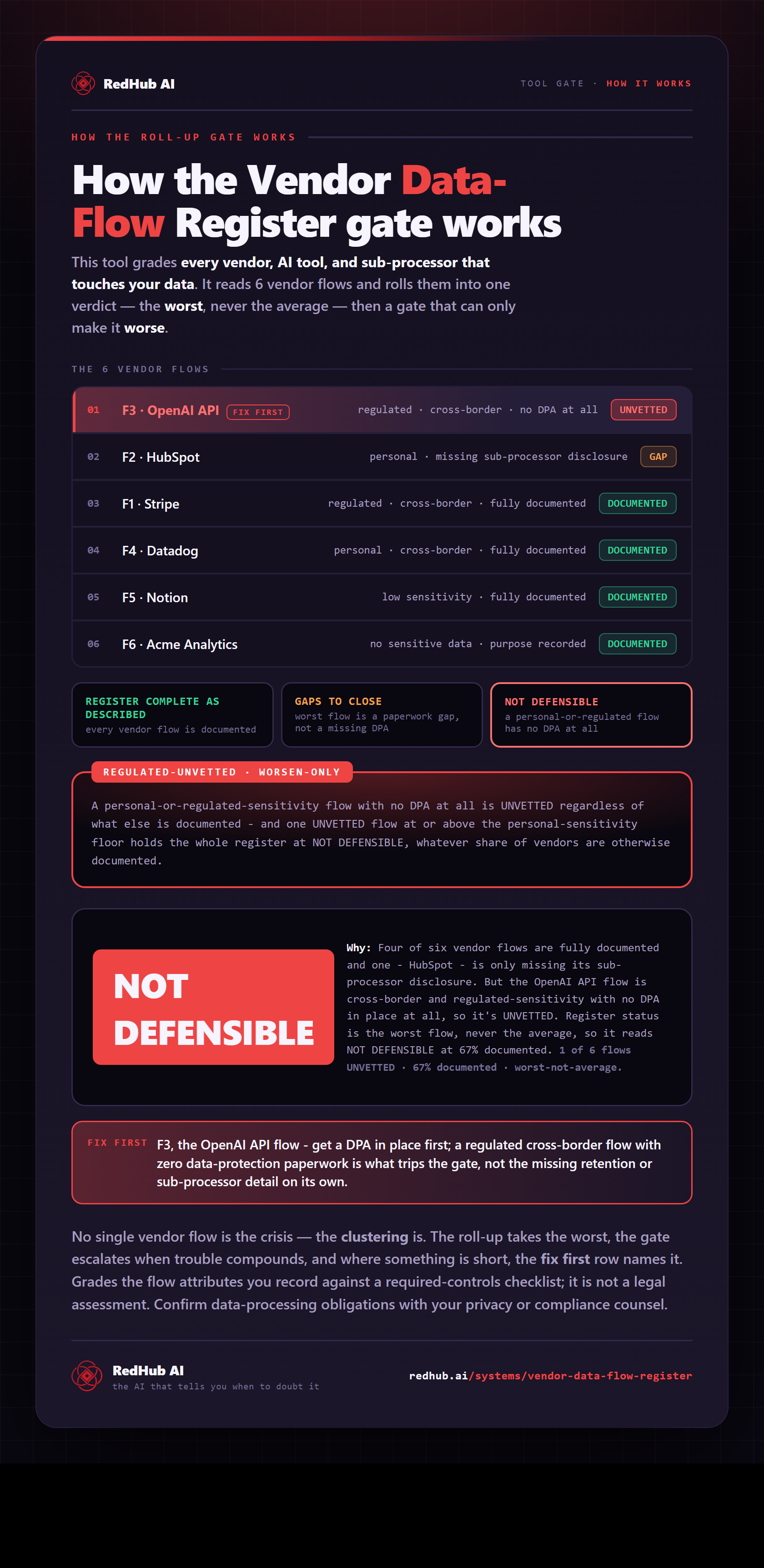
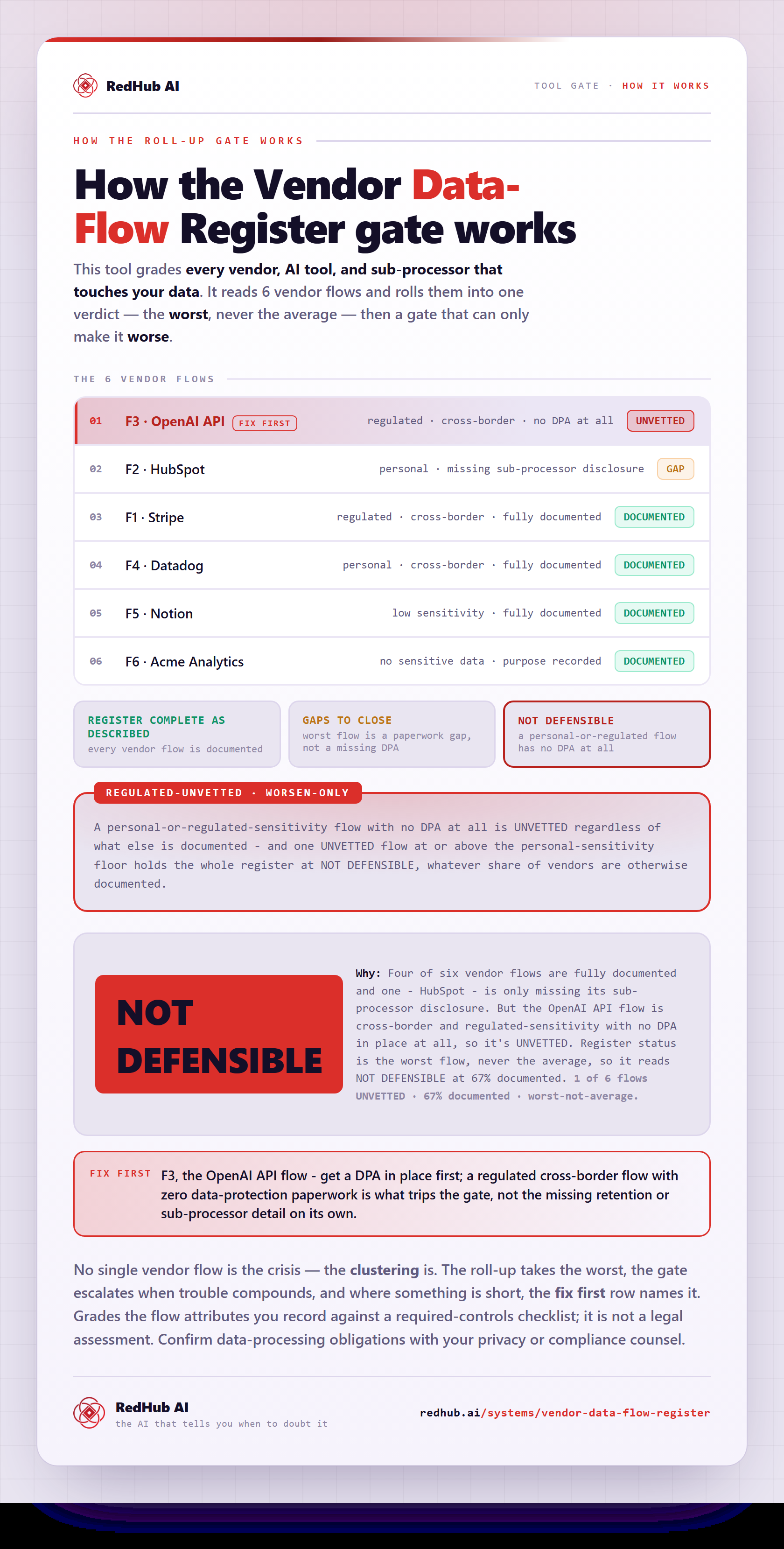
The gate this post refers to, drawn from the tool’s own logic. See the tool.