How to Run an AI Tool Amnesty (So People Actually Tell You)
RedHub AI Editorialupdated September 7, 20265 min read

Jump to a section7
An AI tool amnesty is a stated, time-boxed promise that nobody will be punished for declaring an AI tool they've been using without approval — and it's the single biggest lever for getting an honest inventory instead of a partial one, because the reason most shadow AI stays hidden is fear of the consequence for admitting it, not secrecy for its own sake.
TL;DR: People hide unsanctioned tool use because they expect to get in trouble for it, not because they're trying to deceive anyone — remove the punishment and most of them will tell you. This is the "how to ask" companion to the Shadow AI pillar guide; once your amnesty gets you an inventory, triage it with the Shadow AI Discovery & Risk-Triage Kit — $69.
Why Amnesty Beats Any Audit
You cannot scan your way to an honest picture of shadow AI. There's no login trail for a personal ChatGPT account, no procurement record for a browser extension, no line item for a free tier. The only source that has the full picture is the people using the tools — and they only share it if telling the truth feels safer than staying quiet. That's the entire logic of an amnesty: trade the fear of punishment for the promise that declaring past use, however it happened, carries no consequence.
What Makes an Amnesty Actually Work
An amnesty that isn't believed doesn't work — people need concrete reasons to trust it, not just a friendly tone. A few elements make the difference between a genuine amnesty and one that quietly reads as a trap.
- State it explicitly, in writing. "No one will be reprimanded for declaring a tool they've already been using" — said plainly, not implied.
- Explain the why. This is about protecting the company (and the team) from exposure, not about catching anyone doing something wrong.
- Come from a credible voice. A message from the founder or a trusted lead lands differently than one from an anonymous "IT Security" inbox.
- Give a real deadline, then extend it once. A fixed window creates urgency; a quiet second round after the first catches the people who needed to see others go first.
- Make the ask specific. Vague "any AI tools?" questions get vague answers — ask about drafting, summarizing, coding, and analyzing, by task, not by technology label.
Running the Amnesty Step by Step
- Announce it once, in writing, from a credible voice. State the amnesty explicitly and explain the reason you're asking.
- Send the specific-task questions — drafting, summarizing, coding, analyzing, and any AI feature turned on inside an existing tool.
- Collect answers in one place with who declared it, what data it touches, and how often — see how to take an honest inventory of your AI tools for the exact fields to log.
- Run a second, quieter round about a week later to catch the people who waited to see what happened first.
- Thank people publicly for declaring, and follow through on the no-punishment promise visibly — the first time someone sees that promise broken, every future amnesty in your company stops working.
What Happens to Broken Promises
An amnesty is a one-time credibility bet. If leadership quietly disciplines someone over a declared tool, word travels fast, and the next time you ask your team to be honest — about AI tools or anything else — they won't be. Protect the promise even when a declared tool turns out to be a genuinely serious exposure; the fix there is routing that tool urgently into governance or replacement, not punishing the person who told you about it.
From Honest Answers to a Ranked List
An amnesty gets you the raw declarations. What you do with them next is a separate, deliberate step — scoring each tool by what data it touches and how widely it's used, so you know which one actually needs attention first instead of reacting to whichever one sounds scariest. Read what ungoverned AI tools actually expose before you start ranking, so the scoring reflects real exposure and not just gut feel.
Once an amnesty returns something, the free AI Governance Gap Assessment (opens in a new tab) is where you find out whether the list is enough on its own. It is not: a rule people follow and a named human on each decision are the other two preconditions, and any one of the three reading zero holds the verdict at UNGOVERNED. Self-assessment, not an audit.
The Shadow AI Discovery & Risk-Triage Kit is built for exactly this handoff: it grades the tools your amnesty surfaces, never the people who declared them, and it doesn't do any scanning or detection on its own — you supply the inventory, by amnesty, and the kit turns it into an exposure rate and a single recommended starting point. This is general operational guidance, not legal advice — confirm any regulatory obligations tied to your specific industry with qualified counsel.
Pairs well with
Once your amnesty produces an honest list and you've triaged it, the AI Governance & Acceptable Use Starter Kit ($39) writes the ongoing policy, and the Vendor & Sub-Processor Data-Flow Register ($89) tracks where kept tools' data goes. See the full sequence in the Shadow AI pillar guide.
More in this guide
What is an AI tool amnesty?
A stated, time-boxed promise that no one will be punished for declaring an AI tool they've been using without approval — designed to surface an honest inventory instead of a partial one.
Why won't people just tell IT what they use without an amnesty?
Most people assume admitting unapproved tool use will get them in trouble, so they stay quiet by default. Removing that fear explicitly, in writing, is what actually changes the answer.
How long should an amnesty window last?
Set a real deadline — a week or two — then run a quieter second round shortly after. The first round almost always undercounts because people wait to see how others fare before admitting their own use.
What happens if someone declares a tool that turns out to be a serious risk?
Route it urgently into governance or replacement — but never punish the person who told you. Breaking that promise once ends the amnesty's credibility for every future ask.
Who should send the amnesty announcement?
A credible, trusted voice — ideally the founder or a lead the team already trusts — lands far better than an anonymous security inbox and signals the ask is genuine.
What do I do with the answers once the amnesty is over?
Log them consistently — tool, declarer, data touched, frequency — then score each one for exposure so you know which tool to bring into governance first instead of guessing.
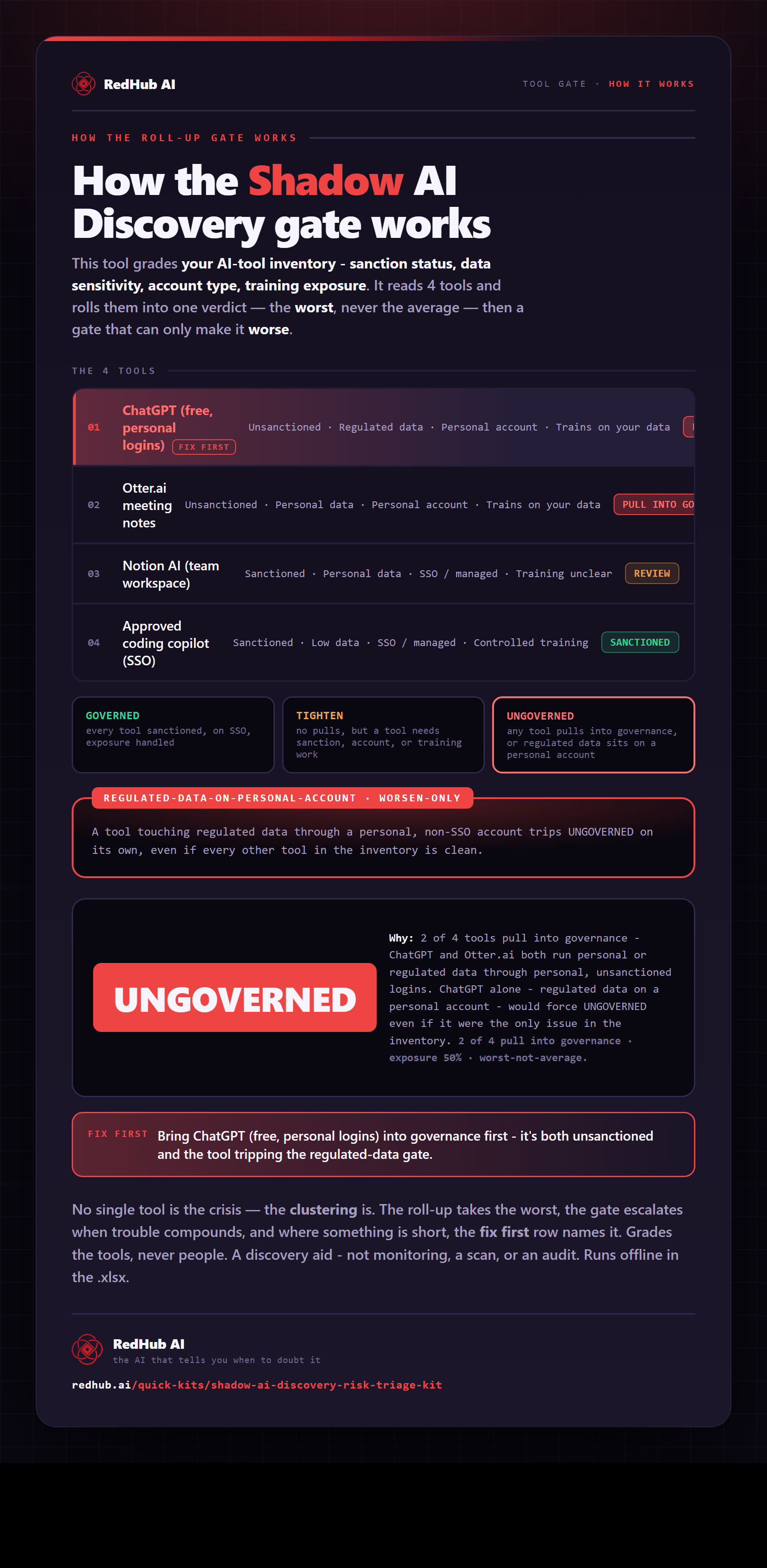
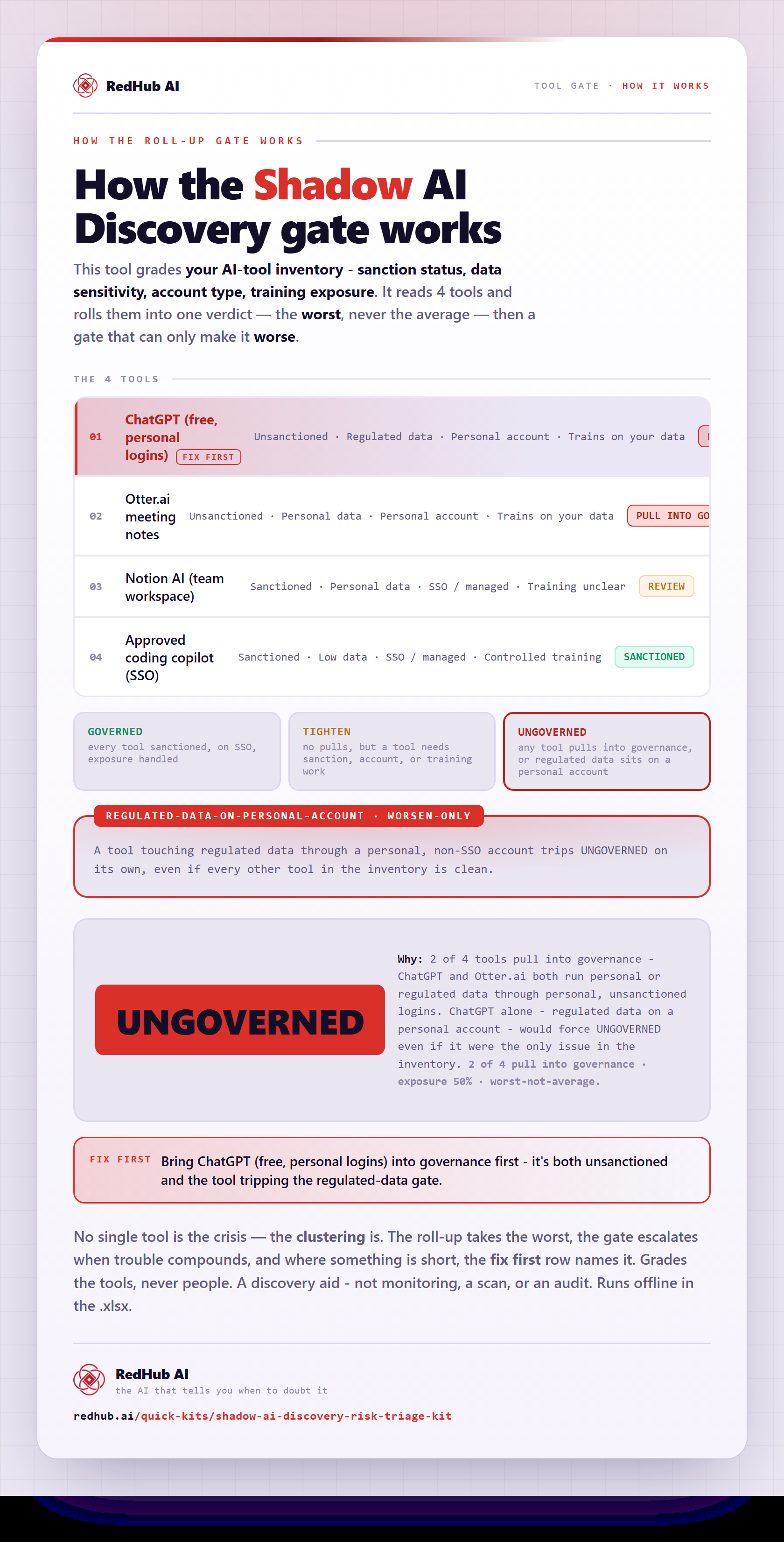
The gate this post refers to, drawn from the tool’s own logic. See the tool.