Are Your Discounts Actually Profitable?
RedHub AI Editorialupdated October 4, 20266 min read

Jump to a section8
The honest answer to "are discounts profitable" is: only when enough of a promo's sales would not have happened without it. A buyer who was going to pay full price still gets the discount, and that discount comes straight out of your margin. A sales report can't tell those two buyers apart, because both look the same at the register. So profitability gets settled one promo at a time, on one estimate: how many buyers were actually new.
TL;DR: Split each promo's sales into incremental (would not have happened without the discount) and cannibalized (would have happened at full price). A 20% discount on a $50 item that costs $30 halves the margin per unit, so at least half the promo's units must be incremental before the promo beats doing nothing. In the worked example below, a promo week sells 50% more units and 20% more revenue, and the promo still finishes $900 behind two ordinary weeks. The split is an estimate you make, so make it a conservative one.
The math nobody runs before the promo email goes out
Say you sell a $50 item that costs you $30, a $20 margin per unit. A 20%-off promo drops the price to $40 and the margin to $10. A normal week moves 100 units. The promo week moves 150. The week after the promo moves 80.
That last number is the easiest one to skip. Twenty customers who would have bought the following week bought early, at the discount. So of the 150 promo units, 100 were normal demand, 20 were next week's demand arriving early, and 30 were new. That leaves 30 incremental units and 120 cannibalized. Our discount cannibalization guide covers how to make that split from your own sales history.
| Two weeks | Without the promo | With the promo |
|---|---|---|
| Units, promo week | 100 | 150 |
| Units, week after | 100 | 80 |
| Revenue, both weeks | $10,000 | $10,000 |
| Margin, both weeks | $4,000 | $3,100 |
The promo week on its own looks like a win: revenue of $6,000 against a normal $5,000. Across both weeks, revenue is flat and margin is down $900.
Where the $900 went
The 30 new units each earned $10 at the discounted price, which adds $300. The 120 cannibalized units each carried a $10 discount that bought nothing, which costs $1,200. $300 in, $1,200 out, for a net of −$900.
The $1,200 is the number to surface first in any promo review. It isn't an accounting abstraction. It is discount paid to your own regulars, people who would have handed you full price that week or the next.
The per-unit inputs here match the sitewide 20%-off event in the Discount & Promo Profit Analyzer's built-in example: a $50 price, a $30 cost and 20% of sales incremental. At 1,000 units, the kit's example nets −$6,000 against no promo and gets a Kill verdict. At 150 units, the same math gives −$900.
Why the bar sits at half
The 20% discount cut the margin per unit from $20 to $10. Each cannibalized unit now loses $10, and each incremental unit gains $10, so the promo breaks even only when the two buckets are the same size. In general, the break-even incremental share is 1 − (discounted margin ÷ full margin). Here that is 1 − (10 ÷ 20), or 50%. This promo reached 20% (30 of 150).
The same bar has a volume form. If every one of your 100 regular buyers would have bought anyway, a 20% discount at this 40% margin needs 200 units, double the normal week, to break even. How to price a promotion runs that bar across other discount depths and margins.
Three questions that decide a promo
- How much of the lift was real? That is cannibalization, and it usually decides the outcome. See Discount Cannibalization: The Hidden Cost of Every Promo.
- How deep is the offer, really? A buy-one-get-one offer is a 50% discount on the pair, deeper than it sounds. See BOGO vs. Percentage Off: Which Discount Costs You Less?
- Did it clear its bar? Once a promo has run, its result depends on the window you measure. See How to Measure Promotion ROI Honestly.
Where this math stops
Everything above measures gross margin inside the promo window. It says nothing about what the 30 new customers are worth next year. If they come back and pay full price, a promo that lost $900 in two weeks could still pay for itself. If they only buy on sale, the loss is the whole story.
We can't tell you which kind of customer your promo found. Your repeat-purchase records can, given a few months. Until they do, score the promo on the margin you can see, and treat any lifetime value you hope for as a separate bet with its own evidence.
The estimate is yours, so keep it honest
No system hands you the true incremental share. It is not in your POS export, your ad dashboard or your CRM. You estimate it from comparison weeks, from the dip after the promo ends and from how many buyers were new. Then you lean low. A cautious estimate that says kill a promo costs you one promo. An optimistic one repeats the loss every time the promo runs.
If you can't estimate the split at all, the promo probably wasn't isolated well enough to measure. That makes it a candidate to limit or test small, not to repeat on faith.
Price every promo against running none
The Discount & Promo Profit Analyzer is one .xlsx for Excel, Google Sheets or Numbers. Enter each promo's units, discount, regular price, unit cost and your incremental estimate. It returns net margin versus no promo, a keep, limit or kill verdict, and the total discount handed to full-price buyers.
Get the Discount & Promo Profit Analyzer — $39Pairs well with
A promo is temporary. A permanent price change is a different decision, and the AI-Assisted Pricing-Change Defensibility Kit ($49) grades an AI-suggested price change before you publish it, returning DEFENSIBLE, PRESSURE-TEST or DO NOT PUBLISH. The Returns & Refund Profit Analyzer ($39) finds the true profit per SKU after returns, with a keep, fix or drop verdict. The Early-Pay Discount Capture & Payment-Timing Leak Audit ($49) looks at the discounts your suppliers offer you, and gives each invoice TAKE THE DISCOUNT, PAY ON TIME or PAYING TOO EARLY.
More in this guide
Can a promo grow revenue and still lose money?
Yes. If most of the extra units would have sold at full price anyway, the discount on those units can outweigh the margin from the new sales. Revenue can be flat or up while margin falls.
What decides whether a discount is profitable?
The share of promo sales that are incremental, meaning they would not have happened without the discount, compared with the break-even share the discount depth requires. That break-even share is 1 minus discounted margin divided by full margin.
How do I estimate the incremental share of a promo?
Compare promo sales with a matched non-promo period, check for a dip below normal after the promo ends, and look at how many buyers were new. When unsure, pick the lower estimate.
Is a small discount always safer than a deep one?
A shallow discount needs a smaller incremental share to break even, but it may also bring in fewer new buyers. The trade-off has to be run per promo, not assumed.
Does a promo that loses margin ever make sense?
It can, if the new customers it brings in come back and pay full price later. That is a separate bet on lifetime value. Check it against your repeat-purchase records rather than assuming it.
What does the Discount & Promo Profit Analyzer compute?
You enter units, discount percentage, regular price, unit cost and your incremental-share estimate for each promo. It returns net margin versus running no promo, a keep, limit or kill verdict, and the total discount handed to full-price buyers.
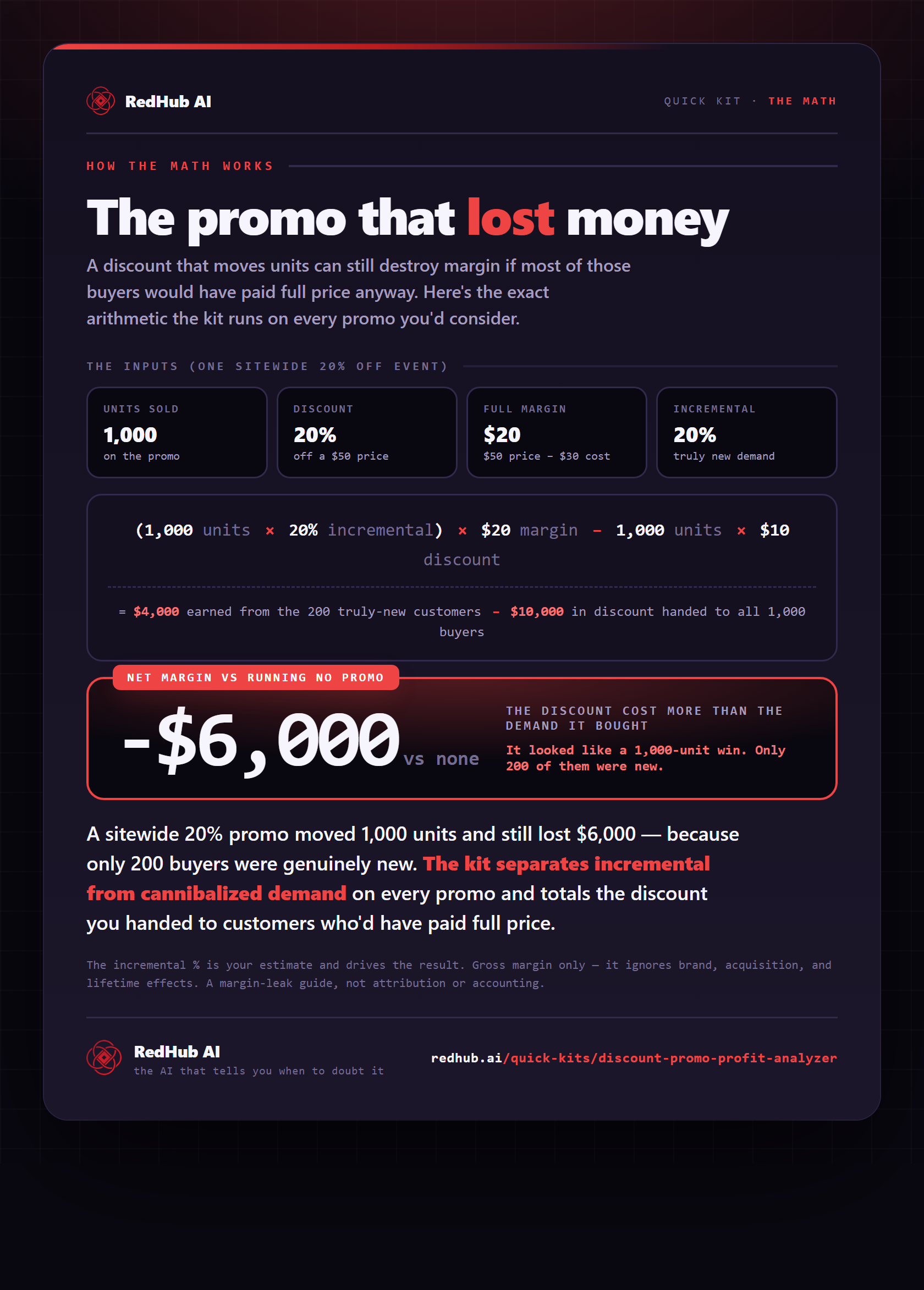
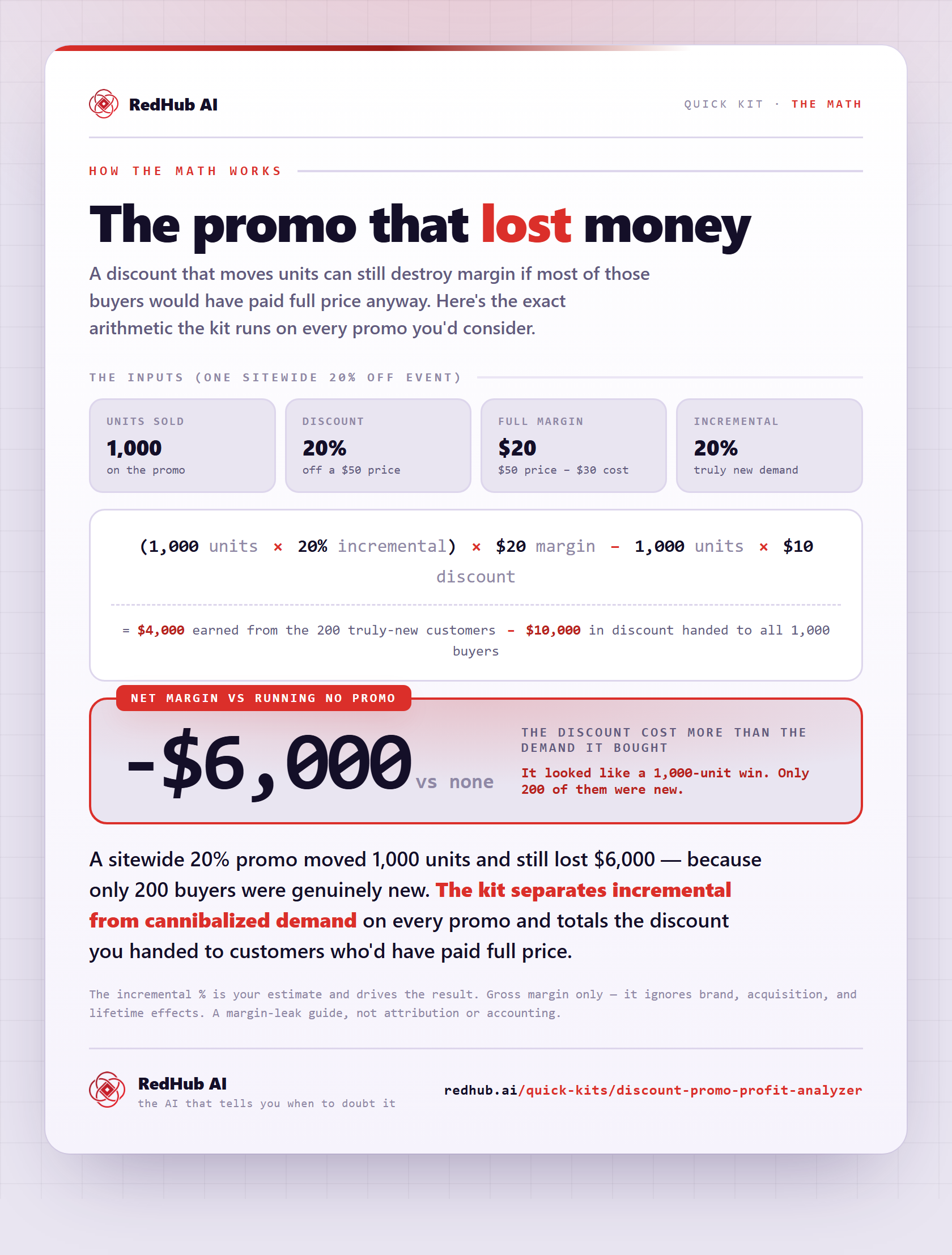
The gate this post refers to, drawn from the tool’s own logic. See the tool.