How to Price a Promotion So It Actually Makes Money
RedHub AI Editorialupdated October 4, 20266 min read

Jump to a section8
A 20% discount on a product with a 40% margin has to double unit sales to earn what a normal week earns at full price. That is the first number to find when you work out how to price a promotion: the break-even bar the discount sets before a single customer sees it. Every depth has its own bar. Deeper discounts raise it fast, and most promos are never checked against theirs before launch.
TL;DR: Break-even incremental share = 1 − (discounted margin per unit ÷ full margin per unit). On a $50 item that costs $30, 10% off needs 25% of promo units to be new, 20% off needs 50% and 30% off needs 75%. The volume form says the same thing: required lift = discount ÷ (margin − discount). Compare the bar with an honest estimate of new demand, and pick the depth from that, not from a round number.
The formula: your promo's break-even bar
You need three numbers: full-price margin per unit, discounted margin per unit, and your estimate of the share of promo units that will be incremental, meaning sales that would not happen without the discount.
- Full-price margin per unit = regular price − unit cost.
- Discounted margin per unit = discounted price − unit cost.
- Break-even incremental share = 1 − (discounted margin ÷ full margin).
- Compare that share with your honest estimate for this promo.
If your estimate sits below the bar, the promo loses money by design. More volume can't fix it, because every extra unit carries the same losing mix.
Worked example: two depths, two bars
At 20% off, the price falls to $40 and the margin to $10. The bar is 1 − (10 ÷ 20) = 50%. Half of every promo unit sold has to be a sale that would not have happened otherwise, just to match running no promo.
At 10% off, the price falls to $45 and the margin to $15. The bar is 1 − (15 ÷ 20) = 25%. Only a quarter of promo units need to be new.
The trade-off is real. The shallower discount needs less new demand to break even, but it is also a smaller nudge, so it may pull in less. No formula settles that part. It has to be estimated per promo, per product and per audience.
The same bar, read as volume
If every regular buyer would have bought anyway, the bar becomes a volume target: required unit lift = discount ÷ (margin − discount), with both as percentages of price. A 20% discount at a 40% margin needs 20 ÷ 20, a 100% lift. It is the mirror image of price increase break even, where a raise can afford to lose volume. A discount has to buy it.
| Gross margin | 10% off | 20% off | 30% off |
|---|---|---|---|
| 30% | +50% | +200% | Never breaks even |
| 40% | +33% | +100% | +300% |
| 50% | +25% | +67% | +150% |
| 60% | +20% | +50% | +100% |
Read across any row and the bar at least doubles with each step deeper. At a 30% margin, a 30% discount leaves no margin at all on any unit, so no amount of volume pays for it. The volume form overstates the room if some promo buyers are pulling next week's purchases forward, because those units look like lift and aren't. Our discount cannibalization guide covers that correction.
Where to set the discount depth
- Start from the bar, not habit. "20% off" is a marketing habit. Check what share of new demand it requires before choosing it.
- Go shallower when the lift is uncertain. A smaller discount limits the damage if the promo turns out to mostly reach existing buyers.
- Go deeper only with evidence of new demand: an audience that has never bought from you, a product with little full-price demand, or clearance stock where the alternative to a deep discount is no sale at all.
- Re-run the math for every promo. Cost, price and audience shift between promos. A bar worked out for last quarter's offer doesn't carry over.
Black Friday changes the baseline
Black Friday falls on November 27, 2026, about six weeks after this post. The formula holds that week, but the comparison underneath it may not. If many of your regulars are shopping other stores' sales that weekend, your no-promo week could be weaker than a normal one. That would make more of your promo sales incremental than an ordinary week suggests.
It may also not. Some regulars may still buy from you that Friday at full price, or hold off for your next offer. A formula can't tell you which way your customers lean. Last year's Black Friday sales, with whatever offer you ran, are the nearest thing to evidence. If you have no such year, price the offer against a normal week's baseline and treat any Black Friday lift above it as a bonus, not a plan.
What the formula leaves to you
The formula gives you the bar. It can't tell you whether you'll clear it. That is still an estimate about your own customers, and it should be a cautious one. Treat the bar as a floor, too: an estimate that lands exactly on it means the promo is a wash at best. If you can't estimate the new-demand share for a promo idea at all, test it small before rolling it out wide.
Test a discount depth before it runs
Enter the units, discount, regular price, unit cost and your incremental estimate for each promo idea. The Discount & Promo Profit Analyzer returns net margin versus running no promo and a keep, limit or kill verdict, so you can compare a 10% and a 20% version side by side.
Get the Discount & Promo Profit Analyzer — $39Pairs well with
If the decision in front of you is a permanent price move rather than a temporary promo, the Should I Raise My Prices? Decision Kit ($49) models increases from +5% to +25%, shows the customer loss each step can absorb, and returns Raise, Hold & test or Restructure. The AI-Assisted Pricing-Change Defensibility Kit ($49) checks an AI-suggested price against your own margin floor and returns DEFENSIBLE, PRESSURE-TEST or DO NOT PUBLISH. If a deep discount is about clearing stock, the Inventory Cash-Trap Finder ($49) flags every SKU Dead, Slow or Healthy and totals the cash trapped in slow and dead stock.
More in this guide
What is a promo's break-even incremental share?
It's the minimum share of promo units that must be new sales for the promo to match the margin you'd earn running no promo at all.
How do I calculate the break-even incremental share?
Divide the discounted margin per unit by the full-price margin per unit, and subtract the result from 1. On a $50 item that costs $30, 20% off gives 1 − (10 ÷ 20), or 50%.
How much must sales rise to cover a discount?
If all your regular buyers would have bought anyway, the required unit lift is the discount divided by your margin minus the discount, both as percentages of price. A 20% discount at a 40% margin needs sales to double.
Is a shallow discount always the safer choice?
It needs a smaller share of new sales to break even, but it may bring in fewer new buyers too. The right depth depends on how confident you are in the incremental estimate for that promo.
Does the math change for Black Friday?
The formula doesn't, but your baseline might. If regulars are busy with other stores' sales that week, more of your promo sales may be new. Check last year's Black Friday sales before assuming it.
Does the Discount & Promo Profit Analyzer calculate the break-even share?
It works the other way round. You supply your incremental estimate, and it returns net margin against no promo plus a keep, limit or kill verdict. Use the formula above to find the bar, then see how far your estimate sits above or below it.
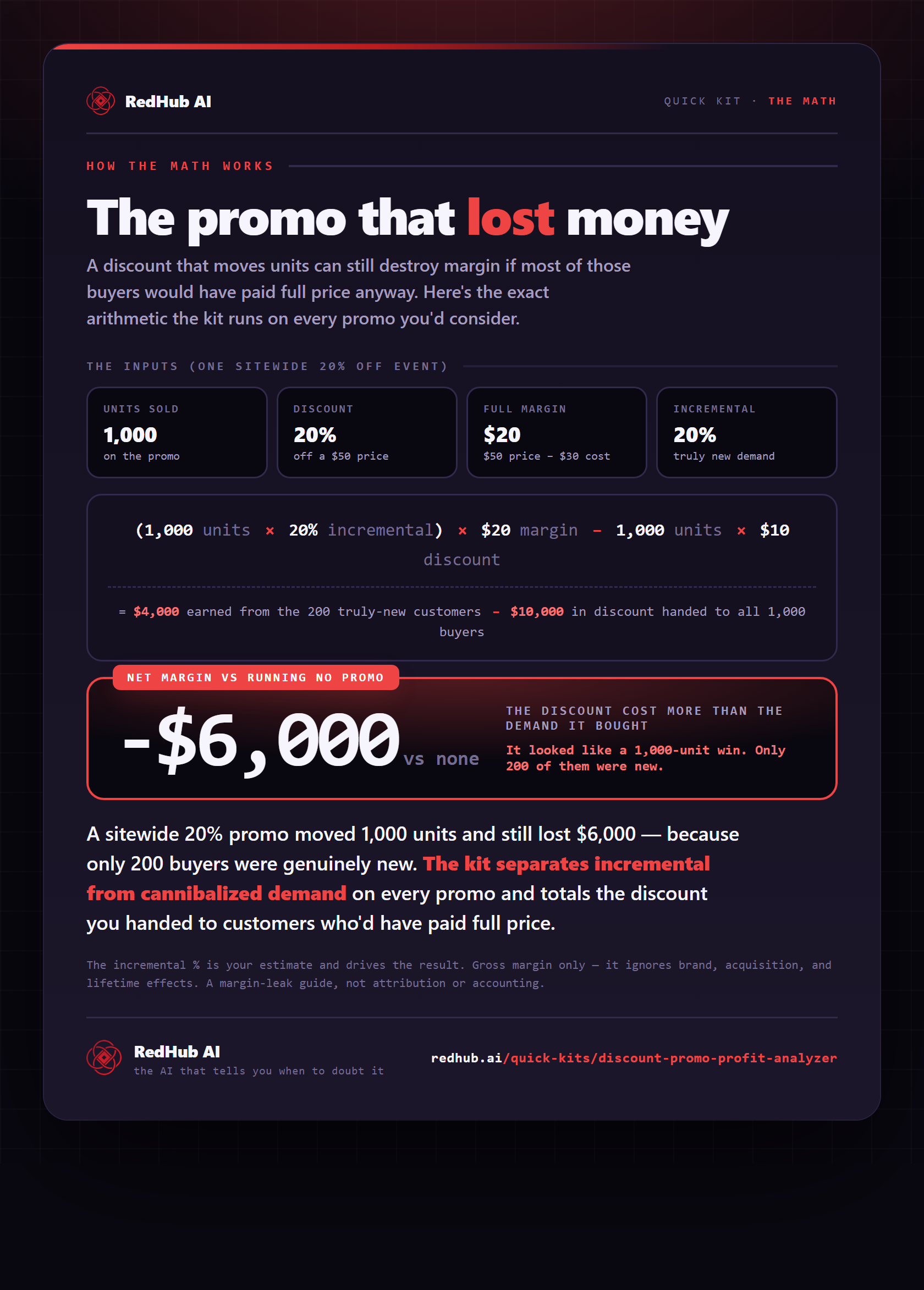
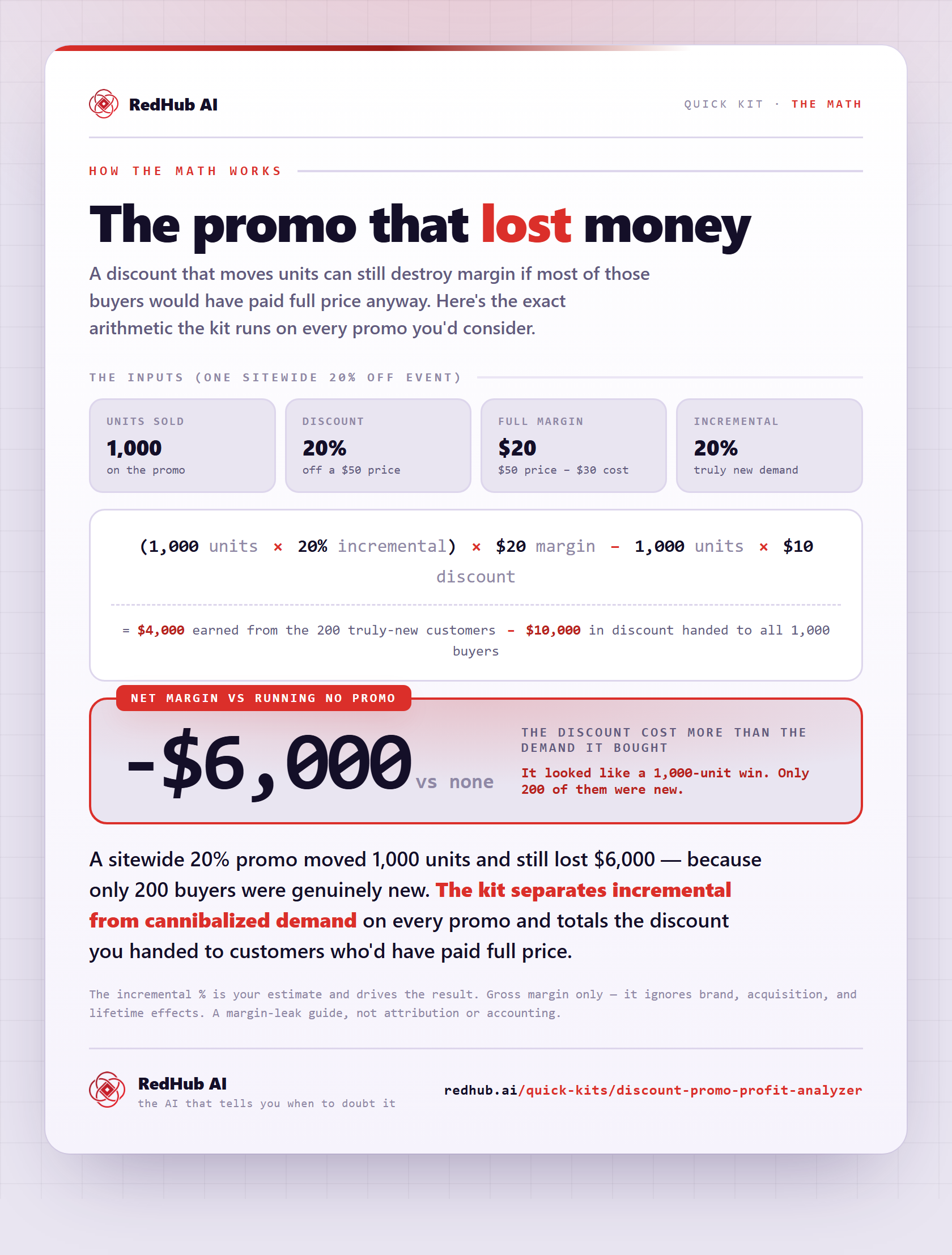
The gate this post refers to, drawn from the tool’s own logic. See the tool.