BOGO vs. Percentage Off: Which Discount Costs You Less?
RedHub AI Editorialupdated October 4, 20265 min read

Jump to a section8
In the BOGO vs percentage off choice, buy-one-get-one is a 50% discount on the pair, so it costs more margin than any percentage-off offer below 50%. It gives away a whole unit instead of shaving a slice off each one. That deeper cut means BOGO needs far more new buyers to break even, and how many more depends on what your regulars would have bought without it.
TL;DR: On a $20 item that costs $8, 20% off keeps $8 of margin per unit and BOGO keeps $2. Counted per buyer, 20% off breaks even when one buyer in three is new. BOGO needs two in three if your regulars would have bought one unit, and five in six if they'd have bought two. Research on bonus packs suggests shoppers may prefer a "more product" offer to an equivalent price cut, which can raise BOGO's new-buyer share. Whether it raises it far enough is a question for your own data.
Why BOGO is deeper than it sounds
A BOGO offer charges full price for one unit and nothing for the second. Across the pair, that is half price. A "20% off" or "30% off" offer can feel as generous to a shopper while giving away less than half as much. BOGO's 50% only gets matched by a straight half-price sale.
Why shoppers like it anyway
A 2012 Journal of Marketing study (opens in a new tab) by Haipeng Chen, Howard Marmorstein, Michael Tsiros and Akshay Rao found that a bonus pack outsold an economically equivalent price discount in a retail field experiment, with supporting results in a mall-intercept survey and lab studies. The authors trace the effect to "base value neglect": shoppers reading a percentage without weighing what it is a percentage of.
A bonus pack isn't exactly BOGO, and the study didn't test your product. Read it as a reason BOGO may draw more buyers than its depth alone predicts, not as a measured BOGO result.
Worked example: one product, two offers
- 20% off, single units: the price drops to $16, so the margin is $16 − $8 = $8 per unit.
- BOGO, sold in pairs: revenue on the pair is $20 and cost is 2 × $8 = $16, so the pair earns $4, or $2 per unit.
Run per unit, the break-even formula from How to Price a Promotion So It Actually Makes Money gives 1 − (8 ÷ 12), about 33%, for 20% off and 1 − (2 ÷ 12), about 83%, for BOGO. The per-unit view hides who takes the free unit, though, so it helps to count buyers instead.
Count buyers, not units
With BOGO, what each regular would have bought without the offer decides the cost. The table runs the three cases.
| Offer and buyer | Margin lost per regular | Margin added per new buyer | New buyers needed to break even |
|---|---|---|---|
| 20% off, regular buys 1 | $4 ($12 → $8) | $8 | 1 in 3 (33%) |
| BOGO, regular would have bought 1 | $8 ($12 → $4) | $4 | 2 in 3 (67%) |
| BOGO, regular would have bought 2 | $20 ($24 → $4) | $4 | 5 in 6 (83%) |
The 83% from the unit math is the worst case. It is what you face when your regulars already buy two. If they buy one, the bar is 67%. Both are far above the one-in-three that 20% off asks for.
The case for BOGO, and its catch
BOGO's steep bar can still be cleared. If the bonus-pack effect is real for your product, BOGO may pull in more first-time buyers than a percentage offer would. On clearance stock, the alternative to a deep discount is often no sale, which pushes the new-buyer share up on its own.
The catch is the free unit. On a product people use up, a buyer who takes two may skip their next purchase. That turns part of a "new" BOGO buyer into a pulled-forward sale, and it won't show until weeks later. We can't tell you how large either effect is for your store. A small test on one product, with the weeks after it measured, can.
When each format tends to fit
- Percentage off suits loyal, repeat-buying audiences, where the new-buyer share tends to be modest and a shallower cut limits the damage from cannibalization.
- BOGO offers suit clearance, first-purchase offers and products where nobody already buys two, so the regular-buyer cost stays at its lower $8 case.
- Neither format is automatically safer. Your honest estimate of new buyers for that product and audience decides which one protects margin.
Run both offers through the same math
Enter a BOGO as a 50% discount next to the percentage-off version, with your incremental estimate for each counted in units. The Discount & Promo Profit Analyzer returns net margin against no promo and a keep, limit or kill verdict for both rows.
Get the Discount & Promo Profit Analyzer — $39Pairs well with
If BOGO is about moving stock, the Inventory Cash-Trap Finder ($49) flags every SKU Dead, Slow or Healthy against your target months on hand and gives you a per-SKU liquidation list. If it is about winning first-time buyers, the CAC & Payback Calculator ($49) compares that spend with your other acquisition channels and returns invest, hold or cut per channel. And if you're weighing a permanent price move instead of a temporary offer, the AI-Assisted Pricing-Change Defensibility Kit ($49) grades it before you publish.
More in this guide
Is BOGO always a deeper discount than percentage off?
It is deeper than any percentage-off offer below 50%. Buy-one-get-one charges full price for one unit and nothing for the second, which works out to half price across the pair.
Why might shoppers prefer BOGO to an equivalent percentage discount?
A 2012 Journal of Marketing study by Chen, Marmorstein, Tsiros and Rao found a bonus pack outsold an economically equivalent price discount in a retail field experiment. The authors attribute it to shoppers neglecting the base a percentage applies to. A bonus pack is close to BOGO but not identical.
How many new buyers does BOGO need to break even?
It depends on what your regulars would have bought. In our $20 item, $8 cost example, BOGO needs two of every three buyers to be new if regulars buy one unit, and five of every six if they buy two. A 20% discount needs one in three.
When does BOGO make sense despite the steep bar?
When many buyers are likely to be new: clearance stock, first-purchase offers, or products your regulars don't already buy in pairs.
Is percentage off automatically the safer choice?
It usually has a lower break-even bar, but whether it is safer still depends on your honest estimate of new buyers for that promo and audience. The format alone doesn't decide it.
How do I compare BOGO and percentage off for my own product?
Work out the margin per buyer under each offer, then the share of new buyers each needs to break even, and compare both with your honest estimate. You can also enter BOGO as a 50% discount in the Discount & Promo Profit Analyzer. Count its incremental share in units: a regular who would have bought one and takes the free second unit adds one incremental unit and one cannibalized unit.
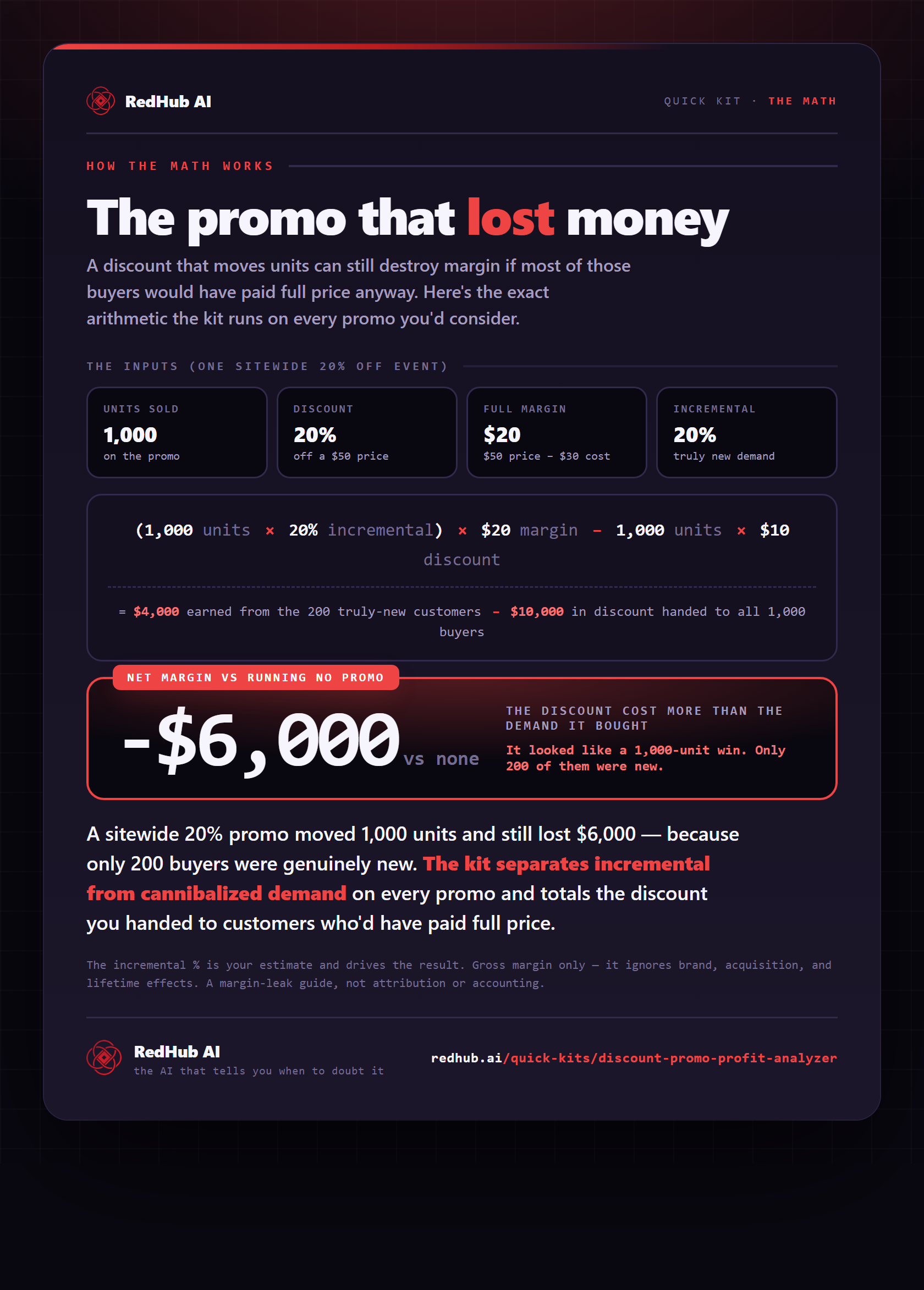
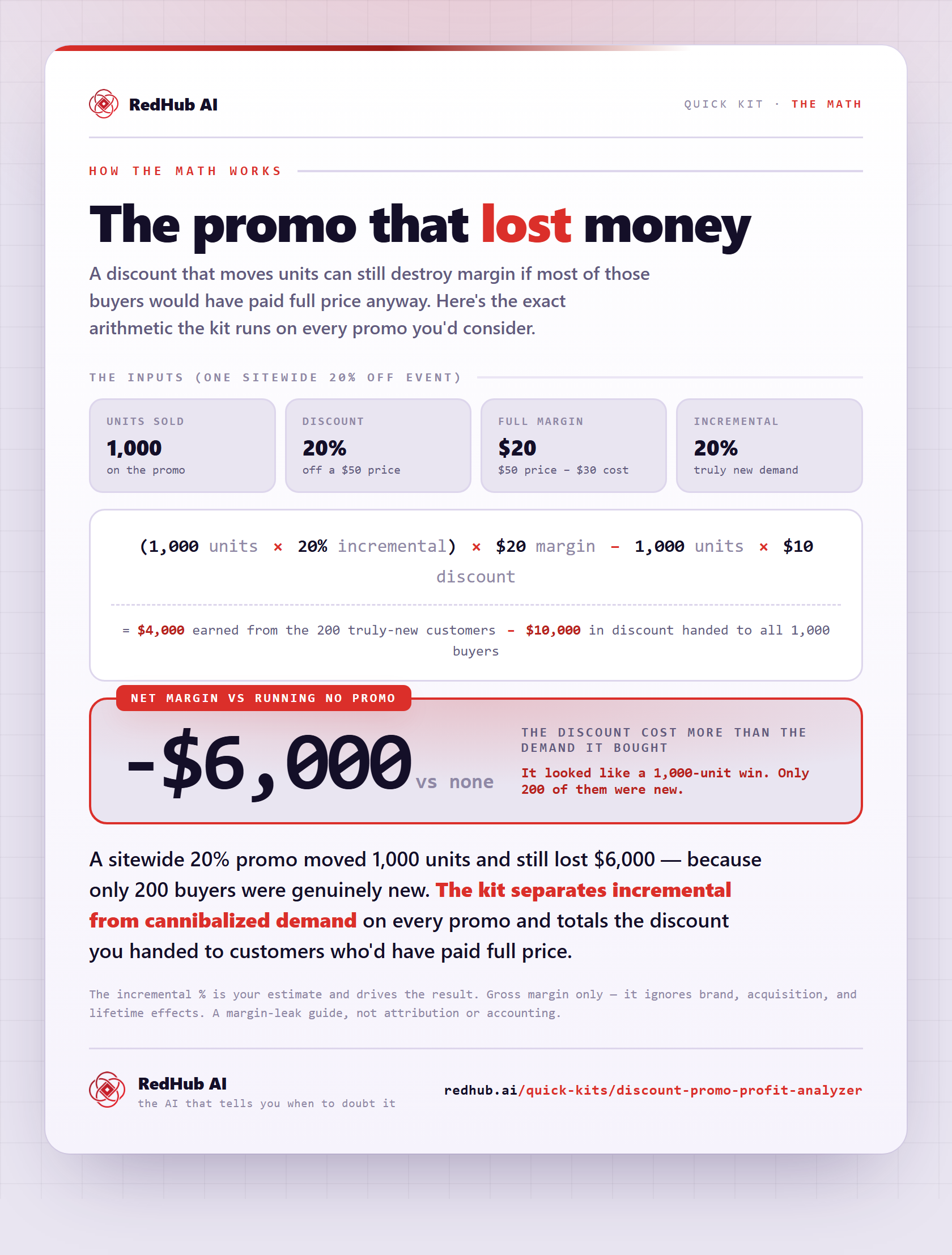
The gate this post refers to, drawn from the tool’s own logic. See the tool.