Should I Raise My Prices? How to Decide With Math, Not Nerve
RedHub AI Editorialupdated October 4, 20267 min read

Jump to a section8
The useful answer to "should I raise my prices?" is a number, not a feeling. A higher price means each remaining sale earns more, so a raise can lose some customers and still leave you ahead. The number to find is how many customers you can lose before the raise stops paying for itself, set against how many you expect to lose. If your price hasn't moved in a year and your costs have, that number is overdue.
TL;DR: Break-even volume loss is increase ÷ (margin + increase). At a 60% gross margin, a 10% increase still breaks even if you lose 14.3% of volume. At a 40% margin, the same 10% increase can lose 20%, because a thinner margin gives more room. Compare that ceiling with the loss you honestly expect. A wide gap says raise. A narrow gap says test on new customers first. An expected loss above the ceiling means a flat raise loses money, so restructure the offer instead. Try your own numbers in the calculator below.
Two decisions wearing one name
Raising a price is two decisions. The first is arithmetic: can you absorb the customer loss a raise might cause? The second is communication: how do you announce it so fewer people leave? Founders tend to rehearse the second one for months without ever writing down the first. This post is about the arithmetic. The words are in our post on announcing a price increase, and the signs that it's time are in when to raise prices.
The arithmetic gets skipped because "I'll lose customers" feels true whether or not anyone measured it. Without a number, that fear has nothing to push against.
Why "charge what you're worth" doesn't settle it
Plenty of pricing advice stops at "charge what you're worth" or "most customers won't leave." Neither tells you what your customers will do. We won't hand you an average churn rate for price increases either. A number borrowed from someone else's customers says nothing true about yours. What you can know before you move is the break-even line, because it comes entirely from your own price and costs.
The break-even formula
Every price increase trades two things: more profit on each sale you keep, and some buyers who may walk. Break-even volume loss is the point where the extra profit on the sales you keep exactly covers the profit lost on the sales that left.
Break-even volume loss = increase % ÷ (current gross margin % + increase %)
Use the margin on each sale: the price minus what that one sale costs you to deliver. A 60% margin and a 10% increase give 10 ÷ 70, or 14.3%. A 40% margin and the same increase give 10 ÷ 50, or exactly 20%.
Look at which way that runs. The lower your margin, the more volume a raise can lose and still break even. On a $100 price with a 40% margin, a 10% raise lifts the profit on each sale from $40 to $50, a quarter more. With a 60% margin it goes from $60 to $70, a sixth more. Each customer who leaves also took less profit with them in the thin-margin case. So the formula, if anything, favors raising when margins are thin.
Try it on your own numbers below.
Price-increase break-even (illustrative)
The calculator takes only your increase and your margin. Run it at three sizes before you settle on one. At a 60% margin, increases of 5%, 10% and 15% break even at 7.7%, 14.3% and 20% volume loss. Each step up buys more room on paper, and each step is also a bigger ask of the customer.
What the calculator doesn't know
This is a decision aid, not financial advice, and its limits are worth naming up front:
- It assumes your margin holds. If a raise brings new costs, such as more support tickets from surprised customers or a competitor undercutting you, your real margin moves too.
- It assumes demand responds smoothly. Real customers don't leave in a straight line. You might lose almost nobody at 8% and a cluster at 12%, because you crossed a price point that matters to them, such as $99 to $100 or a competitor's exact price.
- It's a single blended number. Your best customers and your worst-fit customers react differently. A blended break-even can hide a segment that is far more price-sensitive than the average.
The thin-margin advantage has a catch of its own. If your margin is thin because you compete on price, your customers may be the most price-sensitive buyers in your market. The formula gives you the most room in exactly the business where that room is most likely to get used. Test before you commit the whole book: raise for new customers only, or raise one tier, and watch what happens.
Three verdicts, and what moves you between them
Break-even is only half the comparison. The other half is the loss you expect. Subtract it from the loss you can absorb and you get headroom, measured in percentage points. The Should I Raise My Prices? Decision Kit sets its verdict by that gap:
- Raise at 5+ points of headroom. The kit's built-in example is a $100 price, a $60 unit cost and 200 units a month. A 10% raise can absorb a 20% loss, the owner expects 8%, and profit still rises by $1,200 a month.
- Hold / test at 0–5 points. That's too close to call on an estimate, so pilot the new price on new customers first.
- Restructure below zero headroom. The loss you expect is above the break-even line, so a flat raise loses money. Look at tiers, at what's included, or at cost before you touch the sticker price. Our post on how many pricing tiers to offer is a place to start.
The kit has a fourth label, Fix cost first, for the case where even the new price sits below what each sale costs you. Whichever verdict you land on, write it down with the numbers behind it. "I raised prices because I felt confident" is a story. "A 10% raise at my 35% margin can lose 22% of volume, and I expect to lose 5%" is a decision you can check later.
What to do with the answer
If the math says raise, your next problem is how people hear about it. The structural choices, such as who sees the new price first and whether to phase it, are in raising prices without losing customers. If the math says restructure, look at where margin is leaking before you blame the price. A price that looks too low is sometimes a cost structure that's too loose.
Then put the next review on the calendar, twice a year for example, so the next increase is a scheduled decision instead of an anxious one.
Run the raise on your own numbers
The Should I Raise My Prices? Decision Kit is a one-time spreadsheet. Enter your price, unit cost, monthly units, the raise you're weighing and the loss you expect. It shows the loss you can absorb, your headroom and a Raise, Hold / test or Restructure verdict, with +5% through +25% side by side and copy-paste scripts for the customer notice.
Get the Should I Raise My Prices? Decision Kit — $49Pairs well with
The Profit Leak Finder ($49) ranks every client by true profit after the cost to serve and gives each a keep, reprice, fix or fire verdict, so you can see who a raise should reach first. The Margin Leak Auditor ($79) sweeps your deal book for realized margin below your floor and returns HOLD or CLEAR. It defends a price rather than setting one. The Devil's-Advocate Board ($199) red-teams one big decision, such as a price change, from five skeptical lenses and returns GO, GO WITH CONDITIONS, NOT YET or NO-GO.
More in this guide
How do I know if I should raise my prices?
Compare two numbers: the volume loss a raise lets you absorb, which is the increase divided by your margin plus the increase, and the loss you honestly expect. If the first is comfortably above the second, the case is strong. A price that hasn't moved in a year while your costs have is a good reason to run the check.
What's a safe percentage to raise prices by?
No percentage is safe for every business, because the answer depends on your margin and on how price-sensitive your customers are. Run several sizes through the break-even formula, such as 5%, 10% and 15%, and consider testing a smaller increase before you commit to a larger one.
Will raising prices lose me customers?
Probably some. How many depends on your customers and on how the increase reaches them, and no general average can predict it for your business. The break-even line tells you how many you can lose before the raise stops paying for itself.
Does a thin margin make a price increase riskier?
Not in the break-even math. A 10% raise at a 40% margin can lose 20% of volume and break even, against 14.3% at a 60% margin. The real risk is that a business with a thin margin may be competing on price, so its customers may react more strongly. Test on new customers first.
Should I raise prices for existing customers or just new ones?
Raising for new customers first is usually the lower-risk path. You collect the higher price on new business right away and see how buyers respond before you move existing customers. The break-even math gives you a blended line. Real customer behavior is the test.
Is this pricing calculator financial advice?
No. It's a decision aid built from your own two inputs, increase percentage and gross margin, using a standard break-even formula. It assumes your margin holds and demand responds smoothly, so treat the output as an estimate to test, not a guarantee, and talk to a financial professional for decisions with real stakes.
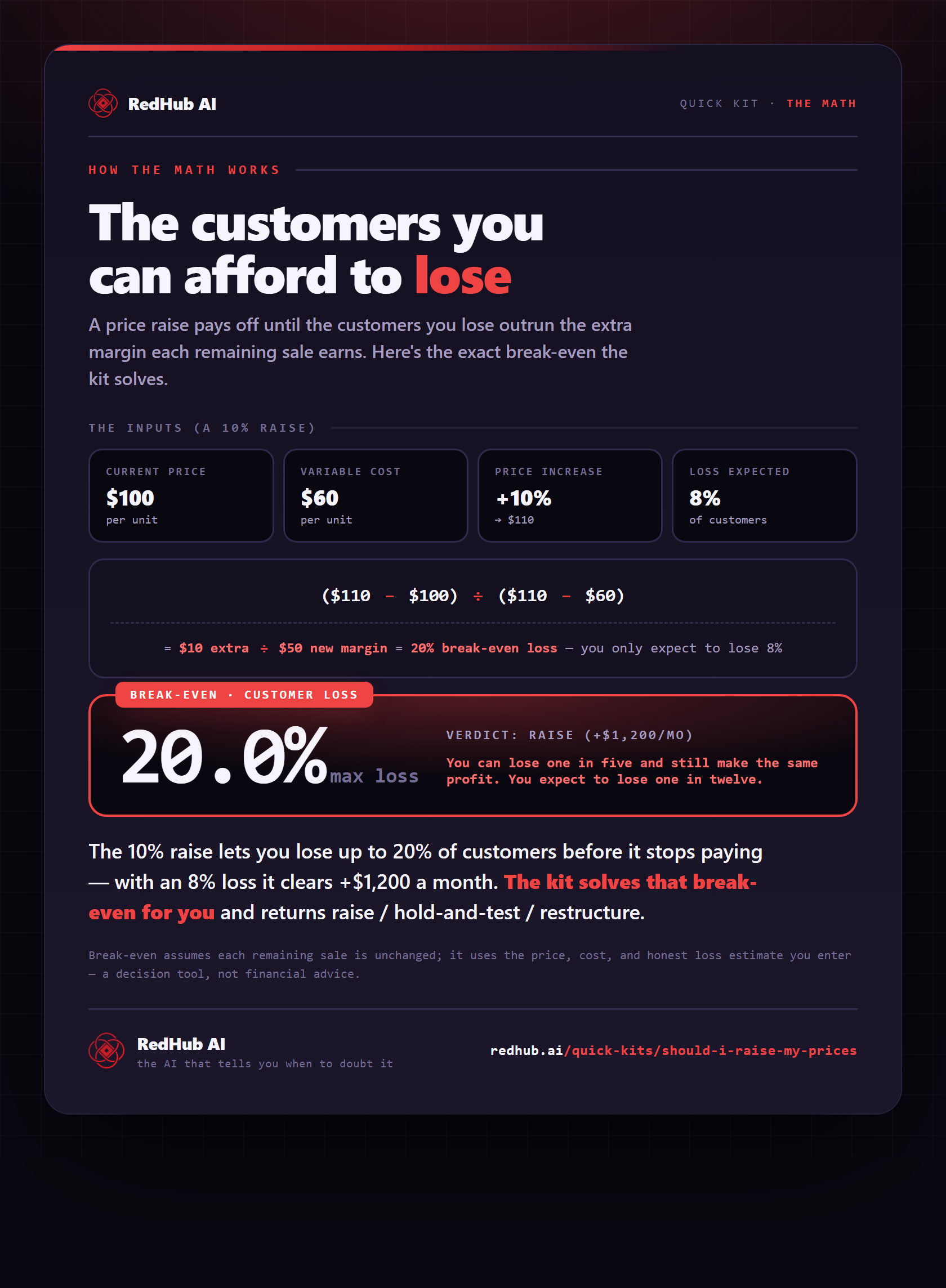
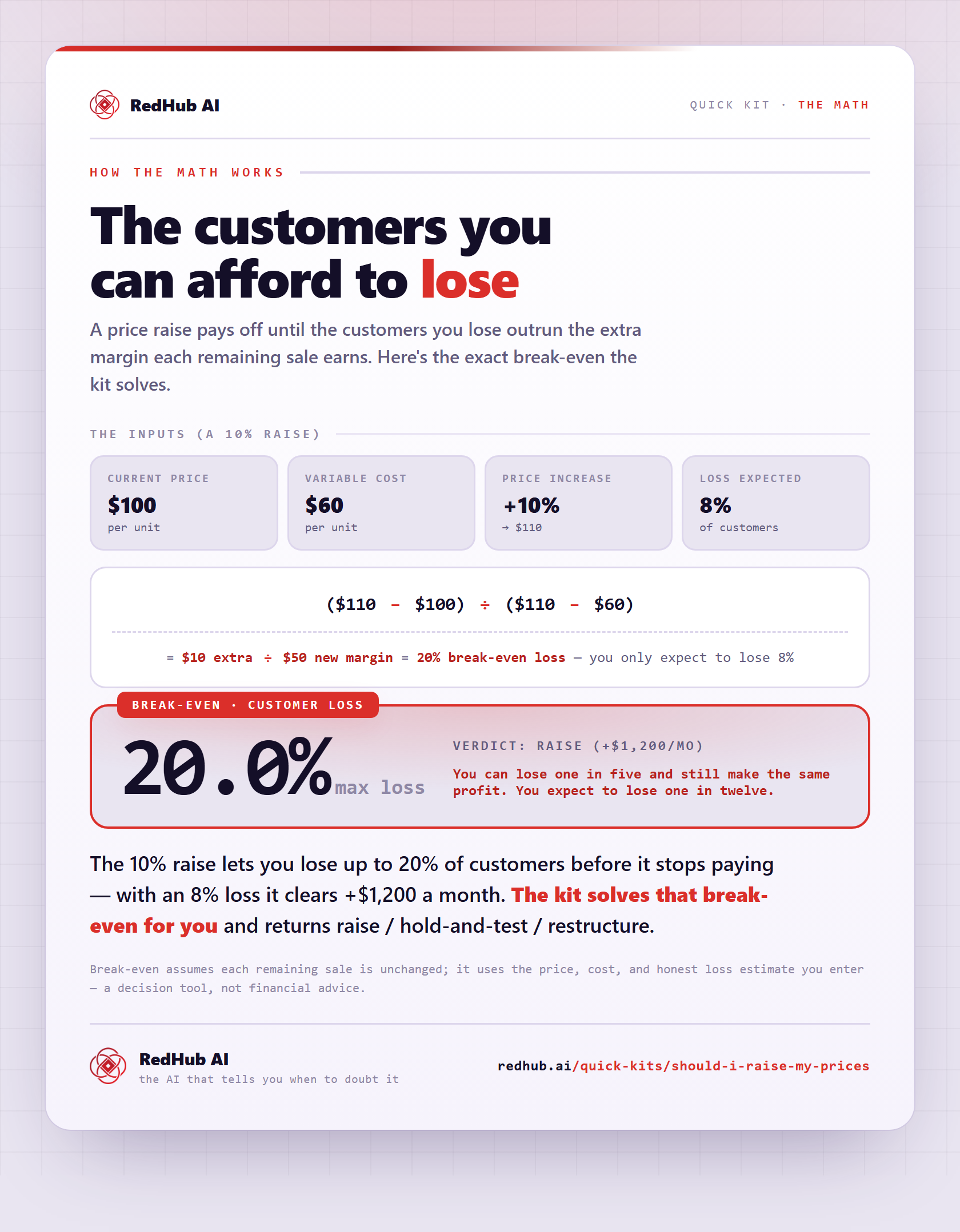
The gate this post refers to, drawn from the tool’s own logic. See the tool.