Cloudflare Agent Stack: Build Without Lock-In
Todd Brooks, Founderupdated July 22, 20268 min read
Jump to a section9
TL;DR
- What it is: Cloudflare's Agent Cloud expansion delivers AI infrastructure with model flexibility, Git-compatible storage, and minimal vendor lock-in.
- Who it's for: Founders and engineering teams building AI agents who need to experiment with models, maintain audit trails, and avoid brittle dependencies.
- How it works: The Replicate acquisition brings 50,000+ models; Artifacts provides versioned storage; open standards reduce platform risk.
- Bottom line: Rent infrastructure primitives from platforms built for scale — invest your engineering time in product differentiation, not reinventing compute and storage.
What Is the Cloudflare Agent Stack?
The Cloudflare Agent Stack is an integrated set of AI infrastructure primitives — including model flexibility via Replicate, Git-compatible storage through Artifacts, dynamic compute with Workers, and execution sandboxes — designed to help developers build production AI agents without vendor lock-in. By offering access to 50,000+ models through a single API and standardized storage, it enables one-line model switching and reduces the architectural risk of betting on a single provider.
Best for: Teams building AI agents at scale who need model flexibility and audit-ready versioning. Not ideal for: One-off experiments or teams deeply committed to proprietary cloud ecosystems. Fast takeaway: Cloudflare makes swapping models and tracking outputs frictionless — that's risk management, not just convenience.
The trap most founders fall into when building with AI is invisible until it costs them.
They pick a model. They build their product around that model's API. They optimize for that model's strengths. Six months later, a better model comes out. Or the pricing changes. Or the provider pivots. And now they have a choice: do an expensive re-architecture, or stay on the suboptimal path because switching is too painful.
This is vendor lock-in. And it is the quiet killer of AI product strategy.
Cloudflare's Agent Cloud expansion, announced April 13, 2026, is designed from the ground up to avoid it. Here is how — and why it changes the calculus for founders building on AI agents infrastructure.
The Replicate Acquisition: 50,000+ Models in Your Back Pocket
The most strategically significant piece of Cloudflare's recent announcements is not a feature. It is an acquisition.
Cloudflare acquired Replicate — a platform that hosts more than 50,000 AI models. The integration of Replicate into Cloudflare's model catalog means that developers building on Cloudflare can switch between OpenAI, GPT-5.4 (opens in a new tab), open-source models, and specialized domain models with a single line of code change.
One line. Not a re-architecture. Not a new integration sprint. One line.
The business implications are significant. If you want to experiment with a cheaper model for lower-stakes tasks and a more capable model for high-priority work, you can do that within the same infrastructure. If a new open-source model beats the incumbents on your specific task — which is happening regularly now — you can switch to it without friction. If your preferred commercial model changes its pricing or terms, you have real alternatives without platform switching costs.
This is not just a developer convenience. It is a business risk management tool. Your AI strategy should not be brittle because your infrastructure forces you into a single model.
What Artifacts Does (And Why Storage Has Always Been an Afterthought)
Every agent that does real work produces outputs. Code. Reports. Data transformations. Processed files. Intermediate results that feed the next step.
Where does all that go?
In most agent architectures today, the answer is some combination of: S3 buckets, custom database tables, ad hoc file paths, and prayer. There is no standard. There is no versioning. There is no way to track how an output at step five of a workflow relates to the input at step one. If something goes wrong, the forensics are painful.
Cloudflare Artifacts is Git-compatible storage (opens in a new tab) built for the agents-first era. Agents can create and manage tens of millions of repositories. Every output is versioned. Every change is tracked. The relationship between inputs and outputs is maintained through the same branching and history model that developers have used for decades.
For business operators, this solves a problem that becomes urgent as agent deployment scales. When one agent is running one task for one user, ad hoc storage is fine. When a hundred agents are running a thousand tasks for a hundred users, you need a storage layer with structure. Artifacts provides that without requiring your team to build it from scratch.
There is also an audit dimension. Regulated industries — finance, healthcare, legal — are particularly cautious about AI agents because the outputs are hard to trace. Artifacts creates a complete, auditable record of what an agent produced, when, and in what context. That is the kind of paper trail that makes AI deployment defensible to a compliance team.
Renting Primitives Beats Building Your Own
There is a broader strategic point here that applies to how founders should think about AI infrastructure in general.
The temptation when building a differentiated AI product is to own as much of the stack as possible. Build your own model fine-tuning pipeline. Build your own agent runtime. Build your own storage layer. The thinking is: if I own the infrastructure, I have a moat.
The reality is: if you build infrastructure that a dedicated infrastructure company could build better, you have technical debt, not a moat. Your moat is in the product logic — the domain expertise, the user experience, the data flywheel, the workflows you have figured out that your competitors have not. The infrastructure is not your competitive advantage. Spending engineering cycles building it is a tax on the time you should be spending on the thing that actually differentiates you.
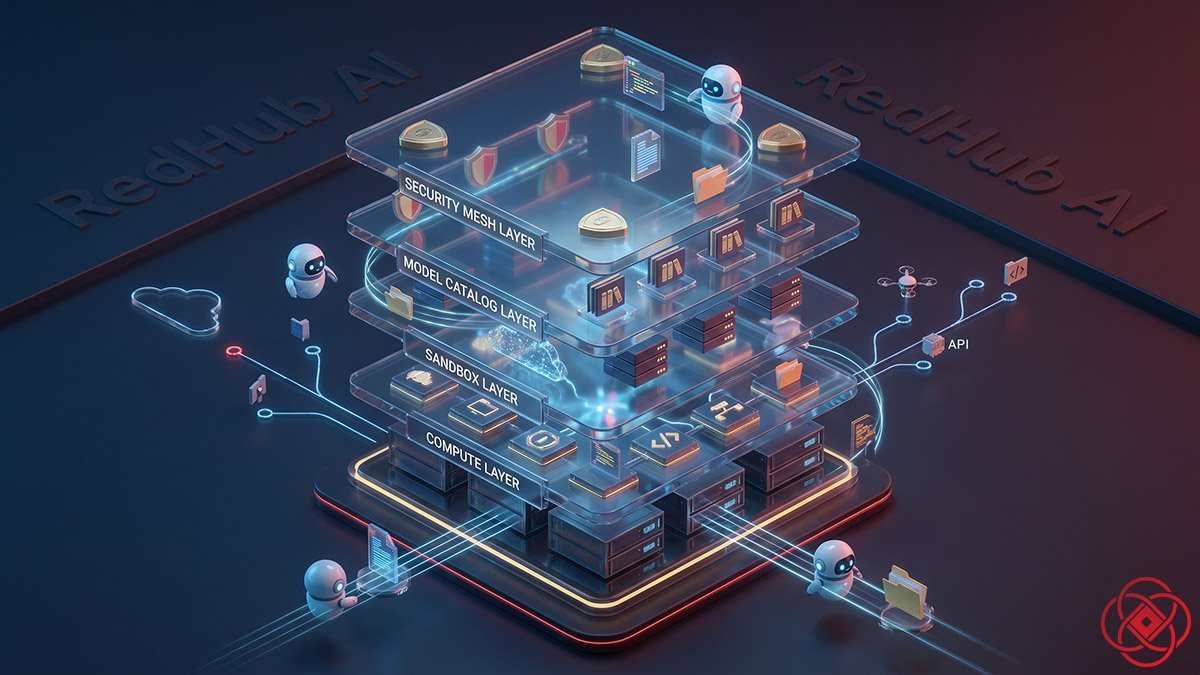
Cloudflare, with this release, is offering the full stack of AI agent primitives: compute (Dynamic Workers), execution environments (Sandboxes), storage (Artifacts), model flexibility (Replicate catalog), security and networking (Mesh), and developer frameworks (Think SDK). These are the building blocks. Your product is what you build with them.
This is not an argument that Cloudflare is the only platform worth considering. It is an argument that the rent-primitives-build-differentiation model is the right one — and that Cloudflare's current offering makes that model more complete than it has ever been. According to OpenAI's endorsement (opens in a new tab) of the platform, Cloudflare makes it "dramatically easier for developers to deploy production-ready agents powered by GPT-5.4 and Codex to run real enterprise workloads at scale." That is a significant signal from the company whose model sits at the top of most agent stacks.
How to Think About Platform Risk
Choosing Cloudflare as your agent infrastructure does not mean you are betting everything on one platform. Here is why.
Cloudflare's stack is largely built on open standards — the Workers ecosystem, Git-compatible storage, standard Linux environments in Sandboxes. The Think SDK is a framework, not a proprietary runtime you cannot port. The Replicate model catalog is accessible through standard APIs. If you needed to move, the migration cost is real but not catastrophic.
Compare that to being locked into a specific cloud provider's proprietary compute, storage, and model API simultaneously. The multi-layer lock-in is where the risk actually lives.
The practical guidance: build your core business logic to be infrastructure-agnostic where possible. Use Cloudflare's primitives to avoid building undifferentiated infrastructure. Keep your model prompts and agent logic modular enough that the one-line model switch Cloudflare offers is actually one line, not "one line plus refactoring our entire prompt structure."
For context on how Sandboxes and persistent agents change what you can build on this platform, see Cloudflare Sandboxes for AI Agents Explained.
And for the full picture of how Mesh, Agent Cloud, and the broader stack work together, the pillar post covers it: Cloudflare Agent Stack for Production AI Agents.
Platform moments do not come often. When they do, the companies that move early — that understand the new primitives before their competitors do — build advantages that compound. You are reading this early.
Should You Build on Cloudflare Agent Stack?
Use it if: You are building production AI agents, need model flexibility to avoid lock-in, require audit-ready versioning for compliance, or want to rent infrastructure primitives instead of building your own compute and storage layers from scratch.
Skip it if: You are running one-off experiments with no scaling plans, already deeply integrated into a competing cloud ecosystem with sunk infrastructure costs, or building a non-agent AI product where model switching and versioned storage add no strategic value.
Best first step: Test the one-line model switch by deploying a simple agent on Cloudflare Workers, switching between two models in the Replicate catalog, and measuring the friction. If it is genuinely one line, you have validated the core value prop. If it requires refactoring, your prompts and logic need modularization before you can benefit from platform flexibility.
FAQ
What is the Cloudflare Agent Stack in simple terms?
The Cloudflare Agent Stack is a set of infrastructure tools — model access, compute, storage, and sandboxes — designed to help developers build AI agents without getting locked into a single model provider. It integrates 50,000+ models through Replicate, offers Git-compatible storage via Artifacts, and uses open standards to reduce switching costs.
How does Cloudflare's Replicate acquisition help with vendor lock-in?
The Replicate acquisition gives Cloudflare users access to over 50,000 AI models through a unified API. Developers can switch between OpenAI, open-source, and specialized models with a single line of code, eliminating the re-architecture cost that normally comes with changing model providers. This flexibility turns model choice into a business decision, not a technical constraint.
What is Cloudflare Artifacts and why does it matter?
Artifacts is Git-compatible storage for AI agent outputs. It versions every file, tracks changes, and maintains relationships between inputs and outputs — solving the ad hoc storage problem that breaks most agent workflows at scale. For regulated industries, it also provides the audit trail compliance teams need to approve AI deployment.
Is Cloudflare Agent Stack only for large enterprises?
No. While enterprises benefit from audit trails and model flexibility, startups and solo developers gain the most from not having to build their own infrastructure. Renting primitives from Cloudflare means you can focus on product differentiation instead of reinventing compute, storage, and model management from scratch.
What are the biggest risks of using Cloudflare for AI infrastructure?
The primary risk is platform dependency if you build deeply into Cloudflare-specific features without abstraction layers. However, because Cloudflare uses open standards (Workers, Git storage, Linux sandboxes), migration costs are lower than proprietary cloud stacks. The real risk is not choosing Cloudflare — it is building your own infrastructure poorly and creating technical debt.
How long does it take to deploy an agent on Cloudflare Agent Stack?
For developers familiar with Workers or similar edge compute environments, deploying a simple agent can take under an hour. The Think SDK provides frameworks to accelerate setup. The real timeline depends on your agent's complexity — model selection, workflow logic, and integration with Artifacts for output storage add time, but these are product decisions, not platform friction.