Closed-Lost Follow-Up: Re-Open Deals in Your CRM
RedHub AI Editorialupdated August 18, 20264 min read

Jump to a section7
TL;DR
- What it is: re-touching sales deals marked closed-lost to see which are worth re-opening.
- Who it's for: sales teams who mark a deal lost and never look back — see how to win back customers.
- How it works: most closed-lost is "not now," not "never" — re-touch on the reason it was lost, at the right time.
- Bottom line: closed-lost isn't dead. It's your warmest, most-ignored source of pipeline.
How do you follow up on closed-lost deals?
You follow up on closed-lost deals by re-touching them based on why they were lost — and most were lost to timing, budget, or priority, not a hard "no." A deal lost on budget last year deserves a different re-open than one lost to a competitor. The move is to segment closed-lost by loss reason, wait for the trigger that changes it (a new budget cycle, a competitor stumble, a new decision-maker), and reach back out with a reason tied to what changed. Closed-lost is a warm pipeline most teams never work.
Best for: B2B sales teams sitting on old lost deals. The CRM Win-Back System works closed-lost systematically.
Most sales teams mark a deal closed-lost and never touch it again — treating "lost" as "dead." But the majority of lost deals weren't a hard no; they were a not-now. The reason a deal was lost is also the map to re-opening it. Here's how to work closed-lost as the warm pipeline it is.
Most closed-lost is "not now," not "never"
Deals are rarely lost because the prospect hated you. They're lost to timing ("not this quarter"), budget ("no money now"), priority ("something else came first"), or a competitor who won this round. Every one of those can change — a quarter ends, a budget frees up, a competitor disappoints. A hard "never" is real but rare. Treating all closed-lost as dead throws away the many that were just early.
Segment by loss reason, re-touch on the trigger
| Lost to | The trigger to re-open on |
|---|---|
| Timing | The next budget cycle or planning season |
| Budget | A new fiscal year, funding, or a cheaper option |
| Priority | A change that makes your problem urgent again |
| Competitor | A renewal window or a competitor stumble |
The re-touch works when it ties to what changed: "You passed last year on budget — new pricing might fit now," not a generic "still interested?" A reason tied to the loss reason is what re-opens the conversation.
Log the loss reason, or this doesn't work. Closed-lost follow-up depends on knowing why each deal was lost. If your CRM just says "lost," start capturing the reason now — it's the difference between a targeted re-open and a guess.
Re-engaging isn't permission to spam. Before you re-contact anyone, honor unsubscribes and the rules that apply — CAN-SPAM for email, Do-Not-Call and the TCPA for calls and texts. A dormant contact is not an opted-out one; re-touch the people you may legally reach, and skip the ones who told you to stop. This is general guidance, not legal advice.
Work closed-lost systematically
The reason most teams don't work closed-lost is that it's tedious to do by hand — segmenting by reason, watching for triggers, timing the re-touch. The CRM Win-Back System structures it so re-opening lost deals is a repeatable motion, not a someday task, and the Lead-to-Meeting Engine turns a re-opened deal into a booked conversation. For the whole database (customers, not just deals), the Database Reactivation Readiness Engine scores what's worth working.
Re-open the deals you already earned
Segment closed-lost by reason, re-touch on the trigger, and turn "not now" into pipeline — systematically.
Get the CRM Win-Back System — $149 →Closed-lost is the sales side of win-back. See the whole motion in the win-back guide.
Decision Guide
Work closed-lost if: you have old lost deals in your CRM and log why each was lost.
Fix your data first if: your CRM just says "lost" with no reason — start capturing loss reasons before you re-touch.
Best first step: pull deals lost to timing or budget in the last year and re-touch the ones whose trigger has changed.
Common Questions
How do you follow up on closed-lost deals?
Segment them by why they were lost, wait for the trigger that changes that reason, and re-touch with a message tied to what changed. Most closed-lost is "not now," not "never."
Are closed-lost deals worth re-touching?
Often yes — they're warm and most were lost to timing, budget, or priority, all of which change. It's a pipeline most teams never work.
When should I re-open a lost deal?
On the trigger tied to its loss reason — a new budget cycle for budget losses, a competitor stumble for competitive ones, a priority shift for deprioritized ones.
What do I say when re-opening a deal?
Tie it to what changed: "You passed on budget last year — new pricing might fit now." A reason beats a generic "still interested?"
Why log the loss reason?
Because the reason is the map to re-opening. If your CRM just says "lost," you're guessing. Capture the reason so the re-touch is targeted.
Do consent rules apply to closed-lost follow-up?
Yes. Business contacts still fall under Do-Not-Call/TCPA for calls and texts and CAN-SPAM for email. Re-touch the ones you may legally reach.
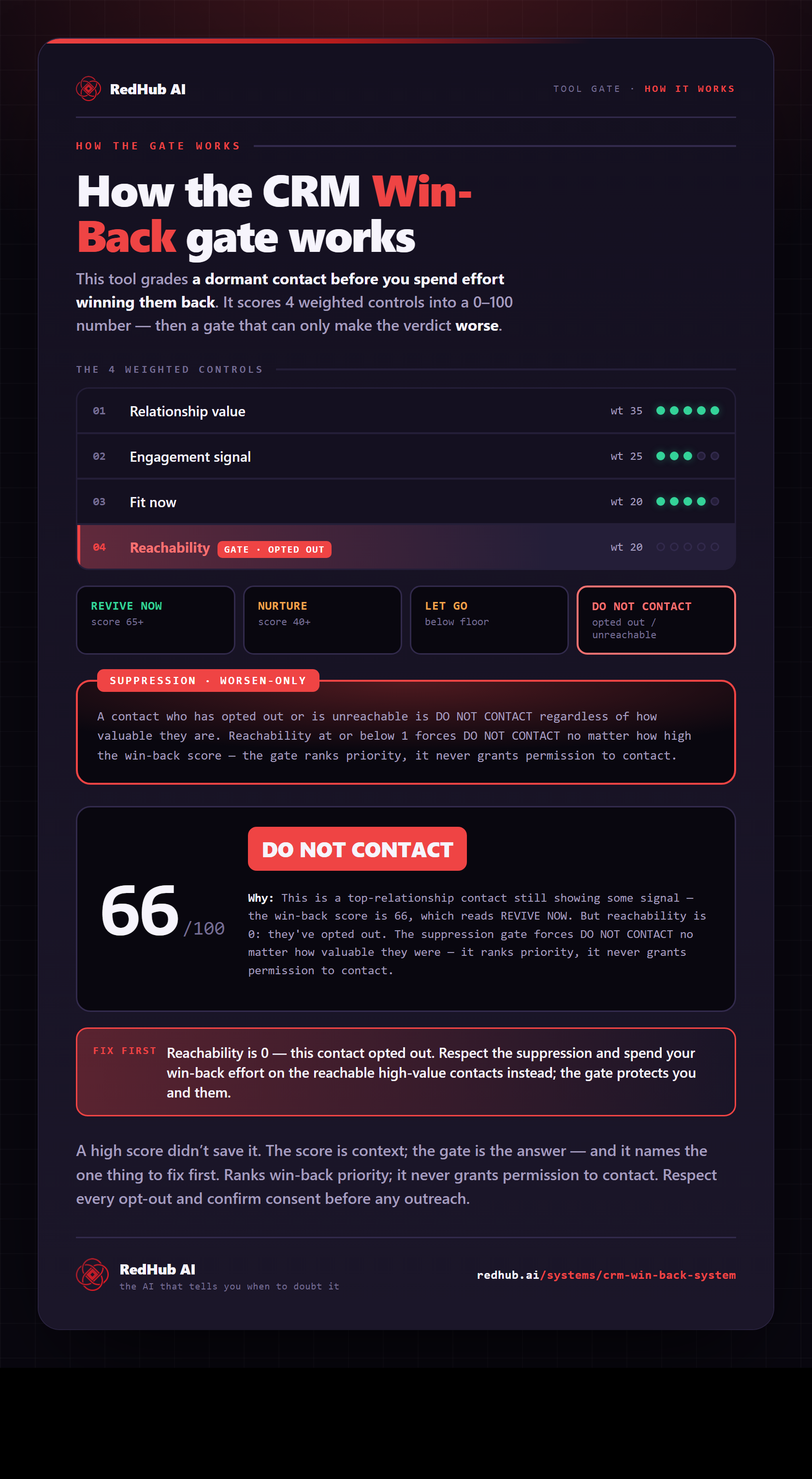
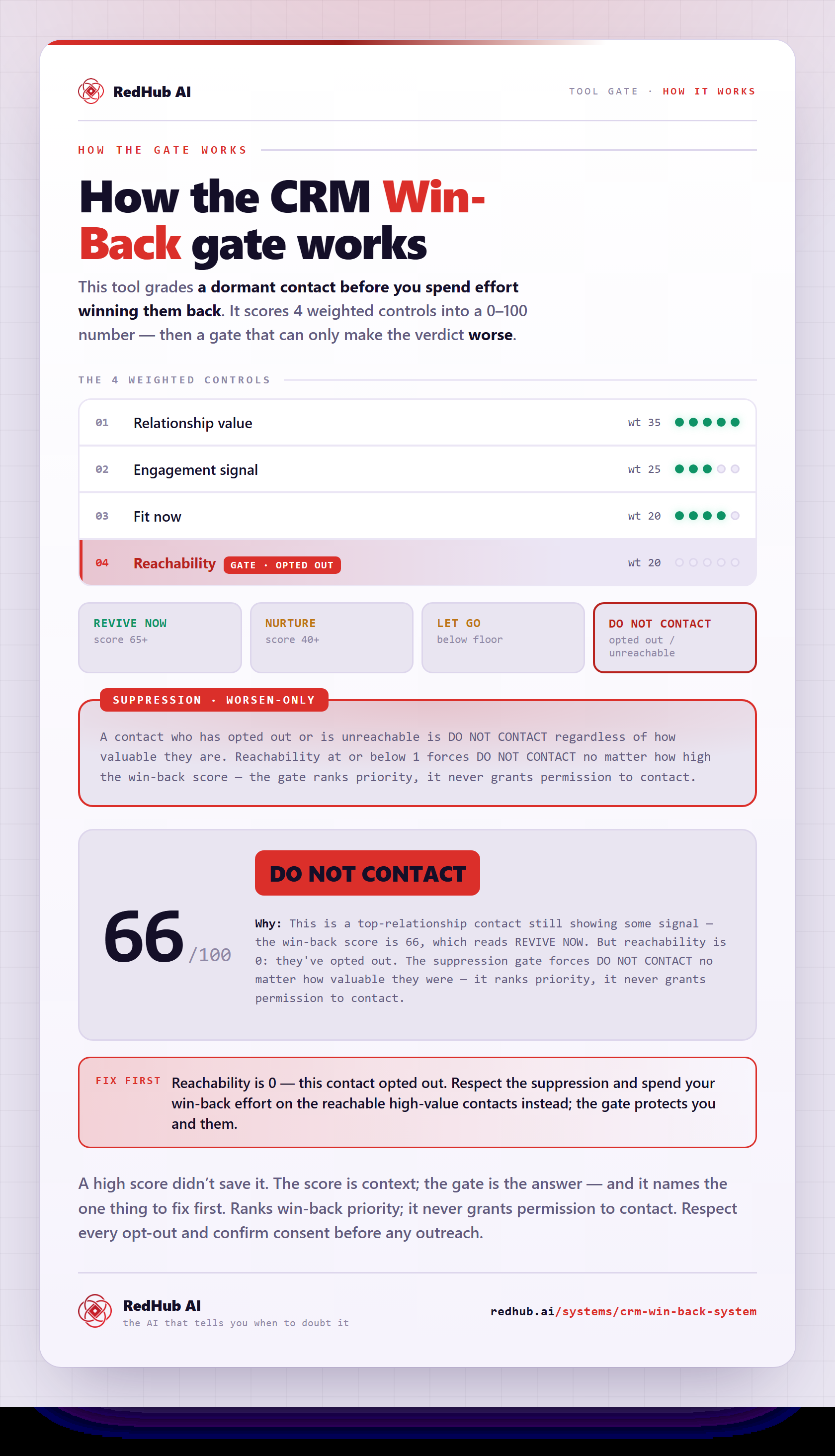
The gate this post refers to, drawn from the tool’s own logic. See the tool.