How to Win Back Customers Who Went Quiet
RedHub AI Editorialupdated August 18, 20264 min read
Jump to a section8
TL;DR
- What it is: re-engaging customers and deals that already know you — the lapsed, the churned, the closed-lost sitting in your CRM.
- Who it's for: owners and sales teams sitting on a stale database — see the CRM Win-Back System.
- How it works: score who's worth re-touching, reach them with a reason to come back, and run it on a schedule — respecting consent.
- Bottom line: your warmest pipeline isn't new leads — it's the people already in your CRM who went quiet.
How do you win back customers who went quiet?
You win back quiet customers by treating your CRM as an asset, not an archive: find the lapsed and closed-lost contacts already in it, figure out which are worth re-touching, and reach out with a real reason to return — a change, an offer, or a genuine check-in — on a repeatable schedule. Re-engaging people who already know you is usually cheaper and warmer than chasing strangers, but it comes with a rule: you can only re-contact the people you still have permission to reach.
Best for: teams sitting on a stale database. The CRM Win-Back System structures the whole re-engagement motion.
Most teams chase new leads while a warmer pipeline sits untouched in their own CRM: the customers who churned, the deals that went closed-lost, the contacts who just went quiet. These people already know you — which makes them the cheapest, warmest audience you have. This guide covers the whole win-back motion: who to re-touch, how to reach them, and the consent line you can't cross.
Why your CRM is your warmest pipeline
A cold lead has to learn who you are before they'll consider buying. A lapsed customer already did — they know your product, they had a reason to engage once, and something (often just time or a bad moment) let it lapse. Re-engaging them skips the entire "who are you" stage. That's why re-engaging existing contacts is generally cheaper and higher-converting than cold acquisition. The exact lift depends on your data and your offer, so don't trust a fixed multiple — but the direction holds: warm beats cold.
The three moves of a win-back motion
| Move | The question | Where it lives |
|---|---|---|
| 1 · Score | Who's worth re-touching (and reachable)? | Your CRM data + consent status |
| 2 · Re-engage | What reason do they have to come back? | A sequence with a real hook |
| 3 · Convert | How do we make returning easy? | A clear next step and offer |
Score before you send
Not every dormant contact is worth re-touching, and some you're not allowed to. Before a campaign, sort the database: who lapsed recently vs. years ago, who was high-value, who still has valid consent to be contacted. Scoring first stops you from blasting a stale list — which wastes effort and risks your sender reputation. A tool like the Database Reactivation Readiness Engine grades your database so you win back the right names, not all of them.
Re-engage with a reason, not a "just checking in"
The re-engagement itself needs a genuine hook — something changed, a new offer, a relevant update, or an honest "we noticed you left, what happened?" A bare "just checking in" gets ignored because it gives the person nothing. The best win-backs lead with a reason the customer would actually care about.
Convert by making the return easy
When someone responds, the path back should be frictionless — a clear offer, an easy reactivation, a booked call. The Lead-to-Meeting Engine handles that last step when the goal is a conversation.
Re-engaging isn't permission to spam. Before you re-contact anyone, honor unsubscribes and the rules that apply — CAN-SPAM for email, Do-Not-Call and the TCPA for calls and texts. A dormant contact is not an opted-out one; re-touch the people you may legally reach, and skip the ones who told you to stop. This is general guidance, not legal advice.
Turn your stale database into pipeline
Score who's worth re-touching, re-engage with a real reason, and run it on a schedule — the whole win-back motion, structured.
Get the CRM Win-Back System — $149 →What win-back is not
Two honest limits. First, it's not a guarantee — a structured motion improves the odds that quiet customers come back, but some are gone for good, and no system changes that. Second, it's not permission to spam. Re-engaging works on people you can still legally and respectfully reach; the moment someone opted out, they're off the list. Win-back is about re-earning attention you once had, not forcing it.
Decision Guide
Run a win-back if: you have a CRM full of lapsed customers and closed-lost deals you've never re-touched.
Score first if: your list is old or huge — blasting all of it wastes effort and risks your sender reputation.
Best first step: pull your closed-lost and churned contacts, remove anyone who opted out, and re-engage the recent, high-value ones first.
More in this guide
Common Questions
How do you win back lost customers?
Find the lapsed and closed-lost contacts in your CRM, score who's worth re-touching and still reachable, and re-engage them with a real reason to return — on a repeatable schedule.
Is winning back customers cheaper than finding new ones?
Usually — they already know you, so you skip the "who are you" stage. The exact lift depends on your data and offer, so don't bank on a fixed multiple, but warm generally beats cold.
Which customers should I try to win back?
The recently lapsed, the high-value, and anyone who still has valid consent to be contacted. Score first so you re-touch the right names, not the whole stale list.
Can I email or call customers who went quiet?
Only the ones you may legally reach. Honor unsubscribes and CAN-SPAM for email, Do-Not-Call and the TCPA for calls and texts. Dormant is not the same as opted-out.
Does a win-back campaign guarantee they'll return?
No. A structured motion improves the odds, but some customers are gone for good. It re-earns attention you once had — it doesn't force it.
Where do I start?
Score your database first (who's worth it and reachable), then re-engage with a real reason. The Win-Back System runs the whole motion.
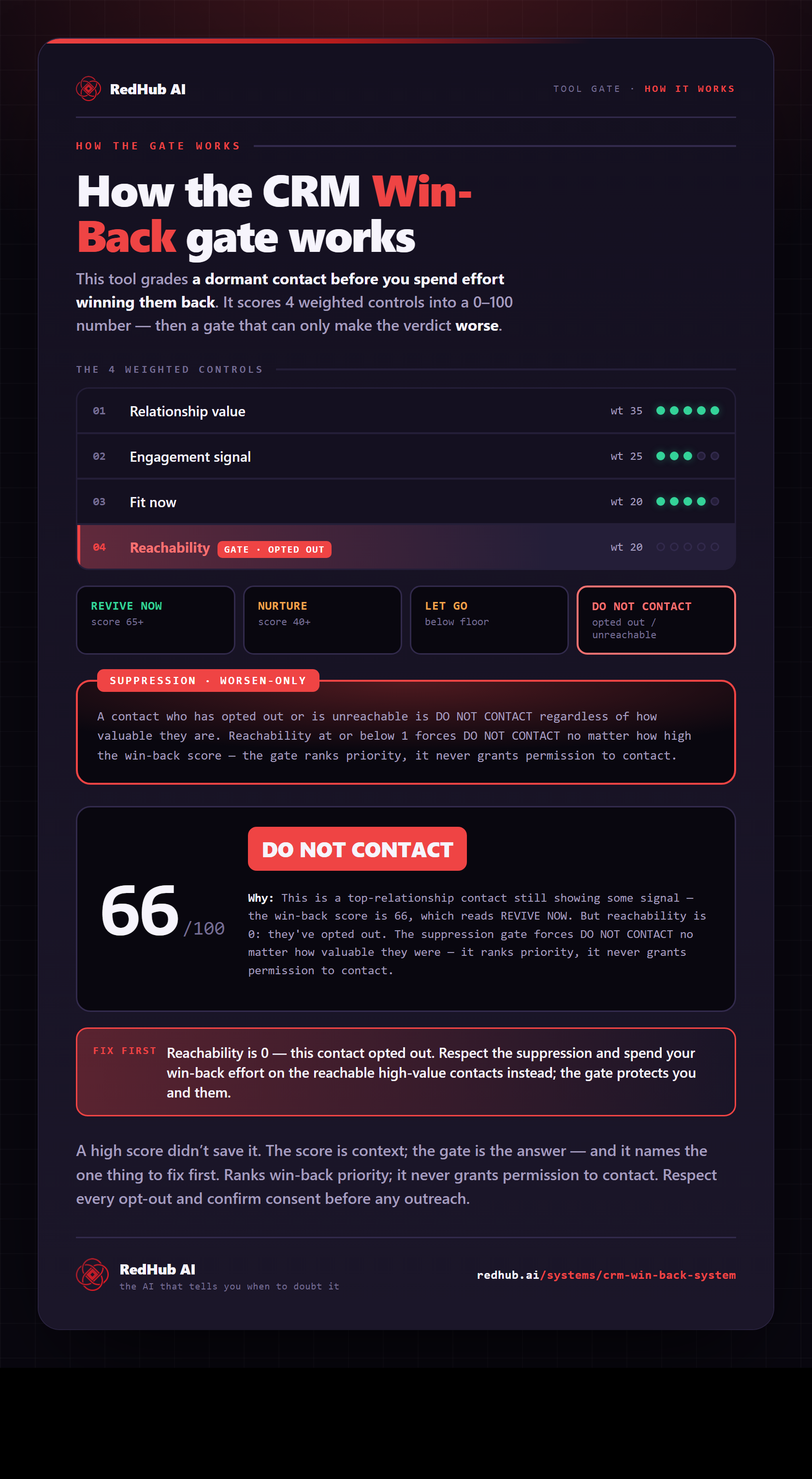
The gate this post refers to, drawn from the tool’s own logic. See the tool.