Win-Back Emails: Bring Lapsed Customers Back
RedHub AI Editorialupdated August 18, 20264 min read

Jump to a section7
TL;DR
- What it is: the emails you send to re-engage a customer who lapsed or went quiet.
- Who it's for: teams whose win-back emails get deleted — see how to win back customers.
- How it works: a short series — a reason, a value, an honest ask, a clean close — each with one clear next step.
- Bottom line: a win-back email lives or dies on the reason in it. Lead with what changed, not "we miss you."
What is a win-back email?
A win-back email is a message sent to re-engage a customer who has lapsed, churned, or gone quiet — with the goal of bringing them back to an active relationship. The effective ones aren't a single "we miss you" note; they're a short series, each email built around one real reason to return and one clear next step. The subject line earns the open, the reason earns the read, and the single call to action makes returning easy. Everything else is filler that gets it deleted.
Best for: reviving a warm list. The CRM Win-Back System ships the sequence written.
Win-back emails have a brutal bar: the person already stopped engaging once, so a weak email confirms their decision to ignore you. The good ones earn back attention with a real reason and make returning effortless. Here's the anatomy of a win-back email and the short series that works.
The anatomy of a win-back email
- A subject line that earns the open. Specific and curiosity-driven beats "We miss you." Hint at the reason inside — what's new, what's changed, what's for them.
- A reason in the first line. Lead with why they'd care now, not a warm-up. If the reason isn't in the first sentence, it won't get read.
- One clear next step. A single call to action — reactivate, claim, book, reply. Two asks split attention and lower response.
- An easy out. A visible way to opt out. Counterintuitively, making leaving easy protects your deliverability and your relationship with the ones who stay.
The short series that works
One email rarely wins anyone back — a short, escalating series does. Lead with the strongest reason; follow with something useful; then ask honestly whether the timing was just off. Match the series to the re-engagement sequence — reason, value, honest ask, clean close — so each email adds a reason instead of repeating the last.
The offer isn't the only reason. A discount works, but it trains customers to lapse and wait for one. A product change, a relevant update, or an honest question can re-engage without teaching people that going quiet earns a coupon.
Re-engaging isn't permission to spam. Before you re-contact anyone, honor unsubscribes and the rules that apply — CAN-SPAM for email, Do-Not-Call and the TCPA for calls and texts. A dormant contact is not an opted-out one; re-touch the people you may legally reach, and skip the ones who told you to stop. This is general guidance, not legal advice.
Don't write four emails from scratch
The hard part of win-back emails is writing a series that escalates the reason without sounding desperate. The CRM Win-Back System ships the sequence — subject lines, reason-first bodies, and the clean close — so you adapt rather than invent. Pair it with the Database Reactivation Readiness Engine to send only to the segment worth it.
The win-back series, written
Reason-first subject lines and bodies, a single clear CTA, and a clean close — adapt it to your list and send.
Get the CRM Win-Back System — $149 →Emails are how the motion reaches people. See the full motion in the win-back guide.
Decision Guide
Send win-back emails if: you have lapsed customers with valid consent and a real reason to offer them.
Rethink the offer if: you lead with a discount every time — it trains customers to lapse and wait for one.
Best first step: write the first email's reason line — what changed that they'd care about — before anything else.
Common Questions
What is a win-back email?
An email sent to re-engage a lapsed or churned customer. The effective ones are a short series, each built around one real reason to return and one clear next step.
What should a win-back email say?
Lead with a reason they'd care about now in the first line, give one clear call to action, and include an easy opt-out. Skip the "we miss you" warm-up.
How many win-back emails should I send?
A short escalating series — commonly a reason email, a value email, an honest ask, and a clean close — not a single note or an endless drip.
Should a win-back email include a discount?
It can, but not always — leading with a discount trains customers to lapse and wait for one. A change, an update, or an honest question can re-engage without that.
Why include an easy unsubscribe?
Because making leaving easy protects your deliverability and your relationship with the customers who stay — and honoring opt-outs is required.
Can I send win-back emails to anyone who lapsed?
Only to contacts with valid consent. Honor unsubscribes and CAN-SPAM — a dormant subscriber who opted out is off the list.
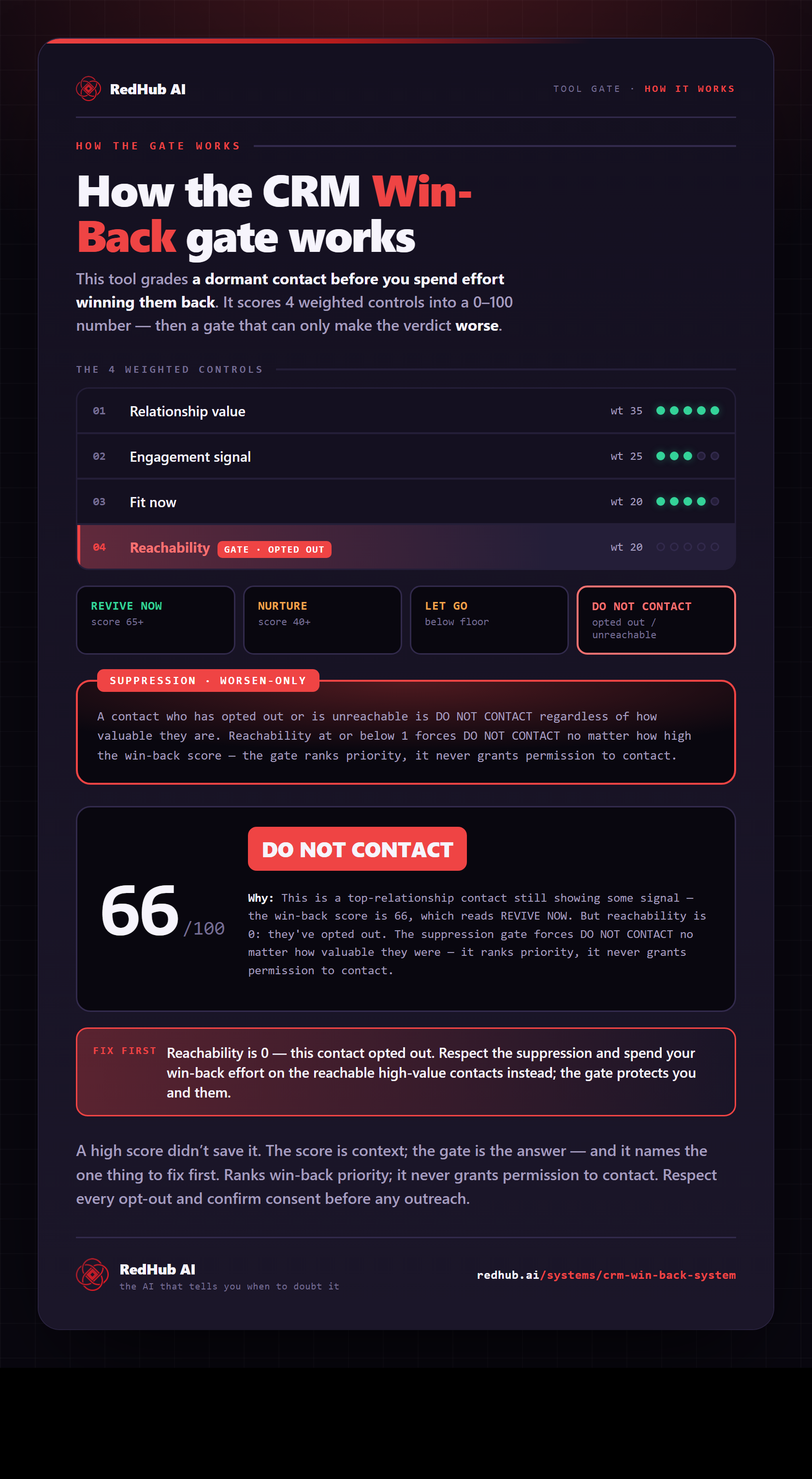
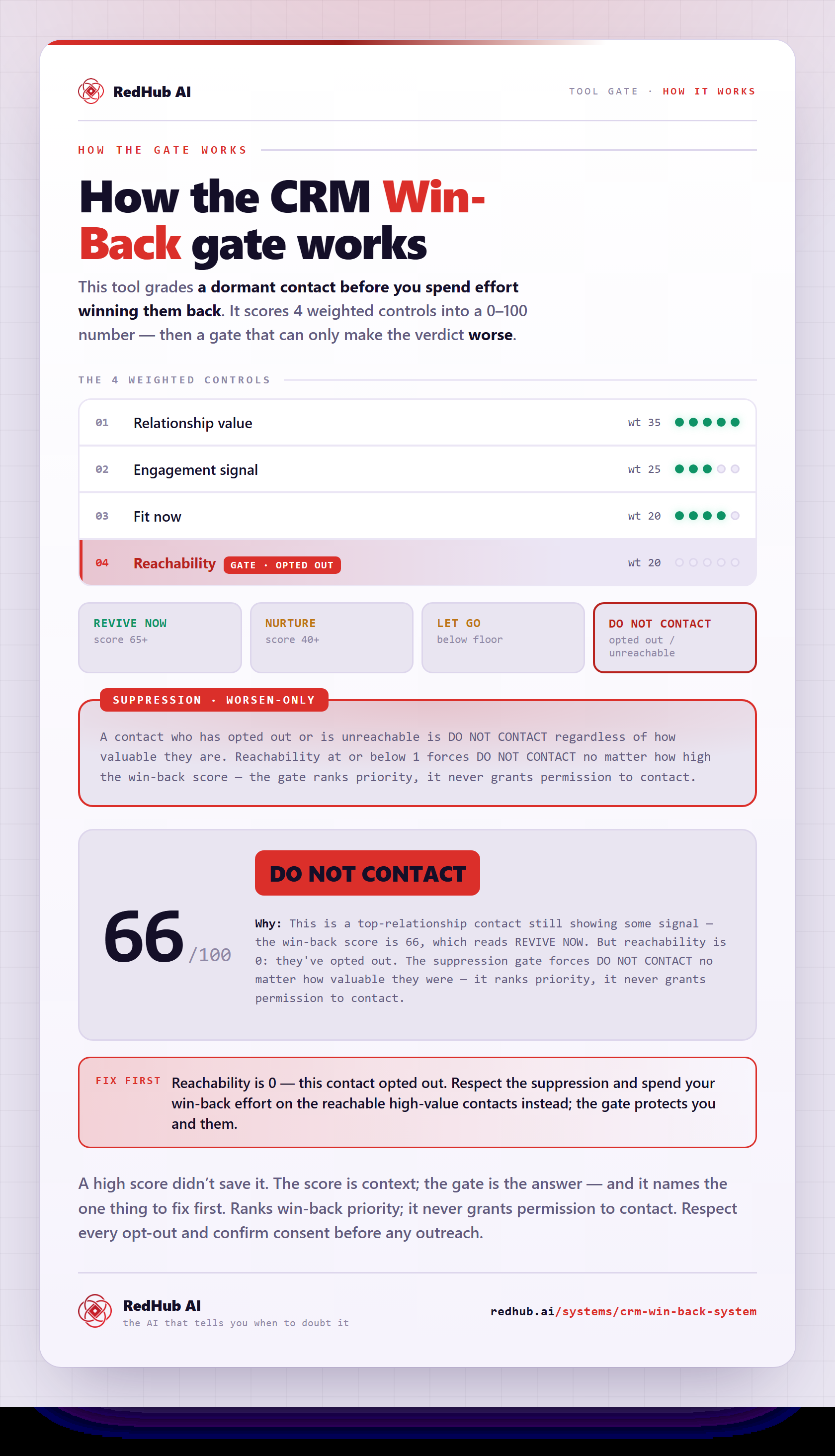
The gate this post refers to, drawn from the tool’s own logic. See the tool.