Customer Re-Engagement: A Practical Playbook
RedHub AI Editorialupdated August 18, 20263 min read

Jump to a section7
TL;DR
- What it is: a sequence of touches that gives a lapsed customer a real reason to come back.
- Who it's for: teams whose "check-in" emails get ignored — see how to win back customers.
- How it works: lead with a reason, escalate the hook over a few touches, and stop when they're clearly gone.
- Bottom line: re-engagement fails when it's a "just checking in." It works when every touch gives the customer something.
What is customer re-engagement?
Customer re-engagement is the deliberate sequence of messages you send to bring a lapsed or dormant customer back into an active relationship. It's not a single "we miss you" email — it's a short series of touches, each leading with a reason the customer actually cares about: something new, a relevant offer, or an honest question about why they left. The difference between re-engagement that works and the kind that gets ignored is simple: every touch has to give, not just ask.
Best for: reviving a warm list the right way. The CRM Win-Back System builds the sequence for you.
"Just checking in!" is where most re-engagement dies. It gives the customer nothing to respond to, so they don't. Good re-engagement is a planned sequence where each message carries a real reason to come back. Here's the playbook, and the consent rule that has to sit underneath it.
Why "just checking in" fails
A check-in puts the work on the customer — they have to remember you, decide they care, and act, all with no prompt. People don't. A re-engagement touch has to do the opposite: hand them a reason. Something changed since they left, there's an offer that fits them, you have an honest question about their experience. Give first, and you earn a reply; ask for attention with nothing in return, and you get silence.
The re-engagement sequence
- The reason touch. Lead with what's new or what changed — the single most relevant thing that might pull them back. Not "we miss you," but "here's what's different now."
- The value touch. If no response, follow with something useful on its own — an insight, a resource, a relevant win — so even a non-buyer gets something.
- The honest-ask touch. Ask directly and humanly: "Did we drop the ball, or is the timing just off?" Honest questions get honest answers, and sometimes re-open the door.
- The clean close. If they're still quiet, say you'll stop reaching out — and mean it. A respectful last touch sometimes re-engages, and always protects the relationship.
Escalate the reason, not the pressure. Each touch should offer a better reason to return, never more guilt or urgency. Pressure re-engages no one and burns the goodwill you're trying to rebuild.
Re-engaging isn't permission to spam. Before you re-contact anyone, honor unsubscribes and the rules that apply — CAN-SPAM for email, Do-Not-Call and the TCPA for calls and texts. A dormant contact is not an opted-out one; re-touch the people you may legally reach, and skip the ones who told you to stop. This is general guidance, not legal advice.
Where re-engagement fits
Re-engagement is the middle move of the win-back motion — after you've scored who's worth reaching and before you convert them back. The CRM Win-Back System ships the sequences so you're not writing four touches from scratch, and the Customer Retention Bundle helps keep the ones you win back from lapsing again.
A re-engagement sequence that gives, not nags
The touches written for you — reason, value, honest ask, clean close — the way re-engagement actually works.
Get the CRM Win-Back System — $149 →Re-engagement is one move in the motion. See the whole thing in the win-back guide.
Decision Guide
Run a sequence if: your one-off "check-in" emails get ignored — a planned series with real reasons does better.
Rework it if: your touches ask more than they give — flip every one to lead with a reason.
Best first step: write the "reason touch" — the single most relevant thing that changed since they left.
Common Questions
What is customer re-engagement?
A deliberate sequence of touches that brings a lapsed customer back — each leading with a real reason to return, not a bare "we miss you."
Why do re-engagement emails get ignored?
Because "just checking in" gives the customer nothing to act on. Touches that hand over a reason — news, an offer, an honest question — earn replies.
How many touches should a sequence have?
A short series — commonly a reason touch, a value touch, an honest ask, and a clean close. Escalate the reason each time, never the pressure.
Is re-engagement pushy?
It shouldn't be. Each touch offers a better reason to return, not more guilt. Pressure burns the goodwill you're trying to rebuild.
Can I re-engage anyone who went quiet?
Only those you may still legally reach. Honor unsubscribes, CAN-SPAM, and Do-Not-Call/TCPA — dormant is not opted-out.
What if they don't respond at all?
Send a respectful clean close and stop. It sometimes re-engages, and it always protects the relationship for later.
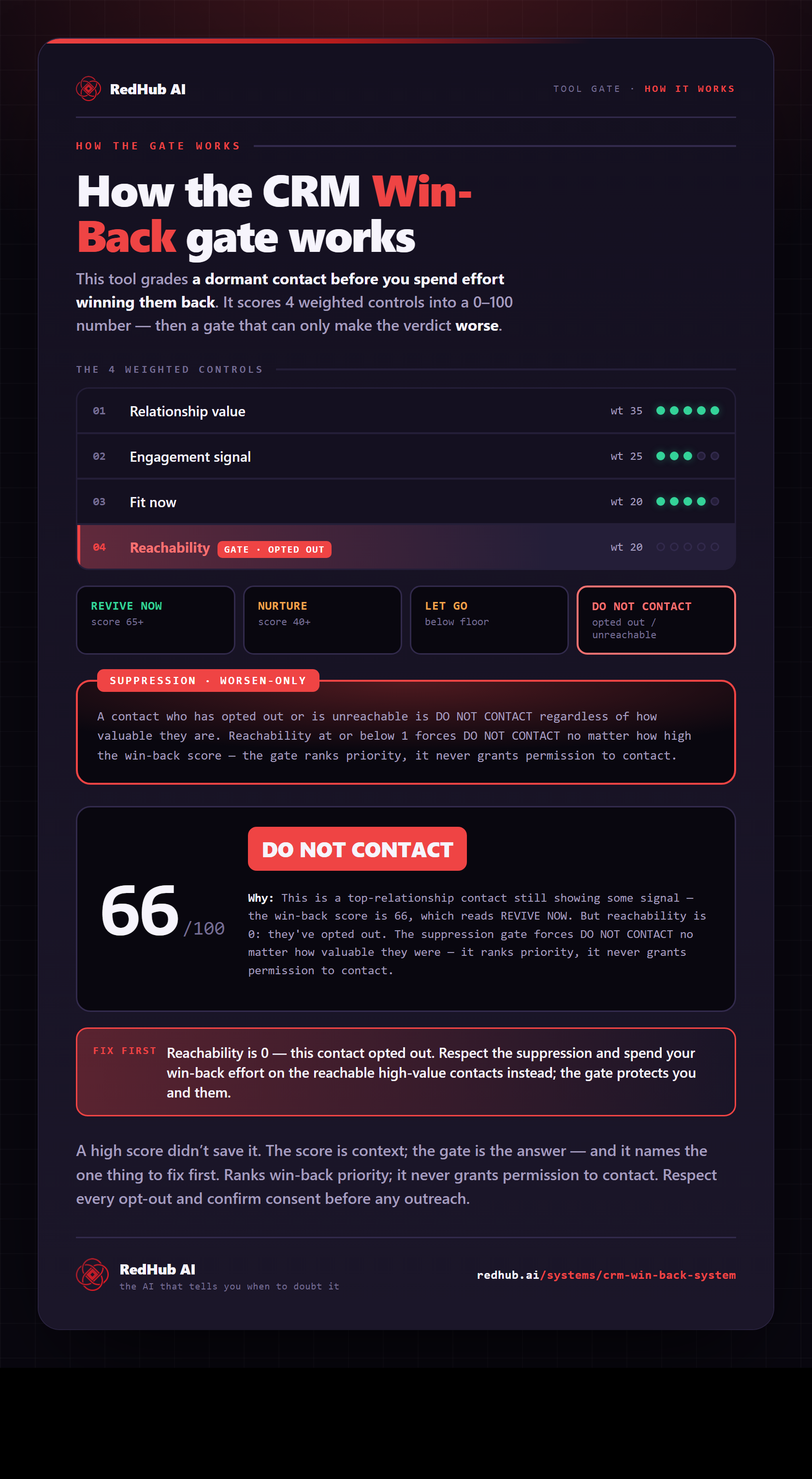
The gate this post refers to, drawn from the tool’s own logic. See the tool.