Customer Onboarding: The Activation Playbook
RedHub AI Editorialupdated August 17, 20268 min read

Jump to a section12
- TL;DR
- What is customer onboarding?
- Why most customer onboarding fails
- Start with the activation milestone
- The six sequences of a complete onboarding system
- The first 30 days are the whole game
- The standard: helpful, honest, never naggy
- SaaS, services, and everything between
- When customers leave anyway
- Where to go deeper
- Decision Guide
- FAQ
TL;DR
- What it is: Customer onboarding is the sequence of messages and moments that takes a new customer from signup to first real value.
- Who it's for: Founders, customer success leads, and lifecycle marketers who paid to win a customer and want to keep them — browse RedHub Systems.
- How it works: Define your activation milestone first, then build six sequences that move every new customer toward it — helpfully, never naggily.
- Bottom line: Onboarding isn't marketing. It's profit protection. You already spent the money to win this customer; onboarding decides whether that spend pays back.
What is customer onboarding?
Customer onboarding is the structured set of emails, in-app messages, and touchpoints that guides a new customer from signup to the first moment of real value — the point where the product has actually paid off for them. Good onboarding is built around one defined activation milestone, not around email opens. It removes obstacles between the customer and that milestone, and it does it helpfully: each message earns its place by helping the customer succeed, not by nagging them back into the app.
Best for: teams losing new customers in the first weeks — see the Customer Onboarding Sequence Kit ($69).
Here's the reframe that changes how you budget for customer onboarding: it's not a marketing task. It's profit protection. Every new customer arrived with an acquisition cost attached — ad spend, sales time, content, referral rewards. That money is already gone. Whether it comes back depends almost entirely on what happens in the first days and weeks after signup.
When a new customer signs up and then drifts away before getting value, you don't just lose future revenue. You lose the acquisition spend that won them, and you cap the lifetime value of every cohort you bring in. And it happens silently — no complaint, no cancellation call. Just a login that never comes.
This guide is the activation playbook: what onboarding is actually for, why most sequences fail, and how to build one that moves customers to value instead of chasing opens.
Why most customer onboarding fails
Most onboarding sequences are a drip of emails written before anyone defined what success looks like. Welcome email, feature tour, "did you know?" tips, a discount nudge. Each one is measured on opens and clicks — vanity metrics that can look healthy while the customer quietly never activates.
The root problem is simple: you can't move a customer to a destination you haven't named. If nobody on the team can answer "what exact moment counts as this customer being activated?", every message in the sequence is aimed at nothing in particular. It fills the inbox. It doesn't change the outcome.
Key insight: an onboarding email that gets opened but doesn't move the customer closer to first value didn't work. It just looked like it worked. Opens are the easiest metric to improve and the least connected to whether the customer stays.
Start with the activation milestone
Before writing a single message, define your activation milestone: the earliest moment where a customer gets real value from your product — the "aha" that makes staying feel obvious. For a scheduling tool, it might be the first booked meeting. For an analytics product, the first report shared with a teammate. For a service business, the first delivered result.
Everything downstream anchors to that milestone. Every message either removes an obstacle between the customer and the milestone, or it doesn't belong in the sequence. We go deep on finding and measuring your milestone in customer activation: opens are not the goal, value is.
The six sequences of a complete onboarding system
One drip campaign isn't onboarding. A complete system covers the whole early-customer journey with six distinct sequences, each doing one job:
| Sequence | Job | Fires when |
|---|---|---|
| Welcome | Set expectations and point at the first win | Immediately at signup |
| Activation | Guide the customer to first real value — the core sequence | Days 1–14, obstacle by obstacle |
| Adoption & habit | Turn one win into a routine | After activation |
| Stall-recovery | Catch customers who went quiet before value | On inactivity, not a calendar date |
| Expansion & renewal | Grow the account once value is real | After sustained adoption |
| Milestone messages | Celebrate real wins as they happen | When the customer hits a milestone |
The sequences compose. Welcome hands off to activation. Activation hands off to adoption. Stall-recovery catches anyone who fell out of the flow. The full message-by-message build — cadence, channels, and what each touch says — is in the customer onboarding email sequence that drives activation.
Those are how the Customer Onboarding Sequence Kit is built — six sequence types, one milestone-first method, three ways to run it — not performance claims. The kit writes the sequences; your product and your follow-through decide the results.
The first 30 days are the whole game
Early churn — customers who leave in the first month or two — is the most expensive kind, because you paid full acquisition cost and collected almost nothing back. How much is at stake varies by business, and any specific figure you see quoted is an estimate, not a law. But the shape of the problem is consistent: a leaky first month can quietly forfeit a meaningful share of the lifetime revenue each new cohort would otherwise produce, and it caps growth no matter how good your acquisition gets.
The defense is built into the sequence design: a welcome that points at a concrete first win, an activation sequence that clears obstacles one at a time, and a stall-recovery sequence that notices silence early. We break the whole early-churn defense down — including a calculator for your own numbers — in reduce early churn: the first 30 days decide.
The standard: helpful, honest, never naggy
There's a version of onboarding that "works" on the dashboard and burns the customer: daily nudges, fake urgency, feature claims the product can't quite back up. It juices short-term numbers and creates disappointed customers who churn anyway — with a worse opinion of you than if you'd said nothing.
The honest standard has three rules:
- Every touch earns its place. Each message helps the customer take one concrete step toward value. If a message exists only to re-open the app, cut it.
- Ground every claim in the real product. Never invent features or oversell outcomes to juice activation. Oversold onboarding creates churn with extra steps.
- Respect the customer's pace. Trigger on behavior, not just the calendar. A customer who activated on day two doesn't need the day-five "getting started" email.
Build all six sequences this week
The Customer Onboarding Sequence Kit ($69, one-time) ships a master onboarding prompt, focused prompts, templates and cadences for all six sequence types, an installable Claude skill, and a worked example. It makes you define your activation milestone first — then builds every message toward it. Runs in whatever tool you already use: Klaviyo, HubSpot, Customer.io, Mailchimp, in-app, SMS.
Get the Onboarding Sequence Kit — $69 →SaaS, services, and everything between
The milestone-first method applies beyond software. A SaaS product onboards toward a first in-product win; a service or agency onboards toward a first delivered result. The sequencing logic is the same — define value, remove obstacles, respect pace — but the practices differ enough that we cover software separately in SaaS onboarding best practices that respect the customer. If your business onboards clients rather than users — agencies, consultants, service firms — the Client-Onboarding Runway ($129) is built for that lane.
When customers leave anyway
No onboarding sequence retains everyone, and pretending otherwise is how teams stop learning. When customers churn, run the loss like an investigation: the Customer Churn Autopsy Kit ($69) turns cancellations into pattern-level findings you can feed back into onboarding. For customers who went quiet months ago, the CRM Win-Back System ($149) works the re-engagement side. If you want the full lifecycle covered in one purchase, the Customer Retention Bundle ($225) packages the retention line together.
Where to go deeper
This pillar is the map. Each stage of the onboarding lane has its own guide:
- Customer onboarding email sequence — the six-part build, message by message.
- Reduce early churn — why the first 30 days decide, plus a cost estimator.
- Customer activation — defining and measuring the milestone that matters.
- SaaS onboarding best practices — the software-specific playbook.
Decision Guide
Invest in customer onboarding if: you're paying real money to acquire customers and a visible share of them never reach first value.
Deprioritize it if: you're pre-launch or your product delivers its value in the first session with no follow-through required.
Best first step: write down your activation milestone in one sentence. If the team can't agree on it, that disagreement is the first thing to fix — before any email gets written.
FAQ
What is customer onboarding?
The structured messages and moments that take a new customer from signup to first real value. Done well, it's anchored to one defined activation milestone and built to remove obstacles, not to farm email opens.
Why is onboarding "profit protection" and not marketing?
Because the acquisition cost is already spent. Onboarding doesn't win new revenue — it decides whether the revenue you already paid to win actually stays. A leaky first month silently caps the lifetime value of every cohort.
How many emails should an onboarding sequence have?
There's no magic count. The right number is however many touches it takes to remove the real obstacles between signup and activation — and no more. Every message should earn its place; padding a sequence to hit a number is how nagging starts.
What is an activation milestone?
The earliest moment a customer gets real value from your product — the point that predicts they'll stay. Defining it is the first step of onboarding design, because every message should move the customer toward it.
Does onboarding guarantee lower churn?
No, and be wary of anyone who promises that. Onboarding removes the obstacles your messaging can remove; product quality, fit, and support do the rest. What a good sequence does guarantee is that customers don't drift away simply because nobody guided them to value.
What channels should onboarding use?
Usually a mix. Email carries the narrative, in-app messages catch the customer at the moment of action, and SMS works for time-sensitive nudges where the customer opted in. Build for the channels your customers actually live in.
Which RedHub tool should I start with?
The Customer Onboarding Sequence Kit ($69) — it builds all six sequences from your product facts and activation milestone. If customers are already churning, pair it with the Customer Churn Autopsy Kit ($69) to learn why.
Stop losing customers you already paid for
Six onboarding sequences — welcome, activation, adoption, stall-recovery, expansion, milestones — built with Claude from your real product and your real activation milestone. Helpful and honest by design: no invented features, no naggy pressure. One-time $69, yours to keep, 30-day guarantee.
Get the Customer Onboarding Sequence Kit — $69 →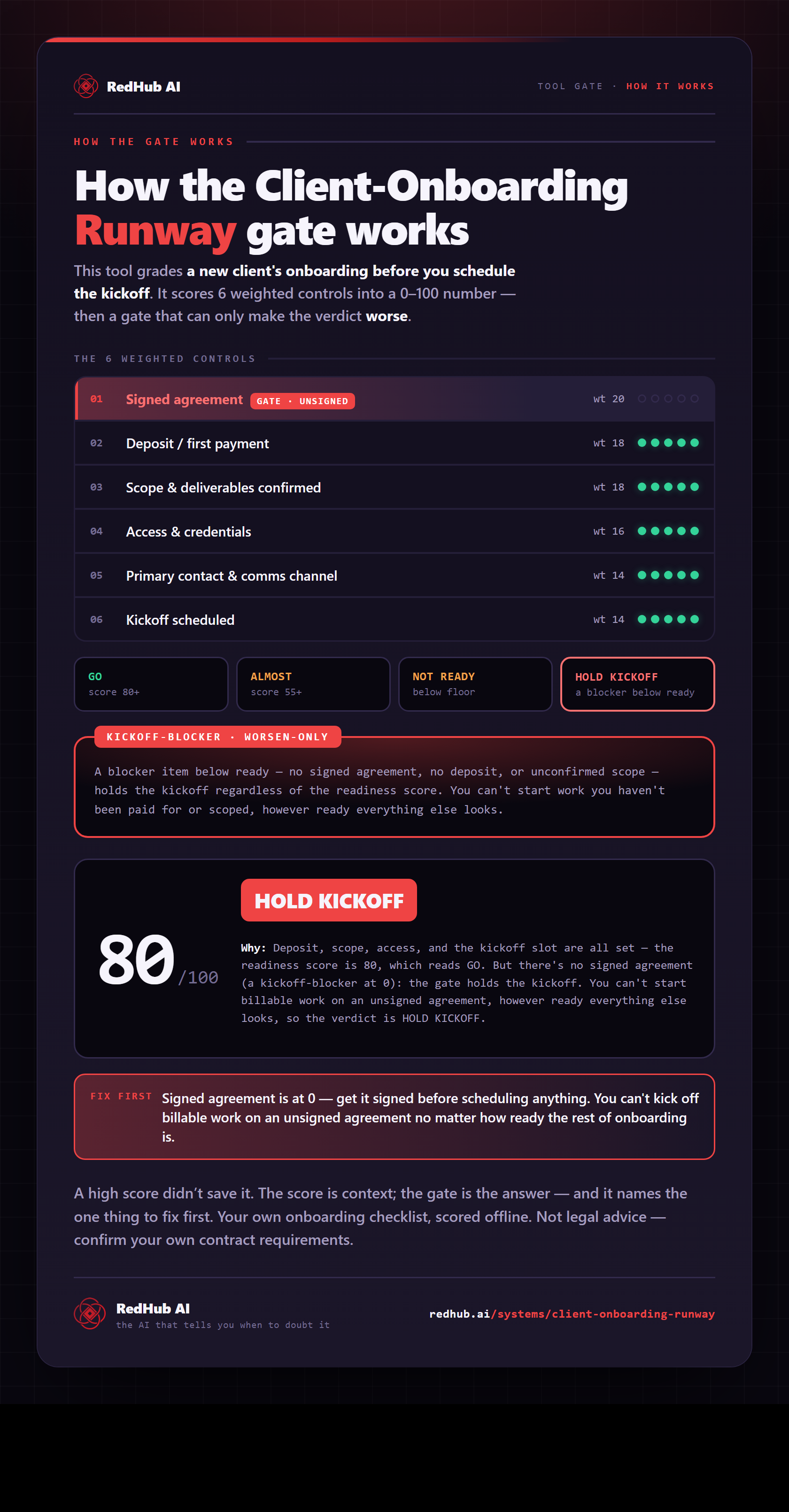
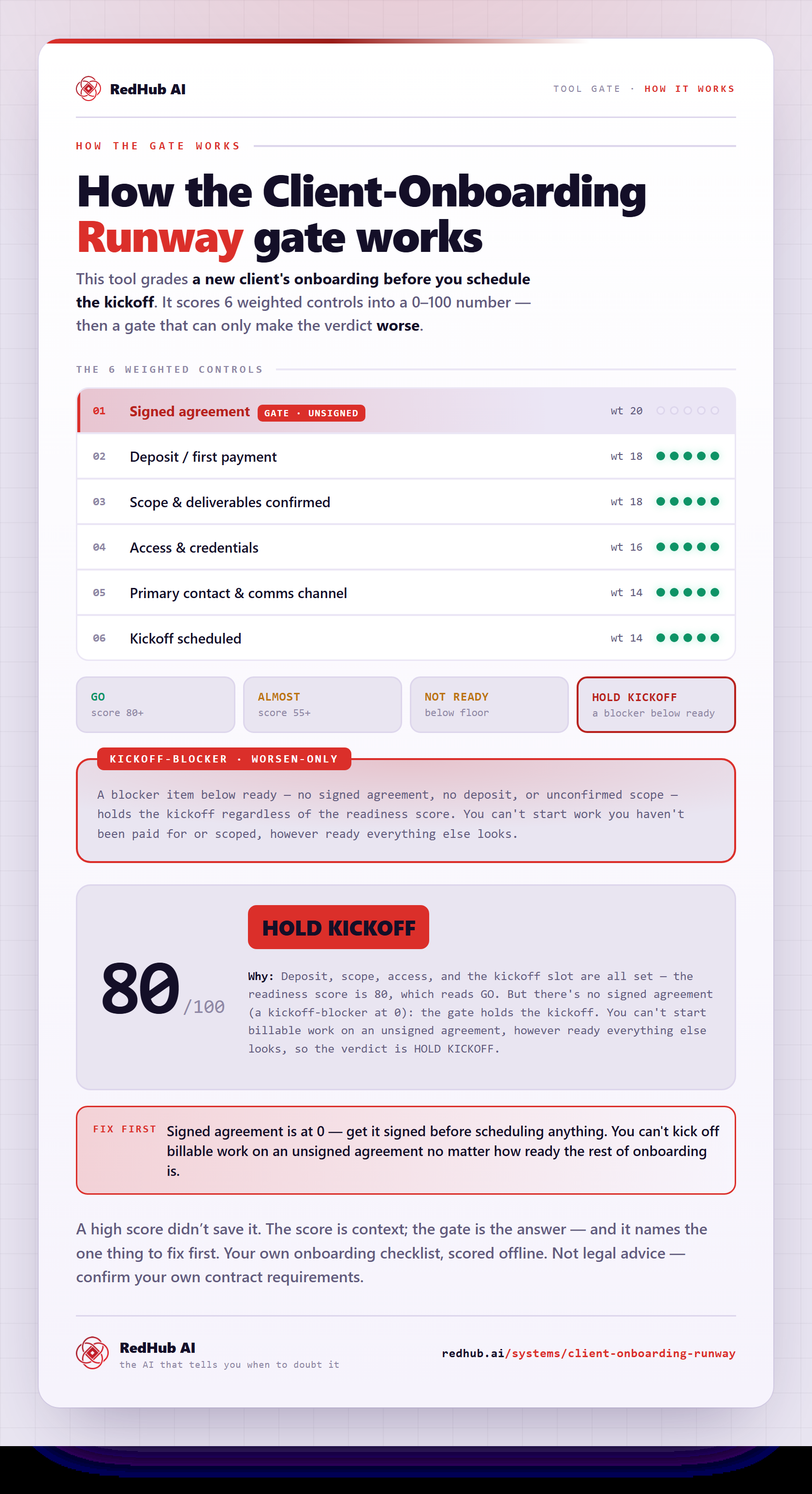
The gate this post refers to, drawn from the tool’s own logic. See the tool.