Is DeepSeek V4.1 Flash Safe for Business Data?
Todd Brooks, Founder6 min read

Jump to a section10
TL;DR
- The hosted API: DeepSeek's privacy policy says it collects, processes and stores personal data in the People's Republic of China.
- The open weights: V4.1 Flash is MIT-licensed, so you can run it on hardware you control, and your data never goes to DeepSeek's service. It's a data-center job, not a laptop one.
- The September 14 change: from 12:00 Beijing time on September 14, 2026, until V4.1 Pro is released, requests to deepseek-v4-pro are served by V4.1 Flash, with no code change on your side.
- What to do: decide which data may go where before anyone sends any, and write it down. The AI Vendor & Sub-Processor Data-Flow Register is built for that.
Is DeepSeek V4.1 Flash safe for business data?
It depends on how you run it and what you send. DeepSeek's privacy policy says it collects, processes and stores personal data in the People's Republic of China. The policy also says it doesn't cover personal data from end users of apps that developers build on DeepSeek's open platform, so if you call the API from your own product, read the platform terms too. The model's weights are released under the MIT license, which lets you run it on hardware you control instead. Decide which kinds of data may go to which setup before anyone on your team sends any.
Best for: owners and ops leads whose team is already asking to try V4.1 Flash on real work. This is not legal advice.
Every cheap model launch creates the same moment in a small company. Someone on the team reads the price, pastes a customer spreadsheet into the new model to see how good it is, and nobody asks where the spreadsheet went.
With DeepSeek V4.1 Flash, that question has a written answer, and it's worth reading before the price does your thinking. This guide is part of DeepSeek V4.1 Flash changes the economics of AI agents.
What DeepSeek's policy says, in its own words
From DeepSeek's privacy policy (opens in a new tab), last updated February 10, 2026:
"To provide you with our services, we directly collect, process and store your Personal Data in People's Republic of China."
Two more points from the same policy are worth knowing. It lists a right to opt out of your personal data being used for training its models. And it says it doesn't cover end users of apps that developers build on DeepSeek's open platform. If you're calling the API from your own product, read DeepSeek's platform terms as well as the privacy policy, because the policy alone isn't the whole picture.
I'm not a lawyer, and nothing here is legal advice. If your contracts, your customers or your industry limit where data can go, ask your counsel before anything goes to this API.
Three ways to run it, three different data answers
| How you run it | Who sees your data | What to check |
|---|---|---|
| DeepSeek's own API | DeepSeek, which says it stores personal data in China | The privacy policy, the platform terms and the training opt-out |
| A third-party host | That host, under its own terms | Which provider serves the request, where it runs, and whether it keeps your data |
| Your own hardware | You, and whoever runs your servers | Whether you can afford to host a 552-billion-parameter model |
The third-party route needs one caution. OpenRouter (opens in a new tab) lists several providers for V4.1 Flash, DeepSeek among them, and which one serves a request can vary. Check which provider served each request before you assume your data went somewhere other than DeepSeek.
Self-hosting keeps your data in your hands, and the MIT license allows it. But all 552 billion parameters have to be loaded even though only 8 to 16 billion are active at a time. Plan on data-center hardware or a hosting partner, not a spare workstation.
The September 14 swap
DeepSeek's changelog (opens in a new tab) says that after 12:00 Beijing time on September 14, 2026, and until V4.1 Pro is released, every request to deepseek-v4-pro will be served by V4.1 Flash and billed at V4.1 Flash prices. The deepseek-v4-flash name is already temporarily routed to V4.1 Flash. DeepSeek says V4.1 Flash is ahead of V4 Pro on performance, speed and cost.
Your code doesn't change. Your model does. That's cheaper, and for most teams it's probably fine. But "probably fine" is not how you want to find out that a customer-facing workflow is answering differently.
Four questions before any data goes
- What kinds of data will this touch? Customer names, payment details, health or employee records, contracts. Write the list.
- Where will each kind be processed? DeepSeek's API, a named third-party host, or your own servers. One answer per kind of data.
- What happens to it afterward? Whether it's kept, for how long, and whether it can be used for training. Check whether DeepSeek's training opt-out covers how you use it.
- Who owns this decision, and when do they look again? A name and a review date, because the terms and the routing can change without you touching anything.
If an answer is "we don't know," that data type doesn't go yet. Test with made-up or public data first. It tells you just as much about the model's quality and nothing about your customers.
What I won't tell you
I'm not going to tell you V4.1 Flash is "safe" or "unsafe" for your business. That depends on what data you'd send, where your customers are, and what your contracts say. Nobody writing launch-day coverage knows those things about you. What I can say is that the question has to be answered in writing, by someone with the authority to say no, before the first real record goes anywhere.
Write down where your data goes
The AI Vendor & Sub-Processor Data-Flow Register ($89, one-time) keeps a register of the data flows between your business and the vendors and AI tools that touch your data, and grades each flow DOCUMENTED, GAP or UNVETTED. It's built for anyone who just added an LLM API and isn't sure it's governed. It isn't legal advice or a compliance certification.
Get the Register — $89 →Decision Guide
Start here if: someone on your team wants to try V4.1 Flash on real company or customer data.
Skip it if: you're only testing with public or made-up data and nothing else will go through it.
Best first step: list the kinds of data the first workflow would touch, and pick one setup for each.
More in this guide
FAQ
What does DeepSeek's privacy policy say about where it stores data?
DeepSeek's privacy policy, last updated February 10, 2026, says it collects, processes and stores personal data in the People's Republic of China. It also says it doesn't cover personal data from end users of apps developers build on its open platform, so read the platform terms too if you call the API from your own product.
Can I run DeepSeek V4.1 Flash without sending data to DeepSeek?
Yes. The weights are MIT-licensed on Hugging Face, so you can run the model on hardware you control or through a host you choose. It's a 552-billion-parameter model, so plan for data-center hardware.
Does DeepSeek use my data for training?
Its privacy policy lists a right to opt out of personal data being used to train its models. Check the current opt-out process before you send real data.
What happens to deepseek-v4-pro on September 14?
DeepSeek's changelog says that after 12:00 Beijing time on September 14, 2026, requests to deepseek-v4-pro are served by V4.1 Flash and billed at V4.1 Flash prices until V4.1 Pro is released.
Is this legal advice?
No. It describes what DeepSeek's own documents say. Which kinds of data should go to which service is a question for your counsel, with your contracts and customers in front of them.
Every AI data flow, graded
A register of who touches your data, with a verdict per flow. $89, offline, nothing uploaded.
Get the AI Vendor & Sub-Processor Data-Flow Register — $89 →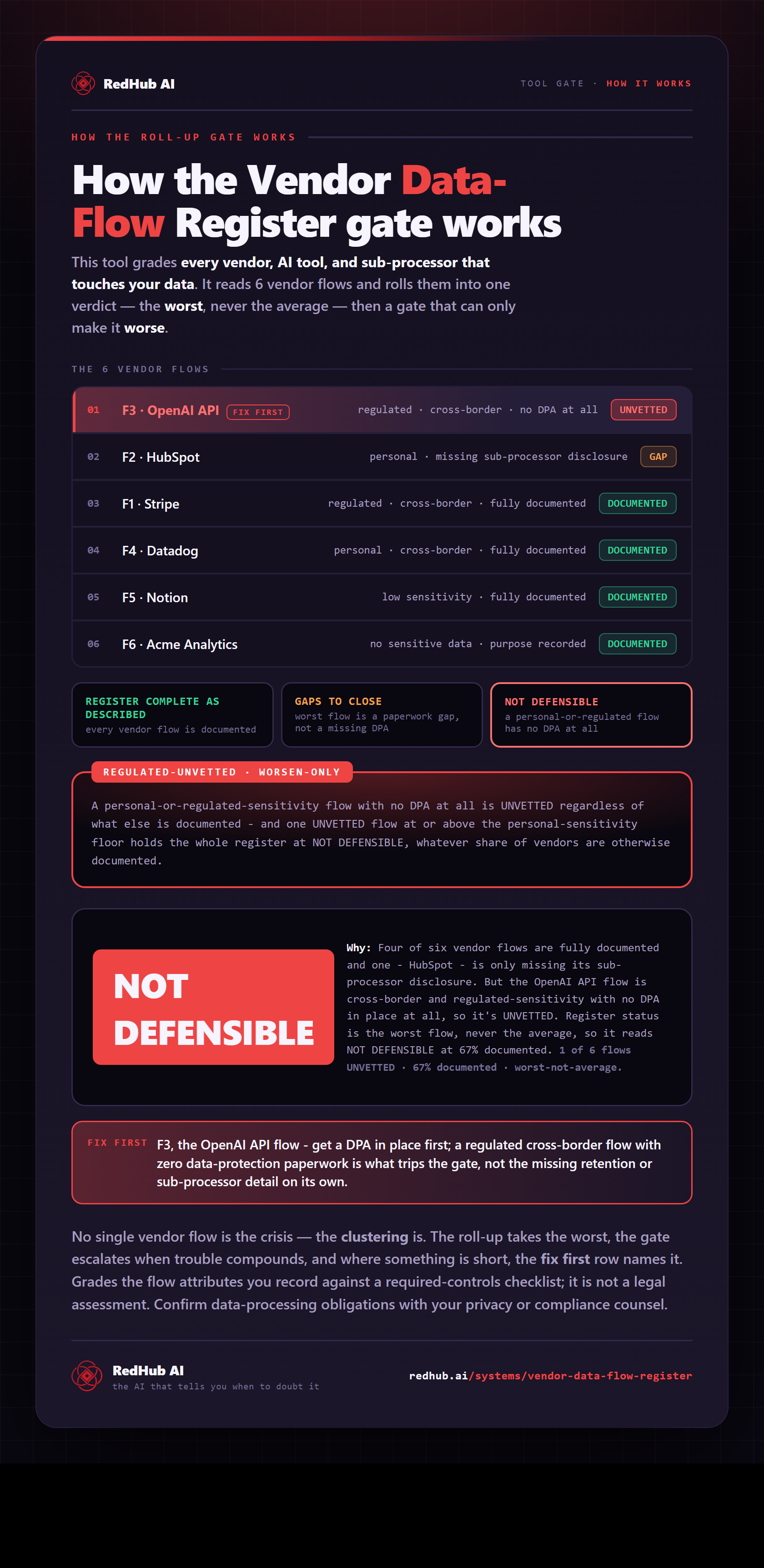
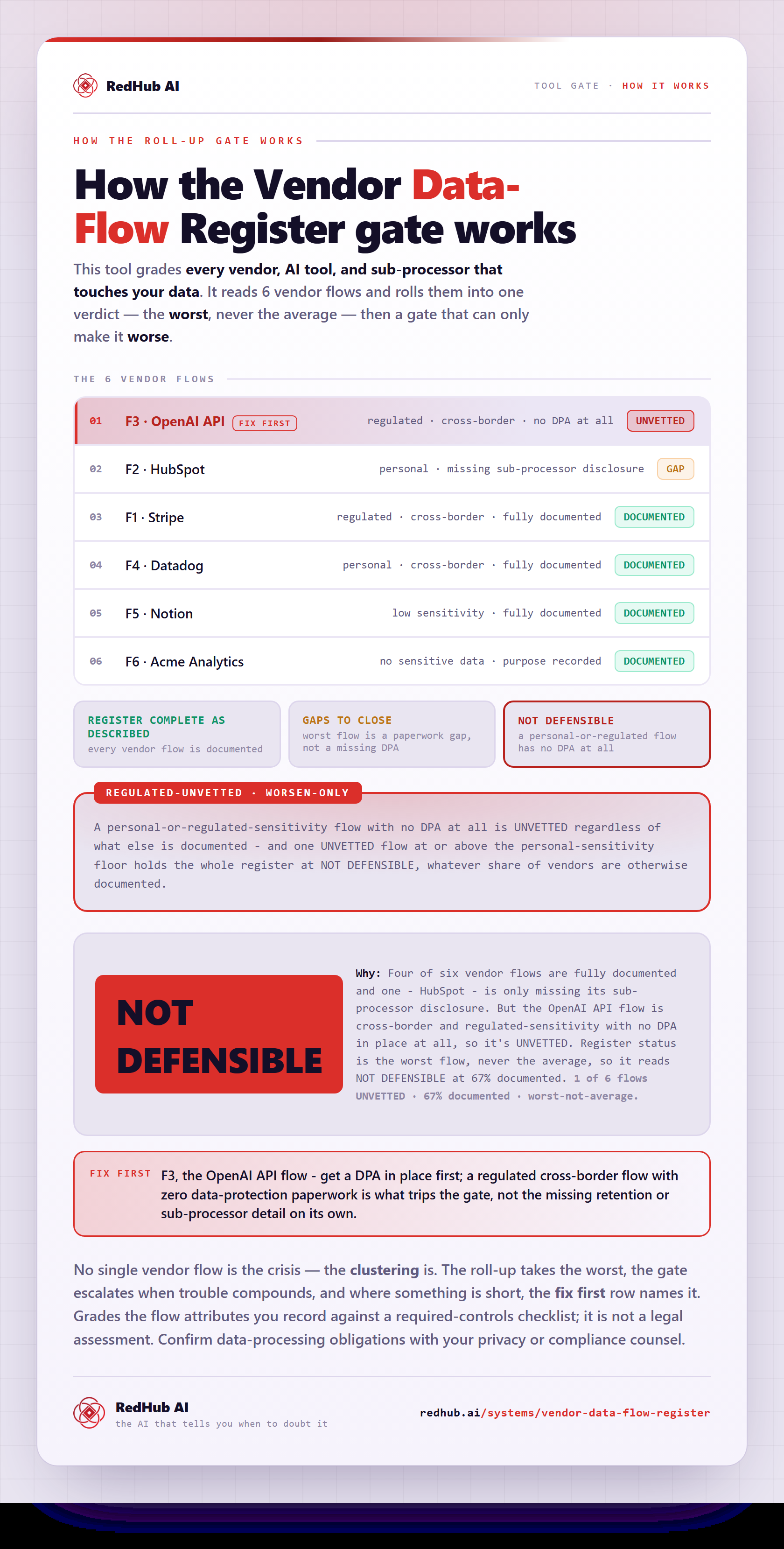
The gate this post refers to, drawn from the tool’s own logic. See the tool.