DeepSeek V4.1 Flash Changes the Economics of AI Agents
Todd Brooks, Founder10 min read

Jump to a section12
- TL;DR
- What is DeepSeek V4.1 Flash?
- What DeepSeek shipped
- Why it's cheap: the memory bill agents pay
- The benchmark story, told straight
- The price, and the hour it applies
- The catch: the token bill isn't the task bill
- What cheap agents make worth running
- The market was already heading here
- What I'd do this week
- What this guide won't tell you
- Decision Guide
TL;DR
- What it is: DeepSeek V4.1 Flash is a 552B-parameter mixture-of-experts model released September 10, 2026, with a 1M-token context window, image input and MIT-licensed open weights.
- What changed: Off-peak API pricing is $0.15 per million input tokens and $0.60 per million output tokens, and the whole US workday falls inside DeepSeek's off-peak hours.
- The honest read: DeepSeek's own benchmarks put it level with Opus 5 on several agent tests and well behind it on the newest, hardest ones.
- What to do: Price your work per finished task, not per token, before you move anything. The AI Unit-Economics & Token-Shock Exposure Kit computes cost per outcome from your own numbers, and its Model Swap tab prices a cheaper model per finished task, the cost of fixing misses included.
What is DeepSeek V4.1 Flash?
DeepSeek V4.1 Flash is the smallest model in DeepSeek's new Causal Encoder-Decoder family, released September 10, 2026. It holds 552 billion parameters but activates 8 billion while reading input and 16 billion while writing output, which is why it's cheap to run. It takes text and images, reads up to 1 million tokens at once, and costs $0.15 per million input tokens and $0.60 per million output tokens during off-peak hours.
Best for: high-volume agent work where a wrong step is cheap to catch and retry. Not for, on any model: anything where a wrong answer reaches a customer before a person sees it.
The easy headline for this launch is a benchmark. DeepSeek V4.1 Flash scored 74.2 on DeepSWE. Opus 5 scored 74.0. That number is real, and it's the least useful thing about the release.
I read DeepSeek's model card, its pricing page and its changelog before writing this. The part that should change how you plan isn't a two-tenths lead on one test. It's that capable agent work now costs little enough to run all day, in parallel, without anyone deciding each run is worth it.
That shift is bigger than a leaderboard. It also comes with a catch the leaderboard hides, and the catch is where your money goes.
What DeepSeek shipped
| Spec | DeepSeek V4.1 Flash |
|---|---|
| Architecture | Mixture-of-experts, new Causal Encoder-Decoder design |
| Total parameters | 552B |
| Active while reading input | 8B |
| Active while writing output | 16B |
| Context window | Up to 1M tokens, 384K max output |
| Input types | Text and images |
| Reasoning effort | Adjustable from 1 to 100 |
| License | MIT, open weights on Hugging Face |
| API model name | deepseek-flash |
| Off-peak price per 1M tokens | $0.15 input, $0.60 output, $0.003 cached input |
From DeepSeek's announcement (opens in a new tab), model card (opens in a new tab) and pricing page (opens in a new tab), as of September 10, 2026. AI prices move fast. Check the pricing page before you budget.
Why it's cheap: the memory bill agents pay
An agent doesn't answer once. It works in a loop: read the instructions, call a tool, read the result, decide, call the next tool. Every turn, it carries everything that came before it. The earlier steps, the documents, the tool output. A model holds that running context in a working memory called the KV cache, and on long jobs that memory is a big part of what each turn costs to serve.
DeepSeek went after that memory directly. Its model card puts V4.1 Flash at 890 bytes of cache per token. That's about four times smaller than V4 Flash and about 437 times smaller than DeepSeek's first model. Add the fact that only 8 to 16 billion parameters do work at any moment, and every extra turn of an agent loop gets much cheaper to serve.
That's why I care more about the design than the price tag. A low price that comes from how the model runs is a different thing from a launch promotion. One of the rates I compare against below is a promotion.
The benchmark story, told straight
DeepSeek published a table of 19 benchmarks against Opus 5, GPT-5.6 Sol and several other models. Read the whole table and a pattern shows up that the headline number hides.
| Benchmark | V4.1 Flash | Opus 5 | GPT-5.6 Sol |
|---|---|---|---|
| DeepSWE v1.1 | 74.2 | 74.0 | 73.0 |
| Terminal-Bench 2.1 | 90.6 | 89.1 | 88.8 |
| Terminal-Bench 3.0 | 30.0 | 43.3 | 34.4 |
| Terminal-Bench 4.0 | 31.2 | 51.8 | 39.9 |
| AutomationBench | 54.8 | 50.3 | 45.8 |
| Agent's Last Exam | 31.8 | 28.6 | 26.7 |
| NL2Repo-Bench | 64.0 | 75.3 | 56.8 |
| HLE, no tools | 36.8 | 56.3 | 44.5 |
DeepSeek's own published figures, not independent tests. Every V4.1 Flash score was run at maximum reasoning effort. All 19 rows are in DeepSeek V4.1 Flash vs Opus 5.
V4.1 Flash wins the older Terminal-Bench 2.1 and loses the newer 3.0 and 4.0 by 13 and 21 points. It wins AutomationBench and Agent's Last Exam. It trails Opus 5 on whole-repository coding and loses the hardest reasoning test by nearly 20 points.
My read: V4.1 Flash has caught the frontier on the kinds of tasks the benchmarks have mostly figured out, and the frontier still leads where the tests are hardest. For a business, that's a routing map. It is not a verdict on which model is "better."
The price, and the hour it applies
Here's one agent workload priced five ways: 10 million input tokens and 1 million output tokens.
| Model | Per 1M tokens, in / out | This workload |
|---|---|---|
| DeepSeek V4.1 Flash, off-peak | $0.15 / $0.60 | $2.10 |
| DeepSeek V4.1 Flash, peak | $0.30 / $1.20 | $4.20 |
| Claude Sonnet 5 | $2 / $10 | $30 |
| GPT-5.6 Sol, promotional rate | $4 / $20 | $60 |
| Claude Opus 5 | $5 / $25 | $75 |
List prices from DeepSeek (opens in a new tab), Anthropic (opens in a new tab) and OpenAI (opens in a new tab) as of September 10, 2026, uncached input. OpenAI lists the Sol rate as promotional through at least November 21, 2026.
One detail almost everyone will miss. DeepSeek's peak hours run 01:00 to 04:00 and 06:00 to 10:00 UTC on weekdays. In Eastern time that's 9 p.m. to midnight and 2 a.m. to 6 a.m. The entire American business day is off-peak. If you're in the US, $2.10 is your daytime price.
The full breakdown, including cached input at $0.003 per million, is in DeepSeek V4.1 Flash pricing: what a task really costs.
The catch: the token bill isn't the task bill
Take one support ticket. The model reads 3,000 tokens and writes a 400-token triage note. On Opus 5 that costs $0.025. On V4.1 Flash off-peak it costs $0.00069. About 36 times cheaper per attempt.
Now add the part nobody prices. When the triage is wrong, a person catches it and spends three minutes fixing it. At $40 an hour, each miss costs $2.00. Say, purely to show the math, that Opus 5 gets 97 of 100 tickets right and V4.1 Flash gets 92.
| Per ticket | Opus 5 | V4.1 Flash |
|---|---|---|
| Token cost | $0.025 | $0.00069 |
| Misses per 100 | 3 | 8 |
| Review cost (misses × $2.00 ÷ 100) | $0.06 | $0.16 |
| Cost per finished ticket | $0.085 | $0.161 |
In this made-up case, the model that's 36 times cheaper per attempt costs almost twice as much per finished ticket. The success rates are invented. Yours will be different, and you can't know them without testing.
Flip one assumption and the answer flips. If a bad output gets caught by an automatic check and retried at no labor cost, the cost of each success is just token cost divided by success rate. That's $0.026 for Opus 5 and $0.00075 for V4.1 Flash. Now the cheap model wins by about 34 times.
What cheap agents make worth running
Where a failure is cheap to catch, low prices change which work is worth doing at all. Jobs nobody would pay Opus 5 rates to run around the clock start to cost pocket change:
- Rescoring every open deal every night, not once a month.
- Reading every support ticket for the complaint pattern, not a sample.
- Checking every invoice line against the purchase order instead of spot-checking.
- Running a second agent whose only job is to critique the first.
That last one matters most. Cheap intelligence doesn't mean fewer controls. It means you can afford more of them. A checker agent that doubles your token use costs almost nothing at $0.60 per million output tokens. The flip side is that a loop with no stop is also cheap to start and slow to notice, which I cover in always-on AI agents: cheap tokens still run away.
The market was already heading here
Ramp's September 2026 AI Index (opens in a new tab) says the effective price businesses pay per million tokens fell about 41% from its March peak, from $1.15 to $0.68. Frontier models' share of token use dropped from about 53% in early August to 45%. Median AI spend per employee among Ramp's top 1% of spenders fell nearly 10% in a single month, from about $7,976 a month in July to $7,205 in August. Ramp says companies are setting cheaper standard models as the default, calling them still highly performant and more cost-effective.
So V4.1 Flash lands in a market that had already started asking a different question. Less "who has the smartest model?" More "who gives me enough intelligence at the lowest cost per finished task?"
What I'd do this week
- Don't migrate anything yet. Launch-week benchmarks are the vendor's own numbers.
- Pick one workflow where a miss is cheap to catch. High volume, repeatable, low stakes.
- Run 100 real tasks on your current model and on V4.1 Flash. Count the misses by hand.
- Price each model per finished task. Token cost plus review time, not token cost alone.
- Read where your data goes before you send any. DeepSeek's privacy policy says it collects, processes and stores personal data in the People's Republic of China. See is DeepSeek V4.1 Flash safe for business data?
- Put a hard spend cap in place before it runs unattended. A notify-only budget alert is not a cap.
- Keep a person on anything that reaches a customer or moves money.
What this guide won't tell you
I'm not going to tell you V4.1 Flash is right for your business, and I'm not going to quote you a savings percentage. Nobody writing launch-day coverage has run it on your workflow, and a savings figure taken from someone else's tickets says nothing true about yours. What I can give you is the math to find out, and the four guides below walk through it.
Find your cost per finished task before you switch
The AI Unit-Economics & Token-Shock Exposure Kit ($59, one-time) computes the fully-loaded cost per outcome for each of your AI workflows, retries and expected growth included, from your own numbers. It grades each workflow PREDICTABLE, DRIFTING or TOKEN SHOCK, and it flags an uncapped contract before a busy month turns into an open-ended bill. Its Model Swap tab prices a cheaper model per finished task, the cost of fixing misses included, and won't recommend a switch without a pass rate you measured.
Get the Kit — $59 →Decision Guide
Start here if: you run AI on high-volume, repeatable work and your bill is growing faster than your results.
Skip it if: your AI use is a few chats a day. The savings round to nothing.
Best first step: pick one workflow, count misses on 100 real tasks for each model, and price the finished task.
More in this guide
FAQ
What is DeepSeek V4.1 Flash?
A mixture-of-experts model DeepSeek released on September 10, 2026. It has 552 billion parameters, activates 8 billion while reading and 16 billion while writing, takes text and images, and reads up to 1 million tokens of context. The API model name is deepseek-flash.
How much does DeepSeek V4.1 Flash cost?
As of September 10, 2026, off-peak API pricing is $0.15 per million input tokens, $0.60 per million output tokens and $0.003 per million cached input tokens. Peak rates are double. Peak runs 01:00 to 04:00 and 06:00 to 10:00 UTC on weekdays, which falls in the US evening and overnight.
Is DeepSeek V4.1 Flash better than Claude Opus 5?
Not across the board. DeepSeek's own table has it ahead of Opus 5 on DeepSWE, Terminal-Bench 2.1, AutomationBench and Agent's Last Exam, and behind on GPQA Diamond, Terminal-Bench 3.0 and 4.0, NL2Repo-Bench and HLE, among others. Those are the vendor's figures, not independent tests.
What is DeepSeek V4.1 Flash's context window?
Up to 1 million tokens of input, with a maximum output of 384,000 tokens, according to DeepSeek's pricing page.
Is DeepSeek V4.1 Flash open source?
Its weights are released under the MIT license on Hugging Face, so you can run it on hardware you control. Using DeepSeek's hosted API is a separate service with its own data handling.
Why is DeepSeek V4.1 Flash so cheap?
Two design choices. Only 8 to 16 billion of its 552 billion parameters are active at a time, and its working memory for long context is small, at 890 bytes per token by DeepSeek's figures. Both cut the cost of serving each agent turn.
Price the finished task, not the token
Cost per successful outcome for every AI workflow, from your own numbers. $59, offline, yours to keep.
Get the AI Unit-Economics & Token-Shock Exposure Kit — $59 →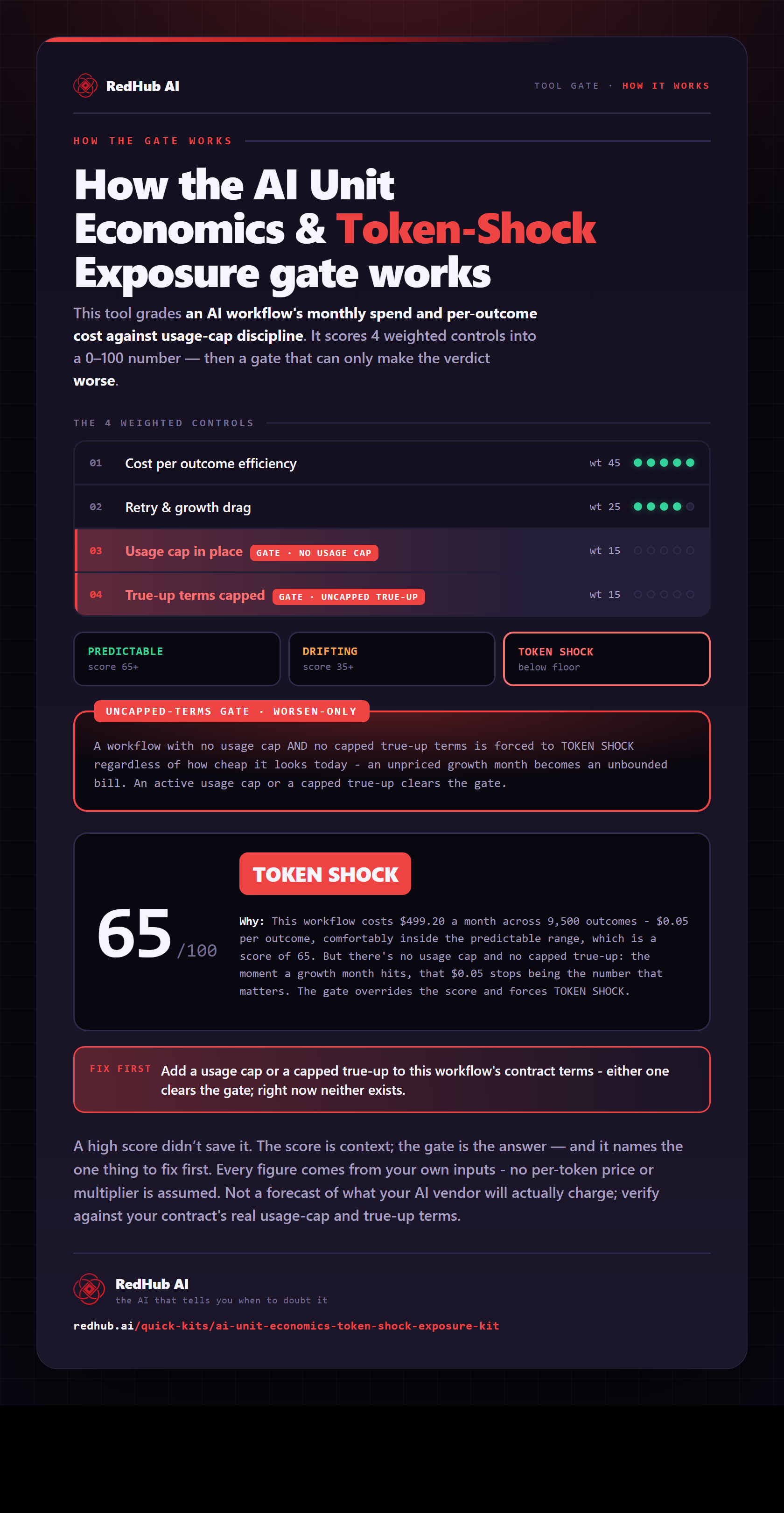
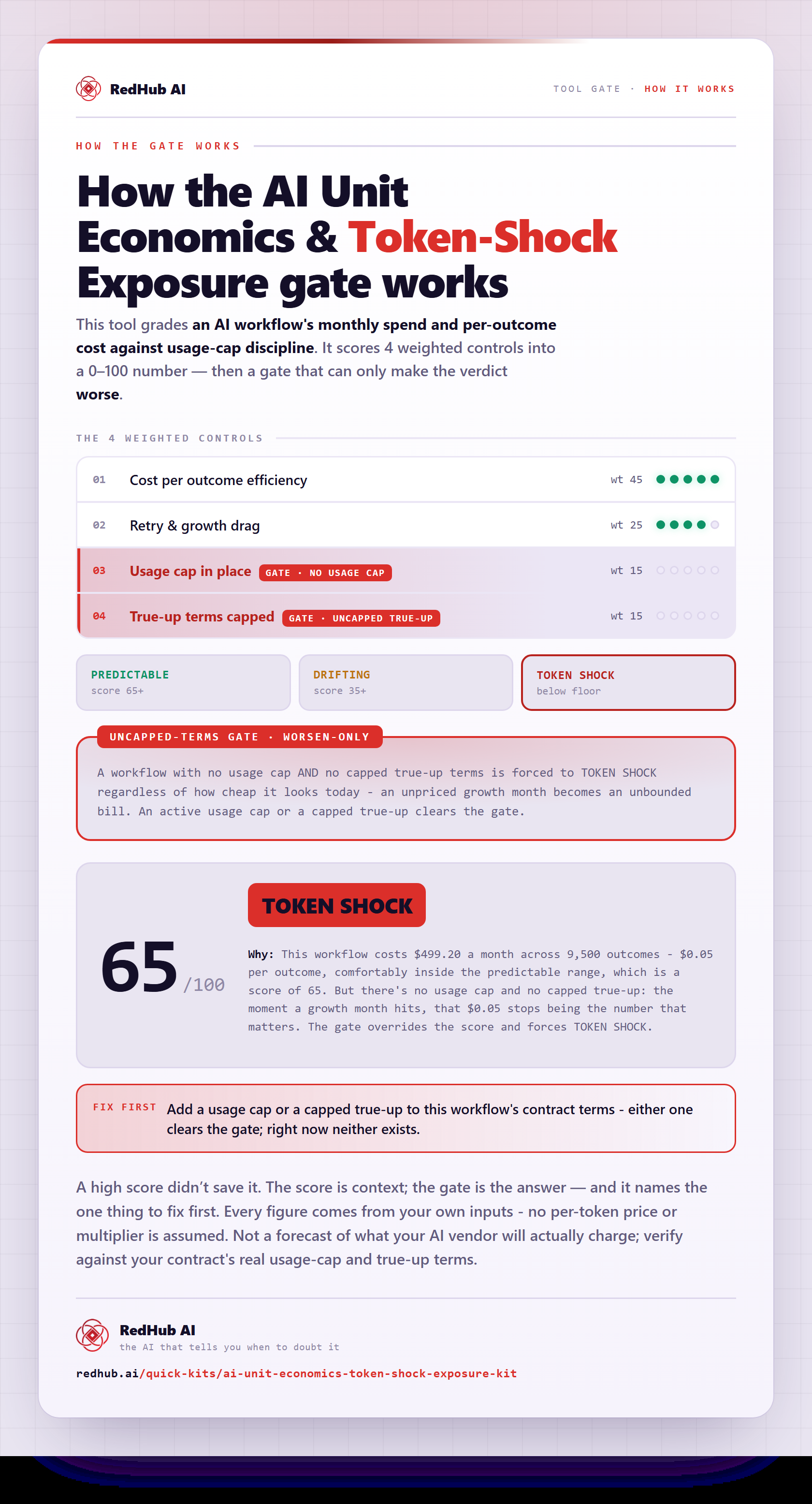
The gate this post refers to, drawn from the tool’s own logic. See the tool.