Always-On AI Agents: Cheap Tokens Still Run Away
Todd Brooks, Founder6 min read

Jump to a section9
TL;DR
- What changed: in worked examples at DeepSeek V4.1 Flash prices, always-on jobs cost between $1.44 and $11.70 a month, against $51 to $412.50 on Opus 5.
- What it buys: room for more checking. A second agent that critiques the first costs almost nothing.
- What it doesn't buy: a ceiling. In a worked example, a stuck loop at $0.15 per million tokens still burns $432 a day, and it hides longer because it looks small.
- What to do: put a hard cutoff behind every always-on agent. The AI Spend Runaway & Billing-Safeguard Gate grades, from your own answers, whether a hard cutoff is in place.
What are always-on AI agents?
Always-on AI agents run on a schedule or a trigger instead of waiting for someone to ask. They rescore the pipeline every night, read every support ticket as it arrives, or check every invoice line. DeepSeek V4.1 Flash's pricing makes far more of these affordable. It doesn't make them safe to leave uncapped: a low price per token multiplied by a loop with no stop is still an open-ended bill.
Best for: operators planning scheduled or event-driven AI jobs who want the savings without the surprise invoice.
Cheap enough to leave running in the background all day. That's the real shift in DeepSeek V4.1 Flash, more than any benchmark score.
For three years, running an AI model was a decision. Someone asked, it answered, the meter ran for a moment. At V4.1 Flash prices, the question stops being "is this run worth it?" and becomes "why isn't this running already?" This guide is part of DeepSeek V4.1 Flash changes the economics of AI agents.
What always-on work costs now
Three jobs a small company might want running constantly, priced at off-peak list rates as of September 10, 2026, with no caching:
| Job | Monthly volume | V4.1 Flash | Opus 5 |
|---|---|---|---|
| Rescore 500 open deals every night | 60M input, 4.5M output | $11.70 | $412.50 |
| Read all 3,000 support tickets for patterns | 7.5M input, 0.9M output | $1.67 | $60 |
| Check 1,200 invoices line by line | 7.2M input, 0.6M output | $1.44 | $51 |
Worked examples, not measurements. Deals: 4,000 input and 300 output tokens each, 30 nights. Tickets: 2,500 in and 300 out. Invoices: 6,000 in and 500 out. Token prices only, with no review time.
The nightly deal rescore is the telling one. At $412.50 a month you'd think hard about it. At $11.70 you wouldn't think about it at all. That's the shift, and it's also the problem.
Cheap buys verification
The best use of cheap tokens isn't doing the same work for less. It's checking the work. A pipeline that used to be one agent can become four:
- An agent that does the task. Extracts the fields, scores the deal, drafts the reply.
- An agent that checks it. Compares the output against the source and flags what doesn't match.
- A rule that decides. Anything flagged, or anything that touches money or a customer, goes to a person.
- A log. Which model answered, what it saw, what it said, and who approved it.
At Opus 5 prices, doubling your tokens to add a checker is a budget conversation. At V4.1 Flash prices, doubling the $11.70 deal rescore makes it $23.40. Cheap intelligence doesn't mean fewer controls. It means you can afford more of them.
One caution: a checker built on the same model can share the same blind spots. Where the stakes are real, the check should be a fixed rule or a person, not another model's opinion.
The runaway math
Here's the catch. The price that makes an always-on agent affordable also makes a broken one cheap enough to miss.
Picture a stuck agent re-sending 200,000 tokens of context ten times a minute, none of it hitting the cache. That's 2 million input tokens a minute, or 2.88 billion a day. At V4.1 Flash's uncached off-peak rate of $0.15 per million, that's $432 a day. Left running through a weekend, it's roughly $1,000. The same loop on Opus 5 would cost $14,400 a day.
One stuck loop, 2.88 billion input tokens a day, uncached list prices as of September 10, 2026. Output tokens left out.
The Opus 5 loop gets noticed by lunch. A $432 day can pass for a busy day on a dashboard, so it could run for days before anyone asks. And DeepSeek's concurrency limit of 2,500 means you can have a lot of those loops running at once.
Six safeguards before an agent runs unattended
- A hard spend cutoff. Spend stops when it's reached. A budget that only sends an email is not a cutoff. See why API spending limits don't stop runaway bills.
- Scoped, rotated keys. One key per agent, so a leak or a loop shows up on its own line.
- A loop circuit breaker. A maximum number of turns and retries per run.
- Anomaly alerts. Set against this agent's normal spend, not a monthly total it won't hit until it's too late.
- Cost attribution. Every call tagged to the job that made it.
- One named owner. A person who can pull the switch, and knows they're the one.
One more check for anyone already on DeepSeek: if an always-on agent calls deepseek-v4-pro, DeepSeek's changelog says it will be served by V4.1 Flash after 12:00 Beijing time on September 14, 2026. Re-test its output that week. For the full six-safeguard walkthrough, read how to stop a runaway AI bill before it happens.
Grade the safeguards behind your agents
The AI Spend Runaway & Billing-Safeguard Gate ($49, one-time) grades six billing safeguards from your own answers and returns SAFEGUARDED, EXPOSED or RUNAWAY RISK. A missing hard cutoff forces RUNAWAY RISK no matter how good the rest of your setup looks.
Get the Gate — $49 →Decision Guide
Start here if: you're about to put an agent on a schedule or a trigger with no one watching each run.
Skip it if: every AI call you make is started by a person who reads the answer.
Best first step: find out whether your AI provider account has a cutoff that stops spend, or only an alert.
More in this guide
FAQ
What are always-on AI agents?
Agents that run on a schedule or trigger without a person starting each run, such as nightly pipeline scoring, ticket reading as tickets arrive, or invoice checks as bills come in.
Does a cheaper model make runaway bills less likely?
No. It makes each runaway cheaper per hour and slower to notice. A stuck loop that costs $432 a day on DeepSeek V4.1 Flash can run far longer than one costing $14,400 a day before anyone checks.
Should I use a second AI agent to check the first?
For routine work, a checker agent is a cheap way to catch mistakes at these prices. For anything touching money or customers, back it with a fixed rule or a person, because two agents on the same model can miss the same thing.
What is a hard spend cutoff?
A limit that stops API spend when it's reached. Many provider "budgets" only send a notification, which doesn't stop a loop running overnight.
How many requests can run at once on DeepSeek V4.1 Flash?
DeepSeek's pricing page lists a concurrency limit of 2,500.
Run agents all day, with a ceiling
Six safeguards, one hard-cutoff gate, a clear verdict. $49, offline, your own answers.
Get the AI Spend Runaway & Billing-Safeguard Gate — $49 →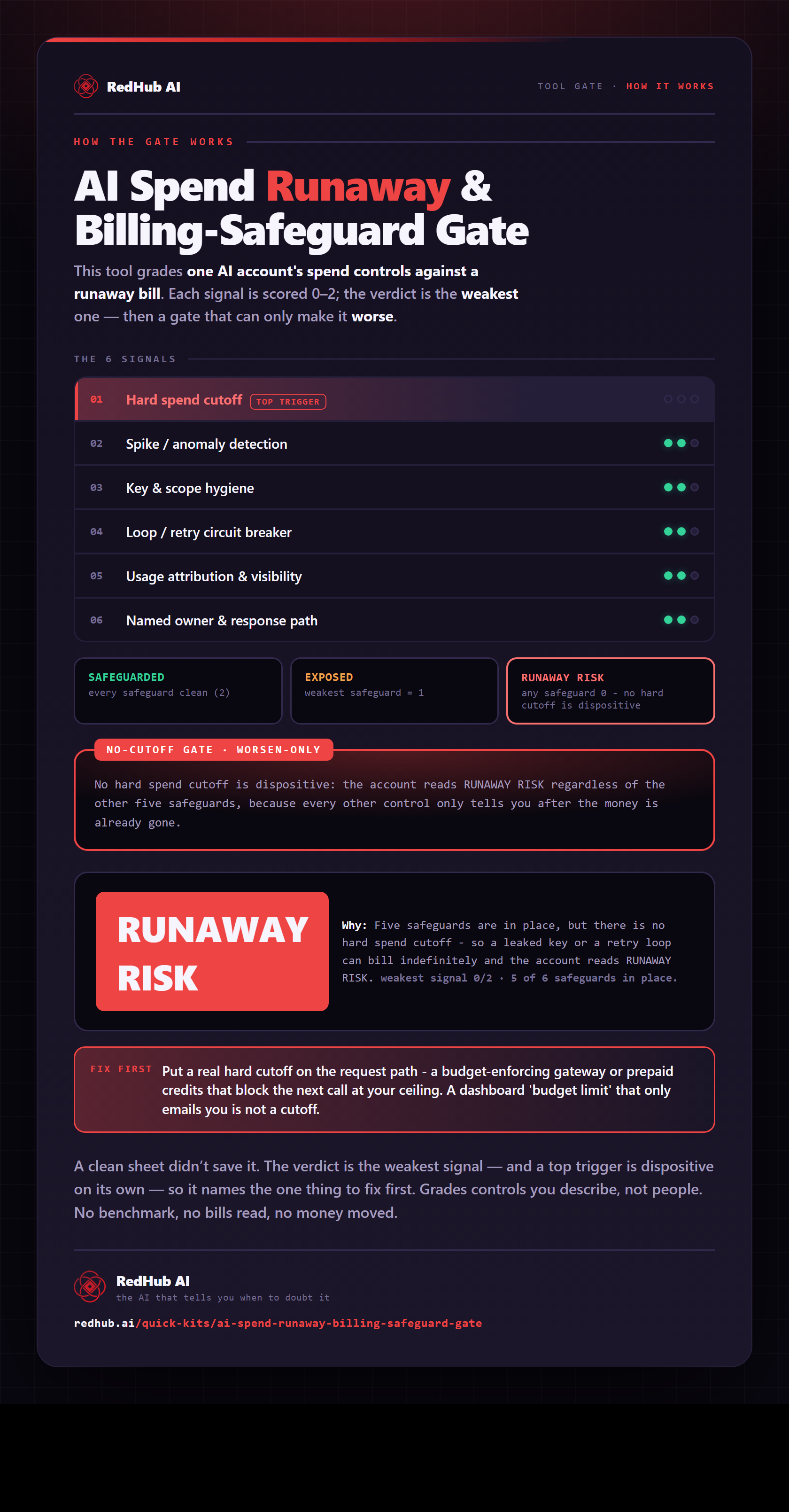
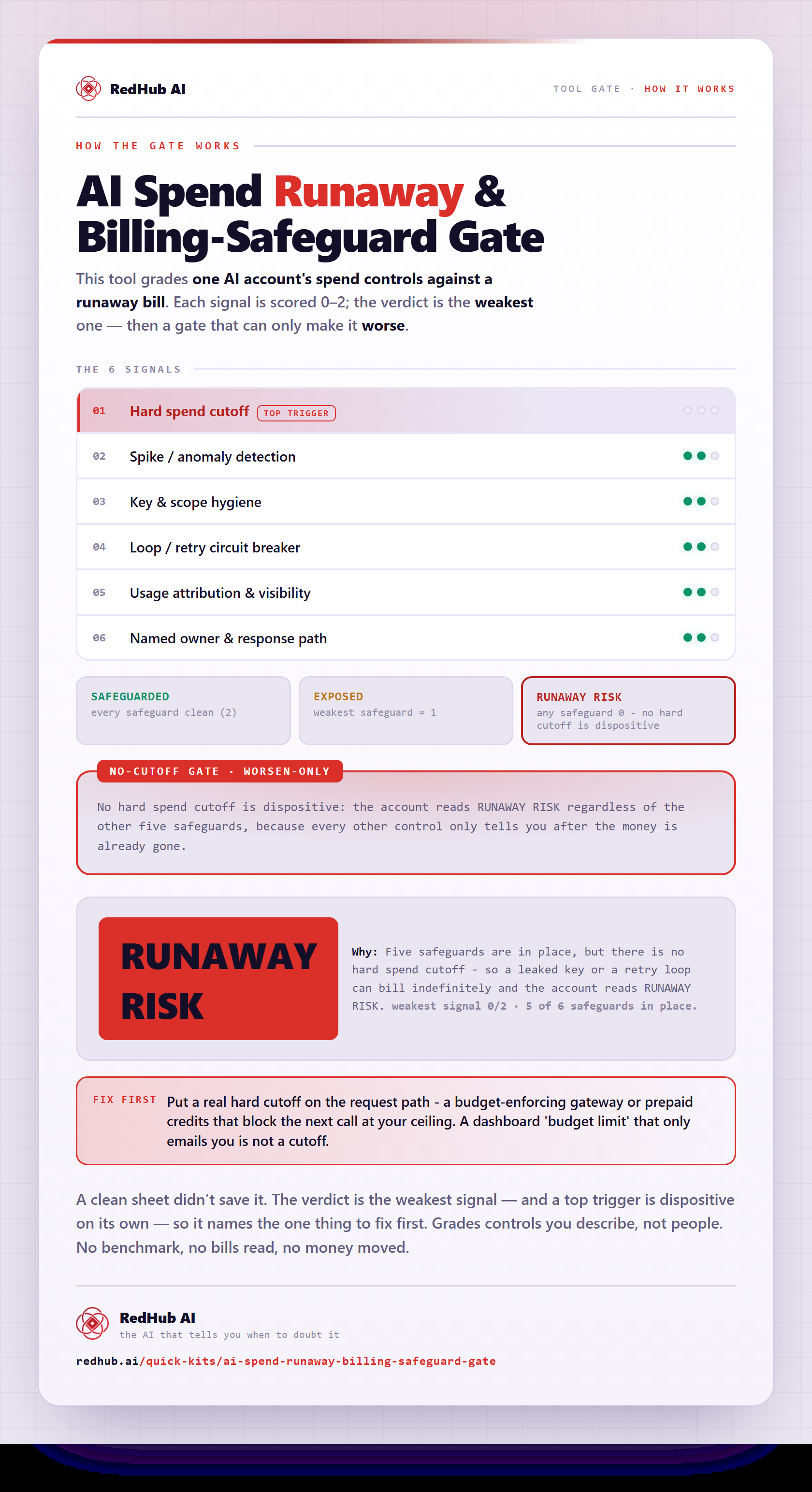
The gate this post refers to, drawn from the tool’s own logic. See the tool.