Delegate, Automate, or Eliminate: A Founder's Task Triage
RedHub AI Editorialupdated September 7, 20264 min read

Jump to a section8
TL;DR
- What it is: a three-way triage for every task that isn't yours to keep — delegate it, automate it, or eliminate it.
- Who it's for: founders clearing their plate who want to route each task correctly. See the leverage audit.
- How it works: eliminate first (free), automate what's rule-based, delegate what needs a human but not you.
- Bottom line: ask "should this exist?" before "who does this?" A leverage read, not management consulting.
How do you decide to delegate, automate, or eliminate a task?
Run each task through three questions in order. First, does it need to exist at all? If not, eliminate it — that's free and instant. Second, is it repetitive and rule-based? If so, automate it with software or AI. Third, does it need a human but not specifically you? Then delegate it, handing off the decision along with the task. The order matters: eliminating removes work entirely, automating removes it from any human, and delegating is the most expensive option because it adds a person — so it's the last resort, not the first.
Best for: founders deciding how to offload each task, not just whether to — the Founder-Time Leverage Audit routes each one. A leverage read, not consulting.
"Delegate more" gets all the attention, but delegation is actually the most expensive way to get a task off your plate — it adds a salary and a management overhead. Before you hand anything to a person, two cheaper options deserve a look first: eliminating the task entirely, and automating it so no human touches it. Run every task through the triage in that order.
Eliminate first — it's free
The cheapest task is the one that doesn't need doing. Before you route anything, ask whether it needs to exist: the report nobody reads, the meeting that could be a message, the process built for a problem you no longer have. Founders accumulate these by inertia. Cutting them costs nothing, frees time instantly, and — surprisingly often — nobody notices. Always ask "should this exist?" before "who should do this?"
Key insight: delegation gets the glory, but elimination and automation are cheaper. Every task you delegate adds a person; every task you eliminate or automate removes the work itself. Reach for the free options first.
Automate what's rule-based
If a task survives the elimination test and follows predictable rules, automate it before you assign it to a human. Scheduling, reminders, data moving between tools, first-pass sorting, routine reporting — software and AI handle these tirelessly and cheaply. The test is simple: if you could write down the exact steps, a tool can probably run them. Automation removes the task from every human's plate, including a future hire's.
Delegate what needs a human but not you
What's left after eliminating and automating is work that genuinely needs human judgment — just not your judgment. That's what you delegate, and it's the most powerful and the most misused of the three, because delegation only works if you hand off the decision, not just the task. More on that failure mode below.
| Option | Ask | Cost | Best for |
|---|---|---|---|
| Eliminate | Does this need to exist? | Free | Reports nobody reads, legacy processes |
| Automate | Is it rule-based? | Cheap, one-time setup | Scheduling, data moving, routine reports |
| Delegate | Needs a human, not you? | A salary + management | Judgment work that isn't founder-defining |
Route every task correctly
The Founder-Time Leverage Audit grades each task and points to the right move — keep, delegate, automate, or eliminate — plus six Claude skills to automate and speed up what stays on your plate.
Get the Leverage Audit — $79 →Why founders skip to delegating
The instinct is to jump straight to "who can I hire for this?" because delegation feels like progress — you're building a team. But hiring for a task you could have eliminated bakes the waste permanently into payroll, and hiring for one you could have automated means paying a person to do what software does for pennies. Run the free options first, and you'll delegate a shorter, sharper list — which also makes each hire more clearly worth it.
For the full picture, read the pillar on founder time management. And because delegation is the trickiest of the three, see why delegation fails before you hand anything off.
Decision Guide
Use it if: you know what to get off your plate but not how to route each task.
Skip it if: you've already eliminated the deadwood and automated the rule-based work.
Best first step: take your task list and ask "should this exist?" on each — eliminate before you route anything else.
FAQ
Should I delegate, automate, or eliminate a task?
Ask three questions in order: does it need to exist (eliminate if not), is it rule-based (automate if so), does it need a human but not you (delegate). Run them in that order because eliminating and automating are cheaper than adding a person.
Why eliminate before delegating?
Because delegating a task that didn't need to exist bakes the waste into payroll forever. Elimination is free and instant, so it always comes first — ask "should this exist?" before "who should do this?"
What tasks should I automate instead of delegate?
Anything repetitive and rule-based: scheduling, reminders, moving data between tools, first-pass sorting, routine reports. If you can write down the exact steps, a tool can probably run them — and automation removes the work from every human, not just you.
Isn't delegating the whole point?
Delegation is powerful, but it's the most expensive option because it adds a salary and management overhead. It's the right move for judgment work that needs a human but not you — after you've eliminated the unnecessary and automated the rule-based.
How do I know if a task can be automated?
If you can describe the exact steps and the rules that decide each one, it's automatable. Tasks that require reading context, weighing trade-offs, or exercising taste usually still need a human — which pushes them into the delegate bucket.
Is this a management framework or a product pitch?
It's a leverage read you can apply on your own. It grades how your time is spent and routes each task, but it doesn't promise an outcome or make the hire-versus-automate call for you — those stay your decision.
Eliminate, automate, then delegate
Ask "should this exist?" before "who does this?" — and delegate a shorter, sharper list. A leverage read, not management consulting.
Get the Leverage Audit — $79 →
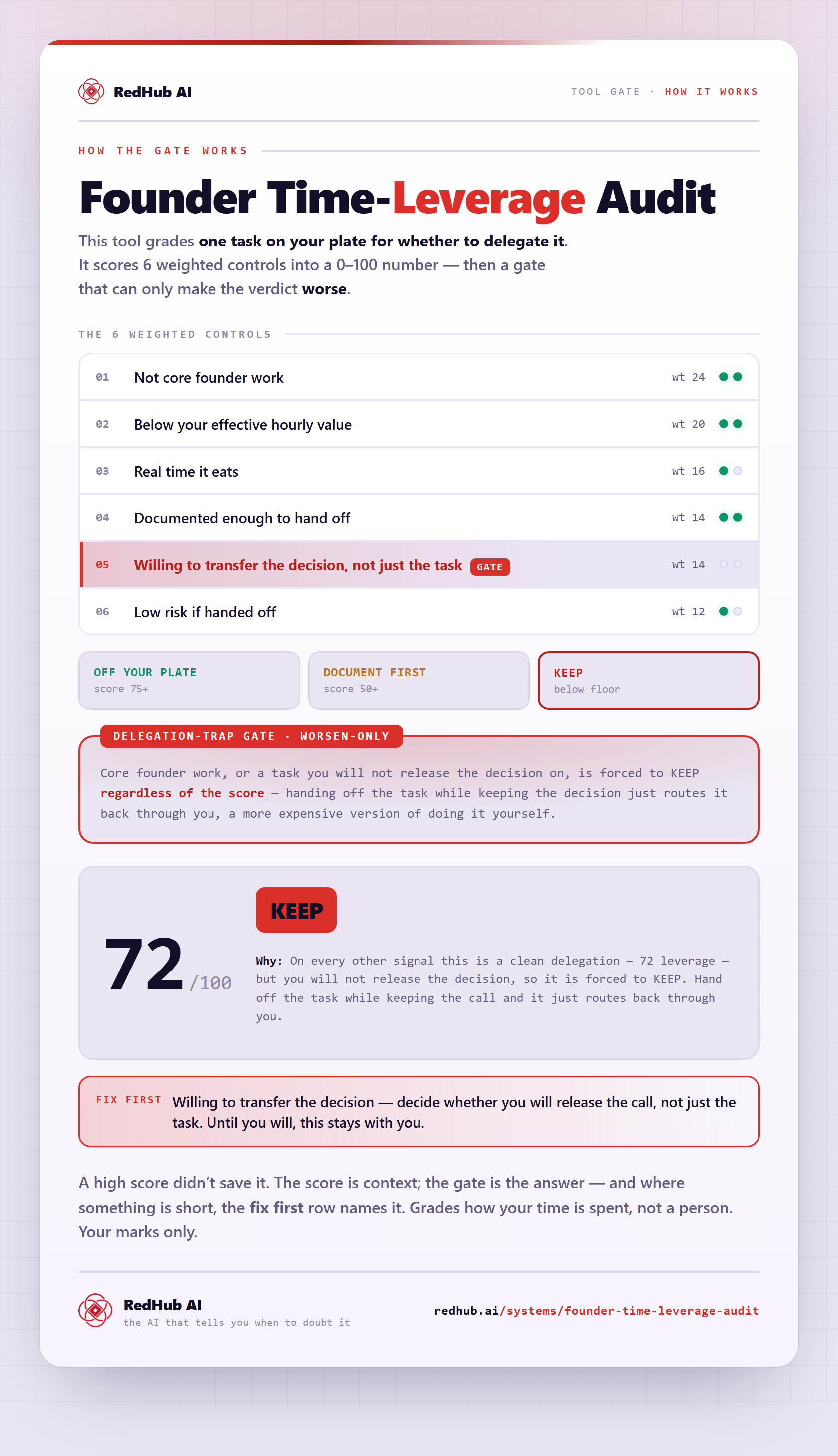
The gate this post refers to, drawn from the tool’s own logic. See the tool.