Founder Time Management: How to Escape the Bottleneck and Reclaim High-Leverage Hours
RedHub AI Editorialupdated September 7, 20266 min read

Jump to a section9
TL;DR
- What it is: founder time management is deciding which work only you can do — and getting everything else off your plate by delegating, automating, or eliminating it.
- Who it's for: founders who are the bottleneck and know their time is misallocated. See the leverage audit.
- How it works: audit where your hours actually go, triage each task, and redeploy the reclaimed time into higher-value work — reclaimed hours only count if you spend them well.
- Bottom line: the goal isn't to do more; it's to do only what has leverage. This is a leverage read, not a management consultant.
What is founder time management?
Founder time management is the practice of matching your hours to your highest-value work by systematically removing everything else. It starts by auditing where your time actually goes, then triaging each task into one of four buckets — keep it (only you can do it), delegate it, automate it, or eliminate it. The trap most founders fall into isn't laziness; it's doing $50-an-hour work while $500-an-hour decisions wait, because handing things off feels harder than just doing them. Good founder time management makes that handoff a repeatable system, not a one-time heroic effort.
Best for: founders who are the bottleneck in their own business — the Founder-Time Leverage Audit grades each task for the leverage you'd gain by removing it. A leverage read, not management consulting.
Every founder starts as the person who does everything, because at the start that's the fastest path. The problem is that the habit outlives its usefulness. You keep doing the $50 tasks because you're good at them and handing them off feels slower — while the $500 decisions that only you can make sit in a tab you'll get to "later." That's not a work-ethic problem. It's a leverage problem, and it has a fix.
The real cost of doing everything
The cost isn't just your time — it's the higher-value work that never happens because your hours are spoken for. When a founder whose best hour is worth a lot spends that hour on a task someone else could do at a fraction of the rate, the difference is pure waste. Do that for fifteen hours a week and it compounds into a serious number over a year. Estimate your own below — it's an illustrative gut-check, not an exact figure.
Estimate your annual leverage lost
Key insight: the number that matters isn't what a task costs to do — it's what you're not doing while you do it. Leverage is the gap between your highest-value work and the work currently filling your calendar.
The four buckets: keep, delegate, automate, eliminate
Founder time management comes down to sorting every recurring task into one of four buckets.
| Bucket | When | The move |
|---|---|---|
| Keep | Only you can do it, and it's high-value | Protect the time for it fiercely |
| Delegate | Someone else could do it at 80% quality | Hand off the task AND the decision |
| Automate | It's repetitive and rule-based | Let software or AI run it |
| Eliminate | It doesn't actually need doing | Stop, and see if anyone notices |
Most founders over-index on "keep" — they convince themselves more tasks require them than actually do. The audit's job is to challenge that honestly.
Reclaimed time only counts if you redeploy it
Here's the catch every framework names and most founders miss: freeing up ten hours does nothing if those ten hours refill with more low-value work. Reclaimed time only becomes leverage when you deliberately spend it on higher-value work — strategy, key relationships, the decisions only you can make. Delegation without redeployment just gives you a tidier calendar and the same output. So the audit doesn't end at "what to remove"; it ends at "what to move those hours toward."
Two natural next steps once the hours are free: the Operating Cadence Engine installs a weekly rhythm so the reclaimed time gets spent on the right work, and if you're still a team of one, the Solo Founder Skills Pack is the do-more-yourself companion for the tasks you keep.
See exactly where your leverage is
The Founder-Time Leverage Audit grades each task on your plate for the leverage you'd gain by removing it, gives you a portfolio read of how founder-bound you really are, and includes six Claude skills to do more yourself and make what you keep take less time.
Get the Leverage Audit — $79 →Why delegation is the hard part
Automating and eliminating are easy once you spot them. Delegation is where founders get stuck, and almost always for the same reason: they hand off the task but keep the decision. The delegate then escalates every judgment call back to you, and you've built a more expensive version of yourself that still routes through your inbox. Real delegation means handing off the decision rights too, with clear guardrails — otherwise you haven't delegated, you've just added a middleman.
What this is not
Straight talk on the lane: this is a leverage read, not a management consultant and not a productivity guru. It grades how your time is spent, not any person — it isn't a scoring of you or your team. And it doesn't promise a specific outcome; what you delegate, hire for, or automate is your call. The tools make the leverage visible; the decisions stay yours.
Go deeper: what to delegate first (and what never to), the delegate-automate-eliminate triage, how to stop being the bottleneck, and why delegation fails.
Decision Guide
Use it if: you're the bottleneck, your calendar is full of work below your pay grade, and higher-value work keeps slipping.
Skip it if: you've already got a lean, high-leverage calendar and a team that owns decisions, not just tasks.
Best first step: track a week of your time, then sort every recurring task into keep, delegate, automate, or eliminate — and be honest about how few truly require you.
FAQ
What is founder time management?
It's matching your hours to your highest-value work by systematically removing everything else — auditing where your time goes, then keeping, delegating, automating, or eliminating each task. The aim isn't doing more; it's doing only what genuinely needs you.
How do I know what my time is worth?
A rough proxy is what an hour of your highest-value work — closing a key deal, setting strategy, a decision only you can make — is worth to the business. The exact figure matters less than the gap between that number and what's actually filling your calendar.
What should a founder never delegate?
The work that only you can do and that shapes the company: vision and strategy, key hires, major financial calls, and the relationships that depend on you personally. Almost everything else is a candidate for delegation, automation, or elimination.
Why does delegating never seem to stick?
Usually because you hand off the task but keep the decision. The person then escalates every judgment call back to you, so you've added a step instead of removing one. Real delegation transfers the decision rights too, within clear guardrails.
What if I free up time and just fill it with more busywork?
That's the most common failure. Reclaimed hours only become leverage if you deliberately redeploy them into higher-value work. Decide in advance what the freed time is for — strategy, relationships, the decisions only you can make — or it quietly refills.
Is this a productivity system or a consultant?
Neither — it's a leverage read. It grades how your time is spent (not any person) and shows what to remove and where to redeploy. It doesn't promise an outcome or replace your judgment; the delegate, hire, or automate calls stay yours.
Stop being the bottleneck
Audit where your time goes, triage every task, and redeploy the hours into work only you can do. A leverage read, not management consulting.
Get the Leverage Audit — $79 →
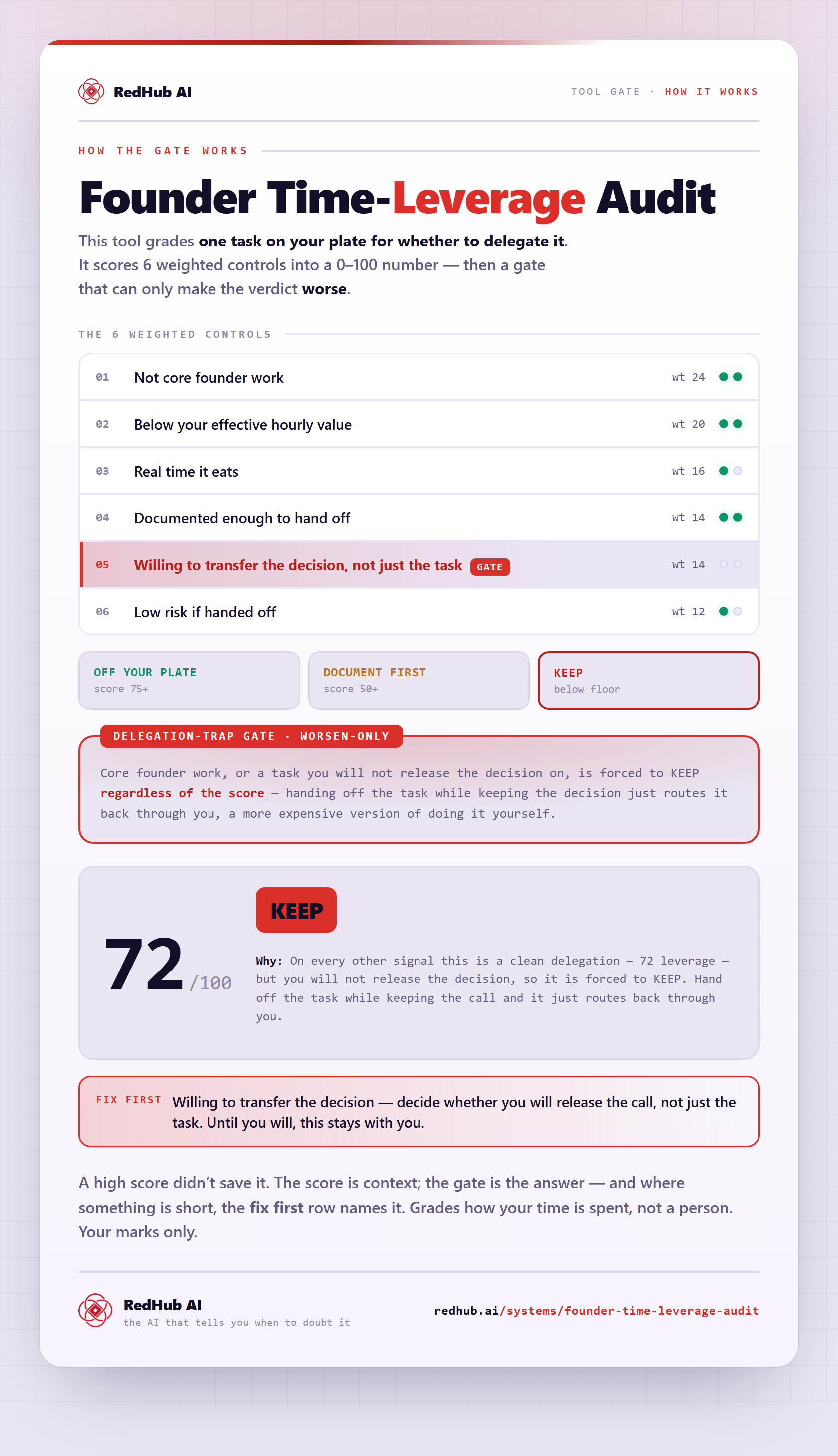
The gate this post refers to, drawn from the tool’s own logic. See the tool.