Why Delegation Fails: You Handed Off the Task but Kept the Decision
RedHub AI Editorialupdated September 7, 20265 min read

Jump to a section8
TL;DR
- What it is: the single most common reason delegation doesn't stick — handing off the task while keeping the decision.
- Who it's for: founders who delegated and somehow got busier. See the leverage audit.
- How it works: if the delegate escalates every judgment call, you built a middleman, not a handoff — fix it with decision rights and guardrails.
- Bottom line: delegate the decision, not just the doing. A leverage read, not management consulting.
Why does delegation fail?
Delegation fails most often because the founder hands off the task but keeps the decision. The person does the work, then escalates every judgment call — "which option?", "is this okay?", "can I spend this?" — back to the founder for approval. The result is a more expensive version of the founder that still routes through their inbox: you've added a person and kept the bottleneck. Real delegation transfers the decision rights along with the task, inside clear guardrails, so the person can finish the work without you. Fix that one thing and most "delegation doesn't work for me" problems disappear.
Best for: founders who delegated and didn't get their time back — the Founder-Time Leverage Audit flags exactly this pattern. A leverage read, not consulting.
You finally delegated. You hired the person, handed over the tasks — and a month later you're just as busy, now fielding a stream of "quick questions" from someone you're paying to reduce your load. This is the most-cited delegation failure, and it has nothing to do with the person. You handed off the task but kept the decision.
The middleman you accidentally built
When you delegate a task but retain the approval, you don't remove yourself from the work — you insert a relay. The delegate does the doing, then stops at every fork and waits for your call. Your inbox fills with decisions dressed as questions, and the work moves slower than when you did it alone, because now there's a handoff in the middle. You've spent money to make yourself a required checkpoint. That's not delegation; it's supervision of a task you no longer do.
Key insight: delegation transfers tasks; leverage transfers decisions. If every judgment call still comes back to you, you delegated the labor and kept the bottleneck — the expensive half stayed on your desk.
The fix: hand over decision rights, with guardrails
The repair is to give the delegate the authority to decide, bounded by clear limits so the downside is contained.
- State the decision they now own. Be explicit: "You choose the vendor," not "run the vendor process and check with me."
- Set the guardrail. The boundary inside which they decide freely: "under $500," "anything in the policy," "unless it's a refund over 30 days."
- Define the escalation line. Name the few cases that should come to you, so escalation becomes the exception, not the default.
- Stop overturning good-enough calls. If you reverse decisions made inside the guardrail, you retrain them to ask first — and rebuild the bottleneck.
Catch the keep-the-decision trap
The Founder-Time Leverage Audit grades each task for the leverage of removing it and flags the ones where you've kept the decision — so your next handoff actually gives you the time back.
Get the Leverage Audit — $79 →Other ways delegation quietly fails
Keeping the decision is the big one, but a few others compound it:
| Failure | What it looks like | The fix |
|---|---|---|
| Kept the decision | They escalate every judgment call | Transfer decision rights + guardrails |
| No definition of "done" | Endless back-and-forth on quality | Give an example of a great result upfront |
| Delegated the what, not the why | They can't handle edge cases | Share the goal, not just the steps |
| Perfectionist takebacks | You redo their work "faster" | Accept 80%, coach the gap |
Delegation is a skill, not a personality trait
Founders often conclude "I'm just bad at delegating" and go back to doing everything. But delegation isn't a trait — it's a repeatable move: transfer the decision, set the guardrail, define done, and let good-enough be good enough. Get those four right and the same handoff that failed last quarter works this one. The task was never the problem; the decision was.
For the full method, read the pillar on founder time management, and how the same trap makes you the bottleneck in your business.
Decision Guide
Use it if: you delegated and got busier, or your team escalates decisions you wish they'd just make.
Skip it if: your handoffs already include decision rights and your inbox isn't a decision queue.
Best first step: pick one delegated task where they still ask you to decide, set a guardrail, and hand over the call in writing.
FAQ
Why does my delegation never save me time?
Because you handed off the task but kept the decision. The person does the work and escalates every judgment call back to you, so you've added a handoff without removing yourself. Transfer the decision rights, with guardrails, and the time actually comes back.
What does "keeping the decision" look like?
It's the stream of "which option?", "is this okay?", "can I approve this?" that lands in your inbox after you delegated the doing. The task moved; the approval didn't — so you're still the required checkpoint.
How do I hand off a decision safely?
State the decision they now own, set a guardrail (a dollar cap, a policy, an "if X then Y"), name the few cases that should escalate, and then stop overturning calls made inside the guardrail. The guardrail contains the risk; the authority removes you.
What if their decision isn't as good as mine?
Inside a guardrail, a good-enough decision made without you usually beats a perfect one that waited days for your approval. If you reverse every call that isn't exactly yours, you retrain them to ask first — which rebuilds the bottleneck you were trying to remove.
Am I just bad at delegating?
Probably not — delegation is a skill, not a personality trait. It's four repeatable moves: transfer the decision, set the guardrail, define "done" with an example, and accept 80%. Get those right and the handoff that failed before works.
Is this management consulting?
No — it's a leverage read you apply yourself. It flags where you've kept the decision and grades tasks by the leverage of a clean handoff. It doesn't promise an outcome or decide who you delegate to.
Delegate the decision, not just the doing
Transfer decision rights, set guardrails, accept good-enough — and get the time back this time. A leverage read, not management consulting.
Get the Leverage Audit — $79 →
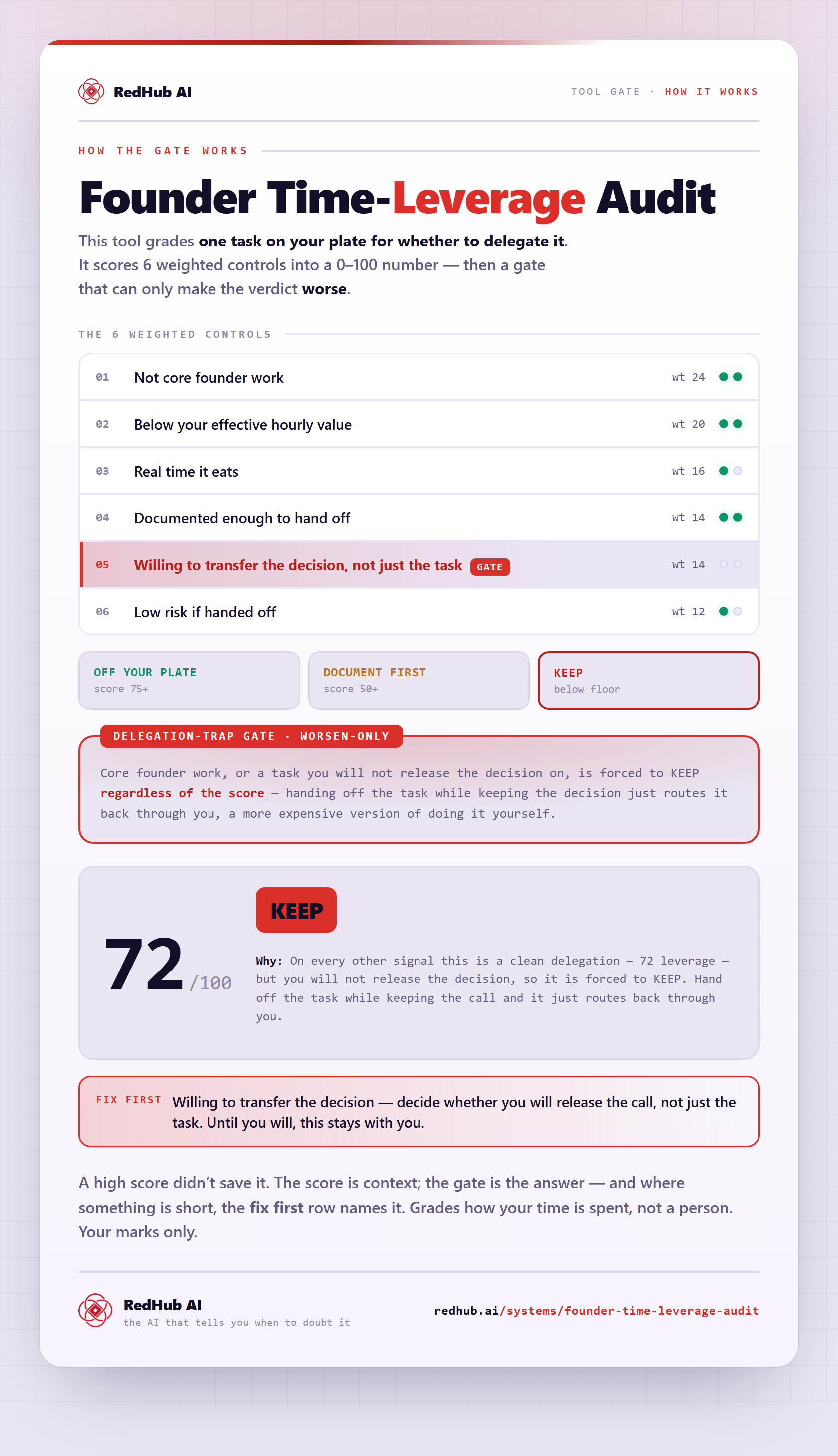
The gate this post refers to, drawn from the tool’s own logic. See the tool.