What to Delegate First (and What You Should Never Delegate)
RedHub AI Editorialupdated September 7, 20264 min read

Jump to a section7
TL;DR
- What it is: a simple order for handing off work — what to delegate first, and the short list only you should keep.
- Who it's for: founders who know they should delegate but never quite do. See the leverage audit.
- How it works: delegate the high-frequency, low-judgment tasks first; keep the few that shape the company.
- Bottom line: start with what eats the most hours for the least judgment. A leverage read, not management consulting.
What should a founder delegate first?
Delegate the tasks that happen often and require little of your unique judgment — scheduling, inbox triage, first-draft content, data entry, routine customer replies, bookkeeping admin. These give back the most hours for the least risk, because a clear process can carry them and a mistake is cheap and fixable. Keep the short list of work that only you can do and that shapes the company: vision, strategy, key hires, major financial decisions, and the relationships that depend on you personally. Everything between those two poles is a judgment call — but you start at the high-frequency, low-judgment end.
Best for: founders staring at a full plate unsure where to start — the Founder-Time Leverage Audit ranks your tasks by the leverage of removing them. A leverage read, not consulting.
"Delegate more" is useless advice without an order of operations. Faced with a full plate and no system, most founders delegate nothing, because deciding what to hand off first is itself overwhelming. The fix is a simple rule: sort by frequency and judgment, and start in the corner that's easiest to give away.
Rank tasks by frequency and judgment
Every task sits somewhere on two axes: how often it happens, and how much of your unique judgment it needs. That gives four groups, and a clear order.
| Task type | Frequency | Judgment needed | Delegate? |
|---|---|---|---|
| Scheduling, inbox triage, data entry | High | Low | First |
| First-draft content, routine replies | High | Some | Early, with a template |
| Hiring screens, vendor calls | Medium | Medium | Later, with guardrails |
| Vision, strategy, key hires | Low | High | Never — keep |
Key insight: delegate high-frequency, low-judgment work first not because it's the most valuable to remove, but because it's the easiest to hand off cleanly — which builds the delegation muscle you'll need for the harder stuff.
The order that works
- Pure-process tasks. Scheduling, data entry, inbox sorting, invoicing admin. A checklist carries them; a mistake is cheap. Hand these off first.
- Templated tasks. First-draft content, routine customer replies, standard reports. Give a template and examples so the output stays consistent without you.
- Judgment tasks with guardrails. Hiring screens, vendor selection, small spending calls. Delegate the decision within limits — "you choose under $500, escalate above."
- Never: founder-defining work. Strategy, key hires, major money, relationships that depend on you. Protect these; they're the reason you're freeing time in the first place.
Rank your own tasks by leverage
The Founder-Time Leverage Audit scores each task on your plate for how much you'd gain by removing it — so you delegate in the right order instead of guessing.
Get the Leverage Audit — $79 →The short list you should never delegate
Four things stay with the founder, always: the company's direction (vision and strategy), who joins the leadership team (key hires), the big financial calls, and the handful of relationships that only work because they're with you. Everything else is negotiable. If you find yourself defending a task as "only I can do this" and it isn't on that list, that's exactly the task the audit is designed to challenge.
Delegate first
- High-frequency, low-judgment tasks
- Anything a checklist can carry
- Work where mistakes are cheap
Keep
- Vision and strategy
- Key hires and big money calls
- Relationships that depend on you
For the full method, read the pillar on founder time management, and the triage in delegate, automate, or eliminate.
Decision Guide
Use it if: you want to delegate but can't decide where to start.
Skip it if: your low-judgment work is already off your plate and you're down to genuine judgment calls.
Best first step: hand off one pure-process task this week — scheduling or inbox triage — and build from there.
FAQ
What should I delegate first as a founder?
High-frequency, low-judgment tasks — scheduling, inbox triage, data entry, invoicing admin. They return the most hours for the least risk because a process carries them and mistakes are cheap. Start there, then work up to templated and guardrailed work.
What should a founder never delegate?
Four things: vision and strategy, key hires, major financial decisions, and the relationships that only work because they're with you. Everything else is a candidate. If you're defending a task as "only I can do this" and it's not on that list, question it.
How do I decide what's delegatable?
Score each task on two axes: how often it happens and how much of your unique judgment it needs. High-frequency, low-judgment work is the easiest and first to hand off; low-frequency, high-judgment work stays with you.
Should I delegate content and customer replies?
Yes, early — but with a template and examples so the output stays consistent without you. These are high-frequency and only need "some" judgment, so a clear pattern lets someone else (or AI) carry them at close to your quality.
What are guardrails in delegation?
Limits that let someone own a decision without escalating everything — "choose any vendor under $500, escalate above," or "reply to anything in the FAQ, flag the rest." Guardrails are how you hand off the decision, not just the task.
Is this consulting advice?
No — it's a leverage read. It shows what to delegate in what order and grades how your time is spent, not any person. It doesn't promise an outcome or replace your judgment on who to hire or hand work to.
Start with the easy handoffs
High-frequency, low-judgment first; the founder-defining four never. A leverage read, not management consulting.
Get the Leverage Audit — $79 →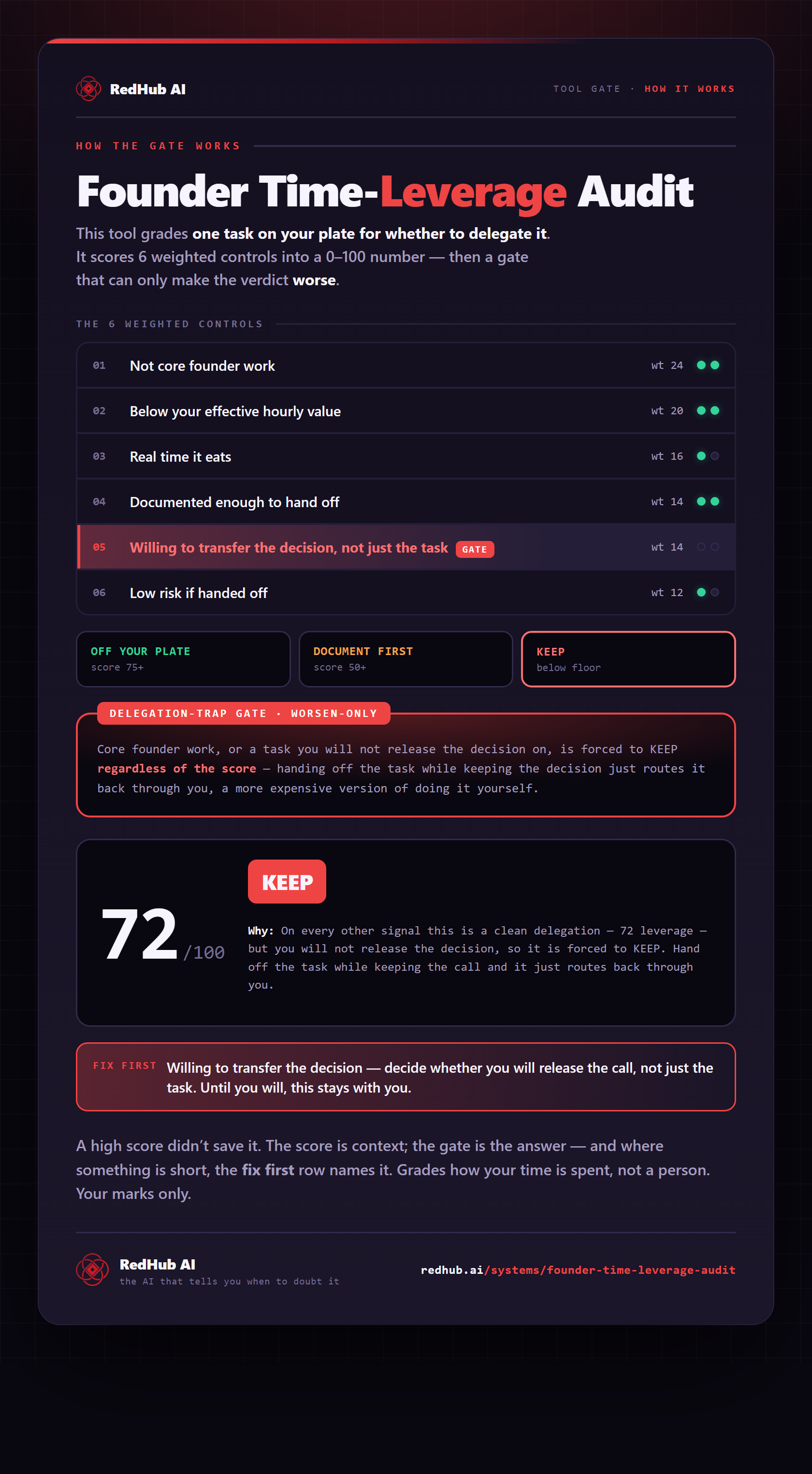
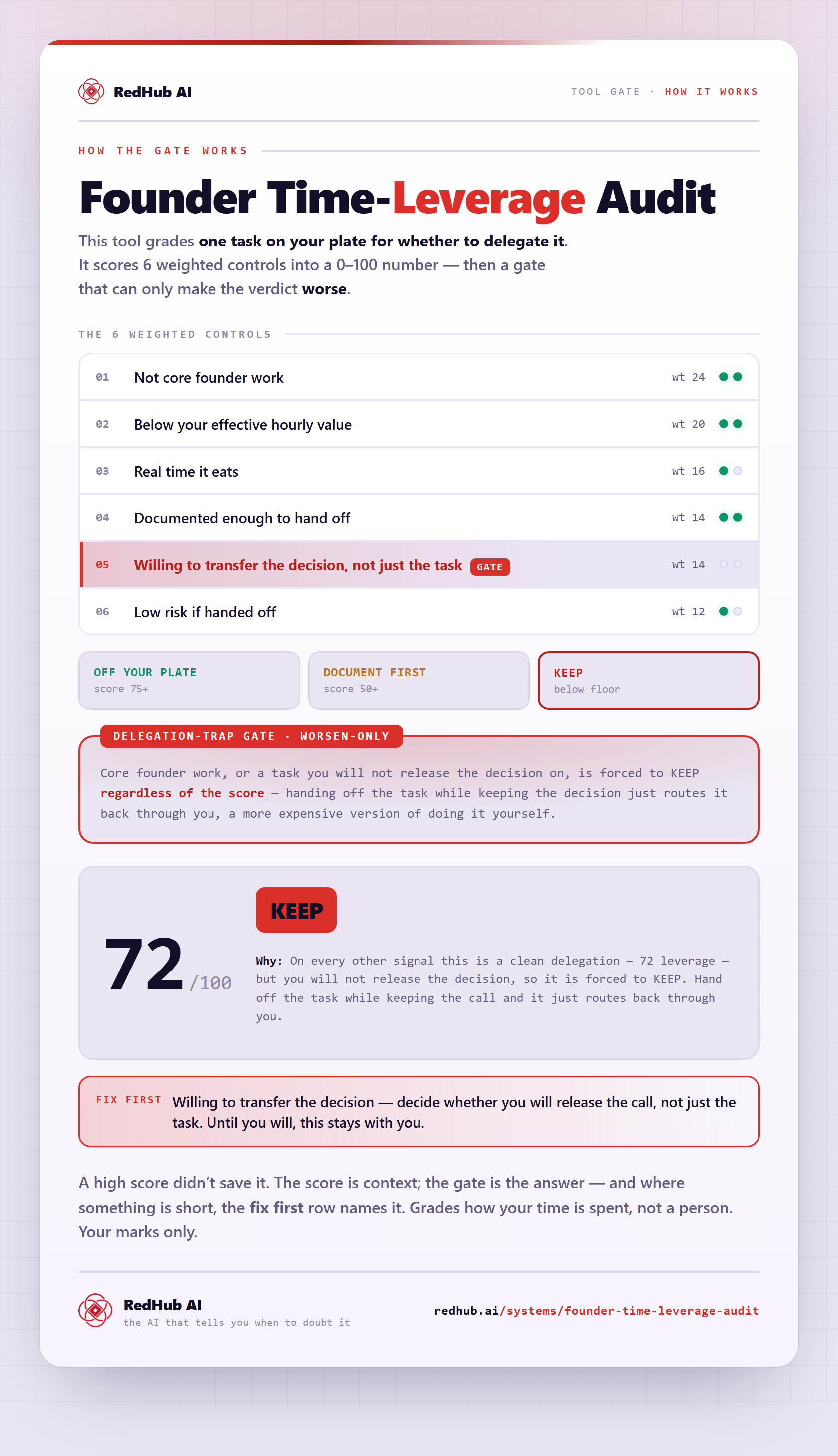
The gate this post refers to, drawn from the tool’s own logic. See the tool.