Google & Yahoo Bulk Sender Requirements Explained
RedHub AI Editorialupdated August 18, 20264 min read

Jump to a section8
TL;DR
- What it is: rules Google and Yahoo enforce on anyone sending 5,000 or more emails a day to personal Gmail or Yahoo addresses.
- Who it's for: any business sending real email volume, even if you don't think of yourself as a "bulk sender."
- How it works: authenticate with SPF and DKIM, publish a DMARC record, add one-click unsubscribe, and keep your complaint rate under 0.3%.
- Bottom line: miss one of these and mail to Gmail or Yahoo can get throttled or routed to spam — no warning email, just quieter delivery.
What are the Google Yahoo bulk sender requirements?
Since February 2024, Google and Yahoo require anyone sending 5,000 or more messages a day to personal Gmail or Yahoo addresses to authenticate with SPF and DKIM, publish a DMARC record (at least in monitor mode, p=none), include a one-click unsubscribe link using the List-Unsubscribe header, and keep their spam-complaint rate under 0.3%. Microsoft has published similar expectations for its own mailbox services. Miss any one of these and mail can get throttled or routed straight to spam, with no notification sent to you.
Best for: anyone sending real volume of marketing, transactional, or outreach email to consumer inboxes — check your own compliance with the Email Deliverability & DMARC Enforcement Readiness Gate.
"Bulk sender" sounds like it means someone else — a mass-market newsletter operation, not a normal business. In practice, the 5,000-per-day threshold is measured across a rolling window to personal addresses at one provider, and plenty of ordinary businesses cross it without realizing: a single big campaign day, a shared sending pool at your email platform, or simple growth over time.
Who this actually applies to
If you send 5,000 or more messages in a day to personal Gmail or Yahoo addresses, the rules apply to you — not just to obvious bulk senders. The count is per sending domain, and it adds up faster than most people expect once a business is running regular campaigns, transactional receipts, and outreach through the same domain.
The four requirements, plainly
| Requirement | What it means | How to check |
|---|---|---|
| SPF + DKIM | Your domain is properly authenticated | See SPF and DKIM explained |
DMARC (p=none minimum) | A policy record exists, even if it isn't enforcing yet | See DMARC explained |
| One-click unsubscribe | Every commercial message lets a reader leave in one click, no login required | Check your List-Unsubscribe header, or ask your sending platform |
| Complaint rate under 0.3% | Recipients aren't routinely hitting "report spam" | Check your platform's postmaster or complaint dashboard |
What happens if you don't comply
There's no warning email. Mail simply gets throttled, bulk-classified, or routed straight to spam. A complaint rate above 0.3% is treated as a hard signal on its own — Google has said it aims to keep senders well under that, with 0.1% as a safer target to hold to.
How to check your own compliance
- Confirm whether you're sending 5,000 or more emails a day to personal Gmail or Yahoo addresses.
- Verify SPF and DKIM are passing, and that a DMARC record is published.
- Confirm every commercial send includes a List-Unsubscribe header with one-click support.
- Check your spam-complaint rate in Google Postmaster Tools or your platform's equivalent dashboard for Yahoo.
These are deliverability rules, not legal rules. Meeting Google's and Yahoo's sender requirements is separate from legal email compliance like CAN-SPAM or GDPR. Satisfying one doesn't automatically satisfy the other, and this isn't legal advice.
Read the original guidance directly: Google's bulk sender guidelines (opens in a new tab) and Yahoo's sender best practices (opens in a new tab).
This matters most where volume spikes fastest. A CRM Win-Back System re-engagement push or a Lead-to-Meeting Engine outreach campaign can cross the 5,000-a-day threshold in a single send — check compliance before you launch, not after delivery drops.
Check every bulk-sender signal at once
The Email Deliverability & DMARC Enforcement Readiness Gate grades SPF, DKIM, DMARC, alignment, one-click unsubscribe, and complaint headroom against the Google, Yahoo, and Microsoft rules — ENFORCING, AT RISK, or FAILING, per domain.
Get the Readiness Gate — $79 →See how this fits the bigger picture in email deliverability, explained.
Decision Guide
Check this now if: you send marketing, transactional, or outreach email and aren't sure whether you cross 5,000 messages a day to Gmail or Yahoo.
You're likely fine if: SPF, DKIM, and DMARC all pass, unsubscribe is one click everywhere, and your complaint rate sits comfortably under 0.3%.
Best first step: pull your complaint rate from your sending platform's dashboard — it's the number most senders have never actually looked at.
Common Questions
What are the Google Yahoo bulk sender requirements?
Rules requiring anyone sending 5,000+ daily emails to personal Gmail or Yahoo addresses to authenticate with SPF and DKIM, publish a DMARC record, add one-click unsubscribe, and keep spam complaints under 0.3%.
Does the 5,000-a-day threshold apply to me?
If you send that volume to personal Gmail or Yahoo addresses in a day, yes — even if you don't think of your business as a bulk sender. Shared sending pools and campaign spikes push many businesses over it unknowingly.
What if I use an email service provider?
Your provider may handle some infrastructure, but SPF, DKIM, DMARC, and your complaint rate are still tied to your own sending domain and reputation. Confirm your provider's setup meets the requirements — don't assume it does.
Do I need full DMARC enforcement (reject) to comply?
No. The requirement is a published DMARC record at minimum p=none. Full enforcement is good practice, covered in DMARC explained, but it isn't the bare minimum required here.
What's the spam-complaint rate ceiling?
Google says never cross 0.3%, and recommends keeping complaints under 0.1% for safety. Crossing 0.3% is treated as a hard signal that gets mail demoted to spam.
Is this the same as CAN-SPAM compliance?
No. These are mailbox-provider deliverability rules, separate from legal requirements like CAN-SPAM or GDPR. Meeting one doesn't automatically satisfy the other, and this isn't legal advice.
Where do I check my own compliance?
Verify your SPF, DKIM, and DMARC status, confirm one-click unsubscribe on every commercial send, and check your complaint rate in your platform's postmaster dashboard. A readiness tool can grade all of it against these rules at once.
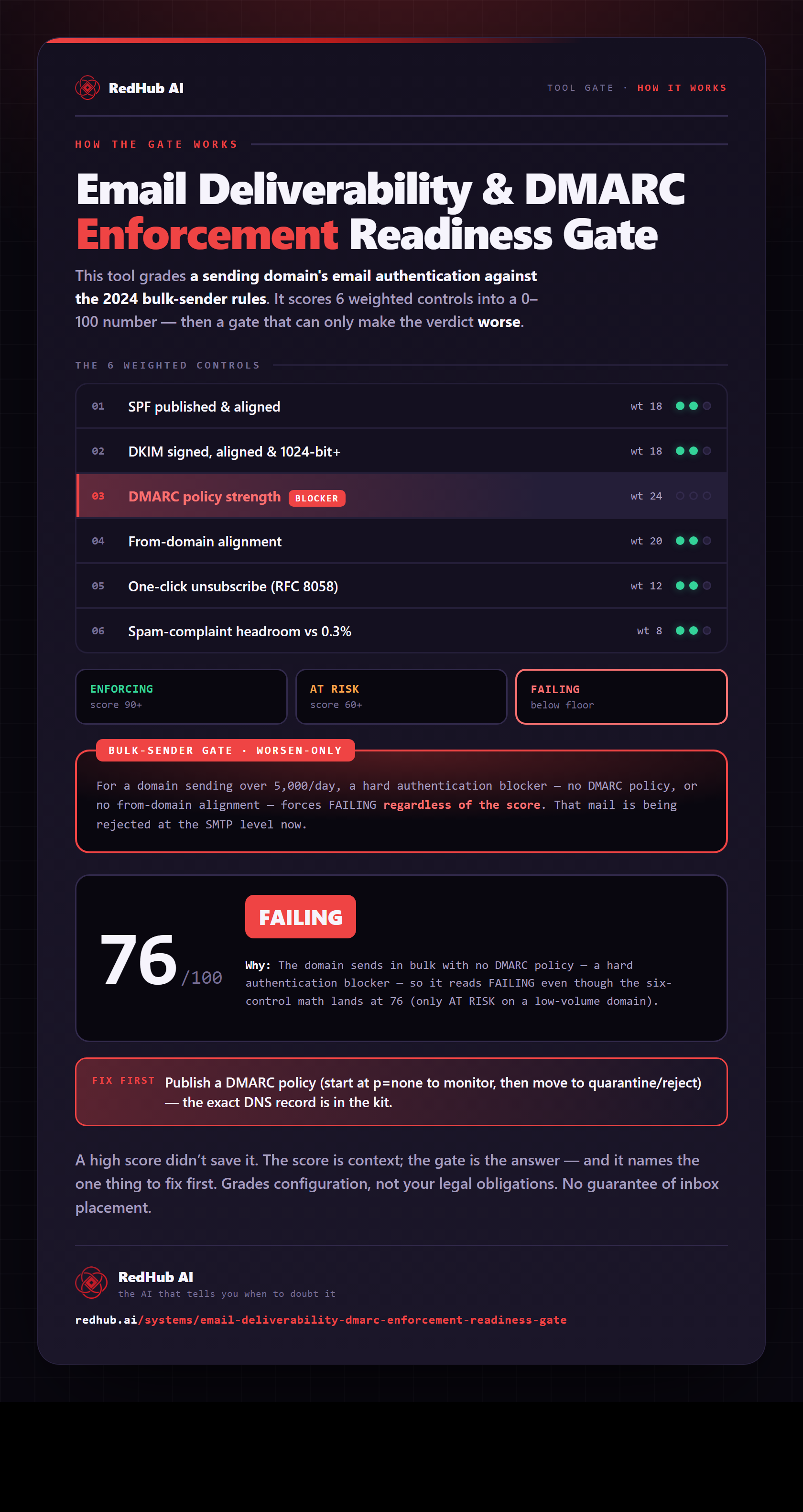
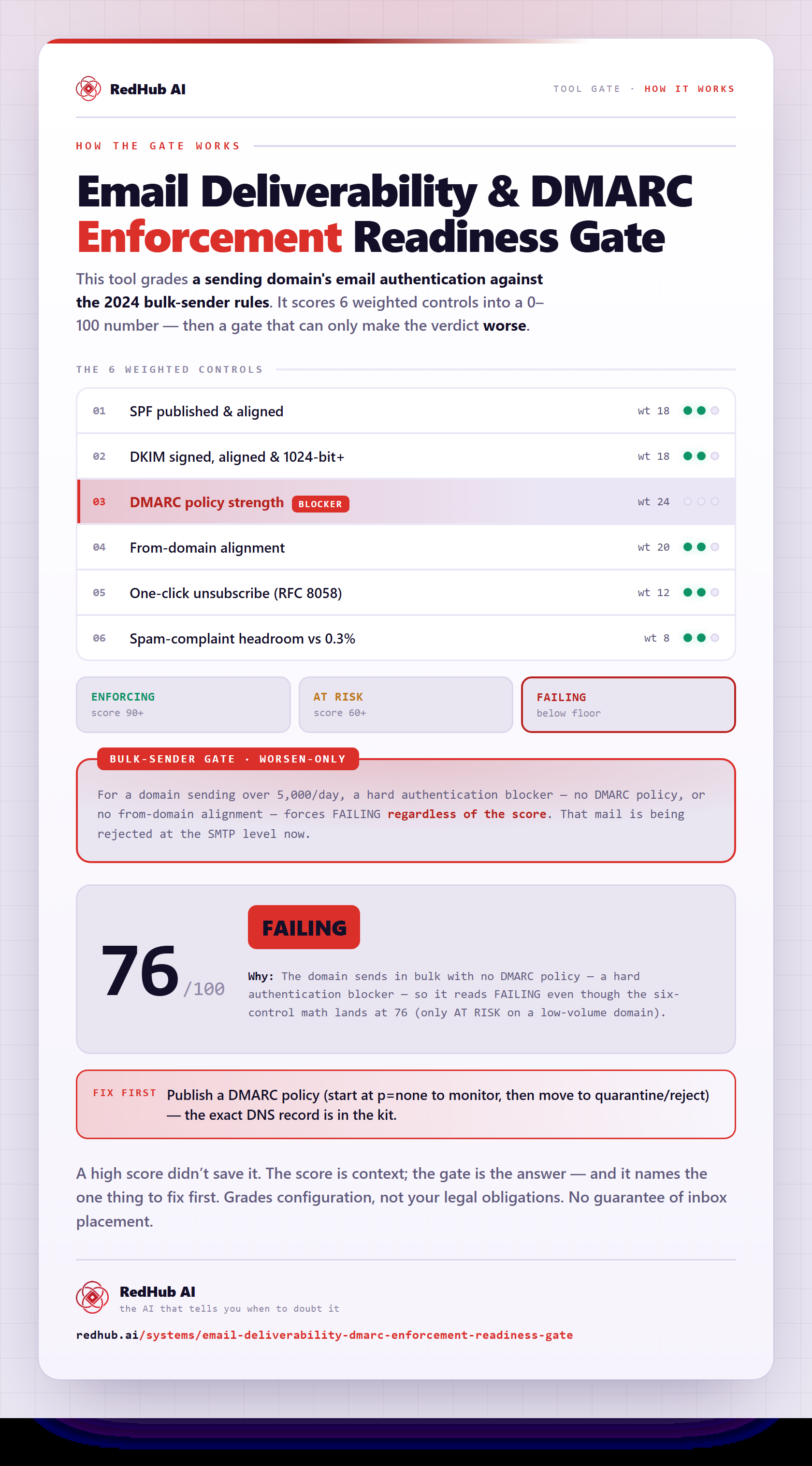
The gate this post refers to, drawn from the tool’s own logic. See the tool.