LLM API Cost Control: 5 Controls That Actually Cap Spend
RedHub AI Editorialupdated August 18, 20265 min read

Jump to a section9
TL;DR
- What it is: LLM API cost control is the set of controls — scoped keys, rate limits, model routing, caching, and a hard cutoff — that cap what your AI calls actually cost.
- Who it's for: Anyone shipping an AI feature on usage-based billing — see the AI Spend Runaway & Billing-Safeguard Gate.
- How it works: Four controls shrink day-to-day cost; the fifth — a hard cutoff — is the backstop against the worst case.
- Bottom line: Cost control isn't one setting. It's five habits working together, with one non-negotiable backstop.
What is LLM API cost control?
LLM API cost control is the combination of practices that keep AI API spend predictable: scoping and rate-limiting keys per project, routing requests to the cheapest model that can do the job, caching repeat requests instead of re-paying for them, and backing all of it with a hard spend cutoff for the cases the other controls don't catch. Each control shrinks a different kind of waste — the cutoff is the only one that also protects against a genuine runaway.
Best for: teams shipping an AI feature who want predictable day-to-day cost, not just protection from disaster — see the Token Economics Workbook for modeling exact per-unit cost.
LLM API cost control gets talked about like it's one lever — set a spending cap and move on. It's actually five separate habits, and most teams that get surprised by their bill are missing at least three of them. None of these controls are exotic. They're the same practical habits that keep any metered resource in check, applied to AI calls specifically.
The five controls, in plain English
- Scoped keys per project. Instead of one shared key across every feature, give each project or environment its own key with only the permissions it needs. A cost spike in one project is now visible and isolated instead of buried in one combined bill.
- Rate limits per key. Cap how many requests a single key can make per minute. This slows down both accidental loops and malicious abuse before either can generate a large bill.
- Model routing. Not every request needs your most expensive model. Route simple, high-volume tasks to a cheaper model and reserve the expensive one for the calls that actually need its capability.
- Caching and deduplication. If the same input produces the same output, cache it. Paying twice for an identical request is pure waste, and it compounds fast at volume.
- A hard spend cutoff. The backstop. The first four controls reduce normal cost. Only a real hard cutoff — not a notify-only "limit" — protects against the case where something breaks and none of the other four controls apply anymore.
Key insight: the first four controls make your normal bill smaller and more predictable. The fifth is the only one that matters when something goes wrong. Skipping it because "the other four should catch it" is the mistake that leads to a runaway bill — see why API spending limits don't stop runaway bills for how to build a real one.
Where each control actually saves money
Illustrative comparison of typical day-to-day cost impact, not a measured benchmark — model routing and caching tend to move the normal bill the most; rate limits and key scoping mainly control the worst case and improve visibility.
Model routing without breaking quality
The fear with model routing is quality loss — sending a hard task to a cheap model and getting a worse answer. The fix is to route by task, not by default: classify requests by how much reasoning they genuinely need, send routine, high-volume, low-stakes calls to the cheaper model, and reserve the expensive one for anything where quality actually moves the outcome. Most teams find that a large share of their volume is routine enough to route down without anyone noticing a quality difference.
Caching is the easiest win most teams skip
If your product sees the same or highly similar requests repeatedly — a common FAQ, a repeated document, a standard classification — caching the response means you pay for the generation once, not every time. This is one of the highest-leverage, lowest-risk controls on the list, because it costs nothing in quality and only requires identifying which requests actually repeat.
Why the hard cutoff still matters even with the other four in place
Model routing, caching, and rate limits all assume the system is working as designed. They don't help at all if a key leaks, an agent gets stuck in a loop, or a bug causes a request storm — those situations bypass all four normal controls. That's exactly why the hard cutoff is treated as a separate, non-negotiable backstop rather than a fifth optimization. For the full six-safeguard grading of that backstop, see how to stop a runaway AI bill before it happens.
If you want to go further and model exactly what each request costs per unit — not just cap it — that's a separate exercise covered by the Token Economics Workbook.
Cap the worst case while you optimize the everyday cost
The AI Spend Runaway & Billing-Safeguard Gate ($49, one-time) grades whether your hard cutoff — and five other safeguards — are actually in place, so the backstop behind your cost controls is real, not assumed.
Get the Gate — $49 →Decision Guide
Start here if: you've never separated your AI keys by project, or you're routing every request to your most expensive model by default.
Skip the deep dive if: you already scope keys per project, route by task complexity, cache repeat requests, and have a tested hard cutoff behind it all.
Best first step: pick your single highest-volume request type and ask whether it truly needs your most expensive model. That's usually the fastest win.
FAQ
What is LLM API cost control?
It's the combination of scoped keys, rate limits, model routing, caching, and a hard spend cutoff that together keep AI API spend predictable and capped, instead of relying on one setting.
Does model routing hurt output quality?
Not if you route by task. Send routine, low-stakes requests to a cheaper model and reserve the expensive one for tasks where quality genuinely changes the outcome, instead of defaulting every request to your top-tier model.
Is caching worth the setup effort?
Usually yes, if any meaningful share of your requests repeat. You pay for the generation once instead of every time, with no quality tradeoff — one of the highest-leverage, lowest-risk controls available.
Do rate limits alone prevent a runaway bill?
No. Rate limits slow down abuse and loops, but they don't create a hard ceiling. A determined loop or a large-scale leak can still generate a large bill within a rate limit — only a real hard cutoff stops it entirely.
What's the difference between cost control and a runaway safeguard?
Cost control (scoping, routing, caching, rate limits) shrinks your normal, day-to-day bill. A runaway safeguard — the hard cutoff — is the separate backstop for when something breaks and the normal controls no longer apply.
How do I model exactly what each request costs?
That's a separate exercise from capping spend — see the Token Economics Workbook for modeling cost per token and per unit.
Make sure the backstop behind your cost controls is real
Grade your hard cutoff and five other safeguards in one deterministic pass — $49, offline, your own marks.
Get the AI Spend Runaway & Billing-Safeguard Gate — $49 →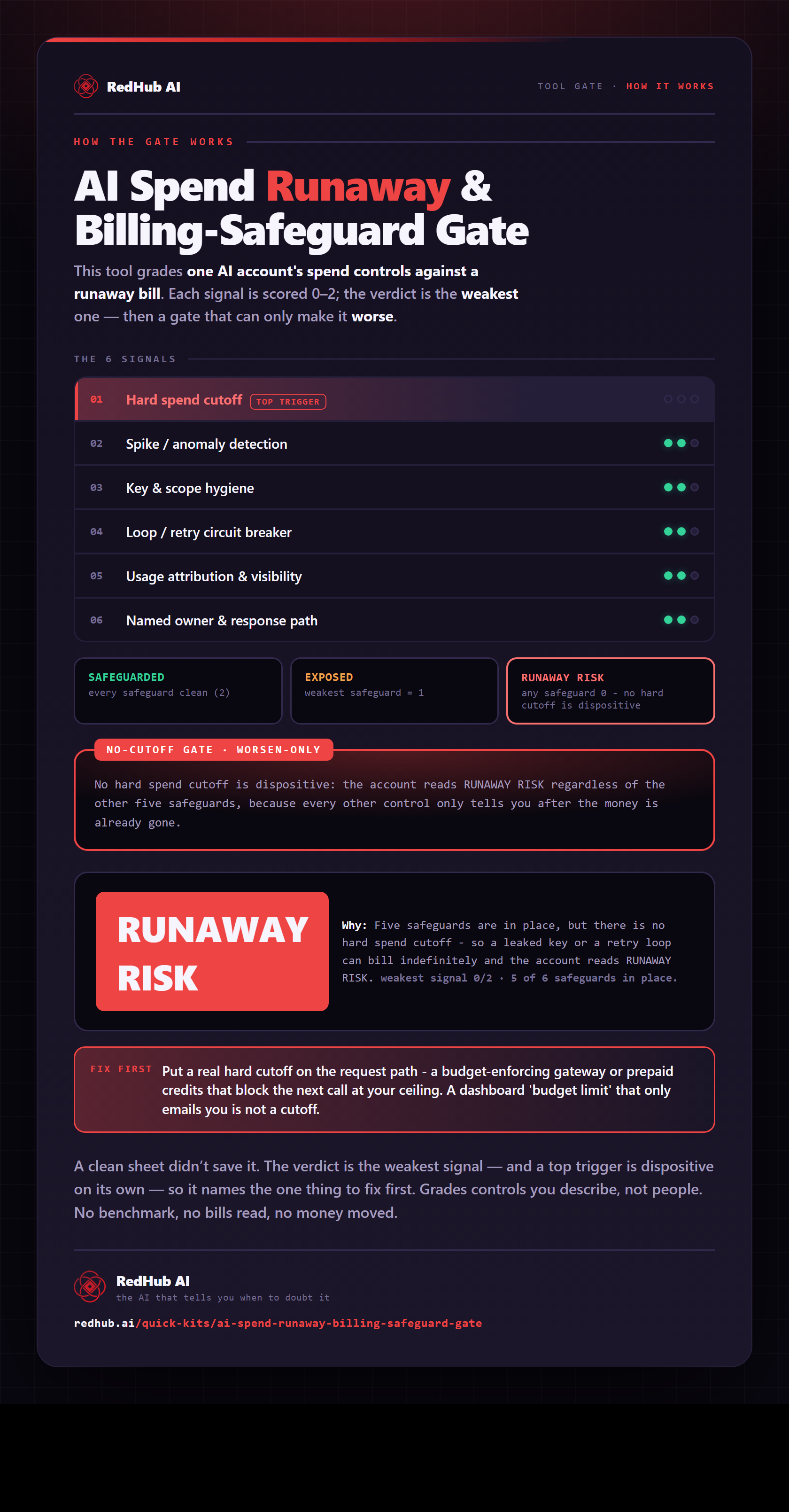
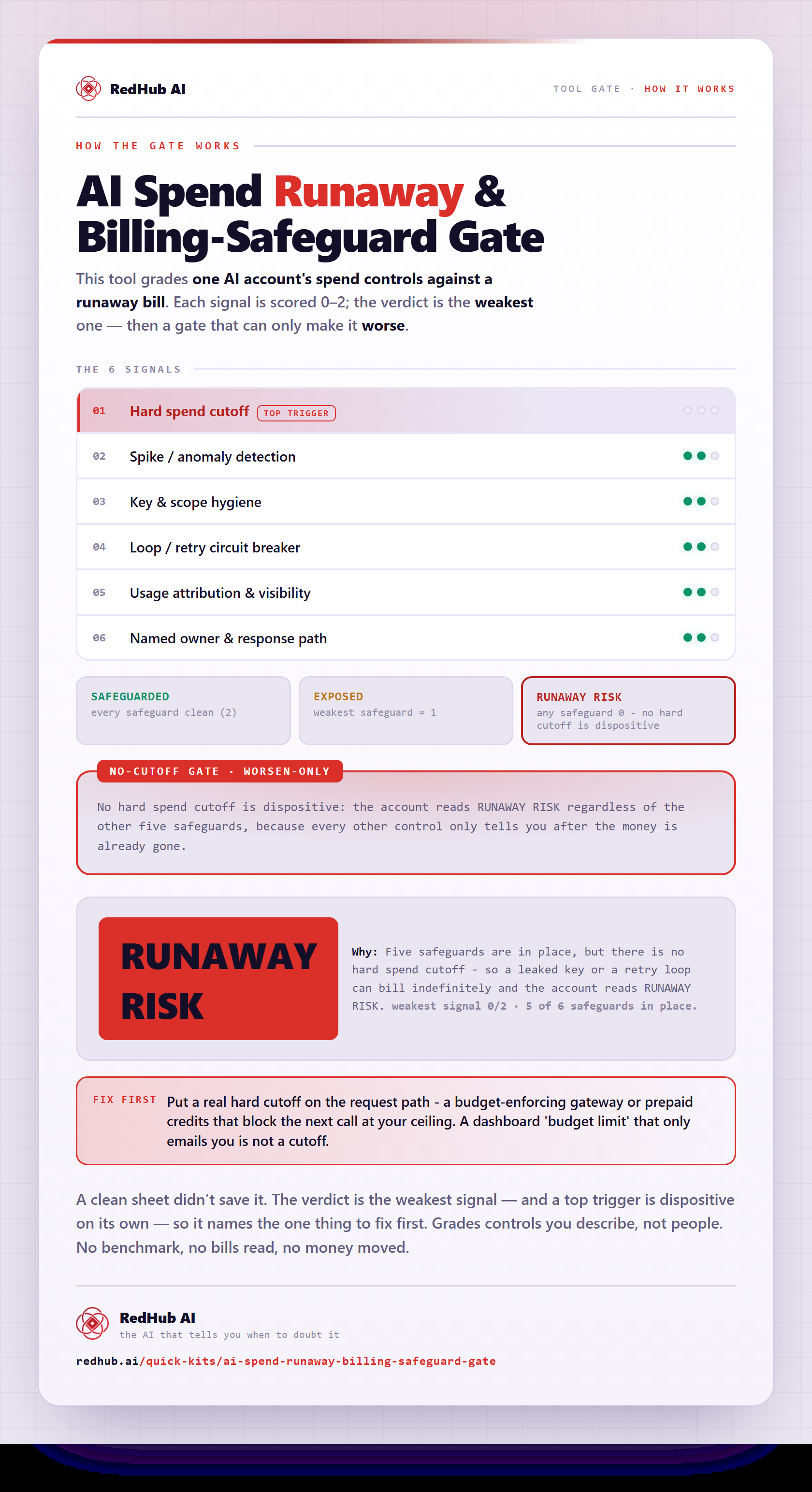
The gate this post refers to, drawn from the tool’s own logic. See the tool.