How Many Abandoned Cart Emails to Send
RedHub AI Editorialupdated November 5, 20267 min read

Jump to a section7
Send at least two abandoned cart emails, and three if each one has a job the others do not. That is the short answer to how many abandoned cart emails to send. One message is a reminder with no follow-up. A second message gives the shopper who was still deciding something new to act on. A third can close the loop. The usual reason stores stop at one is a fair fear of nagging, and the answer to that fear is suppression, not silence.
TL;DR: Two distinct messages is the minimum, and three distinct messages earns full marks on sequence depth. On a seven-lever grade, a one-message flow reads DORMANT whatever it scores. Give each message its own job: reminder, then the likely hesitation, then an optional final nudge. Handle the annoyance risk with purchase and opt-out suppression, and stop adding messages when you run out of distinct jobs.
Why one message is a hard ceiling
Sequence depth is the heaviest of the seven levers in the Cart-Recovery Sequence Effectiveness Gate, at 22 of 100 points. Its marks are simple. One message, or none, is a 0. Two messages is a 1. Three or more across the recovery window is a 2.
Depth also carries a gate. A flow with depth at 0 reads DORMANT, the lowest verdict, no matter how it scores on the other six. The workbook’s sample row “Flagship store (single email)” shows it. That flow is made up to make the point: full marks on all six other levers, a score of 78 out of 100, and a verdict of DORMANT. The Gate column reads FIRED.
Here is what each extra message does to that same flow.
| Distinct messages | Depth mark | Depth points | Score | Verdict |
|---|---|---|---|---|
| 1 | 0 | 0 | 78 | DORMANT (gate fired) |
| 2 | 1 | 11 | 89 | OPTIMIZED |
| 3 or more | 2 | 22 | 100 | OPTIMIZED |
The second message changes the verdict. The third adds 11 more points. On a flow that is weak elsewhere, the third message can be the difference between bands too, so it is worth building if you can give it a real job.
What goes in each message
“Send more emails” is weak advice by itself. Each message has to do something the one before it did not. Otherwise you have one message, repeated.
- Message 1: the reminder. Send it while intent is warm, around an hour after the shopper leaves. Show the actual items left in the cart, with images, names and prices. Leave the discount out. Job: catch the shopper who simply got pulled away.
- Message 2: the hesitation. Send it within the next one to three days. Answer what likely stopped the purchase: shipping cost, sizing, returns, a support contact. Do not just repeat the reminder. Job: catch the shopper who was still deciding.
- Message 3: the final nudge (optional). Send it near the end of that window. Close the loop. If you use an incentive at all, a later touch like this is where the grader’s discount lever wants it. Job: give the last holdouts a clear final reason to come back.
| Message | Roughly when | Job | Leave out |
|---|---|---|---|
| 1 | Around an hour after abandon | Reminder with the real cart contents | Discount code |
| 2 | Within one to three days | Answer the likely hesitation | A repeat of message 1 |
| 3 (optional) | Near the end of the window | Final, time-bound nudge | A new pitch unrelated to the cart |
The annoyance fear, handled with suppression
The fear is reasonable. Repeated emails about one cart can feel like nagging. They feel worst to someone who already bought, maybe through another channel, or who already opted out. Sending fewer messages does not fix that. Stopping the flow the moment it stops being relevant does.
Suppression is its own lever, worth 8 points, and it has a rule of its own: “A 0 on Purchase & opt-out suppression caps the result at UNDERPERFORMING, regardless of score.” A flow with three strong messages and no suppression cannot read OPTIMIZED. So depth and suppression go together. Add the second message and the stop rule in the same change.
- Check purchase status before every send. Each step should re-check whether the shopper has bought since the last message, through any channel. Look at: whether your platform re-evaluates the exit condition at each step or only when the flow starts.
- Honor opt-outs in the recovery flow too. Someone who opted out should not keep getting cart emails. Whether a given message legally needs an opt-out is a separate legal question. The grader only asks whether your flow suppresses opt-outs. Look at: whether the recovery flow reads the same suppression list as your other campaigns.
- Stop the flow from restarting. A shopper who re-adds the same item should not get the whole sequence again inside the same window. Look at: your platform’s re-entry setting for the flow.
The top mark on suppression is real-time suppression of buyers and opt-outs across channels. Doing one but not the other, or doing it with a lag, is a 1.
How many is too many
If two is the floor and three earns full marks, is there a ceiling? The grader does not set one. Three or more all mark as 2, so a fourth message adds no points. That leaves the choice to you, and the test is the job.
A reminder, a hesitation message and a final nudge are three different jobs. A fourth message often turns out to be one of those three again in new copy. That is not a rule against longer flows. A high-ticket, considered purchase may have a real fourth job, such as offering a call with your team. Before you add one, write its job in one sentence. If the sentence repeats an earlier message’s job, fix the spacing or the suppression on the messages you already have.
| Messages in the flow | What they usually do | What to check |
|---|---|---|
| 1 | Reminder only | The single-message gate holds the verdict at DORMANT |
| 2 | Reminder, then hesitation | Message 2 does something message 1 did not |
| 3 | Reminder, hesitation, final nudge | Each message has a job you can name |
| 4 or more | Often an earlier job in new copy | Name the job first, and re-test suppression |
Deciding your own depth
Count the distinct messages that fire today. If it is one, add a second message with its own job before anything else, along with a purchase and opt-out stop rule. If it is two, check that message two is not a near-copy of message one, then decide whether a third has a real job. If it is three and each has a job, depth is done. The largest remaining gap is somewhere else.
Your weakest lever is not always depth. The grader names the fix with the most points left on the table, and on a flow with depth at 1 that can be a different lever. In one shipped sample row, two messages and a discount in the first email, it names Discount discipline first, because that lever has 12 points open and depth has 11.
Timing is the next-heaviest lever at 20 points, and it is covered in the next post in this guide. The Cart-Recovery Sequence Effectiveness Gate marks all seven levers for up to five flows and, when a lever falls short, names the one to fix first. It reads your marks, not your platform, so the counting above is still your job.
More in this guide
Frequently asked questions
How many abandoned cart emails should I send?
At least two distinct messages: a reminder around an hour after the abandon, then a follow-up within one to three days that answers a likely hesitation. A third distinct message, such as a final nudge, earns full marks on sequence depth.
Is one abandoned cart email enough?
Not on the Cart-Recovery Sequence Effectiveness Gate. A one-message flow reads DORMANT whatever its score. Its shipped sample of a single-email flow scores 78 out of 100 and still reads DORMANT.
Will sending more emails annoy my customers?
The annoyance usually comes from emailing someone who already bought or opted out. Re-check purchase status before every send, suppress opt-outs in the recovery flow, and stop the flow from restarting inside the same window.
Is sending the same email twice a two-message sequence?
No. A sequence counts distinct messages. The same content sent twice, even with a new subject line, is one message repeated.
Does a fourth abandoned cart email help?
On the seven-lever grade, three or more messages all earn the same full depth mark, so a fourth adds no points. Add one only if you can name a job it does that the first three do not.
Should my second email include a discount?
Not by default. The discount-discipline lever gives its top mark to a flow that leads with value and holds any incentive to a later touch or to price-sensitive segments. The discount post in this guide covers the margin math.
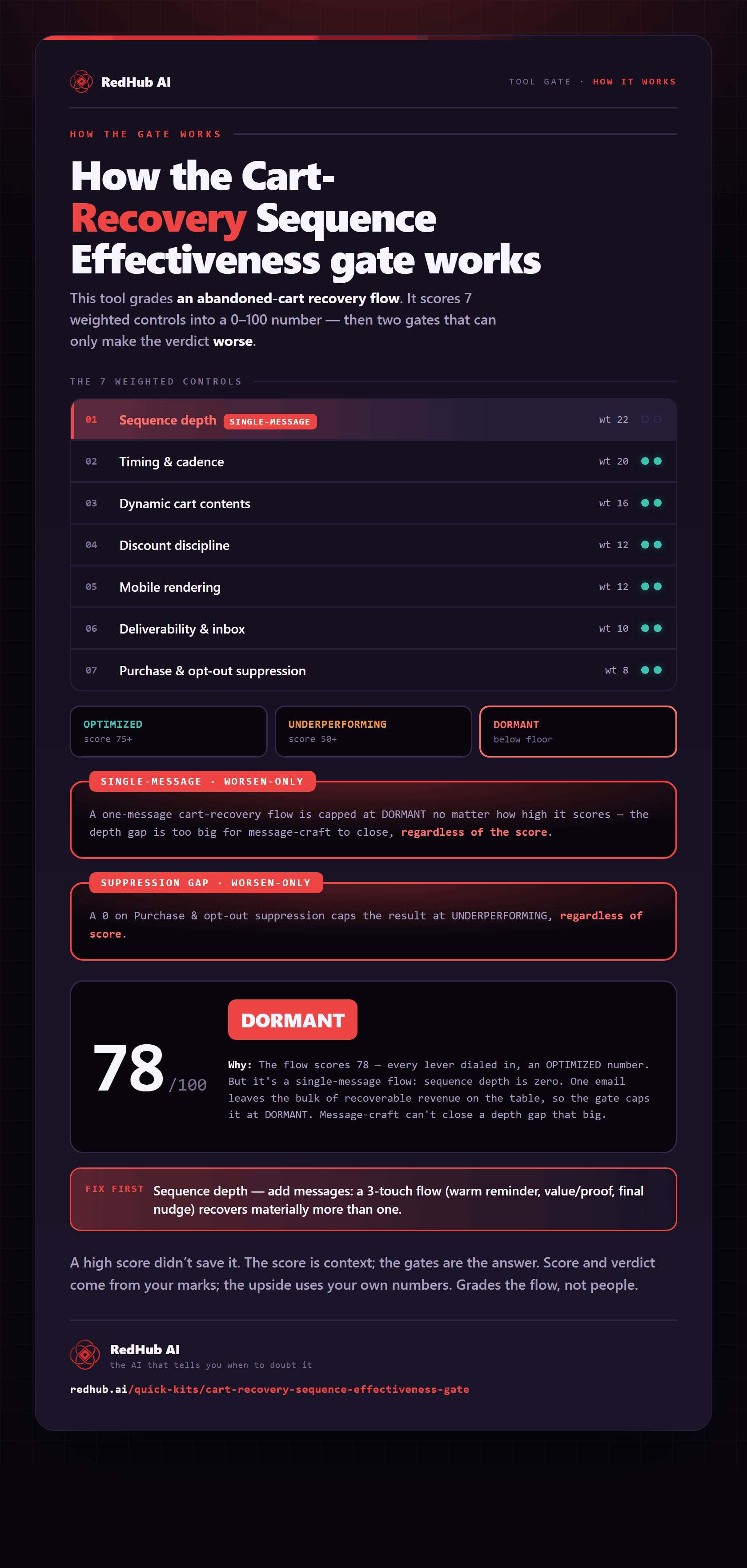
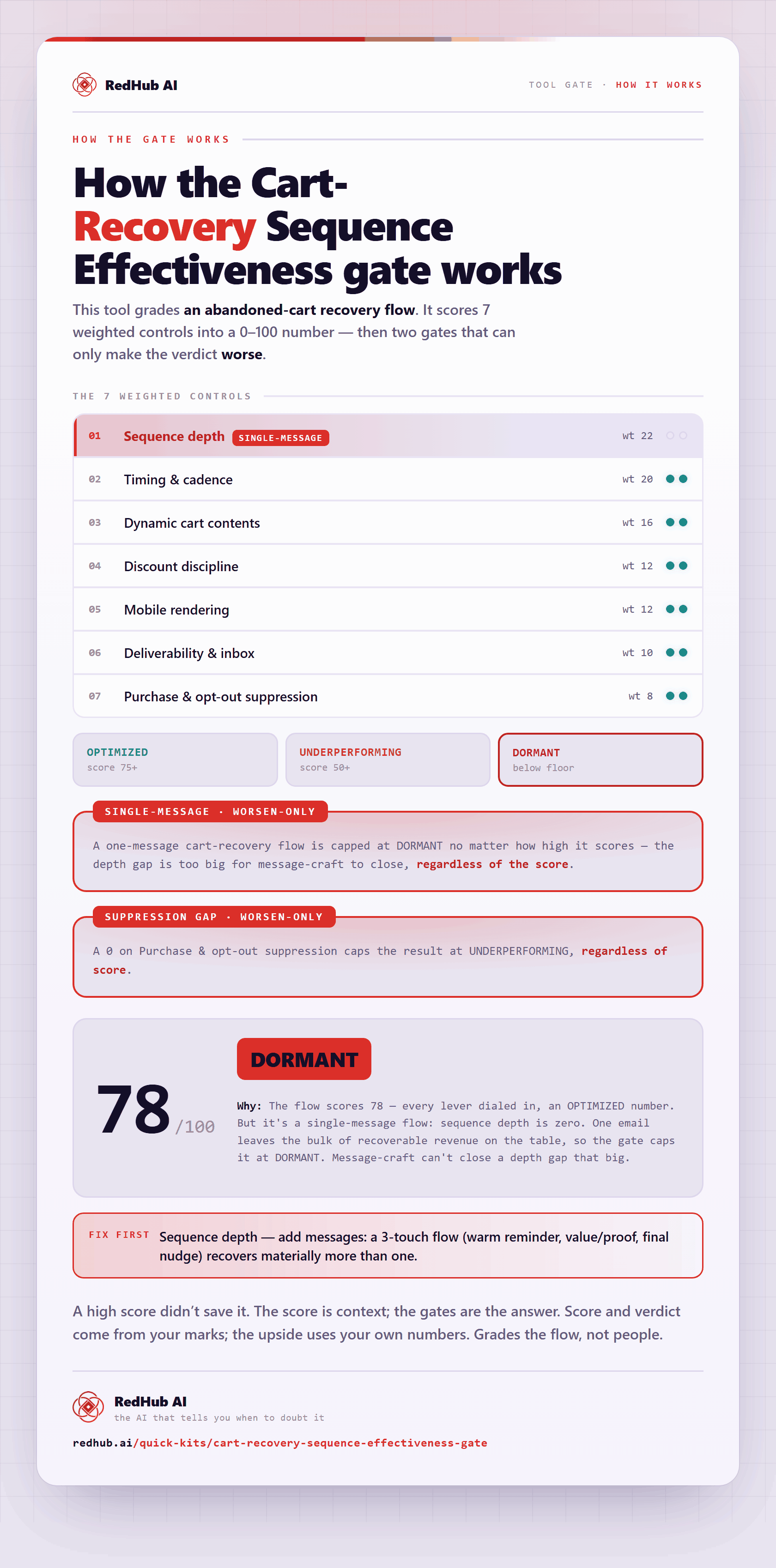
The gate this post refers to, drawn from the tool’s own logic. See the tool.