Abandoned Cart Email Timing: When Each Message Fires
RedHub AI Editorialupdated November 5, 20266 min read

Jump to a section7
Abandoned cart email timing runs on two clocks. The first-touch clock starts when the shopper leaves, and the first message should land while intent is still warm, around an hour later. The follow-up clock spaces the rest of the sequence across the next one to three days. A flow can have the right number of messages and still miss on either clock. Both misses are easy to check, and neither shows up by reading the flow editor alone.
TL;DR: Send message one around an hour after the abandon. Spread messages two and three across the next one to three days instead of bunching them. On a seven-lever grade, timing carries 20 of 100 points, just under sequence depth’s 22. Then time a real test abandon, because the delay you set and the time a message arrives are not always the same.
What the timing lever grades
In the Cart-Recovery Sequence Effectiveness Gate, timing & cadence has three marks. Here they are in the product’s own terms.
| Mark | What it describes | Points |
|---|---|---|
| 0 | No deliberate timing: one delayed blast, or all touches bunched together | 0 of 20 |
| 1 | Reasonable but unoptimized spacing | 10 of 20 |
| 2 | First touch while intent is warm (around an hour), with follow-ups across the next one to three days | 20 of 20 |
Notice that a 0 covers two opposite mistakes: too late and too bunched. One message sent the next morning is a 0. Three messages sent inside the same hour are also a 0.
Two clocks, two different failures
The first-touch clock is about warmth. A shopper who was interrupted, by a call or a closing tab, is still in a buying frame of mind for a while after they leave. Wait too long and the email arrives into a cold context, and it reads like any other marketing message instead of a reminder of something they were just doing.
The follow-up clock is about spacing. If message one did not work, sending message two right behind it reads as pressure. A gap of a day or more gives the shopper room to reconsider, compare, or wait for payday, while the cart is still recent enough that your next message makes sense.
- Set message 1’s delay. Aim for about an hour after the abandon. A short delay lets a shopper who stepped away come back on their own. Look at: the delay on step one of your flow, in minutes or hours, not the default your platform shipped with.
- Set message 2’s delay. Place it one to three days after the abandon, with real space after message one. Look at: the gap between step one and step two in your flow editor.
- Set message 3’s delay, if you use one. Place it near the end of that one-to-three-day window. Look at: whether the flow ends inside the window or drifts days past it.
| Message | Target window | Risk if too early | Risk if too late |
|---|---|---|---|
| 1 | Around an hour after the abandon | Lands while the shopper is still deciding on the site | Arrives into a cold context |
| 2 | Within one to three days | Reads as pressure right after message 1 | Loses the link to the original cart |
| 3 | Near the end of that window | Crowds message 2 | Drags past the point of relevance |
Why timing weighs almost as much as depth
Depth carries 22 points. Timing carries 20. The next lever, dynamic cart contents, carries 16. Depth gives the shopper more than one chance to come back. Timing decides whether each chance arrives when it can work.
Work it through on a flow that is strong everywhere except timing. Mark depth, contents, discount, mobile, deliverability and suppression at 2, and timing at 0. The score is 80, which is OPTIMIZED, and the grader names Timing & cadence as the fix to make first, because it has 20 points open and nothing else has any. Fix it to a 1 and the score is 90. Fix it to a 2 and it is 100.
Here is the complication. In that example the verdict was already OPTIMIZED, so the timing fix moves only the score. Timing has no gate of its own. A badly timed flow with strong depth can still read well, and a grade cannot see the sales the late email missed. That is why the live test below matters more than the mark.
The delay you set versus the time it arrives
A delay of “one hour” in your flow editor may not mean an email arrives one hour after the abandon. Platforms differ in how they detect an abandoned cart and how often they check for new ones. Some may run on a schedule, which adds lag on top of the delay you set. We are not going to tell you how any particular platform behaves. Its own documentation is the source for that, and a timed test settles it.
- Read your platform’s documentation. Find how it decides a cart is abandoned and when the flow’s clock starts. Look at: the help page for the specific abandoned-cart flow feature you use.
- Time a real test abandon. Add an item on your own site, leave, and write down the clock time. Note when each message arrives. Look at: the arrival time in your inbox against your delay settings.
- Repeat at a different time of day. One test can mislead. Look at: whether the gap is steady across tests or swings enough to matter.
- Adjust the setting to hit the real window. If there is steady lag, shorten the configured delay so the arrival lands where you want it. Look at: the pattern across tests, not one send.
Is one to three days right for your store?
It is the window the grader’s top mark describes, and it is a reasonable general range. It is not a law of nature. A store selling impulse-priced items and a store selling considered, high-ticket items do not have the same decision timeline.
Check your own data. Look at how long your shoppers usually take between a first visit and a completed purchase, using your analytics tool’s time-to-purchase or returning-visitor report. If your buyers routinely take a week, a follow-up window that closes on day three may end before most of them decide. In that case you may choose a longer runway and accept that you are working outside the grader’s top-mark description. That is a judgment call, and it is yours to make.
Timing is one of seven levers. The Cart-Recovery Sequence Effectiveness Gate marks all seven for up to five flows and, when any points are open, names the fix with the most. Why the cart was abandoned in the first place is a separate question, and the Checkout Friction & Abandonment Exposure Gate ($79) covers it. This post is about the chase, not the cause.
More in this guide
Frequently asked questions
When should the first abandoned cart email send?
While intent is still warm, around an hour after the shopper leaves. That is the first touch the top timing mark describes on the Cart-Recovery Sequence Effectiveness Gate.
How far apart should follow-up emails be?
Spread them across the one to three days after the abandon instead of sending them back to back. Bunching every touch together earns the same zero timing mark as one late blast.
How much does timing count in a cart-recovery grade?
On the Cart-Recovery Sequence Effectiveness Gate, timing & cadence carries 20 of 100 points, second only to sequence depth at 22. It has no gate of its own, so poor timing lowers the score without forcing a verdict.
How do I know if my timing is off?
Abandon a test cart on your own site, note the time, and record when each message arrives. Compare those times with your delay settings, and repeat the test at a different time of day.
Why might a delay setting not match the arrival time?
Platforms differ in how they detect abandoned carts and how often they check for them, which can add lag on top of the delay you set. Your platform’s documentation and a timed test send are the way to find out.
Is a one-to-three-day follow-up window right for every store?
It is a reasonable general range, but check your own time-to-purchase data. A considered, high-ticket product may need a longer runway than an impulse-priced one.
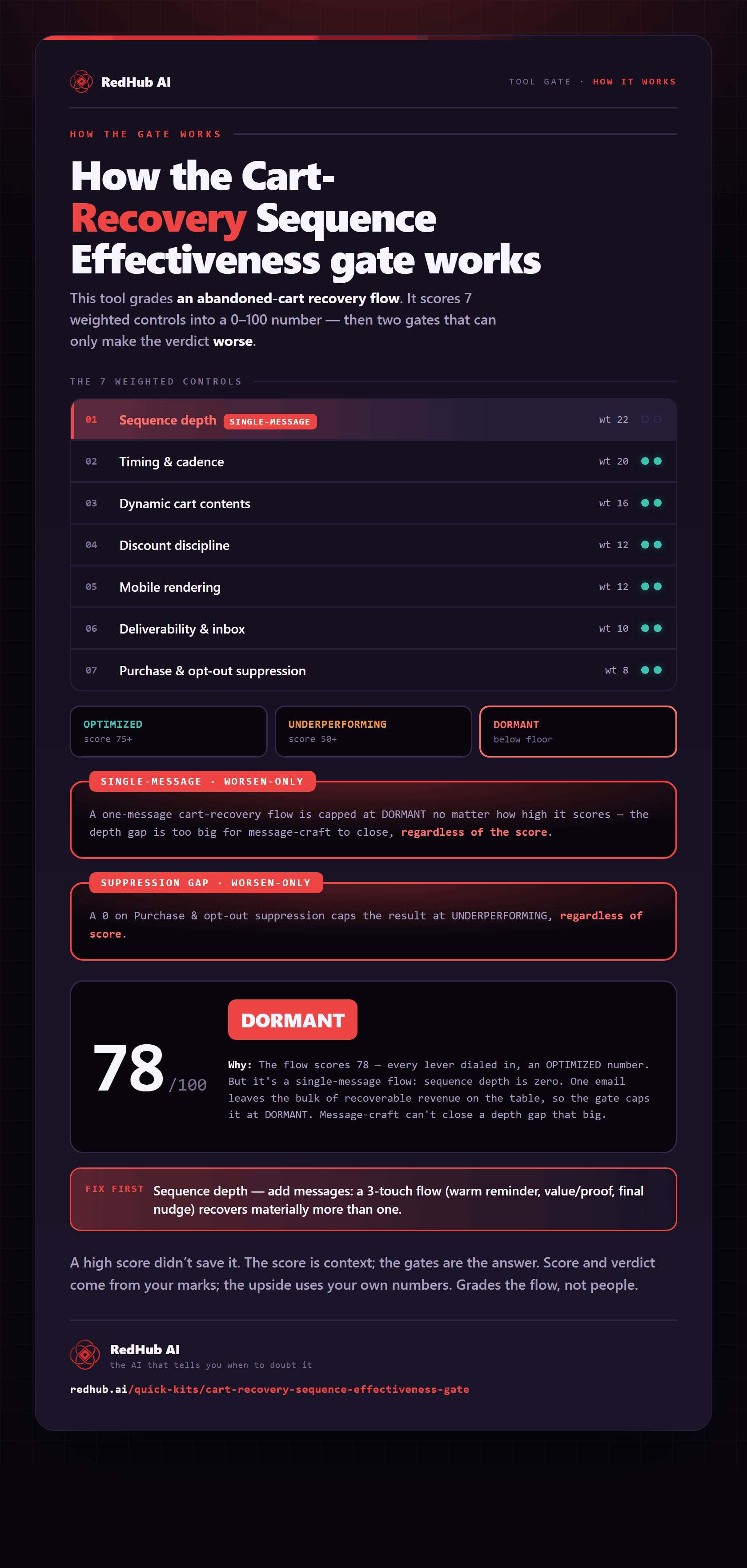
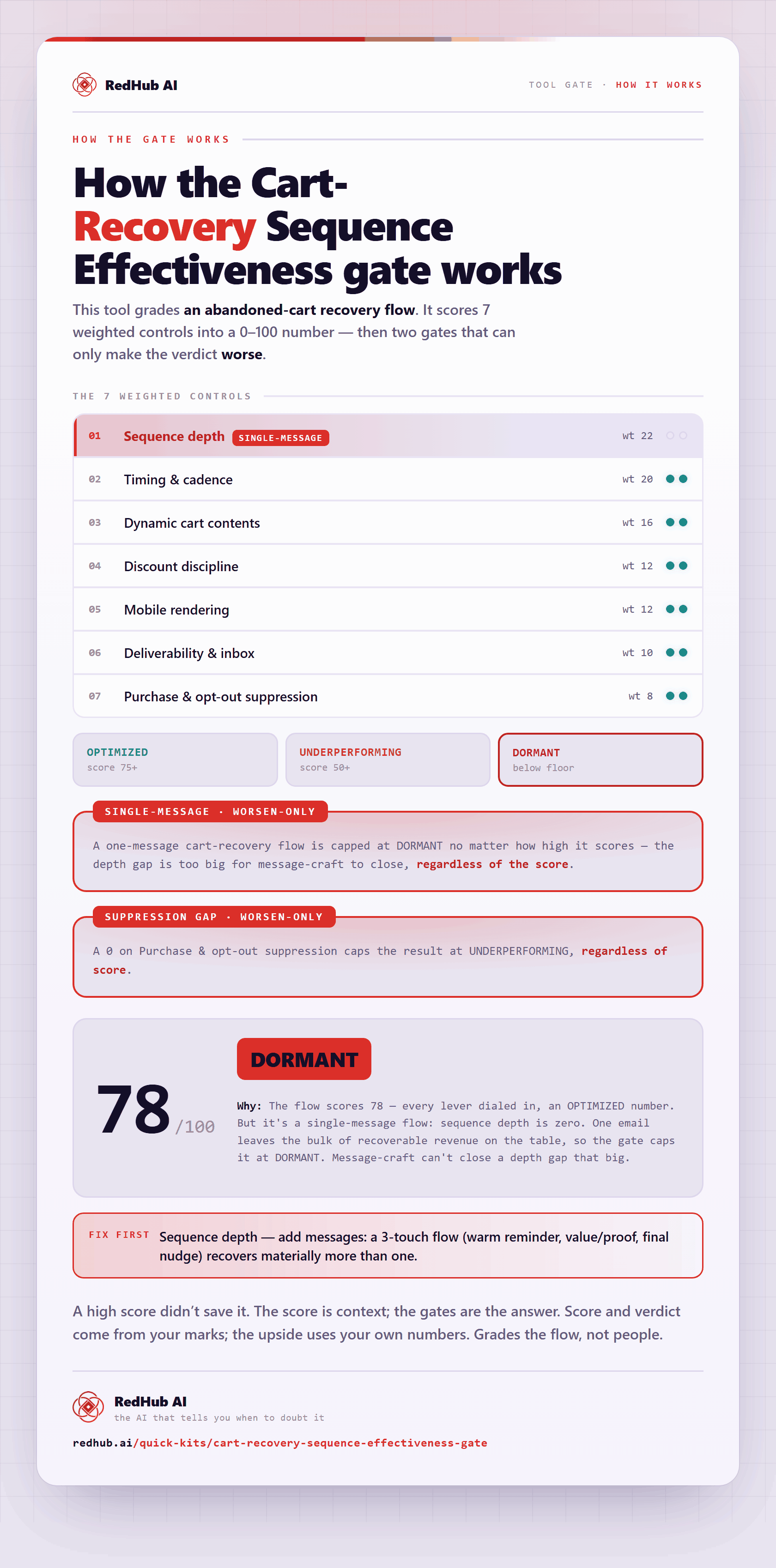
The gate this post refers to, drawn from the tool’s own logic. See the tool.