Abandoned Cart Discount: Should You Send One?
RedHub AI Editorialupdated November 5, 20266 min read

Jump to a section7
Not in the first message, and not automatically anywhere else. An abandoned cart discount can earn a place later in a sequence, aimed at shoppers whose hesitation is about price. Put a code in message one, for everyone, and you risk teaching shoppers that leaving a cart is how you get a discount. You also pay that discount on orders that would have come back without it. This post covers where a discount fits, how to check your own flow, and the margin math to run first.
TL;DR: Keep message one discount-free. If you discount at all, hold it to a later touch or to shoppers who show a price signal. Before you choose a depth, run the margin math: every shopper who would have bought anyway and uses the code costs you the full discount. On a seven-lever grade, discount discipline carries 12 of 100 points, and a blanket code in the first message is a 0.
The training risk
The concern is simple. If leaving a cart reliably produces a code within a day, some shoppers can learn to leave carts on purpose and wait. They are not gaming you. They are responding to a pattern you set. We do not have a number for how often this happens, and it will differ by store and by how visible the code is. The risk is the pattern, and you can check your own flow for it.
The answer is not to refuse ever to discount. It is to control where the discount appears and who sees it.
What the discount lever grades
The Cart-Recovery Sequence Effectiveness Gate marks discount discipline 0, 1 or 2. The lever is weighted 12, so the marks are worth 0, 6 or 12 points.
| Mark | What it describes | Points |
|---|---|---|
| 0 | An immediate blanket discount in the first message | 0 of 12 |
| 1 | A discount used, but early or the same for everyone | 6 of 12 |
| 2 | Value first, with any incentive held to a later touch or kept for price-sensitive segments | 12 of 12 |
The ladder does not describe a flow that never discounts. The mark 2 description, value first, is the closest fit, but it is your call. The marks are yours.
Twelve points can still decide the fix-first. A shipped sample row, “Home goods reminder pair,” has two messages, a blanket code in email one and middling marks elsewhere. It scores 50, reads UNDERPERFORMING, and names Discount discipline as the fix to make first. That is because discount has 12 points open and depth has 11.
A message-by-message discount decision
- Message 1: no discount. This message reminds and shows the cart. You do not yet know whether price was why the shopper left. Why: a code here is the pattern the lever’s 0 describes.
- Message 2: conditional, if at all. Tie any offer to a signal you define, such as a cart above a value you set or a product in your high-consideration range. Why: this aims the discount at shoppers whose hesitation is plausibly about price, instead of everyone.
- Message 3 (optional): a bounded last offer. If you use a third message, it is the least costly place for an incentive. It only reaches holdouts the first two did not move. Give it a real expiry, not a countdown that resets on every page load. Why: a real end date makes it a final offer, not a standing one.
| Message | Discount? | Condition | Margin exposure |
|---|---|---|---|
| 1 | No | — | None |
| 2 | Conditional | A price signal you defined | Only the shoppers who show that signal |
| 3 (optional) | Last offer | A real expiry | Only the remaining holdouts |
Check whether your flow already has the problem
This is a short audit you can finish in a few minutes.
- Open message 1 and look for a code. A code in the first email, every time, with no condition, is the pattern. Look at: the live email, not the template you think is running.
- Check whether the code is unique or evergreen. One standing code reused for every abandon is easier to learn and share than a code made per shopper. Look at: whether the code is identical across several test abandons.
- Search for the code in public. Search your brand name plus “discount code” or “coupon.” Look at: whether a code meant to be private shows up on deal sites or forums.
If all three come back clean, the training risk is low in your flow as it stands, even if you use a discount later in the sequence.
The margin math to run before you decide
A discount has two costs. The visible one is the margin you give up on orders it wins. The hidden one is the full discount you pay on orders that would have come back anyway. Run both with your own numbers.
- Find your gross profit per order. Average order value × gross margin, for the carts the discount would reach. Your number: gross profit per order.
- Find the discount cost per order. Average order value × discount depth. Your number: what each redeemed code costs.
- Find what is left on a discounted order. Gross profit minus discount cost. Your number: profit on each order the code wins.
- Compare the two. For each order that would have come back anyway, you lose the full discount cost. For each order the code actually wins, you keep the reduced profit. Your number: how many won orders you need to cover each giveaway.
Here it is on hypothetical numbers. A store with an $80 average order value and a 40% gross margin makes $32 gross profit per order. A 15% code costs $12 per order and leaves $20 on a discounted sale. Each shopper who would have bought anyway and uses the code costs $12. Each new order the code wins earns $20. So the code pays for itself only if it wins at least 3 new orders for every 5 it gives to shoppers who would have bought anyway, because 3 × $20 = 5 × $12 = $60.
Here is the complication. You do not usually know which redeemers would have bought anyway, so that ratio is hard to measure. A holdout test, where a random share of shoppers gets no code, is one way to estimate it. Even then, the answer belongs to your store and your margin. We are not going to say which side wins for you.
The Cart-Recovery Sequence Effectiveness Gate grades discount discipline as one of seven levers, from the mark you give. It does not run this margin math, and it does not read your codes. Use the steps above for the money question, and the grader for where discount sits among your other gaps. Why carts get abandoned in the first place, including surprise costs at checkout, is covered by the Checkout Friction & Abandonment Exposure Gate ($79).
More in this guide
Frequently asked questions
Should my first abandoned cart email include a discount?
Usually not. The first message should remind and show the cart, because you do not yet know whether price was the reason the shopper left. A blanket code in the first message risks teaching shoppers to wait for one.
What discount amount should I offer?
There is no right amount for every store. Work out gross profit per order, the cost of the code per order, and how many new orders it must win to cover the shoppers who would have bought anyway.
When does an abandoned cart discount pay for itself?
When the profit on the orders it wins covers the full discount paid to shoppers who would have bought anyway. With an $80 order, a 40% margin and a 15% code, each won order earns $20 and each giveaway costs $12, so it needs 3 wins for every 5 giveaways.
How do I know if my flow relies too much on discounts?
Look for a code in message one sent to everyone, check whether it is one evergreen code, and search your brand name plus coupon to see if the code is public.
Is free shipping better than a percent-off code?
It is a different tool. It removes a named cost instead of cutting the price, and it is often tied to a cart threshold. It still costs margin, so run the same math with your real shipping cost.
How does a cart-recovery grade score discounts?
On the Cart-Recovery Sequence Effectiveness Gate, discount discipline carries 12 of 100 points. A blanket discount in the first message is a 0, an early or undifferentiated discount is a 1, and value first with any incentive held back is a 2.
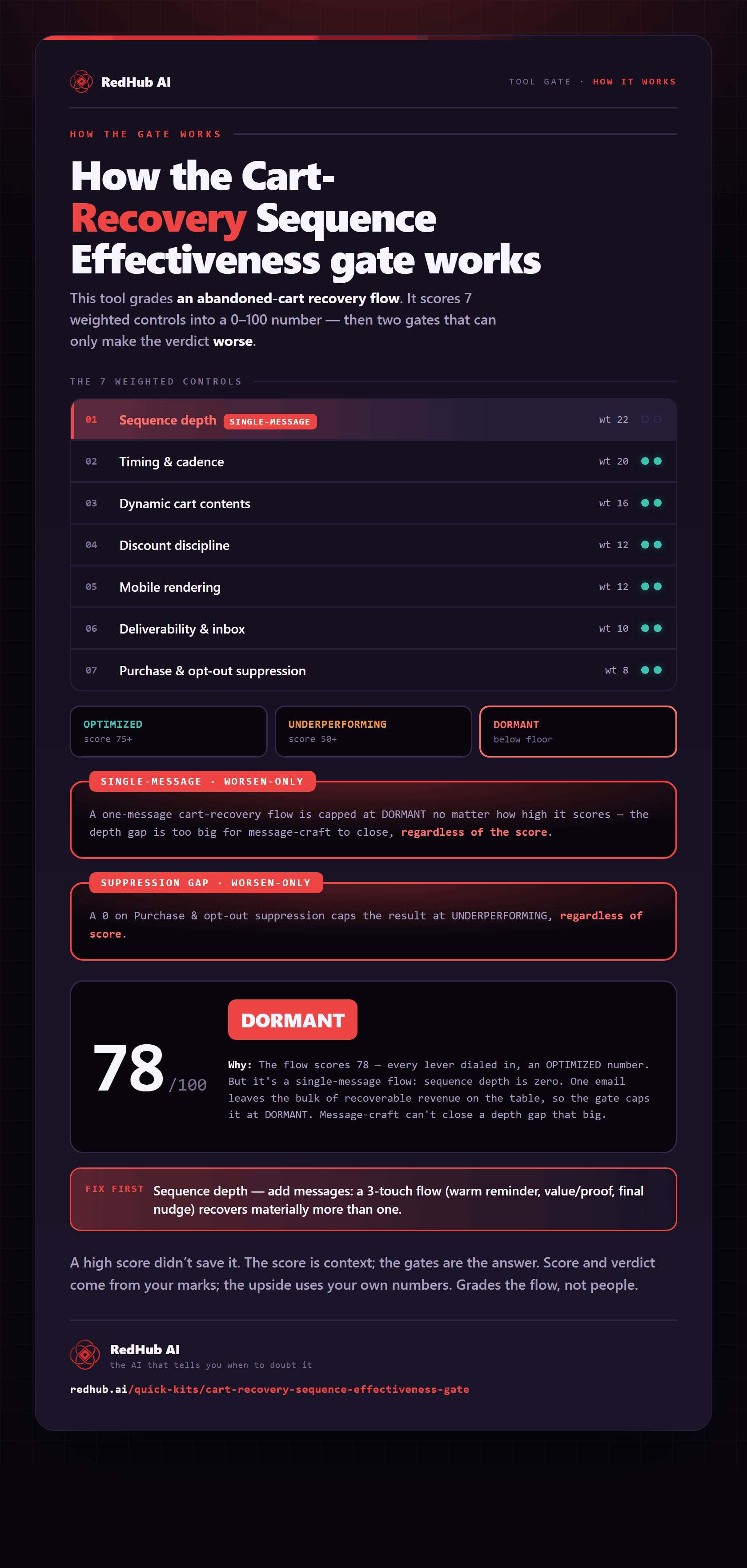
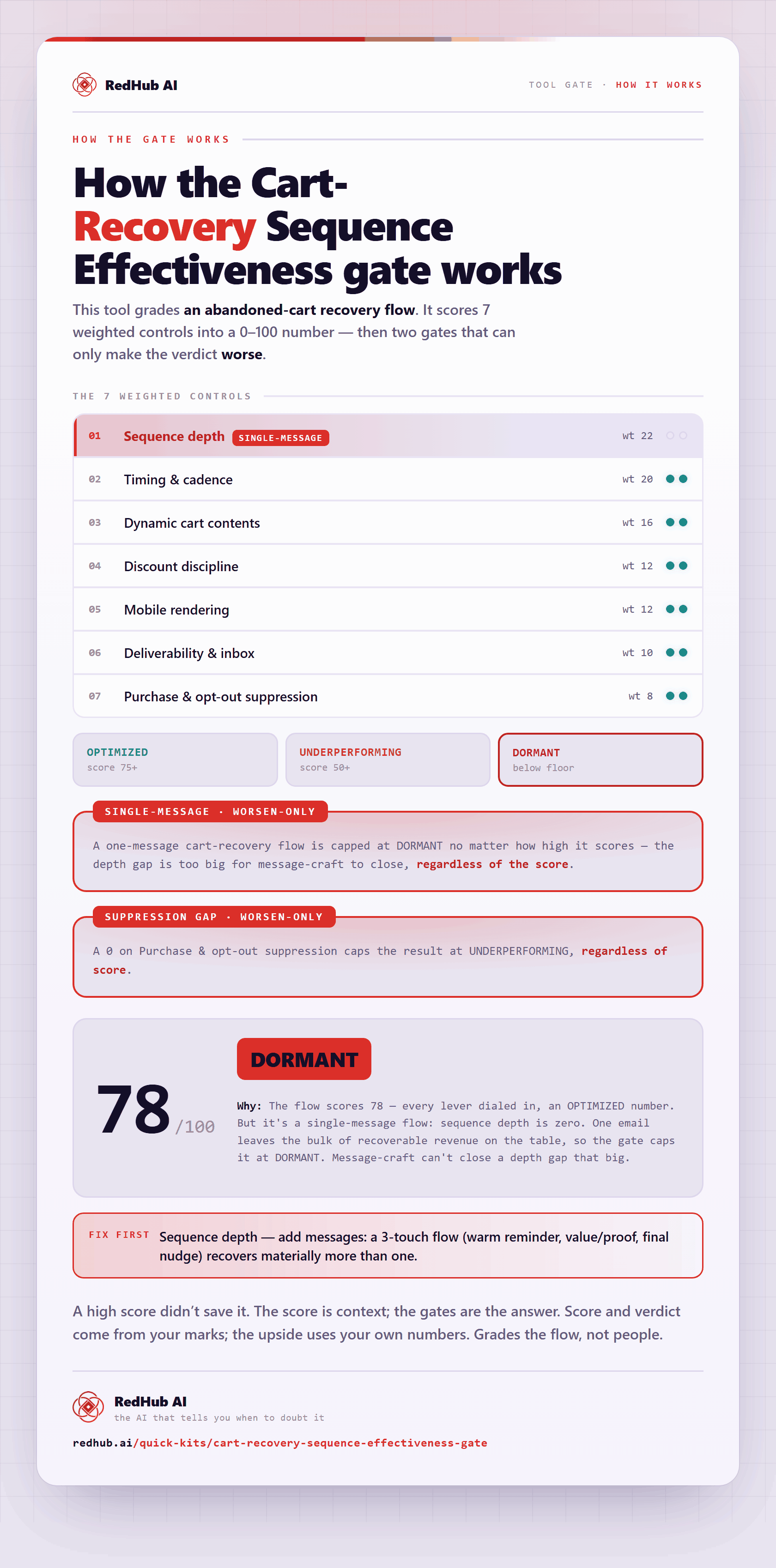
The gate this post refers to, drawn from the tool’s own logic. See the tool.