How to Avoid Running Out of Cash: 5 Founder Rules
RedHub AI Editorial6 min read

Jump to a section8
TL;DR
- What it is: Five rules that keep a company from dying the most common death in business — running out of cash while the balance still looked okay.
- Who it's for: Founders and small-business operators who burn cash in at least some months — the audience Cash-Flow Sentinel was built for.
- How it works: Watch runway monthly, treat accelerating burn as the emergency it is, and know your levers — collect, cut, raise — before you need them.
- Bottom line: Companies don't run out of cash suddenly. They run out slowly, then suddenly. The rules exist to catch the slow part.
How do you avoid running out of cash?
You avoid running out of cash by checking runway — not the bank balance — every month, treating under three months of runway as an immediate emergency, and acting the moment burn starts accelerating instead of waiting for the balance to look scary. The founders who fail at this don't fail at math. They fail at looking: by the time the balance itself alarms you, you're months into the problem with fewer options left.
Best for: founders who want the warning delivered mechanically, not when they happen to feel worried — see Cash-Flow Sentinel.
Ask any founder who's been through a near-death cash crunch how to avoid running out of cash, and you'll hear the same thing: the numbers were visible the whole time. Nobody was looking at the right ones. The balance looked fine. The burn was climbing. And the gap between those two facts is where companies die.
The research backs the war stories. A widely cited U.S. Bank study found that around 82% of small businesses that fail had cash-flow problems as a factor, and CB Insights' startup post-mortems consistently rank running out of cash among the top causes of startup death. Not fraud. Not competition. Cash — usually discovered late.
Why founders run out of cash
Three failure patterns show up over and over, and none of them is stupidity:
- Balance complacency. A comfortable balance feels like safety, so nobody does the division. $640K in the bank is thirteen months of life or four, depending entirely on burn — and the balance never says which.
- Burn creep. A hire here, three tools there, a vendor price bump. Burn climbs quietly, and the runway number from last quarter is optimistic the moment it starts.
- Finding out too late. Every cash lever — collecting faster, cutting, raising — works better with months of lead time. The later you see the problem, the fewer levers you can still pull.
The five rules, in order
- Grade runway, never the balance. Once a month, divide cash on hand by your real monthly net burn. That number — months of life — is the only cash figure that belongs on a founder's dashboard. The formulas are in the pillar guide to cash flow forecasting for small business.
- Use a representative burn, not a lumpy month. A tax payment or annual renewal can make one month look like a crisis; a big invoice landing early can make a crisis look calm. Normalize one-offs before you trust the division.
- Treat accelerating burn as an emergency — early. If this month's burn runs well above your trailing average (15% is a good tripwire), your runway number is already stale. Don't wait for the balance to confirm it. The full signal set is in cash runway early warning.
- Hard floor at three months. Under three months of runway, there is no nuance left. Cut or raise now — not after the next board meeting, not after the deal that's "about to close." A verdict system that refuses to soften this line is worth more than one that flatters you.
- Know your levers before you need them. Which costs you'd cut first, how many months each cut buys, what a raise would need to cover. Do this math on a calm Tuesday, because you will not do it well in a panic.
Key insight: the worked sample inside Cash-Flow Sentinel shows the trap perfectly. $640K in the bank, burn jumps from $50K to $80K a month. The plain division still says 8 months — but because burn is accelerating, the honest verdict is AT RISK, not "fine." The bump is what buys you the months of lead time.
The fastest cash is cash you're already owed
When the read comes back TIGHT or worse, the first lever is rarely a layoff. It's usually money that already belongs to you:
| Lever | What it does | Tool |
|---|---|---|
| Collect what you're owed | Chase overdue invoices with a firm, professional sequence — unpaid receivables are runway sitting in someone else's account | Accounts Receivable Recovery Kit ($39) |
| Find the quiet leaks | Locate the margin you're losing to underpricing, unbilled work, and creeping costs | Profit Leak Finder ($49) |
| Then cut deliberately | With the leaks named and the receivables moving, cut against your burn targets — not at random | Your call, guided by the runway math |
The order matters. Collecting and plugging leaks buys runway without touching the team or the product. Cutting comes after, and it should be aimed at a number: the monthly burn that restores a 12-month runway, or at minimum clears the 6-month risk line.
The rule behind the rules
Every rule above is a version of the same idea: make the warning mechanical. A founder who checks cash "when things feel tight" is running the alarm off the exact instinct — happy ears — that the alarm exists to override. Put the read on a monthly cadence, apply the floors and the trajectory gate without exception, and the fear of missing payroll turns into a number you saw coming two quarters away.
Make the warning mechanical
Cash-Flow Sentinel ($249, one-time) reads your recent months, computes real burn and runway, and returns the honest verdict — HEALTHY, TIGHT, AT RISK, or CRITICAL — with the burn targets that fix it. It applies the three-month floor and the trajectory gate for you, every month, without happy ears. Read-only; the calls stay yours.
Get Cash-Flow Sentinel — $249 →Decision Guide
Use these rules if: your company burns cash in some or all months, and your current "cash monitoring" is glancing at the bank balance.
Skip them if: revenue reliably covers expenses every month — then your job is protecting default-alive, not building an alarm.
Best first step: compute your runway right now — cash ÷ last month's net burn. Under six months? Start with rule three today and pull the collection lever this week.
FAQ
What is the most common reason small businesses run out of cash?
Not a single catastrophe — slow drift discovered late. Burn creeps up, the balance still looks fine, and nobody re-computes the runway until the options have shrunk. Cash-flow problems are a factor in the large majority of small-business failures.
How much cash runway should a small business keep?
Twelve or more months reads healthy. Six to twelve is tight but workable if you're watching it. Under six months means act; under three months means act now — that floor shouldn't bend for a good pipeline story.
How often should I check my cash position?
Monthly, on a fixed day, whether things feel fine or not. "When it feels tight" is too late by definition — the feeling arrives after the balance turns scary, and the balance turns scary last.
What should I do first if my runway is under six months?
Collect what you're already owed and plug the profit leaks — both buy runway without cutting people. Then cut toward a specific burn target: the monthly burn that clears the six-month line, or better, restores twelve months.
Is a big bank balance ever a bad sign?
It's not bad — it's mute. A big balance with accelerating burn is a shrinking runway wearing a disguise. Grade the months, not the dollars, and check whether burn is trending above your trailing average.
Can software prevent me from running out of cash?
No tool spends or raises money for you. What a system like Cash-Flow Sentinel does is remove the two human failure points: forgetting to look, and grading your own cash generously. It computes the read and the fix; the decisions — and the outcome — are yours.
See the wall while it's still far away
One read a month. Two honesty gates. A verdict that won't flatter you — and the concrete burn targets that fix it.
Get Cash-Flow Sentinel — $249 →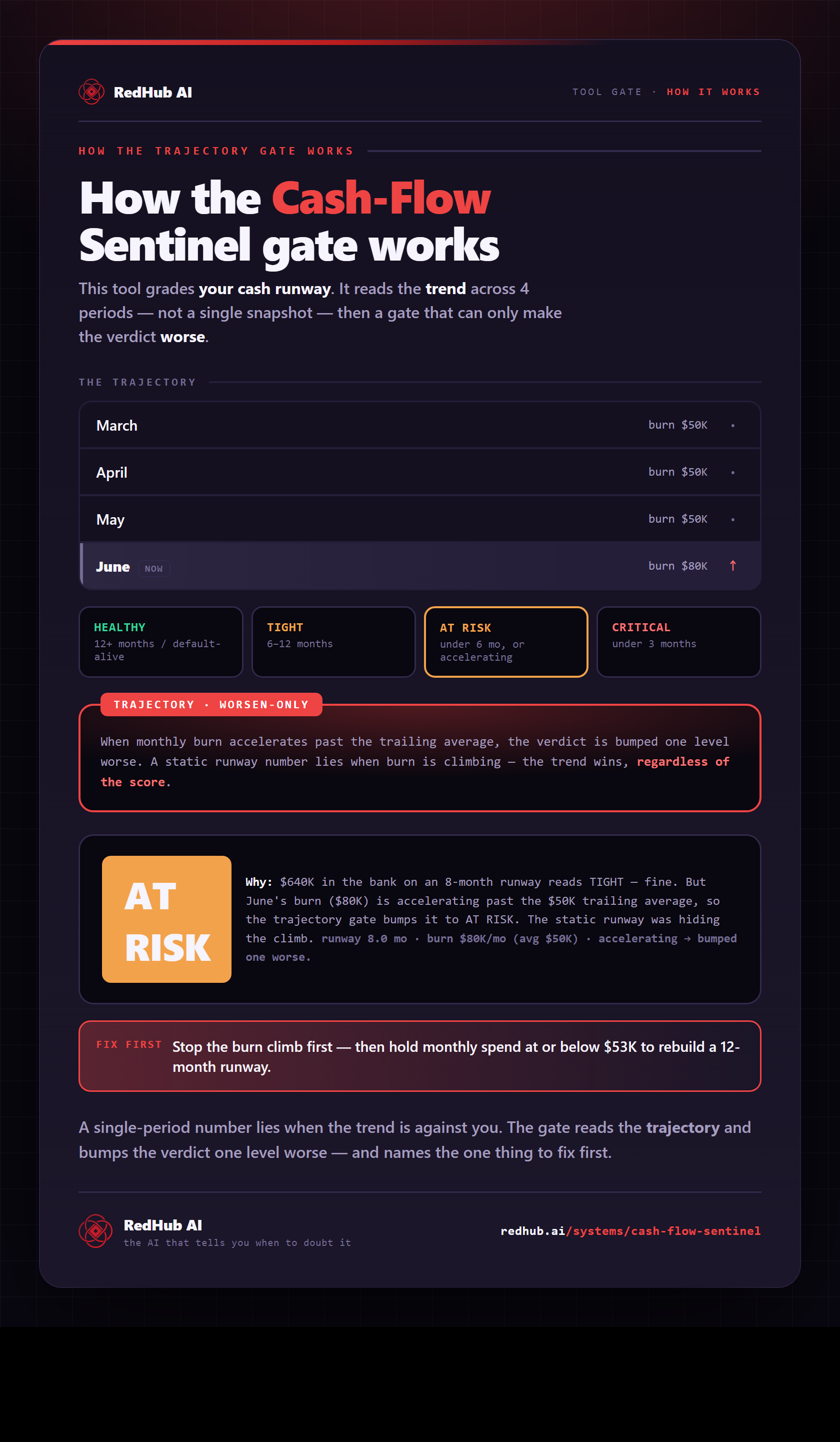
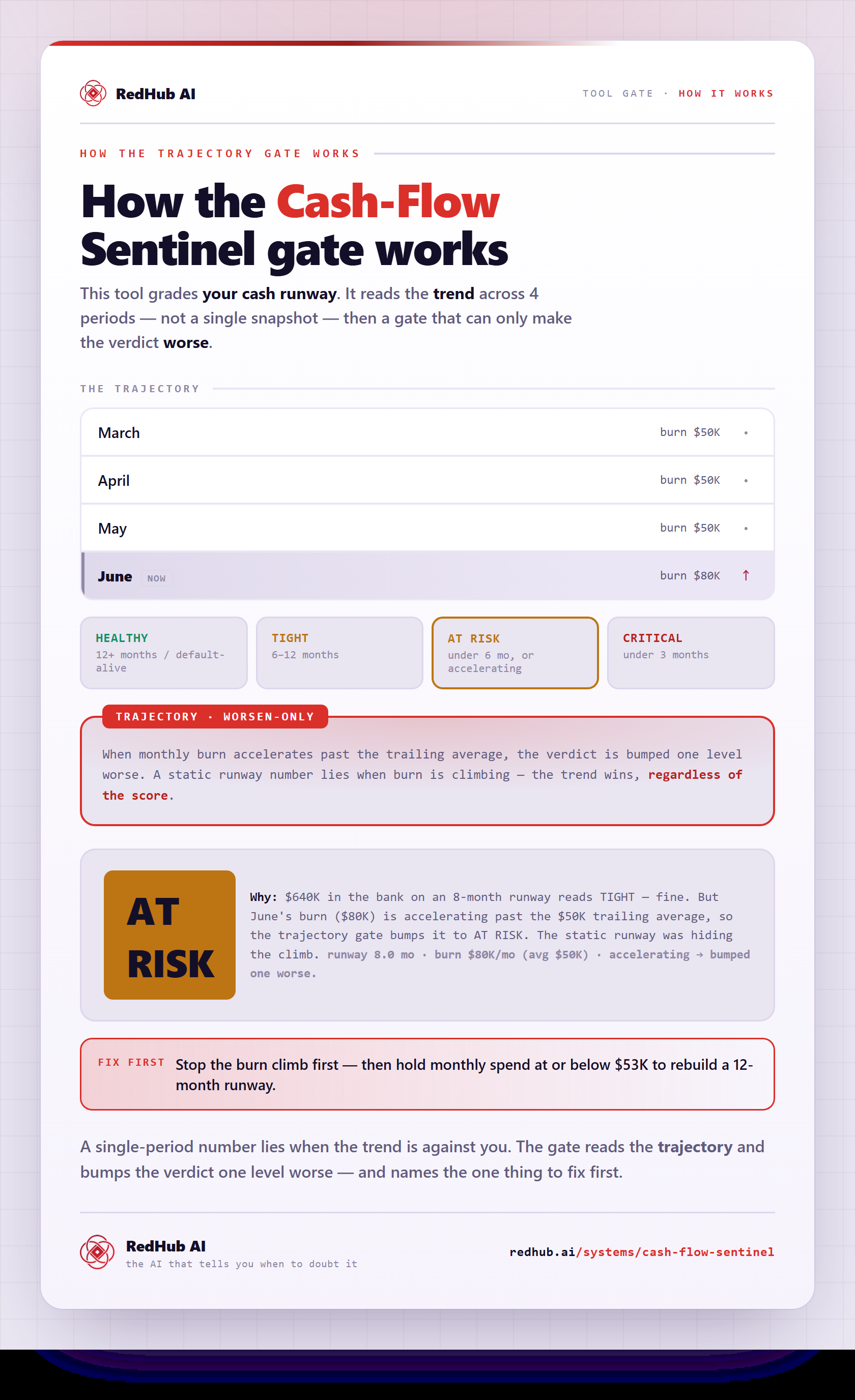
The gate this post refers to, drawn from the tool’s own logic. See the tool.