Cash Flow Management for Founders: A Monthly System
RedHub AI Editorial6 min read

Jump to a section8
TL;DR
- What it is: Cash flow management for founders as a repeatable monthly system — one read, one verdict, one fix — instead of an anxious glance at the bank balance.
- Who it's for: Founders running the money themselves, without a CFO — see Cash-Flow Sentinel.
- How it works: A fixed monthly ritual computes burn, trajectory, and runway; a one-line cash status goes in the operating report; tactical tools fix what the read finds.
- Bottom line: Manage cash on a cadence and it becomes a system. Manage it by mood and it becomes a crisis with a start date you didn't see.
What is cash flow management for founders?
Cash flow management for founders is a monthly discipline with three parts: a read (compute net burn, its trend, and runway from your own numbers), a verdict (grade the position honestly against fixed bands), and a fix (act on concrete burn targets — collect faster, plug leaks, cut, or raise). Done on a fixed cadence, it replaces balance-watching with an early-warning system that catches a crunch while months of options remain.
Best for: founders who want the read and the verdict delivered automatically — that's Cash-Flow Sentinel, the watchtower of the stack below.
Most founders don't manage cash. They monitor their own anxiety about it. Cash flow management for founders — the real kind — is boring on purpose: the same short ritual, the same fixed day, the same honest bands, every month. Boring is what makes it work. A system that only runs when you're worried is running off the exact instinct it exists to override.
Here's the whole system: the monthly ritual, the one-line status that keeps it visible, and the money-defense stack that fixes what the read finds.
The monthly cash ritual
- Pick a fixed day. First business day of the month works. The ritual runs whether things feel fine or not — "feels fine" is not data.
- Pull the three inputs. Last month's revenue, last month's expenses, cash on hand today. That's the entire data requirement.
- Compute the read. Net burn, burn versus the trailing three-month average, runway (cash ÷ current burn). Normalize any lumpy one-off so the burn is representative. Formulas and a calculator: how to calculate burn rate and runway.
- Take the verdict — without negotiating. 12+ months (or default-alive) is HEALTHY. 6–12 is TIGHT. Under 6 is AT RISK. Under 3 is CRITICAL, full stop. And if burn is running more than 15% over the trailing average, bump the verdict one level worse — a static runway number lies when burn is climbing.
- Log it and act on the fix. Write down the date, the numbers, and the verdict. Then act toward a target: the monthly burn that restores 12 months, or at minimum clears the 6-month line.
The one-line cash status
The output of the ritual should fit on one line, because a one-line status actually gets read. Something like:
Cash, June: runway 8.0 mo · burn $80K/mo (avg $50K) · accelerating → AT RISK. Fix: hold burn ≤ $53K to restore 12 mo.
That line — from the worked sample inside Cash-Flow Sentinel — goes in your operating report, your investor update, or the top of your Monday notes. The log it builds is what makes trends visible: a runway that shrinks two months in a row is a warning you can only see if last month's line exists. The full signal set is in cash runway early warning.
The money-defense stack
The read tells you where you stand. It doesn't repair anything by itself — that's the job of the tactical layer underneath it. Think of it as a watchtower and three repair crews:
| Layer | Job | Tool |
|---|---|---|
| The watchtower | Grade runway and trajectory monthly; return the verdict and the burn targets | Cash-Flow Sentinel ($249) |
| Collect what you're owed | Turn overdue invoices into cash with a firm, professional recovery sequence | Accounts Receivable Recovery Kit ($39) |
| Plug the margin leaks | Find the money quietly lost to underpricing, unbilled work, and creeping costs | Profit Leak Finder ($49) |
| Kill zombie spend | Audit the tool and subscription stack — one of burn creep's favorite hiding places | AI & SaaS Subscription Auditor ($49) |
The order of operations when a verdict comes back TIGHT or worse: collect first (it's your money, sitting in someone else's account), plug leaks second, kill zombie spend third — all three buy runway without touching the team or the product. Deliberate cuts come after, aimed at the burn target the read gave you. The full escalation playbook is in how to avoid running out of cash.
Keep the read honest
Two rules protect the system from its most common corruption — the founder's own optimism:
- Never grade the balance. The balance is the number that makes founders complacent. Grade the months, and grade the direction the months are moving.
- Never let a flattering month stand unexamined. Normalizing lumpy months cuts both ways. If a one-off made burn look low, say so in the log — a quiet month posing as your run rate is as dangerous as a spike.
This is the entire discipline, and it's covered end-to-end in the pillar guide to cash flow forecasting for small business. What a system adds isn't smarter math — it's the removal of the two human failure points: forgetting to look, and grading yourself gently.
The watchtower of your money defense
Cash-Flow Sentinel ($249, one-time) runs the ritual for you: reads your months, flags the lumpy ones, applies the floors and the trajectory gate, and returns the verdict plus the one-line cash status for your operating report — and the concrete burn targets that fix a bad read. Four Claude Skills, a runnable engine, a runway workbook, a cash-position template, and two playbooks. Read-only; you make the calls.
Get Cash-Flow Sentinel — $249 →Decision Guide
Use this system if: you're the one watching the money, the company burns cash in some months, and your current process is checking the balance when you're nervous.
Skip it if: you have a real finance function already running a monthly close with runway on the dashboard — then your system exists; keep it honest.
Best first step: put the ritual on the calendar for the first business day of next month, and run steps 2–5 once this week as a baseline.
FAQ
How should a founder manage cash flow without a CFO?
With a fixed monthly ritual: pull revenue, expenses, and cash; compute burn, trend, and runway; grade against honest bands; log a one-line status; act on the burn targets. The math is simple — the cadence and the honesty are the system.
How often should I review cash flow?
Monthly at minimum, on a fixed day. Weekly balance-glancing doesn't count — it tracks the level, not the trajectory, and the trajectory is where crunches announce themselves early.
What should a cash flow report include?
One line: runway in months, current burn versus trailing average, the trajectory (steady, improving, accelerating), the verdict, and the fix target. Anything longer stops getting read.
What's the fastest way to improve cash flow?
Collect what you're already owed — overdue receivables are runway sitting in someone else's account. Then plug margin leaks and cut zombie subscriptions. All three buy months without touching the team.
What is the money-defense stack?
A watchtower plus repair crews: Cash-Flow Sentinel grades runway and trajectory monthly, and points you to the tactical fix — the Accounts Receivable Recovery Kit to collect, the Profit Leak Finder to recover margin, the AI & SaaS Subscription Auditor to kill dead spend.
Is Cash-Flow Sentinel financial advice?
No. It's a read-only system that computes cash and runway hygiene from the numbers you connect — it never moves money, edits your books, or invents figures, and its verdicts aren't financial, accounting, investment, or tax advice. The decisions stay yours.
Run the money like a system, not a mood
One read a month. One honest verdict. One concrete fix. That's the whole job — and it's the difference between a warning and a wall.
Get Cash-Flow Sentinel — $249 →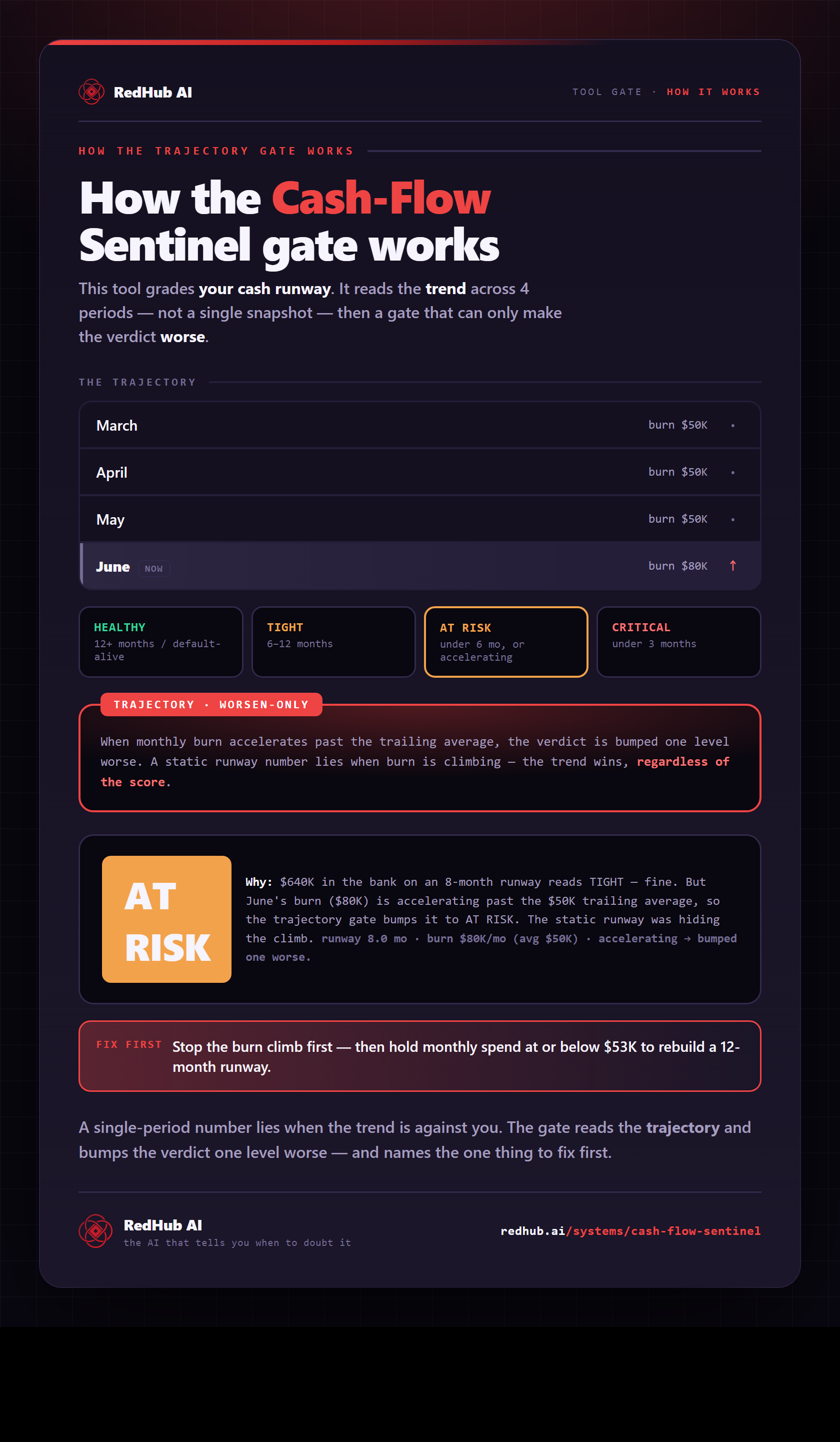
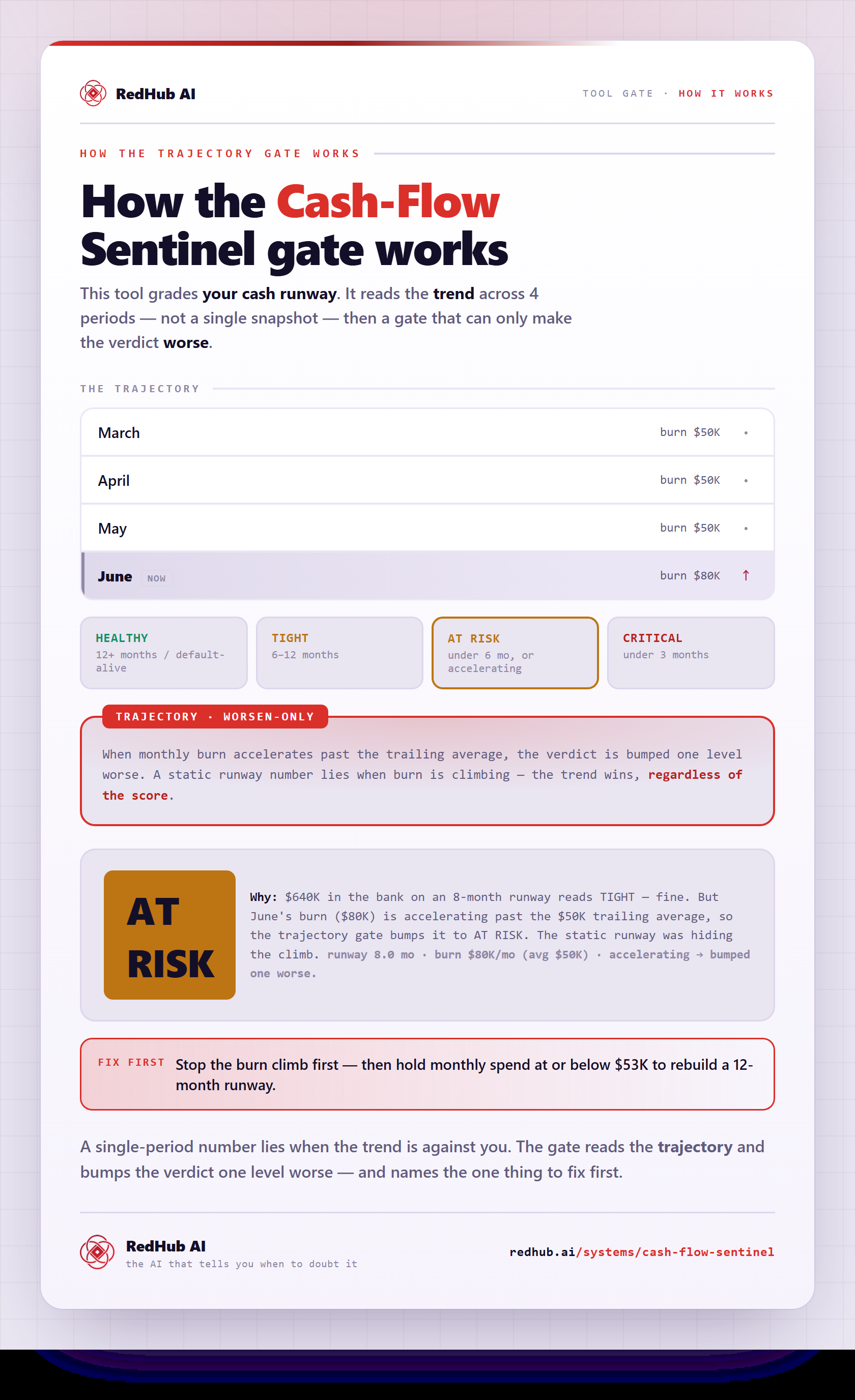
The gate this post refers to, drawn from the tool’s own logic. See the tool.