Cash Flow Forecasting for Small Business, Without a CFO
RedHub AI Editorial8 min read

Jump to a section10
TL;DR
- What it is: Cash flow forecasting for small business is knowing three numbers — real monthly burn, the trend of that burn, and runway (cash ÷ burn) — and re-checking them every month.
- Who it's for: Founders and operators whose survival runs on cash — see the Cash-Flow Sentinel system.
- How it works: The bank balance can't warn you. Runway plus trajectory can — the same $640K is thirteen months or four, depending entirely on burn.
- Bottom line: Companies rarely die from one bad month. They die because nobody re-computed the runway while burn was quietly climbing.
What is cash flow forecasting for a small business?
Cash flow forecasting for a small business is projecting how many months of operation your cash will actually fund. In practice it comes down to three numbers: net burn (monthly expenses minus monthly revenue), the trailing average of that burn (so one lumpy month doesn't distort the picture), and runway (cash on hand divided by current burn). A useful forecast is re-computed monthly and graded on trajectory — because a runway number computed while burn is climbing is already optimistic.
Best for: founders who want a CFO-grade read without hiring one — that's exactly what Cash-Flow Sentinel computes from your own numbers.
Most founders do cash flow forecasting for small business survival exactly once — when a bank or investor asks for it. Then they go back to the dashboard everyone actually uses: the bank balance. That habit is how companies with money in the bank still run out of cash. The balance tells you what you have. It never tells you how long you have it.
This guide covers the whole discipline: the three numbers that matter, the two honesty gates that keep the read from flattering you, and the monthly loop that turns a one-time forecast into an early-warning system. No CFO, no new accounting software — just your own recent months and about an hour a month.
Why the bank balance is the wrong dashboard
A comfortable balance is the most dangerous number in a small company. It feels like safety, so nobody does the division. But $640K in the bank is thirteen months of life at $47K of monthly burn — and four months at $160K. Same balance. Completely different company.
Widely cited research points the same direction: a U.S. Bank study often referenced by SCORE found that the large majority of small businesses that fail — around 82% — had cash-flow problems as a factor. And in CB Insights' startup post-mortems, running out of cash consistently ranks among the top reasons startups die. The pattern isn't "no money." The pattern is "nobody saw the wall until it was close."
Illustrative math on the same $640K balance. The balance is identical in all three rows. Only the burn — and therefore the number of months you have left — changes.
The three numbers that do the work
Everything in a small-business cash forecast reduces to three figures. If you can subtract and divide, you can compute all of them this afternoon.
| Number | How to compute it | What it tells you |
|---|---|---|
| Net burn | Monthly expenses − monthly revenue | How much cash the business consumes per month |
| Trailing average burn | Average net burn over the last 3 months | Your representative run rate — and the baseline that exposes a spike |
| Runway | Cash on hand ÷ current net burn | How many months you have at the current rate |
One caution before you trust the output: a single month lies. A tax payment, an annual software renewal, or one big invoice landing early can make a normal month look like a crisis — or a crisis look normal. Normalize the one-offs so the burn figure is representative, not a lumpy month posing as your run rate. The full formulas and a working calculator are in how to calculate burn rate and runway.
A forecast is not a spreadsheet you build once
Here's where most small-business forecasting fails. The founder builds a beautiful projection in January. By April, headcount changed, two tools got added, and a client paused. The January runway number is still the one in everyone's head — and it's wrong.
The fix is to treat forecasting as monitoring. The question isn't only "how many months do we have?" It's "is that number still true, and which way is it moving?" A runway that reads eight months while burn is climbing is not an eight-month runway. It's a shorter one that hasn't updated yet. The signals that catch this early — burn acceleration, falling revenue coverage, a runway that shrinks two months in a row — get their own guide: cash runway early warning.
Key insight: a static runway number lies when burn is climbing. The division is easy. The discipline of re-doing the division every month — against a trailing average that exposes the climb — is what an early-warning system actually is.
The two gates that keep the read honest
Founders grade their own cash the way students grade their own homework — generously. That's not a character flaw; it's happy ears. The cure is two mechanical rules that don't care how you feel. These are the exact gates Cash-Flow Sentinel applies before it returns a verdict of HEALTHY, TIGHT, AT RISK, or CRITICAL:
- The hard runway floor. Under three months of runway is CRITICAL — no matter the trajectory, no matter the pipeline story, no matter what's "about to close." Under three months, your options shrink fast, so the read has to say so plainly.
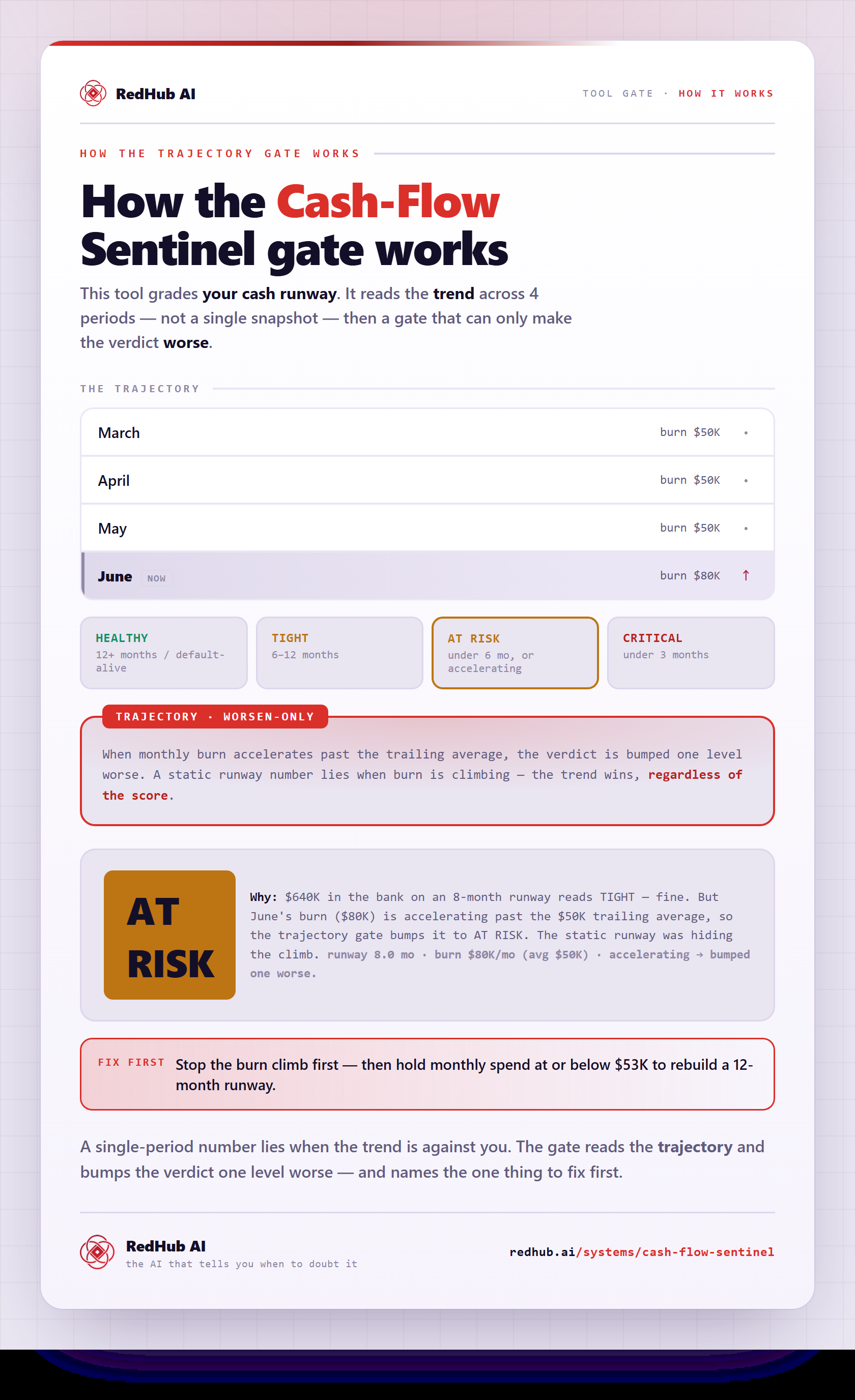
- The trajectory gate. If current burn is running more than 15% above the trailing average, the verdict gets bumped one level worse. Because the runway number was computed at a rate you're already exceeding.
What the worked sample shows
In the worked sample that ships inside Cash-Flow Sentinel: $640K in the bank, and burn had been running about $50K a month. Then one month it jumps to $80K. The plain division says 8.0 months of runway — a TIGHT read, but survivable. The trajectory gate sees burn running 60% over the trailing average and bumps the verdict to AT RISK. That bump is the whole point. Without it, the founder relaxes at "eight months" while the real number shrinks under them.
The monthly loop, step by step
Here is the whole discipline as a repeatable loop. It's the same sequence a good fractional CFO runs — and each step is fully computable from numbers you already have.
- Pull the last few months. Month, revenue, expenses. Three to six months is enough. Export from your accounting tool or type them in — no integration project needed.
- Compute burn — and normalize it. Net burn per month, then the trailing average. Flag lumpy months (tax hits, annual renewals) so a one-off doesn't set your run rate.
- Compute runway and check the trend. Cash ÷ current burn. Then compare current burn to the trailing average: steady, improving, or accelerating?
- Apply the two gates and take the verdict. Under 3 months is CRITICAL, full stop. Accelerating burn bumps the verdict one level worse. Write the verdict down where you'll see it.
- Act on the concrete fix. Know the monthly burn that restores a 12-month runway, the burn that clears the 6-month risk line, and how many months a specific cut — or a raise — buys you. Then decide.
If step five comes back ugly, don't panic-cut at random. Work the ordered playbook in how to avoid running out of cash, and put the whole thing on a repeatable cadence with cash flow management for founders.
Get the CFO read without hiring the CFO
Cash-Flow Sentinel ($249, one-time) reads your recent months, computes real burn and runway, applies the two honesty gates, and returns the verdict — HEALTHY, TIGHT, AT RISK, or CRITICAL — with the concrete burn targets that fix it. Four Claude Skills, a runnable engine, a runway workbook, and two playbooks. Read-only: it computes the read; you make the calls.
Get Cash-Flow Sentinel — $249 →Where to go deeper
This pillar is the map. Each piece of the discipline has its own guide:
- How to avoid running out of cash — the five rules, in order, that keep a company alive.
- Cash runway early warning — the four signals that catch a cash crunch months early.
- How to calculate burn rate and runway — the formulas, a worked example, and a calculator.
- Cash flow management for founders — the monthly system, plus the tactical tools that fix what the read finds.
Decision Guide
Use this approach if: your company spends more than it makes in at least some months, you can pull 3–6 months of revenue and expense figures, and you'd rather hear a hard verdict early than a soft one late.
Skip it if: you're reliably profitable every month with a fat buffer — you're default-alive, and your job is protecting that, not forecasting a crunch.
Best first step: do the division today. Cash on hand ÷ last month's net burn. If the answer is under six, start the monthly loop this week, not this quarter.
FAQ
What is cash flow forecasting for a small business?
It's projecting how many months your cash will fund the business, using three numbers: net burn (expenses minus revenue), the trailing average of that burn, and runway (cash divided by burn) — re-checked monthly so the answer stays true.
How do I calculate my cash runway?
Divide cash on hand by your current monthly net burn. $640K in cash at $80K of monthly burn is 8 months of runway. If burn is running well above your trailing average, treat the answer as optimistic — the real number is shrinking.
How often should I forecast cash flow?
Monthly, minimum. The forecast isn't the deliverable — the re-check is. A runway number computed in January and never revisited is where cash crunches hide.
What's a healthy cash runway?
Twelve or more months (or being default-alive, where revenue covers burn) reads HEALTHY. Six to twelve is TIGHT — watchful. Under six is AT RISK. Under three is CRITICAL, regardless of anything else. Those are the bands Cash-Flow Sentinel grades against.
Why not just watch the bank balance?
Because the balance can't tell you how fast it's falling. The same balance is a year of life or four months, depending entirely on burn — and by the time the balance itself looks scary, you're months into the problem with fewer options.
Do I need a CFO or new accounting software for this?
No. You need month, revenue, and expenses for the last few months, plus cash on hand. The math is subtraction and division; the hard part is the discipline and the honesty gates, which is what a system enforces for you.
What does Cash-Flow Sentinel actually do?
It reads the monthly numbers you connect (read-only), computes burn, trajectory, and runway, applies the two gates, and returns an honest verdict with concrete burn targets. It never moves money, edits your books, or invents a number — and it's cash hygiene, not financial advice. The decisions stay yours.
Stop trusting the balance. Know your runway.
One purchase, lifetime access, 12 months of updates. Connect your own numbers and get the verdict a CFO would give you — before the wall is close.
Get Cash-Flow Sentinel — $249 →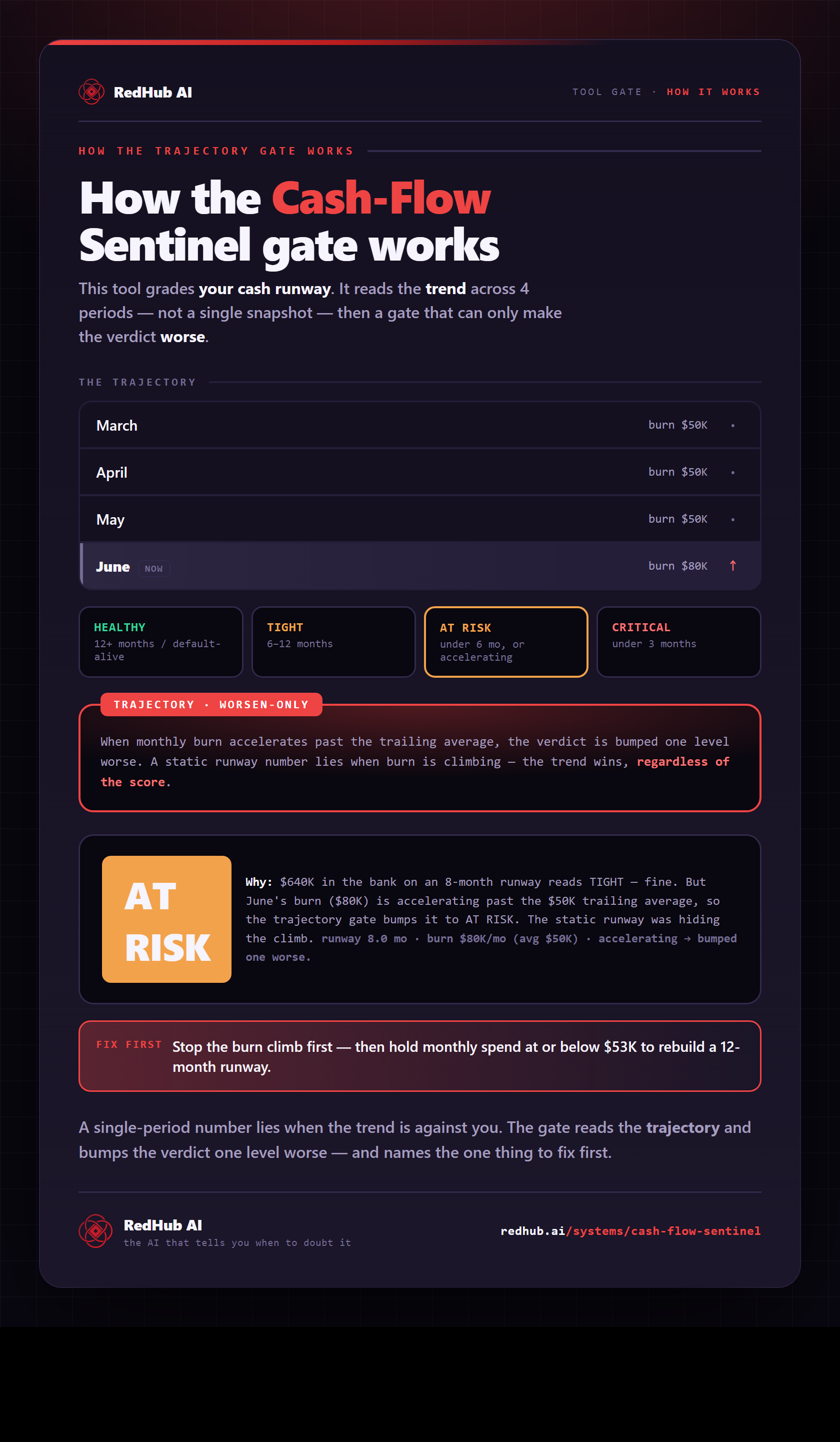
The gate this post refers to, drawn from the tool’s own logic. See the tool.