Cash Runway Early Warning: Catch Burn Before the Crunch
RedHub AI Editorial6 min read

Jump to a section9
TL;DR
- What it is: A cash runway early warning system watches trajectory — where burn is heading — instead of level, so a crunch shows up months before the balance looks scary.
- Who it's for: Founders whose runway number gets checked quarterly and trusted for far longer — the exact gap Cash-Flow Sentinel closes.
- How it works: Four signals — burn acceleration, falling revenue coverage, a multi-month runway slide, and lumpy-month distortion — each catchable with numbers you already have.
- Bottom line: A static runway number lies when burn is climbing. The trajectory is the warning.
What is a cash runway early warning system?
A cash runway early warning system is a monthly check that compares your current burn against its recent trend, so a cash crunch is flagged while you still have months of options — not weeks. The core mechanic: compute runway (cash ÷ current net burn), then check whether current burn is running meaningfully above your trailing average. If it is, your runway number is already optimistic, and the warning should fire now — even if the number itself still looks comfortable.
Best for: founders who want the trajectory gate applied automatically every month — that's the core of Cash-Flow Sentinel.
Every founder who hit a cash wall says a version of the same sentence afterward: "It came out of nowhere." It never did. A cash runway early warning existed in their own numbers for months — burn drifting up, coverage drifting down — and nobody was reading the trend. The balance was the dashboard, and the balance is always the last number to panic.
This guide covers the four signals worth watching, the tripwire threshold that makes the first one mechanical, and a live checker you can run on your own numbers right now.
Signal 1: burn is accelerating
This is the big one. Compare this month's net burn to your trailing three-month average. Running more than 15% above it? Treat every runway number you've computed as stale. That 15% tripwire is the exact threshold Cash-Flow Sentinel's trajectory gate uses — cross it, and the verdict gets bumped one level worse, because the runway math was done at a rate you're already exceeding.
The worked sample that ships with the system makes it concrete. $640K in the bank. Burn had been steady around $50K a month — call it a 12.8-month runway. Then burn jumps to $80K. The plain division now says 8.0 months, which still sounds survivable. But burn is running 60% over the trailing average, so the honest verdict isn't TIGHT — it's AT RISK. The gate fires early, which is the entire point of an early warning.
Check your own numbers
Is your burn accelerating?
Defaults are the worked sample from the tool, not a claim about your business. Swap in your own figures. The same math — plus the verdict, the floors, and the concrete burn targets — is what the full system runs on your actual monthly history.
Signal 2: revenue coverage is falling
Revenue coverage is what share of your monthly expenses revenue pays for. If expenses are $152K and revenue is $72K, coverage is about 47% — every month, the other half comes out of the bank. Coverage sliding over several months means the business is leaning harder on the balance even if burn in dollars looks flattish. It's the ratio version of the same warning.
Signal 3: runway shrinks two months in a row
One shrinking month can be noise. Two in a row is a trend, and three is a trajectory. The discipline that catches it is logging the read monthly — the number, the date, the verdict — so this month is always compared against last month, not against your memory of last month. A one-line cash status in your operating cadence is enough; how to run that log is covered in cash flow management for founders.
Signal 4: a lumpy month is distorting the read
Early-warning systems die from false alarms as surely as from missed ones. A tax payment or an annual renewal can spike one month's burn and fire a warning that isn't real — and after two false alarms, you stop listening. The fix is to normalize one-offs so the burn figure is representative, and to flag lumpy months explicitly instead of letting them quietly set your run rate. If the spike is real spend that will recur, it counts. If it's a once-a-year item, spread it.
Where burn creep hides: tool and subscription spend is one of the quietest climbers — a few seats here, an annual renewal there, an AI tool nobody canceled. The AI & SaaS Subscription Auditor ($49) walks that stack line by line and tells you honestly what to keep and what to kill.
Putting the four signals on autopilot
You can run all four checks by hand each month — the formulas are in how to calculate burn rate and runway, and the full discipline lives in the pillar on cash flow forecasting for small business. The failure mode isn't the math. It's the two human gaps: forgetting to look, and grading your own numbers generously when you do.
The trajectory gate, applied every month without mercy
Cash-Flow Sentinel ($249, one-time) reads your recent months, flags lumpy ones, computes burn versus the trailing average, and returns the verdict — with the trajectory gate that bumps "fine" to AT RISK the moment burn accelerates. Four Claude Skills, a runnable engine, a runway workbook, and the playbooks. Read-only; you make the calls.
Get Cash-Flow Sentinel — $249 →Decision Guide
Use this if: you burn cash in at least some months and your runway number gets computed quarterly (or less) and trusted much longer.
Skip it if: revenue covers expenses every month with a comfortable buffer — then watch for the month that flips you back to burning, and that's the whole system.
Best first step: run the checker above with your real numbers. If burn is more than 15% over your trailing average, act on the trend this week — don't wait for the balance to agree.
FAQ
What are the early warning signs of a cash flow crunch?
Four show up earliest: current burn running well above its trailing average, revenue covering a shrinking share of expenses, runway declining two or more months in a row, and a "steady" burn figure that's actually being masked by one-off months.
How far in advance can a cash crunch be detected?
Usually months. Burn acceleration is visible the first month it happens; the balance doesn't look alarming until much later. The lead time between those two moments is exactly what an early warning system buys you.
What counts as accelerating burn?
A practical tripwire: current net burn more than 15% above your trailing three-month average. That's the threshold Cash-Flow Sentinel's trajectory gate uses to bump a verdict one level worse.
Why is a static runway number dangerous?
Because it was computed at a burn rate you may no longer have. An "8-month runway" calculated while burn is climbing 60% over trend is not eight months — it's a shorter number that hasn't updated yet.
How do I avoid false alarms from one weird month?
Normalize one-offs — tax payments, annual renewals, a big invoice landing early — so the burn figure is representative. Flag the lumpy month, don't let it silently set your run rate in either direction.
Does Cash-Flow Sentinel connect to my bank?
It reads the numbers you connect — pasted in, exported CSV, or wired from your accounting tool — and it's strictly read-only. It never moves money, pays a bill, or edits your books, and it never invents a number. It's cash hygiene, not financial advice.
Catch the turn, not the crash
An honest verdict on runway and trajectory, every month, from your own numbers — before the crunch is a crunch.
Get Cash-Flow Sentinel — $249 →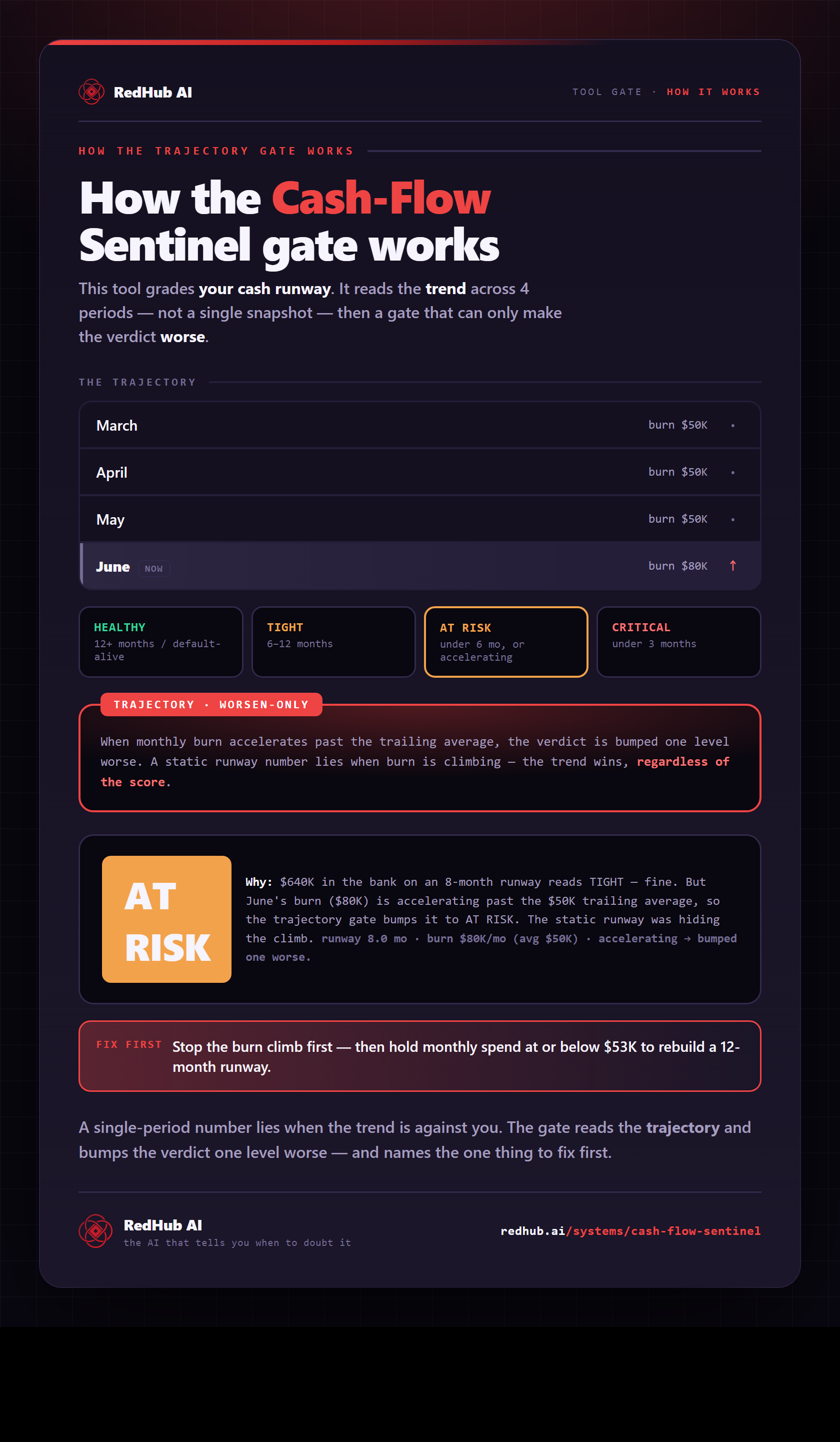
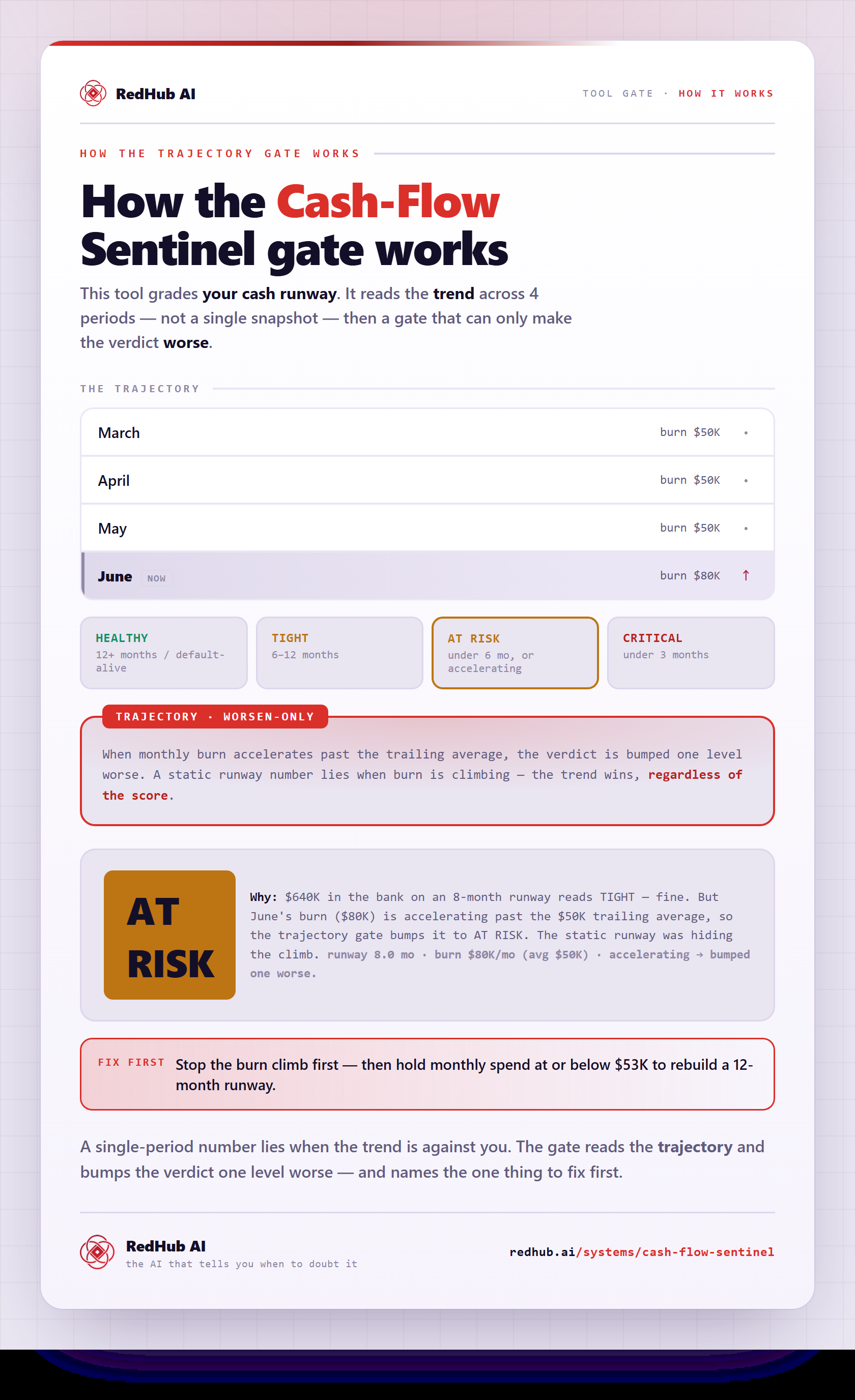
The gate this post refers to, drawn from the tool’s own logic. See the tool.