How to Evaluate Prompts (Before They Break in Production)
RedHub AI Editorialupdated September 20, 20268 min read

Jump to a section9
- The moment prompt evaluation stops being optional
- The four pieces of a real eval framework
- Start with the golden dataset — it defines what “good” means
- Choosing a metric — there is no universal “accuracy” for prompts
- Wire the check into CI, not into a Slack thread
- Benchmark models on your own workload, not a leaderboard
- What the System actually gives you
- Pairs well with
- More in this guide
You evaluate prompts by testing every version against a golden dataset — a fixed set of representative inputs paired with known-good outputs — and scoring the results against a metric you define for your own task, not a universal AI benchmark. You do this before you ship a prompt change, and again every time the underlying model updates. A real eval framework has four pieces: a curated golden dataset, a metric that actually matches your task, an automated regression check that runs on every diff, and a versioning system so you can trace what changed and roll back fast. Skip any one of those and you’re not evaluating prompts — you’re guessing with extra steps.
TL;DR: Prompt evaluation means testing every prompt version against a golden dataset you curate, scoring it with a metric that fits the task — there is no universal “accuracy” number — running that check automatically on every prompt change, and versioning prompts so a bad change can be traced and rolled back. The Prompt Evaluation & Versioning System ($49) ships the repo, dashboard, and Notion templates to run this inside your own stack, no platform required. Four deep dives: LLM output scoring, prompt regression testing, prompt versioning, and the metrics that matter.
The moment prompt evaluation stops being optional
Most teams don’t build an eval framework on day one. They write a prompt, look at a few outputs, decide it “looks good,” and ship it. That works fine for a while — right up until the prompt string has drifted through a dozen small edits with no record of what changed, three people have three different opinions about what “good” output looks like, and nobody can say with a straight face whether the current version is better or worse than the one from two months ago.
Then a model provider ships a quiet update. Accuracy on one customer segment drops. Nobody notices in a spot check, because a spot check only ever samples the easy cases. Two weeks later, support tickets start piling up, and the team spends a day trying to figure out whether it was the prompt, the model, or something upstream. That day is the entire cost of not having an eval in the first place — and it’s a cost that repeats every time something changes.
The four pieces of a real eval framework
An eval framework isn’t one thing. It’s four things working together, and most homegrown attempts are missing at least one:
- A golden dataset. A curated set of real, representative inputs — including edge cases and the ones your users actually send, not the ten happy-path examples that made the demo look good.
- A metric that fits the task. Exact match for structured extraction, a rubric or LLM-as-judge score for open-ended generation, embedding similarity for paraphrase-tolerant output. The wrong metric produces numbers that are precise and useless.
- An automated regression check. The eval runs on every prompt diff, not once a quarter when someone remembers. If a change drops the score below a threshold you set, it blocks the ship.
- A versioning system. Every prompt change has a version, a changelog line, and an owner, so when output shifts you know exactly what changed and can roll it back in minutes.
Start with the golden dataset — it defines what “good” means
This is the piece worth getting right before anything else, because everything downstream depends on it. An eval is only as good as the golden set it runs against. A passing score on ten easy, hand-picked examples proves nothing about how the prompt handles the messy, ambiguous, or adversarial inputs your real users send. If your golden set doesn’t include the cases that actually break things — the vague query, the edge-case customer segment, the input in a format you didn’t expect — a green eval can still ship a broken prompt.
Choosing a metric — there is no universal “accuracy” for prompts
One of the most common mistakes is trying to bolt a single quality score onto every prompt in a codebase. It doesn’t work, because “good” means something different depending on the task. A classifier has a correct answer you can check exactly. A summarizer doesn’t — two reasonable summaries can use completely different words. Picking the metric is a task-specific decision you have to make yourself.
| Task type | Metric that fits | Why |
|---|---|---|
| Classification / intent detection | Exact match, F1 | There’s a single correct label to check against |
| Structured extraction | Field-level exact or fuzzy match | Each field can be checked independently against the source |
| Summarization / generation | Rubric score or LLM-as-judge | No single correct wording exists, so a human-defined standard is scored |
| Paraphrase-tolerant tasks | Embedding similarity | Rewards semantic closeness instead of exact wording |
| Tool-use / agentic steps | Pass/fail on the correct tool call + arguments | The action taken matters more than the surrounding text |
Whatever you pick, define the passing threshold in writing before you look at the results. It’s much easier to talk yourself into “close enough” after you’ve already seen a mediocre score than before.
Wire the check into CI, not into a Slack thread
A golden dataset and a metric only pay off if the check actually runs every time a prompt changes. If it lives in a script someone has to remember to run, it will get skipped the one time it mattered most — usually the week before a deadline. Wire the eval into your CI pipeline so it runs on every pull request that touches a prompt file: run the golden set through the new version, compare it against the last known-good baseline, and fail the build if the score crosses your threshold. The goal isn’t a perfect gate — it’s catching the obvious regressions automatically instead of relying on someone noticing in review.
Benchmark models on your own workload, not a leaderboard
Model migration decisions — should we move from one provider or tier to another — are one of the most common reasons teams build an eval in the first place. Here’s the honest version of how to do it: run your own golden dataset and your own metric across every candidate model, on your own task, and compare cost, quality, and latency side by side. What you get is a number that’s true for your workload, on that day, with that dataset.
What you should never do is repeat a general claim like “Model A beats Model B by some percentage” as if it’s a fact that transfers to your use case. Public benchmarks measure a different task, a different dataset, and often a different version of the model than the one you’ll actually call. Model providers update silently and often. A comparison that was true in one quarter can be stale the next. Benchmarking is something you re-run, not something you look up once and trust forever.
What the System actually gives you
The Prompt Evaluation & Versioning System ($49) is a drop-in framework, not a platform. It ships a TypeScript and Python eval repo with adapters for the major provider SDKs, a dashboard template for tracking scores over time, a Notion war-room for non-engineers to participate in prompt-change reviews, a versioning convention, and benchmark scaffolds for common task types. It runs in your own repo with your own API keys — no telemetry, no cloud dependency, nothing sent to a third party. It does not write your prompts. It’s a scoreboard and a regression net, and it only tells you the truth your golden dataset is built to reveal.
Pairs well with
Prompt evaluation is one layer of a bigger reliability picture, and it’s worth being clear about where this System stops. If a single prompt change breaking things is a recurring problem and you want a dedicated, deeper regression harness, that’s the Prompt Regression Lab ($89). If what you’re actually testing is a full agent — tool calls, multi-step reasoning, the whole trajectory, not just one prompt — hand that to the Agent Reliability Harness ($149). If the quality problem is upstream, in what your retrieval step hands the prompt, the RAG Retrieval Grader ($89) grades that separately. If you’re stitching several prompts and agents into one flow, the Agent Orchestration Cookbook ($79) covers the composition. If the regression showed up in a pull request and you want the code-review layer tightened too, the Codex Code-Review & PR-Hygiene Pack ($79) covers that. And if the gap is your own prompting skill rather than your infrastructure, the Prompt Practice Lab ($69) is built for that.
More in this guide
How do I evaluate a prompt before shipping a change?
Run the new version against your golden dataset, score it with your task’s metric, and compare the result to the last known-good baseline. If the score crosses your threshold in the wrong direction, don’t ship — treat it the same as a failing test in your codebase.
What is a golden dataset and why does it matter this much?
It’s a curated set of real, representative inputs with known-good outputs that you run every prompt version against. It matters because it defines what “good” means for your eval — a small or unrepresentative golden set can pass a broken prompt without anyone noticing.
Is there a single accuracy score I should track for every prompt?
No. Accuracy makes sense for classification, where there’s a clear correct label. Open-ended generation needs a rubric or LLM-as-judge score instead, because there’s no single correct wording to match against. Pick the metric for the task, not a one-size-fits-all number.
Does this replace a hosted eval platform?
Not necessarily — it’s a different trade-off. A platform means sending your prompts and eval data to a third party and adopting their workflow. This System is patterns, code, and templates you own and run in your own repo with your own API keys. Some teams use both; some use this instead of ever adopting a platform.
How often should I re-run my evals?
On every prompt change, automatically, and again any time a model provider ships an update — even one you didn’t ask for. Model behavior can shift silently, and the only way to catch it is to re-run the same golden dataset and compare.
What’s the difference between evaluating a prompt and regression testing it?
Evaluation is scoring a single version against your golden set. Regression testing is doing that automatically, every time, and comparing the new score to the previous baseline so a change that quietly makes things worse gets caught before it ships. See prompt regression testing for the full breakdown.
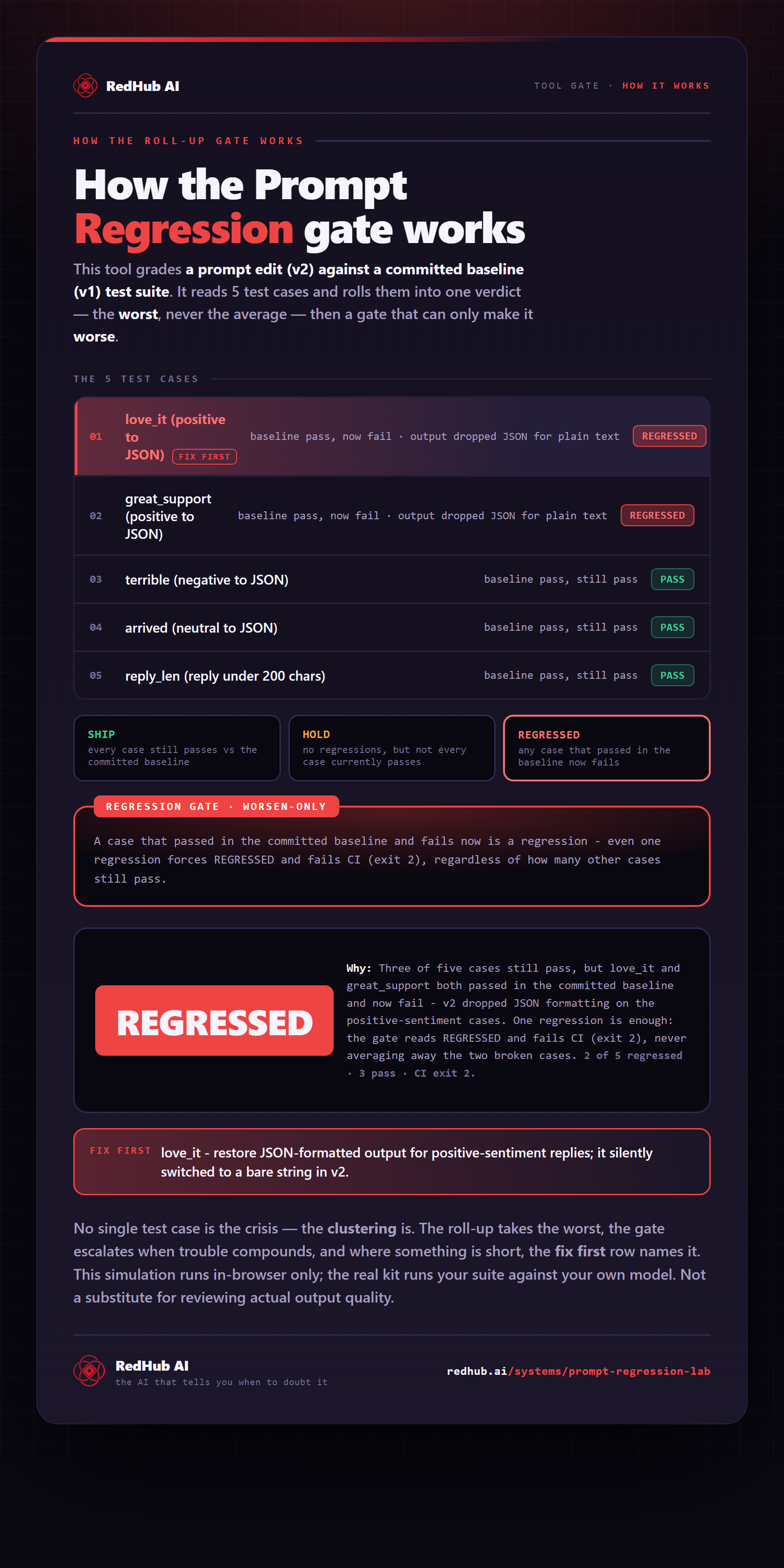
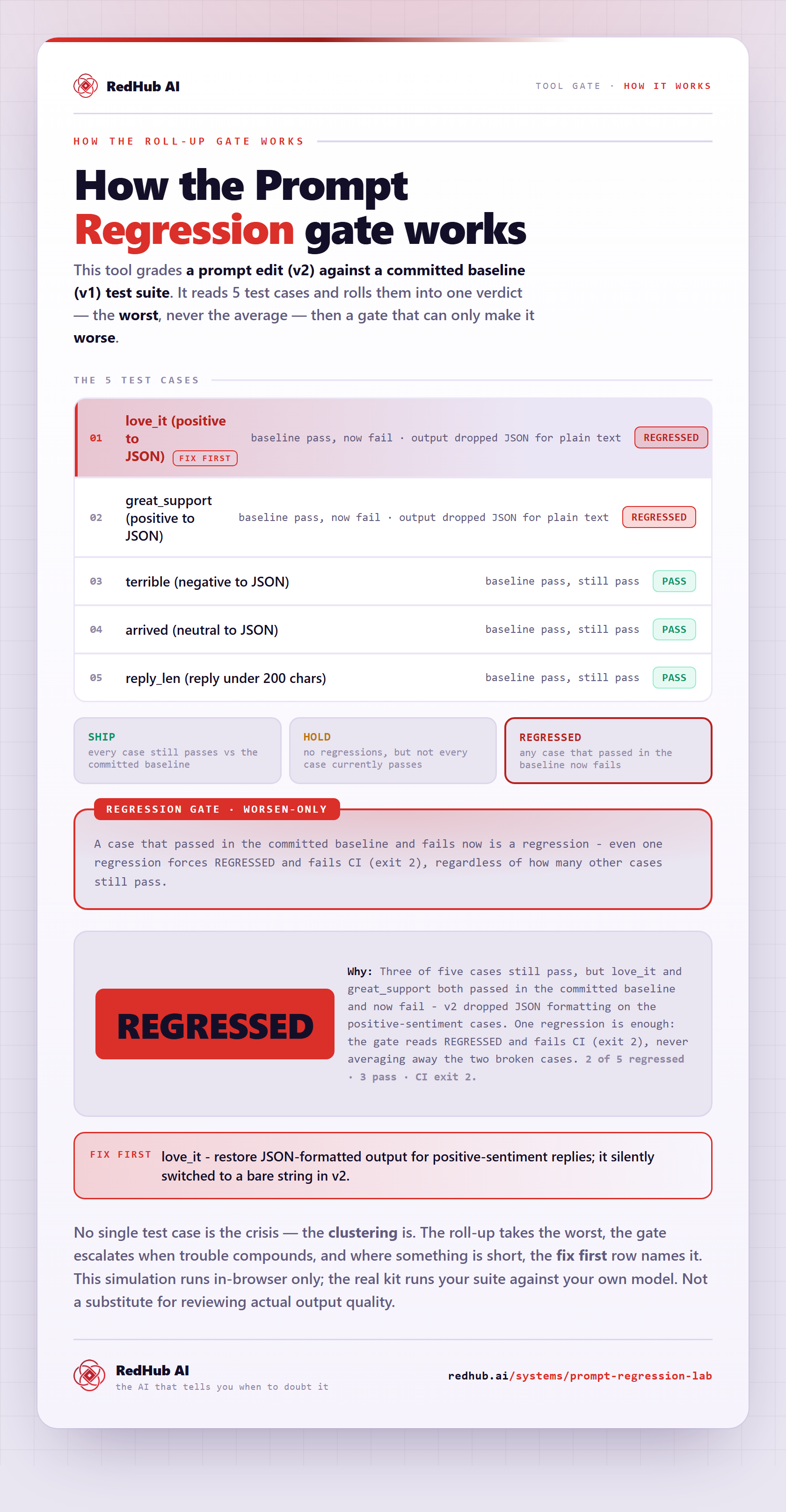
The gate this post refers to, drawn from the tool’s own logic. See the tool.