LLM Output Scoring: Four Methods and When Each Breaks
RedHub AI Editorialupdated September 20, 20265 min read

Jump to a section7
You measure LLM output by picking a scoring method that fits your specific task — exact match for structured extraction, a rubric or LLM-as-judge score for open-ended generation, embedding similarity for paraphrase-tolerant work — then running it against a fixed golden dataset every time the prompt or model changes. There is no single “LLM evaluation score” that works across every task. Using the wrong metric produces numbers that look precise and mean nothing. This guide breaks down the common ways to score output, when each one fits, and the traps that let a broken prompt hide behind a green eval.
TL;DR: LLM evaluation means choosing a metric that matches your task — exact match, rubric scoring, LLM-as-judge, or embedding similarity — and running it against a golden dataset you curate. There’s no universal accuracy number, and LLM-as-judge scoring needs its own periodic sanity check against human review. The Prompt Evaluation & Versioning System ($49) ships pluggable scorers for all four types. Part of a guide that also covers how to evaluate prompts, regression testing, and the metrics that matter.
Why “does it work?” isn’t a metric
Ask five engineers if a prompt’s output “looks good” and you’ll get five different opinions, none of them written down anywhere, none of them repeatable next week when the same question comes up about a different version. That’s the actual failure mode LLM evaluation exists to fix: turning a vague, personal judgment call into a repeatable measurement that gives the same answer regardless of who runs it or when.
The measurement only means something once you’ve decided, in advance, what “correct” looks like for your task. That decision is the whole job. The scoring method you pick afterward is just how you check it at scale.
The four common ways to score LLM output
| Method | Best for | Watch out for |
|---|---|---|
| Exact match | Classification, structured fields with one correct value | Too strict for anything with valid variation in wording |
| Rubric scoring | Open-ended generation with clear quality criteria | Needs a written rubric, or two reviewers will disagree |
| LLM-as-judge | Scoring at volume where a human rubric doesn’t scale | The judge model has its own biases and can drift when it updates |
| Embedding similarity | Paraphrase-tolerant tasks, semantic matching | Rewards topical closeness even when a specific fact is wrong |
Most real eval setups end up using more than one of these — an exact-match check on the fields that must be exactly right, plus a rubric or judge score on the surrounding tone or completeness. Trying to force every output type into one scoring method is where most homegrown evals go wrong.
LLM-as-judge is powerful, and it’s its own kind of unreliable
Using a second LLM to score the first one’s output has become common because it scales in a way human review can’t. It also introduces a new failure mode: the judge has its own preferences, blind spots, and quirks, and those don’t always match a human’s. A judge model can systematically favor longer answers, or answers phrased a certain way, regardless of whether they’re actually more correct.
Judge models also update on their own schedule, same as any other model. A judge that scored consistently last quarter can shift this quarter without warning. Re-calibrate whenever you change the judge model, not just when you change the prompt being judged.
Your golden dataset still does most of the work
Whichever scoring method you choose, it only checks what your golden dataset actually contains. A rubric score against ten easy examples tells you the prompt handles easy examples. It tells you nothing about the ambiguous, adversarial, or edge-case inputs your real users send unless those are represented in the set you’re scoring against. Building that set well is worth more time than picking the perfect scoring method — see the full breakdown in how to evaluate prompts.
What an LLM eval can’t tell you
A prompt-level eval scores what the model returns for a given input — it doesn’t tell you whether the input it received was any good in the first place, and it doesn’t tell you whether a multi-step agent using that prompt actually completed its task. Those are separate evaluation problems with their own tooling. If your prompt sits downstream of a retrieval step, the quality of what gets retrieved needs its own grading, covered by the RAG Retrieval Grader ($89). If the prompt is one step inside a longer agent trajectory — tool calls, multi-turn reasoning, an end goal that spans several model calls — that needs the Agent Reliability Harness ($149) to test the whole path, not just one link in it.
Pairs well with
The Prompt Evaluation & Versioning System ($49) ships pluggable scorers for exact match, rubric, LLM-as-judge, and embedding similarity so you're not building the scoring harness from scratch. If retrieval quality is the layer you actually need graded, use the RAG Retrieval Grader ($89) instead of trying to bolt that check onto a prompt eval. And if the thing under test is a full agent rather than a single prompt call, the Agent Reliability Harness ($149) is built for that scope.
More in this guide
What is LLM evaluation, in plain terms?
It’s the practice of scoring a model’s output against a metric you define for your task, run against a fixed set of test inputs, so you have a repeatable measurement instead of a personal opinion about whether the output “looks right.”
Which LLM evaluation metric should I use?
It depends on the task. Use exact match when there’s one correct answer, a rubric or LLM-as-judge score for open-ended generation, and embedding similarity when paraphrasing is acceptable. Many real setups combine more than one.
Can I trust LLM-as-judge scoring on its own?
Not without checking it. Judge models have their own biases and can drift when the underlying model updates. Periodically compare judge scores against human review on a sample, and re-calibrate whenever you swap the judge model.
Is there a benchmark score that tells me if my model choice is right?
No public benchmark can answer that for your specific task. Run your own golden dataset and metric across the candidate models and compare cost, quality, and latency on your own workload — a public leaderboard number doesn’t transfer.
Does LLM evaluation cover my whole AI system?
No — it scores what one prompt returns for a given input. Grading retrieval quality or a full multi-step agent trajectory are separate problems with their own tools, covered by the RAG Retrieval Grader ($89) and the Agent Reliability Harness ($149).
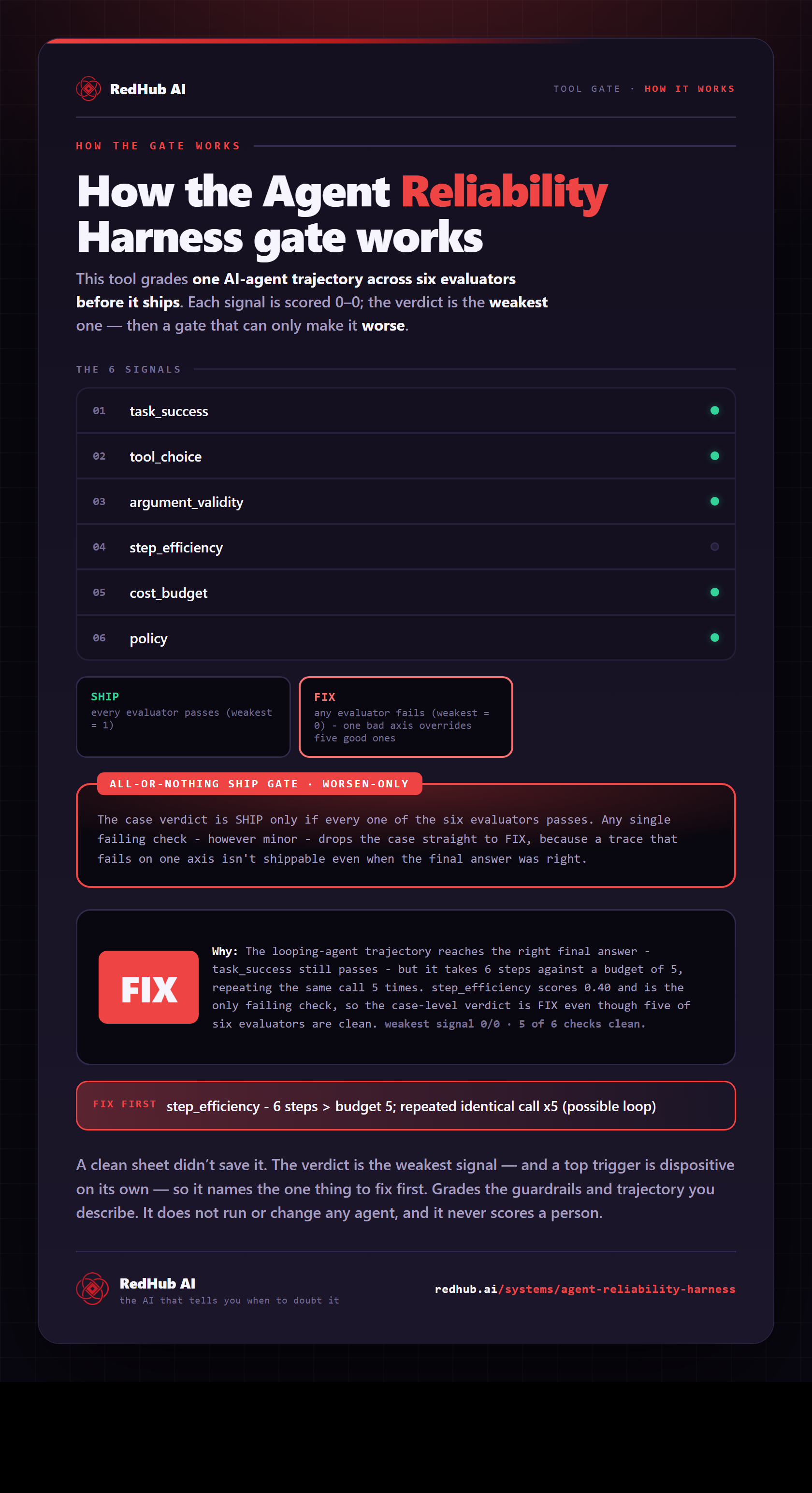
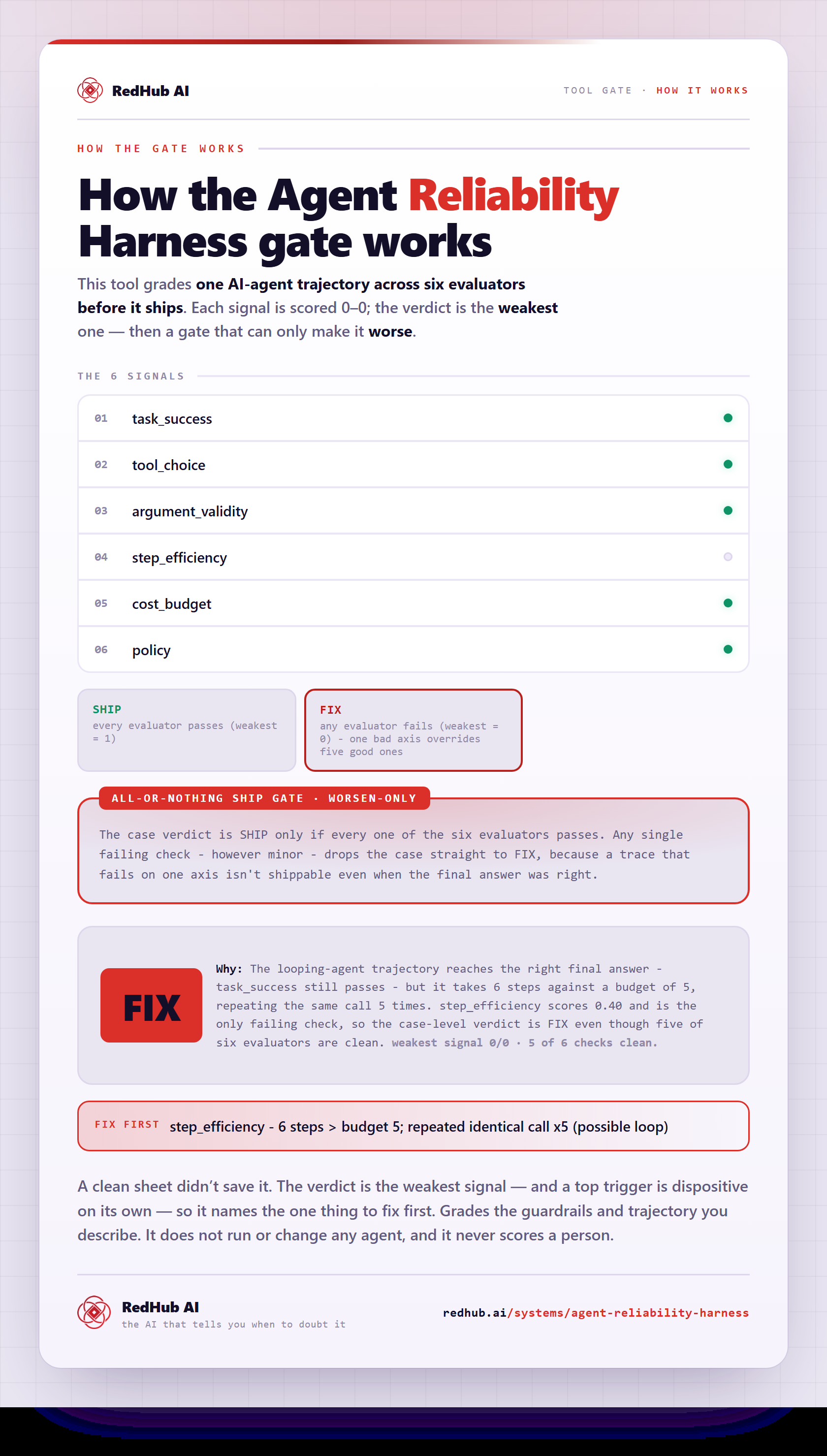
The gate this post refers to, drawn from the tool’s own logic. See the tool.