How to Make AI Content Sound Human
RedHub AI Editorialupdated October 4, 20266 min read

Jump to a section7
To make AI content sound human, change what the draft knows before you change how it sounds. A model can copy a tone when you ask. It cannot supply your customer's name, last quarter's number or the opinion you formed on a sales call, so those have to come from you. Add them, take a side where the draft hedges, and then score the result on the five SPARK marks. Revise whichever mark scores lowest.
TL;DR: Tone prompts change the words but leave the content generic. Ask the model to leave a [FILL: ...] marker wherever a real fact belongs, fill each one yourself, then rate the draft 0 to 5 on SPARK. The scorecard's sample draft moves from 66 (Revise) to 80 (Publish) with two edits: real specifics and one clear stance. Watch one trap: the scorecard rewards specifics more than truth, so an invented number can raise the score. The Anti-Slop Content System ($79) includes the scorecard and the prompts that leave those markers. For why drafts go flat in the first place, read the AI slop guide.
Tone prompts change the words, not the content
"Write in a more human voice" is the most common fix people try, and it changes less than they hope. The model swaps some words and adds a contraction or two. The draft still says "many businesses" where your business belongs. Still no opinion anywhere, and still nothing in it that a competitor could not have published.
A written voice spec does more than a one-line tone request. Our guide to keeping AI writing on brand shows how banned words, sentence rules and contrast pairs give a model something it can check. But a voice spec governs how the draft sounds. It cannot supply facts the model was never given, and missing facts are most of what makes a draft read flat.
Leave holes instead of letting the model fill them
The Anti-Slop Content System's prompt pack runs on one rule: never let the model invent specifics. When the model reaches a spot that needs a number, a name, a story or a proof point it was never given, it writes [FILL: ...] and moves on. You get a draft with marked gaps you fill from what you know.
Take one sentence through it. The example is invented for illustration.
- Raw draft: "Many businesses struggle with slow response times, and the right tools can help streamline communication."
- With markers: "[FILL: which customers] wait [FILL: how long] for a first reply, and [FILL: what that costs]."
- Filled in: "Our two-person support desk answered weekday tickets in about four hours last month. Weekend tickets sat until Monday, and two of them were renewals."
The filled version has a team size, a time, a gap and a cost. None of that could come from a model, and all of it is checkable by the person who wrote it. If you cannot fill a marker with something true, cut the sentence that needed it.
Score the draft on SPARK
Once the gaps are filled, rate the draft from 0 to 5 on each mark before you polish anything. The kit's scorecard weights them to 100: Specific 25, Point of view 20, Authentic voice 25, Real 10 and Kinetic structure 20. Publish starts at 80 and Revise at 60. Anything lower is a Rework.
- Specific: does it name a real number, tool or example instead of "many businesses" or "a recent study"?
- Point of view: does it take a stance, or hedge both sides so nobody can disagree?
- Authentic voice: read it aloud. Does it sound like your brand, or like a template anyone could publish?
- Real: is every claim true and supported, not just confident?
- Kinetic structure: do sentences and paragraphs vary, or does every one march at the same length?
Start from the sample draft in the workbook, rated 3, 3, 3, 4 and 4 for a total of 66: a Revise. Raise Specific from 3 to 5 and the total reaches 76, still Revise. Then raise Point of view from 3 to 4 and it reaches 80, a Publish. Two edits, not a rewrite, and the two lowest ratings showed where to make them.
The scorecard pays more for specifics than for truth
One point on Specific is worth 5 of the 100. One point on Real is worth 2. That gap creates a trap. Take the sample again and pad it with three convincing numbers nobody checked. An honest rater moves Specific from 3 to 5 and drops Real from 4 to 2. The total climbs from 66 to 72, so the draft scores higher and is less true.
The weights fit what SPARK is built to catch, which is vagueness more than falsehood. They also mean the scorecard cannot stop someone from inventing detail to make a draft sound human. That check is yours. Every number you add should be one you could defend if a customer asked where it came from.
Line edits that change how it reads
After the content is right, a few line-level moves account for most of the remaining lift:
- Cut the throat-clearing at the top of a section, such as "It's important to note that," and start with the point.
- Break up runs of same-length sentences. After a long sentence, try one of four words, then read the pair aloud.
- Replace one generic noun phrase, such as "a leading company," with the real one, or delete it.
- Read the last sentence aloud. If it could close any article on the topic, end on a detail from this one instead.
Fill the gaps, then score the draft
The Anti-Slop Content System includes prompts that mark every missing fact instead of inventing it, the SPARK scorecard with a Publish / Revise / Rework verdict, a heuristic slop scanner, a field guide of tells and a playbook. The specifics stay yours to supply.
Get the Anti-Slop Content System — $79Pairs well with
The Brand Voice Engine ($59) turns your real writing into an 8-section Voice Spec and a 100-point QA Checker, which gives the Authentic voice mark something written to measure against. The Brand-Voice Content Multiplier & Drift Guard ($99) drafts multi-channel content from one anchor piece and scores each draft ON-VOICE, DRIFTING or OFF-BRAND by its weakest dimension. For email, the Brand-Voice Email & Newsletter Engine ($69) adds voice-locked templates, humanize prompts and a send-readiness linter that returns Send, Revise or Hold.
More in this guide
What's the fastest way to make an AI draft sound less robotic?
Replace generic placeholders with real facts you know, such as a name, a number or a specific example. If you can't fill a gap with something true, cut the sentence. Tone edits come after the content is right.
Does adding "write more casually" to my prompt fix it?
Rarely on its own. Tone instructions change word choice but leave the draft without specifics or a point of view, which is what reads as generic. A written voice spec helps more, and real facts help most.
What score does a draft need to be ready to publish?
In the Anti-Slop Content System's SPARK scorecard, a weighted total of 80 or more out of 100 reads Publish. A total of 60 to 79 reads Revise, and anything under 60 reads Rework.
Can adding specifics make a draft worse?
Yes, if the specifics are invented. A made-up number raises the Specific rating while lowering Real, and because Specific carries more weight, the total can still rise. Only add details you could defend.
Can I use SPARK on writing a person drafted, not just AI drafts?
Yes. SPARK grades the finished text, not how it was produced. Human drafts often score low on the same marks, especially Point of view and Kinetic structure.
What's the difference between SPARK and proofreading?
Proofreading catches grammar and typos. SPARK asks whether the draft is worth reading at all: whether it is specific, takes a side, sounds like you, tells the truth and varies its rhythm.
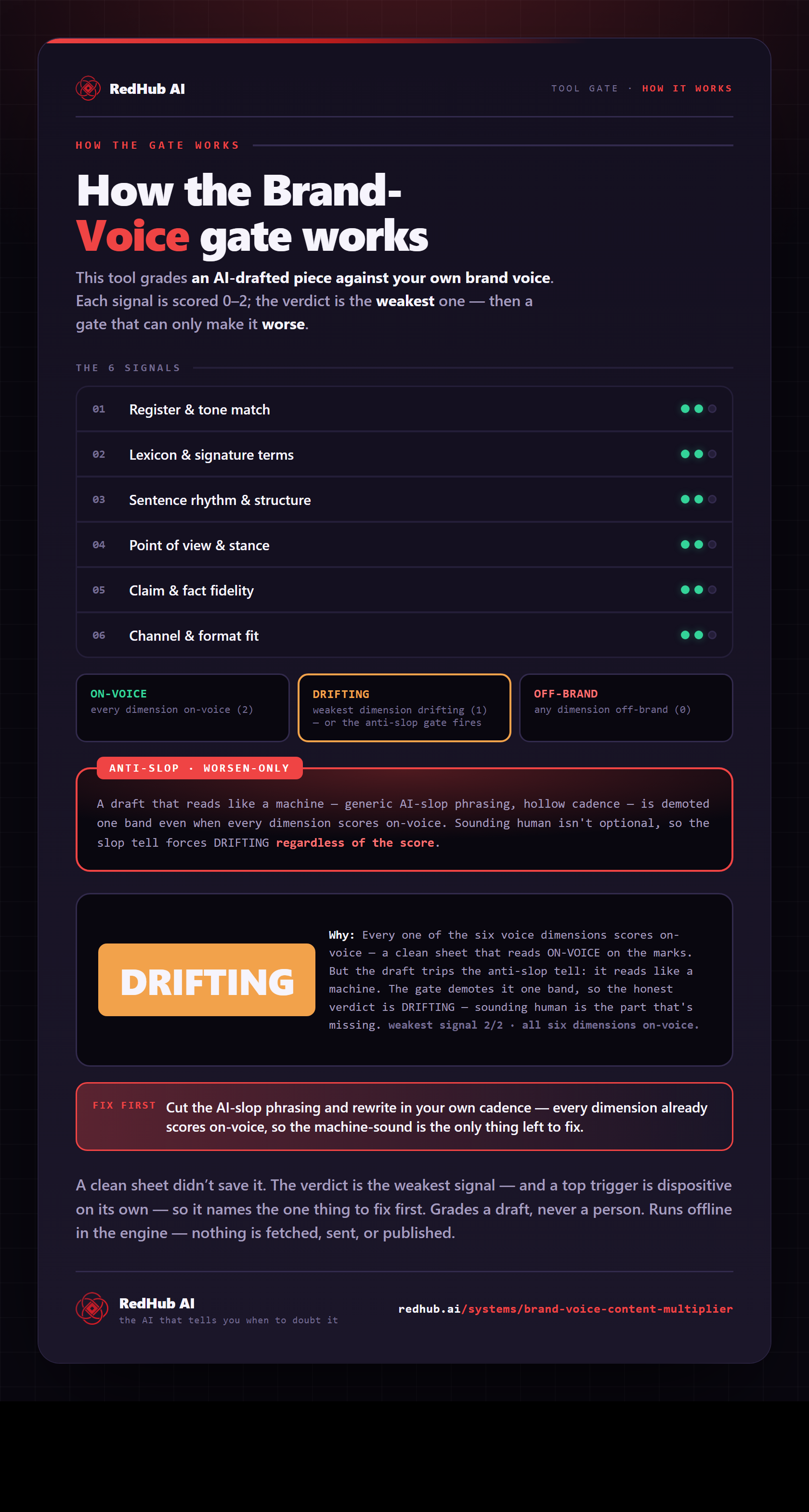
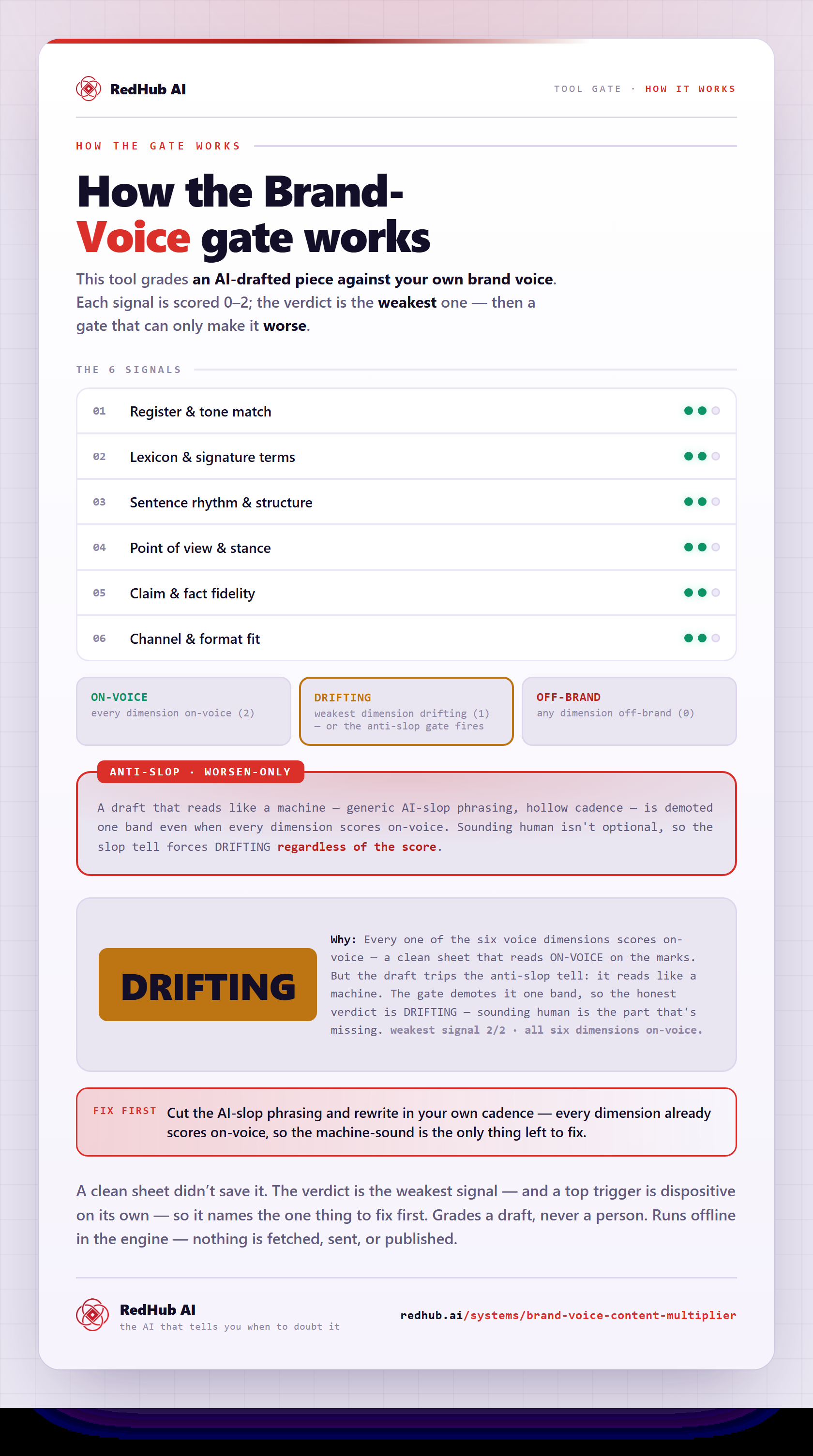
The gate this post refers to, drawn from the tool’s own logic. See the tool.