Signs of AI-Generated Content: Craft Flaws, Not Proof
RedHub AI Editorialupdated October 4, 20266 min read
Jump to a section6
The signs of AI generated content that people trade online, from em dashes to the word "delve," cannot tell you who wrote a page. A person on deadline produces every one of them, and a model told to avoid them can. What the signs do show is a draft nobody finished. Read each one as a craft problem, with a cost to the reader and a known fix, and you get a better edit without having to accuse anyone.
TL;DR: Four patterns get mistaken for proof of a machine: sentences that all run the same length, placeholders where facts belong, confidence with no source, and a hedge where a position belongs. Each one is a decision the writer skipped, and each has a fix. Word lists and em dashes are the weakest evidence of all, because they are the easiest thing to strip. The Anti-Slop Content System ($79) ships a field guide of these tells with fixes and a heuristic scanner that flags candidates for revision. The AI slop guide explains why we define slop by the draft rather than its author.
Why a tell can't settle who wrote it
A tell is a surface pattern, and surface patterns are cheap to change. Strip every "delve" from a draft and you have a draft without that word. You have not learned who wrote it, and the draft is no more worth reading. The reverse also holds: plenty of people wrote "delve" long before any chatbot did.
That is why RedHub does not use tells to call a piece AI-written, and why this guide does not teach you to. When we review a flat draft, the wording we use is "consistent with an unedited draft." These features are not exclusive to AI-generated writing. The judgment being made is that the piece reads flat, which anyone can see and nobody has to prove. The tools that do claim to settle authorship have their own record, covered in why AI detectors don't work.
Four craft problems that get mistaken for a machine
Every sentence runs the same length
Read three sentences in a row aloud. If each has the same length and the same subject-verb-object shape, the paragraph marches. The reader stops hearing a person and starts skimming. The kit's scanner measures this as the standard deviation of sentence length. Its built-in sloppy sample is 78 words across four sentences, with lengths that vary by only 5.1 words. The fix is rhythm on purpose: a short sentence to land the point, then a longer one to unpack it.
A placeholder where a fact belongs
"Many businesses." "A recent study." "Industry experts agree." "A leading company." Each phrase stands in for a detail the writer never supplied. The reader cannot check a placeholder, so they cannot trust it, and it sounds like every other article on the topic. The fix is to name the business, the study or the number. If you cannot, cut the sentence rather than keep the gesture.
Confidence with no source
"This always works." "Studies show." The sentence arrives sure of itself and carries nothing a reader could look up. It may even be true. The problem is that nobody checked before it shipped, and a reader who catches one unsupported claim starts doubting the rest. The fix is either a source named in the sentence or a softer claim you can defend.
A hedge where a position belongs
"There are pros and cons to consider." "It depends on your specific situation." The paragraph lands nowhere. A draft that never disagrees with anything is safe to publish and useless to read. The fix is to say which side you are on and why, then name the case where your advice does not apply.
Em dashes and word lists are the weakest evidence
The kit's own scanner, slopcheck.py, counts em dashes and flags words like "robust" and "seamless." So it is fair to ask why a post arguing against tell-hunting would sell a tool that counts them. The answer is in the weighting. Em dashes make up one tenth of the scanner's score, and the scanner's output says it is "Heuristic only - you make the final call."
We count them as density, not provenance. Three dashes in one paragraph usually hide a relationship the sentence should name: a cause, a contrast or an example. Naming it improves the sentence, and that reason needs no claim about machines. But a clean scan proves nothing about who wrote a draft, and a flagged one proves nothing either. A draft with every listed word removed can still say nothing at all, and the four problems above are where the real edit happens.
A read-through checklist
- Do three sentences in a row share the same length and shape?
- Is there a placeholder ("many," "some," "experts") where a real name or number belongs?
- Is there a confident claim with nothing behind it?
- Does the piece take a side anywhere, or hedge every point?
- Could the closing paragraph be pasted onto another article on the same topic without anyone noticing?
If a draft trips two or more of these, it needs revision before it publishes. Whoever wrote it, it reads as slop to the person on the other end.
Turn the tells into an edit
The Anti-Slop Content System pairs a field guide of lexical, structural and tonal tells, each with its fix, with a heuristic slop scanner, the SPARK scorecard (Publish / Revise / Rework), brand-voice prompts and a playbook. It flags candidates for revision, and you make the final call.
Get the Anti-Slop Content System — $79Pairs well with
The Brand Voice Engine ($59) defines what on-voice means for your brand in an 8-section Voice Spec, so "it reads flat" has a written standard behind it. The AI Deliverable Claim & Citation Defensibility Gate ($79) takes the third problem above further, grading each claim in a finished deliverable and returning DEFENSIBLE, VERIFY FIRST or DO NOT SHIP. For pages already live, the Content Refresh & Publishing Engine ($129) scores each post in a WordPress library on six signals, accuracy included, so you know which ones to fix first.
More in this guide
Can these signs prove a piece was written by AI?
No. Each one shows up in rushed human writing too, and each one is easy to remove from a machine draft. Treat them as signs a draft needs revision, not as evidence of who or what wrote it.
Are em dashes a sign of AI writing?
Not reliably. Writers used em dashes long before chatbots, and the mark is trivial to strip. Too many in one paragraph is still worth fixing, because each dash often hides a relationship the sentence should state plainly.
Is phrasing like "many businesses" a sign of AI content?
It is a sign of weak writing, whoever produced it. The phrase stands in for a detail the writer never supplied. Name the real business or number, or cut the sentence.
How should I give feedback on a draft that reads machine-written?
Talk about the text, not its origin. Point to the placeholder, the unsourced claim or the hedge, and ask for the fact or position that belongs there. That feedback is fair to any writer and it is the edit the draft needs.
Should I use an AI detector instead of reading for these problems?
No. A detector answers a question about origin, and it answers it badly: OpenAI withdrew its own classifier in 2023 for low accuracy. Reading for the four problems gives you an edit you can act on.
Can I check for these problems automatically?
Partly. The Anti-Slop Content System's slopcheck.py counts surface patterns such as stock phrases, hedges and same-length sentences. It cannot tell whether a claim is true or whether the piece takes a side, so a human read still decides.
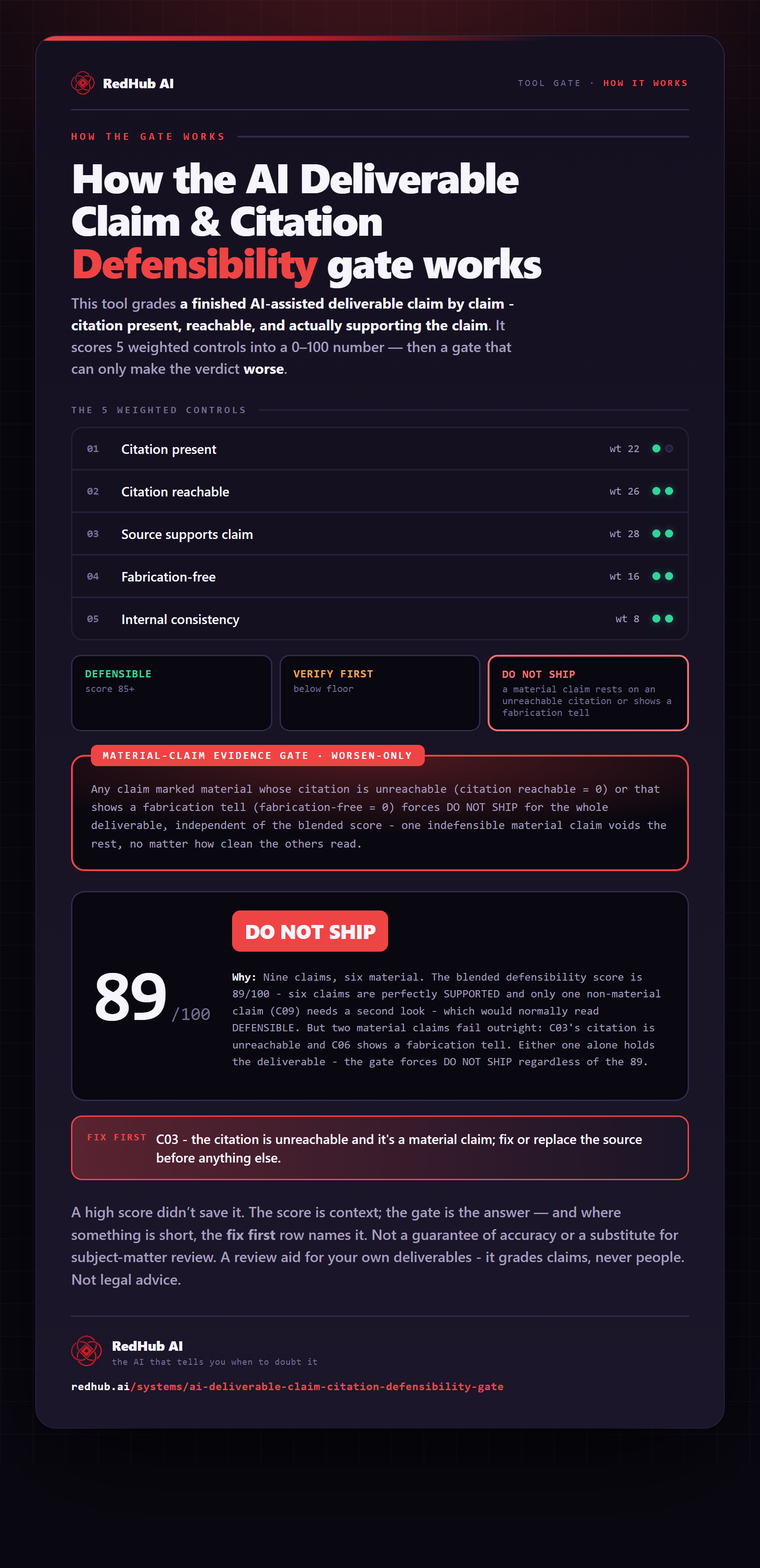
The gate this post refers to, drawn from the tool’s own logic. See the tool.