How to Keep AI Content Quality High at Scale
RedHub AI Editorialupdated October 4, 20266 min read

Jump to a section8
AI content quality slips at volume for an ordinary reason: the standard lives in one editor's head, and at fifty drafts a month that editor stops reading all of them closely. Holding quality at scale means writing the standard down and building it into the publishing process. A scanner catches the cheap problems first, a scorecard gives every draft a verdict, and a log shows which problem keeps coming back.
TL;DR: One editor reading by feel works for a handful of posts and breaks at fifty. Replace the feel with three layers: a heuristic scanner that fails a draft automatically, a SPARK scorecard that returns Publish, Revise or Rework, and a log that shows which mark your team misses most. Read the Real rating on its own, because a draft can score 90 with an unchecked claim. The Anti-Slop Content System ($79) ships the scanner, the scorecard and the log. If your team has not agreed on what slop is yet, start with the AI slop guide.
Why one good editor stops scaling
Say a careful read takes an editor 20 minutes per draft. At fifty drafts a month, that is 1,000 minutes, or about 16.7 hours of close reading. The numbers are illustrative. The point holds at any numbers: if volume grows and review hours do not, each review gets shorter, and a shorter review catches less.
A second problem arrives with a second editor. One editor's "good enough" is another's "send it back," and neither is written anywhere. Writers learn which editor to send which draft to. The standard drifts, and nobody notices the drift until a reader does.
Layer one: a scanner that can fail a draft
The cheapest problems should never reach a person. The kit's slopcheck.py is a zero-dependency Python script that scans a draft and returns a slop score out of 100. It flags cliché phrases, hedge words, em dashes, rule-of-three patterns and uniform sentence rhythm. Any score of 30 or more exits with code 1, so the script can sit in a publishing pipeline and stop a draft without anyone remembering to run it. Its built-in sloppy sample scores 54 and exits 1.
Know what the scanner does not do. It cannot tell whether a claim is true, whether the draft takes a position or whether it sounds like your brand. It counts surface patterns, and its own output calls the result "Heuristic only." A draft that passes the scan has cleared the cheap check, nothing more.
Layer two: a scored verdict
A reviewer rates each surviving draft from 0 to 5 on the five SPARK marks. Each mark has a fixed weight, from 25 points for Specific and Authentic voice down to 10 for Real. The bands are fixed too: a total of 80 or more is Publish, 60 to 79 is Revise, and anything lower is Rework.
The verdict is the point. Two reviewers who give the same five ratings get the same verdict, whatever kind of day either one is having. Disagreements move from "I don't love it" to "I rated Point of view a 2," and that is an argument a team can settle.
Read the Real rating before the total
The weights carry a gap worth knowing about. Real, the mark for whether every claim is true and supported, carries 10 of the 100 points. Rate a draft 5 on the other four marks and 0 on Real, and the total is 90. The verdict reads Publish. On a scorecard where 80 passes, honesty is worth ten points.
That is a fair design for a tool aimed at vague, voiceless drafts, which is what SPARK exists to catch. It does mean the total is the wrong place to look for honesty. Read the Real row first. A low rating there is a reason to hold the draft whatever the total says, at least until someone has checked every claim the rating doubted.
Layer three: the log shows what to fix upstream
The workbook's Log tab records each piece's score, channel and verdict, and its Dashboard counts how many land in each band. The sample rows show the range: a spring sale email at 72 (Revise), a homepage hero rewrite at 58 (Rework) and a founder LinkedIn post at 88 (Publish).
We are not going to tell you which mark your team will miss most. A pattern borrowed from someone else's team would tell you nothing true about yours. A month of honest ratings will, and the mark that fails most often points at the fix: a weak Specific score can mean writers lack source material, and a weak Point of view score can mean nobody agreed on what the company thinks.
Build the process, step by step
- Write down what on-voice means for your brand. A shared document beats a shared understanding.
- Run every AI-assisted draft through the scanner before a person reads it. A failing exit code sends it back to the writer.
- Score surviving drafts on SPARK and route by verdict: Publish goes out, Revise gets edited, Rework goes back to drafting.
- Check the Real rating on every draft, separate from the total.
- Review the log monthly and fix the mark that fails most, in the voice spec, the prompts or the briefs.
Put a gate in front of publish
The Anti-Slop Content System includes slopcheck.py, a heuristic scanner that exits non-zero on slop, plus the SPARK scorecard with a Publish / Revise / Rework verdict, a content log and dashboard, a field guide of tells and a playbook. It filters drafts. It does not certify them as human or AI.
Get the Anti-Slop Content System — $79Pairs well with
The Brand-Voice Content Multiplier & Drift Guard ($99) drafts multi-channel content from one anchor piece and scores each draft ON-VOICE, DRIFTING or OFF-BRAND by the weakest of six dimensions, never the average. The AI Deliverable Claim & Citation Defensibility Gate ($79) is the honesty check the total cannot be: one material claim on an unreachable or fabricated citation forces DO NOT SHIP, and its board-memo sample scores 89/100 and still reads DO NOT SHIP. For a one-person content operation, the Content Engine for One Person ($39) adds pillars, a calendar, a repurposing matrix and a Ship Check that flags generic filler.
More in this guide
How do I keep AI content quality consistent across a team?
Give every writer and reviewer the same written gate: a voice spec, a scanner run before review and a shared scorecard with set verdict bands. Individual judgment drifts across people and over time. A written standard gives everyone the same reference point.
What is a quality gate for content?
A checkpoint every draft must pass before publishing, with a clear verdict. In the Anti-Slop Content System, the scanner can fail a draft automatically, and the SPARK scorecard returns Publish, Revise or Rework.
Can I automate AI content quality checks entirely?
No. A scanner can catch surface patterns like cliché phrases and uniform rhythm, but it cannot tell whether a claim is true or whether a draft takes a position. Automation filters, and a person still decides.
Can a draft with a false claim still pass the SPARK scorecard?
Yes. Real carries 10 of the 100 points, so a draft rated 5 on every other mark and 0 on Real totals 90 and reads Publish. Check the Real rating on its own before trusting the total.
Which quality mark slips first as volume grows?
It depends on the team, and an outside average would not tell you about yours. Log every draft's ratings for a month and the mark that fails most often will show you where to fix the process.
How do I know if my quality gate is working?
Watch the log. If fewer drafts land in Rework over time and the same mark stops failing, the gate is catching problems earlier. If verdicts never change, check whether reviewers are rating honestly or rounding up.
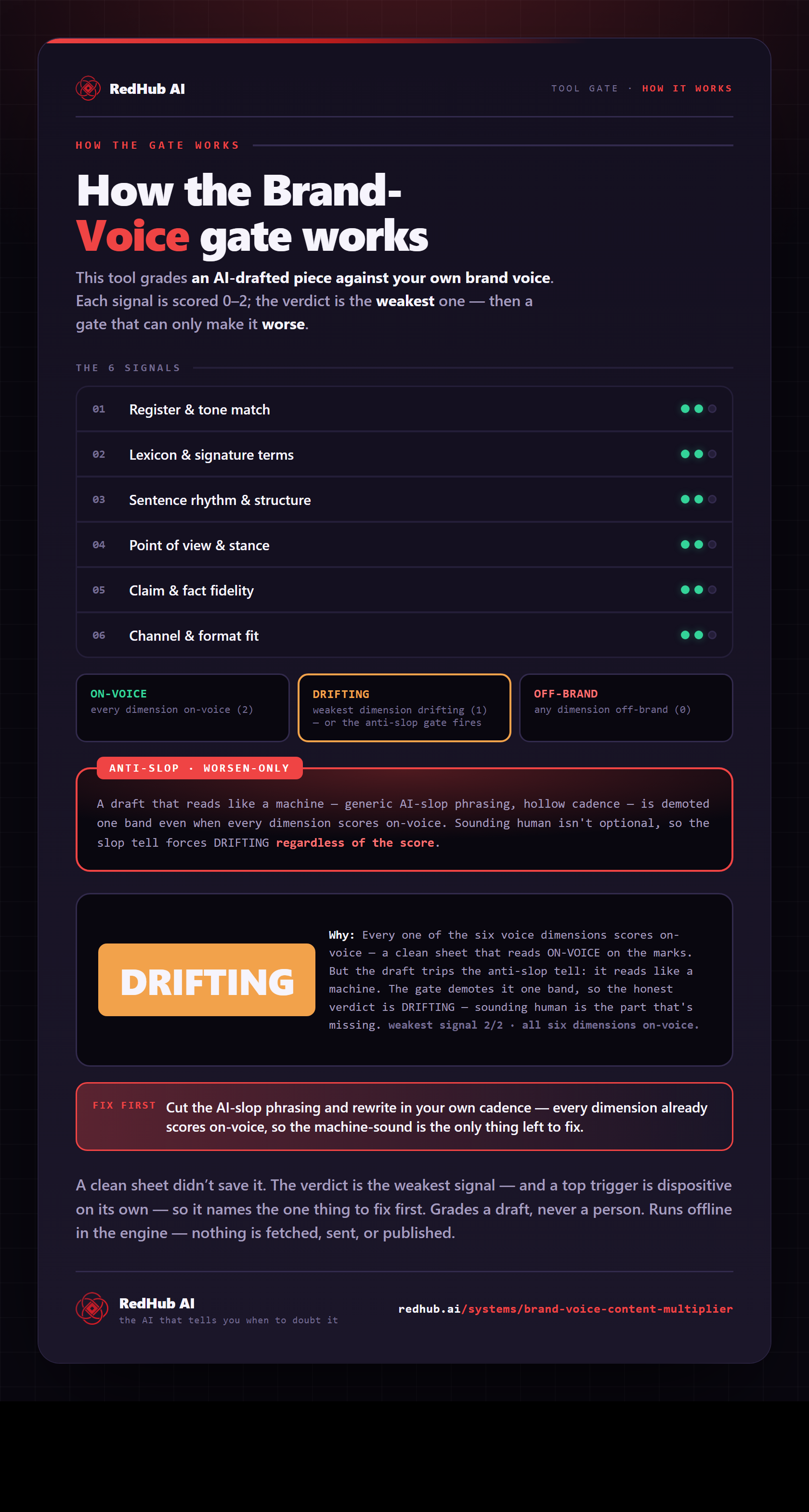
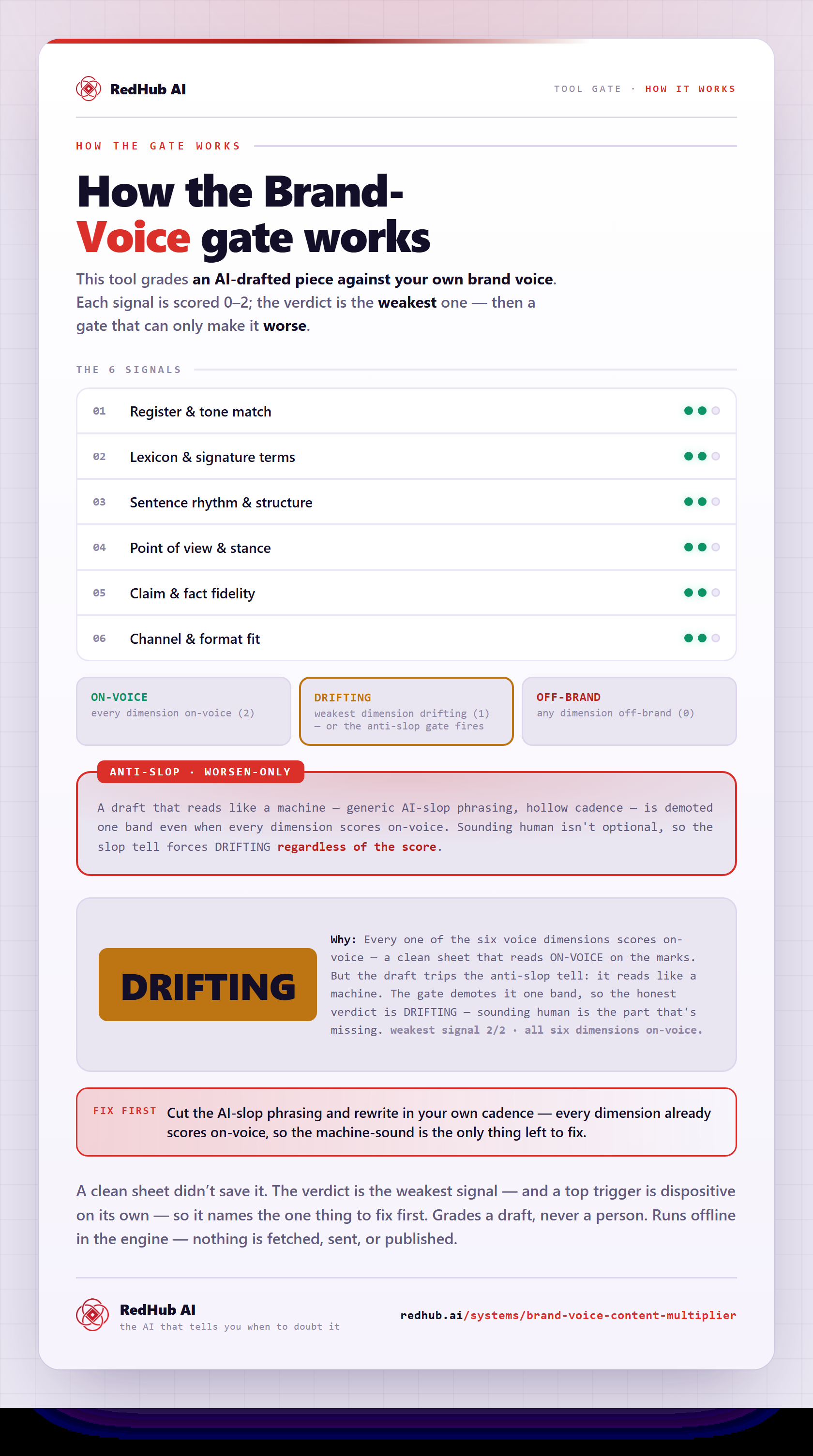
The gate this post refers to, drawn from the tool’s own logic. See the tool.