BANT and Beyond: Lead Qualification Frameworks That Still Work
RedHub AI Editorialupdated September 20, 20264 min read

Jump to a section7
BANT (Budget, Authority, Need, Timeline) is the oldest lead qualification framework still in wide use, and it still works — as long as you treat its four questions as a starting checklist, not a rigid script. Newer frameworks like CHAMP and MEDDIC add nuance BANT misses, but the core idea across all of them is the same: reduce "is this lead worth calling" to a short, consistent set of questions instead of a gut feeling.
TL;DR: BANT (Budget, Authority, Need, Timeline) is a simple, durable qualification checklist. CHAMP reorders it to start with the buyer's Challenge instead of Budget. MEDDIC adds more rigor for complex B2B sales. None of them replace judgment — they just make sure the same questions get asked of every lead, every time. A scoring tool like the Inbound Lead Qualification Engine ($99) can apply this kind of consistent framework automatically as leads come in.
BANT: The Original Framework
BANT asks four questions about every lead:
- Budget — can they actually afford what you sell?
- Authority — is this person able to make or influence the purchase decision?
- Need — do they have a real problem your product solves?
- Timeline — are they looking to solve it soon, or someday?
BANT's strength is its simplicity — it's fast to apply and easy to teach a new hire. Its common criticism is that leading with Budget can filter out a lead who has a real, urgent need but hasn't yet worked out what they can spend — sometimes the right conversation, not a form field, uncovers that.
CHAMP: Leading With the Problem, Not the Budget
CHAMP (Challenge, Authority, Money, Prioritization) reorders BANT's logic to start with the buyer's Challenge — what problem are they actually trying to solve — before asking about money. The idea: a lead with a real, painful challenge is worth a conversation even if budget and authority aren't fully clear yet, because a real problem tends to surface the budget and the decision-maker along the way.
MEDDIC: More Rigor for Complex Sales
MEDDIC (Metrics, Economic buyer, Decision criteria, Decision process, Identify pain, Champion) is built for longer, more complex B2B sales cycles with multiple stakeholders. It asks not just whether there's a need, but whether you can quantify the impact (Metrics), whether you've actually reached the person who controls the budget (Economic buyer), and whether you have an internal champion advocating for you. It's more work to apply — appropriate for a $50,000 deal, overkill for a $99 self-serve purchase.
| Framework | Best for | Leads with |
|---|---|---|
| BANT | Fast, simple qualification for most inbound teams | Budget |
| CHAMP | Consultative, problem-first sales motions | Challenge |
| MEDDIC | Complex, multi-stakeholder enterprise deals | Metrics |
What All of These Frameworks Have in Common
Strip away the acronyms and every framework is doing the same two things at its core: checking fit (does this lead have the need, budget, and authority to actually buy) and checking intent (is the timeline or urgency real). The letters differ in what order they ask the questions and how much detail they demand, but the underlying fit + intent logic is identical. That's worth knowing, because it means you don't have to pick a "perfect" framework — you have to pick one that fits your sales cycle and apply it consistently.
Picking the Right Framework for Your Team
- Short, simple sales cycle with a lower price point — BANT is usually enough.
- Consultative sales where the buyer often doesn't know their own budget yet — CHAMP's challenge-first order fits better.
- Long, multi-stakeholder enterprise deals — MEDDIC's added rigor earns its extra overhead.
- Whichever you pick, write the criteria down and apply them the same way to every lead — the framework only works if it's consistent.
Where a Scoring Tool Fits In
Any of these frameworks can be applied manually, one lead at a time, by a rep with a checklist. That works until lead volume grows past what one person can consistently score by hand. A tool that applies a fit + intent framework automatically to every inbound lead does the same underlying job as BANT or CHAMP — it just does it at scale, without the criteria drifting depending on who's reading the form that day.
Pairs well with: Once a framework tells you a lead is qualified, the next job is getting them on a call before that qualification goes stale — the Lead-to-Meeting Engine ($149) handles that step. For leads a framework flags as "not yet," the CRM Win-Back System ($149) keeps them warm until timeline and budget catch up.
More in this guide
What does BANT stand for?
Budget, Authority, Need, Timeline — the four questions BANT asks about every lead to judge whether they're worth a sales conversation.
Does a low score mean the lead is worthless?
No. A lead that doesn't clear a framework's bar today may simply lack budget or timeline clarity right now — revisit it later rather than writing it off for good.
Is BANT outdated?
No, but leading with Budget can filter out leads with real, urgent needs whose budget isn't yet defined. Many teams now lead with Need or Challenge instead and treat Budget as a later question.
What's the difference between BANT and MEDDIC?
BANT is a fast, four-question checklist suited to simpler sales. MEDDIC adds more rigor — quantified impact, confirmed economic buyer, an internal champion — suited to longer, multi-stakeholder enterprise deals.
Do I have to pick just one framework?
No, but consistency matters more than which framework you choose. Pick the one that fits your sales cycle's complexity and apply its criteria the same way to every lead.
Can a qualification framework be automated?
Yes — the underlying logic of any of these frameworks (fit and intent, asked in some order) can be applied automatically to every inbound lead by a scoring tool, which keeps the criteria consistent as volume grows.
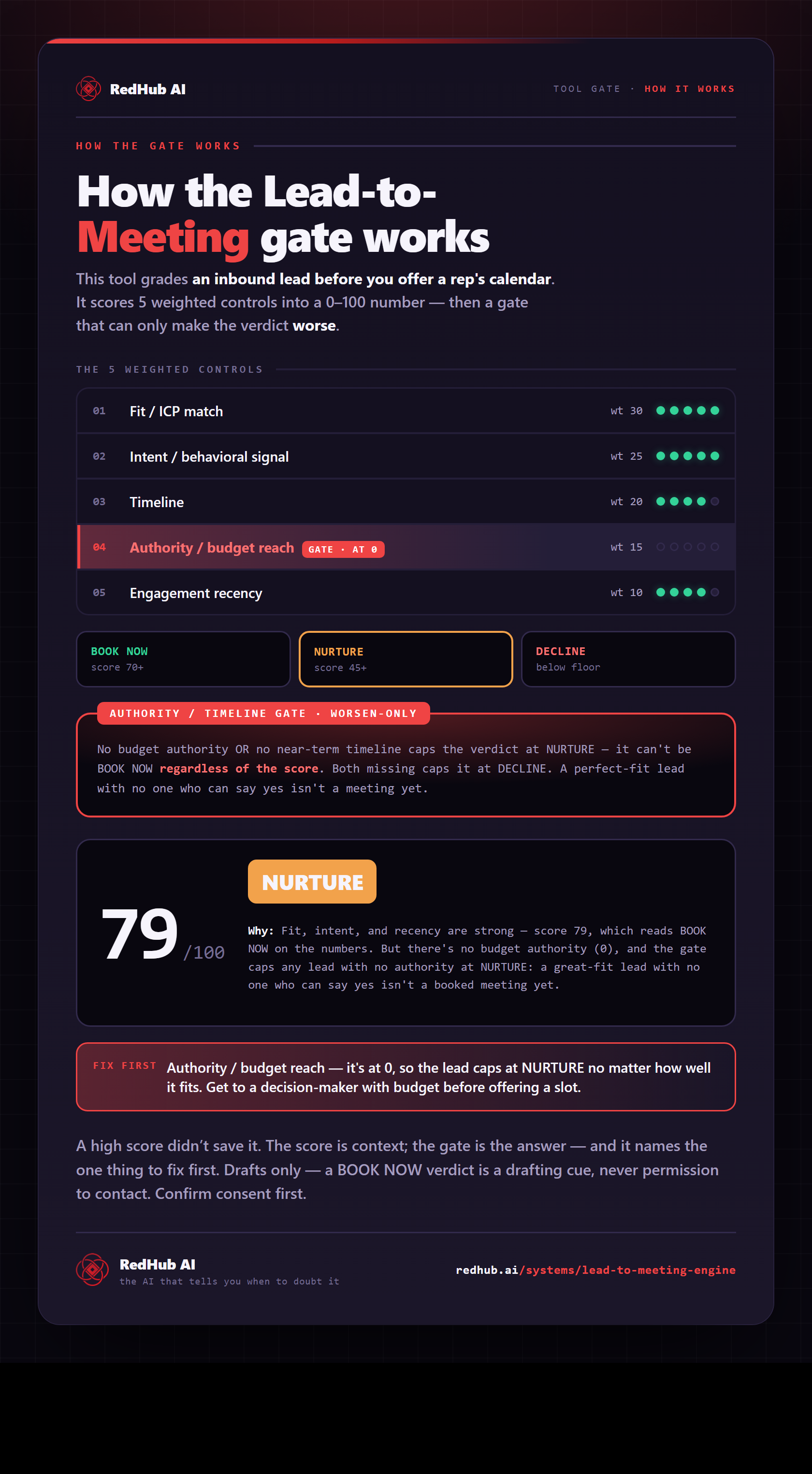
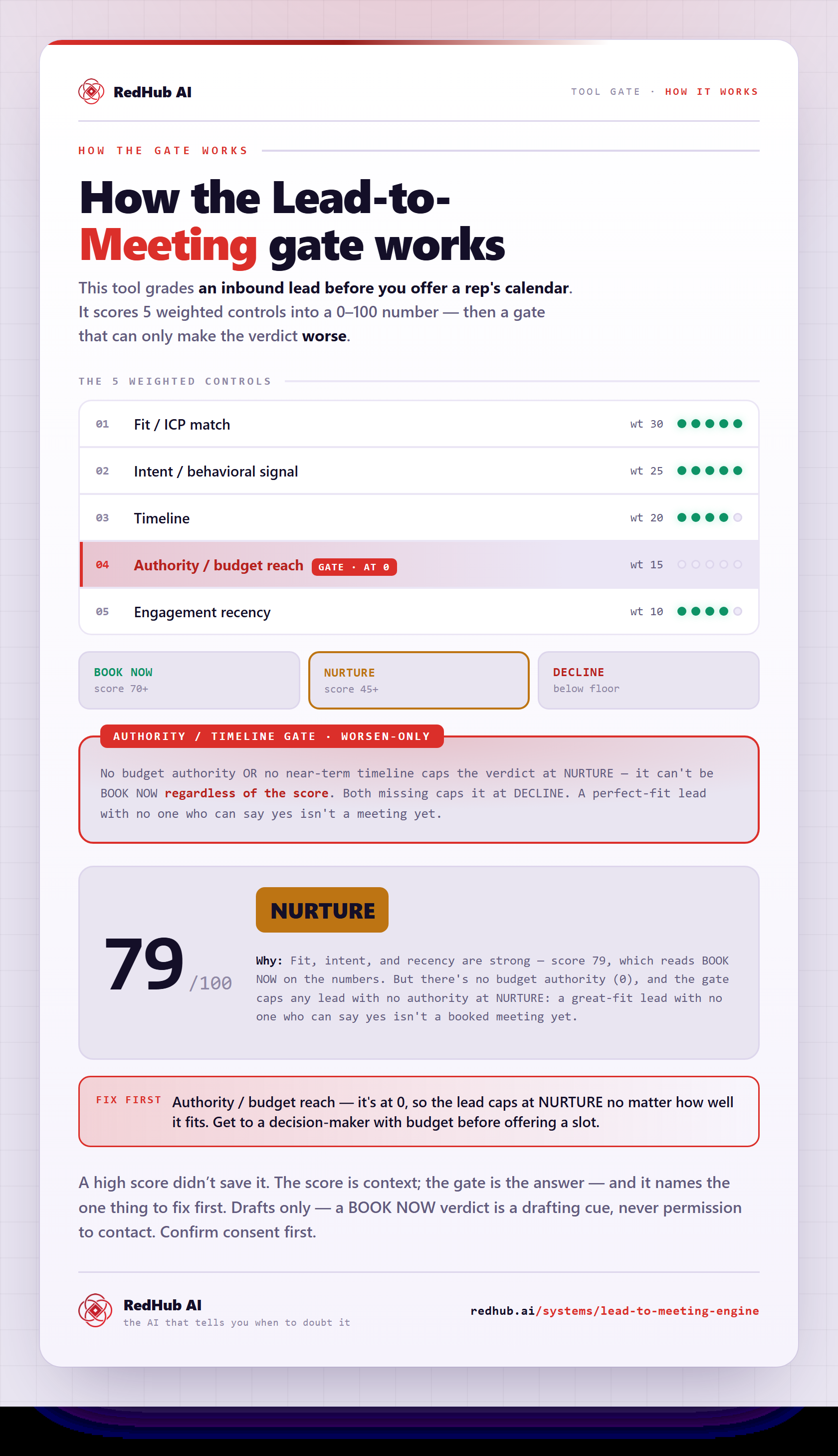
The gate this post refers to, drawn from the tool’s own logic. See the tool.