Long-Horizon AI Agents: 7 Design Rules for Hours-Long Work
RedHub AI Editorial6 min read

Jump to a section11
- The arithmetic of a long run
- Rule 1: Define the finish line
- Rule 2: Add checkpoints that catch errors
- Rule 3: Make failure recoverable
- Rule 4: Separate analysis from action
- Rule 5: Budget the autonomy
- Rule 6: Give the agent a narrow identity
- Rule 7: Log the chain of work
- When control gets in the way
- Pairs well with
- More in this guide
Long-horizon AI agents work through a task over many steps, for minutes or hours, and the longer the run, the more a small error rate compounds. If each step succeeds independently 85% of the time, an 8-step job comes out right end to end only about 27% of the time. Models such as Gemini 4 Argon, which Google says is "built to sustain deep reasoning across complex, long-horizon workflows," are designed to make longer runs practical. That makes the arithmetic matter more, not less. The seven design rules below run in order of how much each one changes it.
TL;DR: Long-horizon AI agents fail more as steps multiply. Three rules raise end-to-end success (a tight finish line, checkpoints, recoverable failure), three contain the failures that still happen (separating analysis from action, hard budgets, a narrow identity), and one improves the per-step rate over time (a full log). These controls catch and contain the failures compounding produces. The Agent Reliability Harness ($149) evaluates the whole run, not just the final answer. Start with the pillar: Gemini 4 Argon: AI That Works Longer Than You Can Watch.
The arithmetic of a long run
If each step of a job succeeds independently, the chance the whole job succeeds is the per-step rate multiplied by itself once for every step.
| Per-step success | Steps | Whole run succeeds |
|---|---|---|
| 85% | 8 | about 27% |
| 95% | 20 | about 36% |
| 99% | 50 | about 60% |
Real steps are not fully independent, so read these as a direction, not a forecast. Still, a model that looks excellent one step at a time can finish most long jobs wrong. Our post on AI agent reliability covers how those quiet failures show up in practice.
Rule 1: Define the finish line
The cheapest way to raise end-to-end success is to cut the number of steps, and a vague goal adds steps. Take an RFP response. "Respond to this RFP" lets an agent wander through every past proposal, every product page and every pricing sheet. "Draft answers to sections 3 to 7 using only the approved answer library, flag any question with no approved answer, and stop" has an end. A precise finish line keeps the run short and tells the agent when to stop, which prevents the common failure where it keeps producing activity because nobody defined done.
Rule 2: Add checkpoints that catch errors
A checkpoint is a planned pause between stages where the work is checked before the next stage builds on it. That check is what breaks the compounding, because a caught error gets redone instead of carried forward.
The catch is a checkpoint that catches nothing. A check that someone rubber-stamps adds delay and none of the benefit, which is the problem the last section of this post comes back to.
Rule 3: Make failure recoverable
Long jobs fail for ordinary reasons: a service times out, a file is missing, a system changes underneath the agent, or it reaches a question only a person can answer. If the agent has to start over from zero, every late failure costs the whole run. If it saves its state at each checkpoint and can resume from there, a failure costs one stage. A good agent reports what it finished, which sources it used, what failed, what is left and what it needs next.
Rule 4: Separate analysis from action
Not every failure costs the same. A mistake while reading and planning costs a redo. A mistake while acting can cost a customer. So give an agent more freedom to read and plan than to act. Reading documents and proposing a plan can be automated and logged. Changing an internal record might need a rule check. Sending an outside message, changing code, touching a customer account or moving money should need explicit approval and a way to undo it.
Rule 5: Budget the autonomy
Budgets do not make a run more likely to succeed. They cap what a failing run can cost. Put hard limits on time, tokens, tool calls, retries, spend, files changed, records touched and messages sent, and have the agent stop at any of them. At Argon's introductory price, a single response that uses the full 1 million-token output limit costs $10 in output alone, and a looping agent can produce many of those.
Rule 6: Give the agent a narrow identity
Do not run every agent under one shared machine login. Give each agent its own credentials, scoped to its task, so it can reach only the data, tools and systems the job needs. Security teams call this least privilege: only the access the task requires. It caps how far one failure spreads, and it means that when something goes wrong you can say exactly which agent acted, under which rules, with which permissions. Our guide to non-human identity security covers how.
Rule 7: Log the chain of work
This is the rule that raises the per-step rate itself, slowly. Record the goal, model version, instructions, retrieved content, tool calls, approvals, errors, retries, outputs and every change of state. Over enough runs, the log shows which step fails most, and that is the step to fix. It is also what you show a customer or auditor who asks how the work was controlled.
When control gets in the way
Every rule here slows the agent down, and some can backfire. Add too many approval steps and people start clicking approve without reading, which is worse than no approval, because it looks like oversight and catches nothing. Aim for the fewest checkpoints that would catch the mistakes you could not afford, placed right before the steps that cannot be undone. Where that line sits differs by workflow, and nobody can draw it for you from outside.
Evaluate the whole run, not just the answer
The Agent Reliability Harness evaluates every step an agent took, covering tool choice, argument validity, step efficiency, cost and policy, and returns a ship, hold or fix verdict that can block a release in your build pipeline.
Get the Agent Reliability Harness — $149Pairs well with
The AI Agent Quiet-Failure & Drift Monitor Kit ($49) computes the true end-to-end success rate of your multi-step agents from their per-step reliability, the same compounding shown above. The Agent Action Admissibility Engine ($99) checks each action an agent proposes against your own rules before it runs, and returns ADMISSIBLE, REVIEW or INADMISSIBLE. The Agent Side-Effect & Blast-Radius Checkpoint ($89) decides which actions can run without a person watching.
More in this guide
What is a long-horizon AI agent?
It is an AI agent that works through a task over many steps and a long time, planning, using tools, checking results and recovering from errors, instead of answering a single question. Code migrations, document reviews and RFP responses are typical examples.
Why do long-running AI agents fail more often?
Errors compound. If each step succeeds independently 85% of the time, an 8-step run succeeds all the way through only about 27% of the time. More steps mean more chances for something to go wrong.
How do checkpoints improve an agent's success rate?
A checkpoint checks the work between stages, so a failed stage gets redone instead of carried forward. In a simple example, splitting an 8-step job into two checked stages with one retry raises end-to-end success from about 27% to about 60%, assuming the checks catch every failure.
What limits should a long-running agent have?
Hard limits on time, tokens, tool calls, retries, spending, files or records changed, and outside messages sent. The agent should stop when it reaches any of them.
Should an AI agent be allowed to act without approval?
For reading and planning, often yes, with logging. For outside messages, code changes, customer records or payments, it should need explicit approval and a way to undo the change, at least until the workflow has a proven track record.
Can too many approval steps make an agent less safe?
Yes. When people approve so often that they stop reading, approval becomes a formality that looks like oversight and catches nothing. Put fewer checkpoints where they matter most, right before actions that cannot be undone.
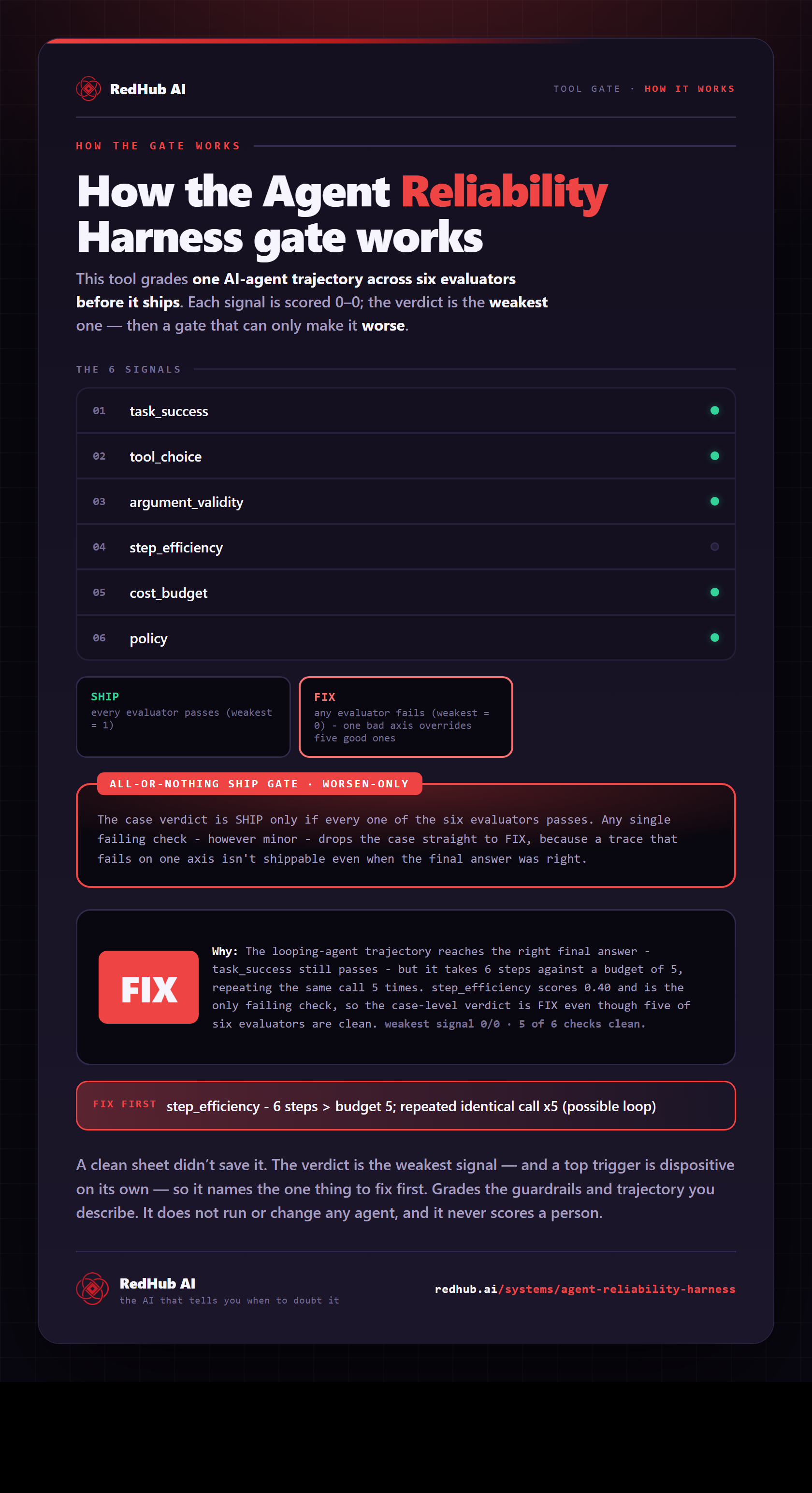
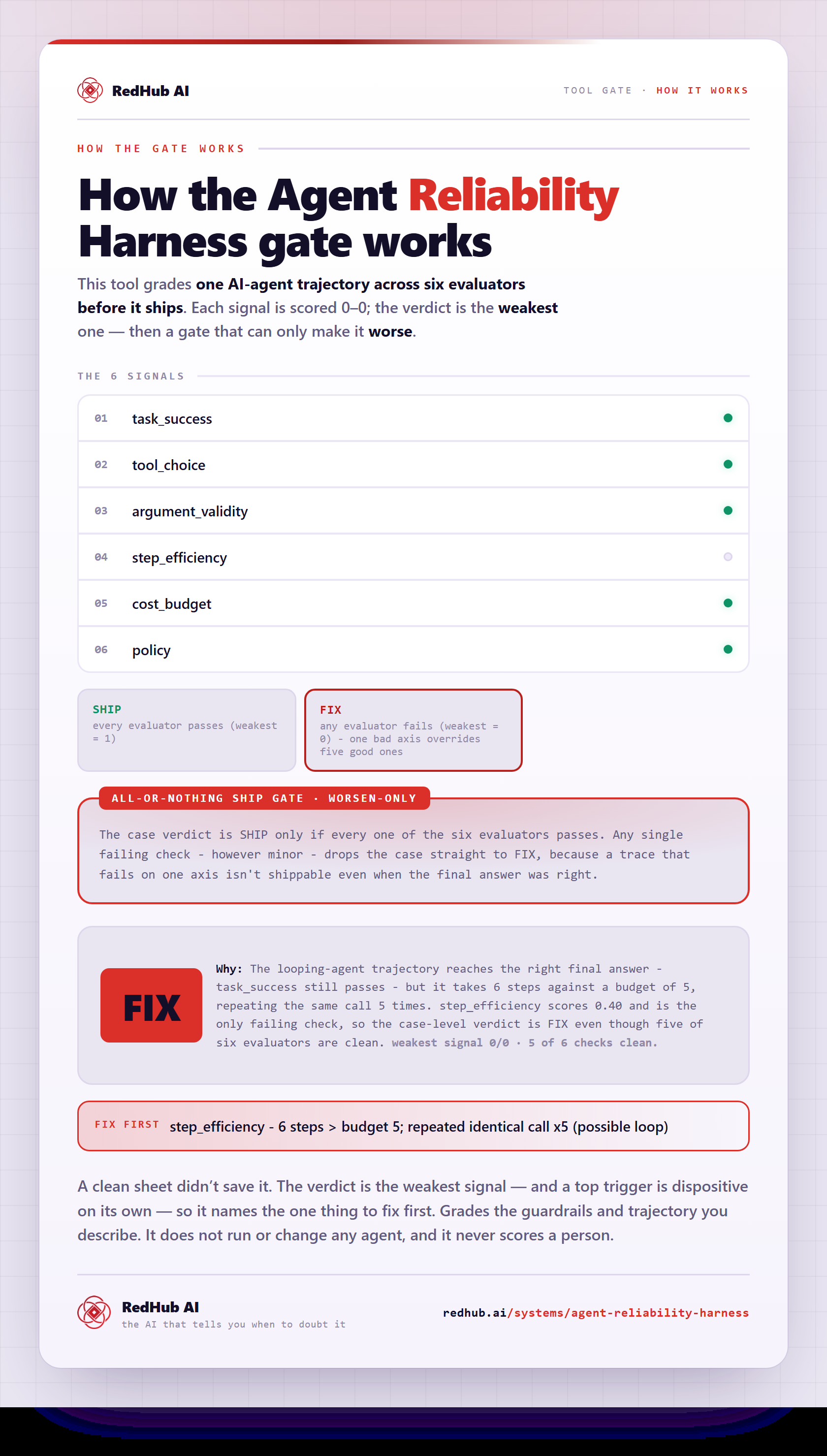
The gate this post refers to, drawn from the tool’s own logic. See the tool.