Gemini 4 Argon vs Claude Sonnet 5.5: What $2 Really Buys
RedHub AI Editorial6 min read

Jump to a section7
Two new AI models launched two days apart at the same list price, and that matching price is the least useful number in the comparison. In the Gemini 4 Argon vs Claude Sonnet 5.5 matchup, both list at $2 per million input tokens and $10 per million output tokens. But Argon's price is introductory, and Google says it will rise to $4 and $20. Sonnet 5.5 is available now, while Argon is limited to an early-access program. And neither price tells you what a finished, usable result costs. Only a test on your own work tells you that.
TL;DR: For a short window, Gemini 4 Argon and Claude Sonnet 5.5 share a $2 / $10 list price. Argon's will double. Google built Argon for long, multi-step work, and Anthropic pitches Sonnet 5.5 as a faster, lower-cost option for well-scoped everyday tasks. Compare cost per accepted result on your own tasks, not price per token. The AI Cost-Per-Task Calculator ($29) runs that math, once per model. Start with the pillar: Gemini 4 Argon: AI That Works Longer Than You Can Watch.
The list prices, side by side
Both companies publish these numbers themselves: Google on its Argon announcement (opens in a new tab) and Anthropic on its Sonnet 5.5 page (opens in a new tab). As of October 2, 2026:
| Gemini 4 Argon | Claude Sonnet 5.5 | |
|---|---|---|
| Input, per million tokens | $2 (introductory) | $2 |
| Output, per million tokens | $10 (introductory) | $10 |
| Cached input | 95% off input: by our arithmetic about $0.10 per million now, about $0.20 after the introductory period | $0.20 per million for cache reads |
| Later price | $4 input, $20 output; Google has not said when | No change announced |
| Released | Announced September 30, 2026 | September 28, 2026 |
| Who can use it | Fairwind cyber defenders and Google's own teams first; paid API customers and Google AI Ultra subscribers later, no dates | Available now |
Read the bottom row before the top ones. A model you cannot run on your own work is not yet an option, whatever it costs, so for most businesses the Argon column is a plan for later.
What each vendor says its model is for
Google says Argon is "built to sustain deep reasoning across complex, long-horizon workflows," aimed at real-world software engineering, enterprise knowledge work such as legal and finance, and cyber defense, with an output limit of 1 million tokens. That points it at jobs that need a long, unbroken stretch of work.
Anthropic calls Sonnet 5.5 "a faster, lower-cost complement to Claude Opus 5.5," good at well-scoped everyday tasks, fixing bugs, and producing polished documents, slides and spreadsheets. Anthropic says it generates output more than 30% faster than Sonnet 5, costs up to 30% less per task than its predecessor, and batches more tool calls into fewer steps.
Both are each vendor's own claims about its own model. Neither measures your workload, and we are not going to rank one above the other on them.
Price per token is not price per result
Anthropic's pitch makes the point both price sheets leave out. If a model finishes the same task in fewer steps, its cost per task falls even when its per-token price does not move. Token price is an input to your cost, not your cost.
The figure to compare is cost per accepted result: everything a task costs, divided by the results you keep. That includes:
- Input and output tokens across every model call, not just the first one
- Retries and calls to a backup model when the first one fails
- Tool and data fees
- The minutes a person spends checking and fixing the output
- The cost of the mistakes that get through
Two models at the same token price can land far apart on that number, in either direction. Our guide to what an AI task costs in full works through the calculation.
Run your own comparison
When Argon reaches your account, the test is the one you would run on any pair of models.
- Pick real tasks. Twenty to fifty pieces of work your team does, including the awkward cases, not demo prompts.
- Define "done" first. The correct outcome, the required format, what the model must not do, a cost ceiling and a response-time target, written down before any results come in.
- Run both the same way. Same prompts, same tools, same reviewers.
- Score what you pay for. Accuracy, completeness, tool errors, retries, response time, tokens used, and the minutes of human correction.
- Roll out gradually. Send a small share of live work to the winner, and keep a backup model and a way back.
The result may not be one winner. A long code migration and a quick customer reply are different jobs, and the cheapest model per accepted result can differ by job. A Decision Fit Check on each task type shows whether a task needs a frontier model at all.
Keep the model replaceable
Two new models and one announced price rise in a single week is a reminder that model choice keeps moving. Keep your workflow rules, tools, policies and test set separate from any one provider's model. Then a price change, an outage or a retirement becomes a test run, not a rebuild. Our post on model deprecation covers what happens when you do not.
Compare the cost of a task, not the cost of a token
The AI Cost-Per-Task Calculator compares human hours against AI for every task your team runs, with real AI cost and setup cost, and gives each task an Automate, Review or Skip verdict. Run it once with each model's cost per run to see where the two diverge.
Get the AI Cost-Per-Task Calculator — $29Pairs well with
The AI Unit-Economics & Token-Shock Exposure Kit ($59) computes the fully loaded cost per successful outcome for each workflow from your own numbers, including retries and growth. The Token Economics Workbook ($59) adds a model-routing matrix and caching patterns for teams running more than one model. When you swap models, the Prompt Regression Lab ($89) snapshots a baseline and fails the build on any regression.
More in this guide
Do Gemini 4 Argon and Claude Sonnet 5.5 cost the same?
For now, at list price, yes: both are $2 per million input tokens and $10 per million output tokens. Argon's price is introductory, and Google says it will rise to $4 and $20 without saying when.
Which is cheaper for cached input?
Google prices Argon's cached input at 95% off the input price, which works out to about $0.10 per million tokens now and about $0.20 after the introductory period. Anthropic lists Sonnet 5.5 cache reads at $0.20 per million. Check both pages before you budget.
Which model is better?
Neither company's claims answer that for your business. Google built Argon for long, multi-step work and Anthropic pitches Sonnet 5.5 at faster, well-scoped everyday tasks. Run both on your own real tasks and compare what you would keep.
What is cost per accepted result?
It is the full cost of a task, including tokens, retries, tool fees and the time a person spends checking it, divided by the number of results you use. It is a better comparison than price per token.
Why can two models at the same price cost different amounts?
Because they use different numbers of tokens and steps to finish the same task, and produce different amounts of work a person has to fix. A model that finishes in fewer steps with fewer errors costs less per result at the same token price.
Should I lock my workflow to one of these models?
No. Keep your workflow rules, tools and test cases separate from any one model. Then a price rise, an outage or a model retirement means a new test run, not a rebuild.
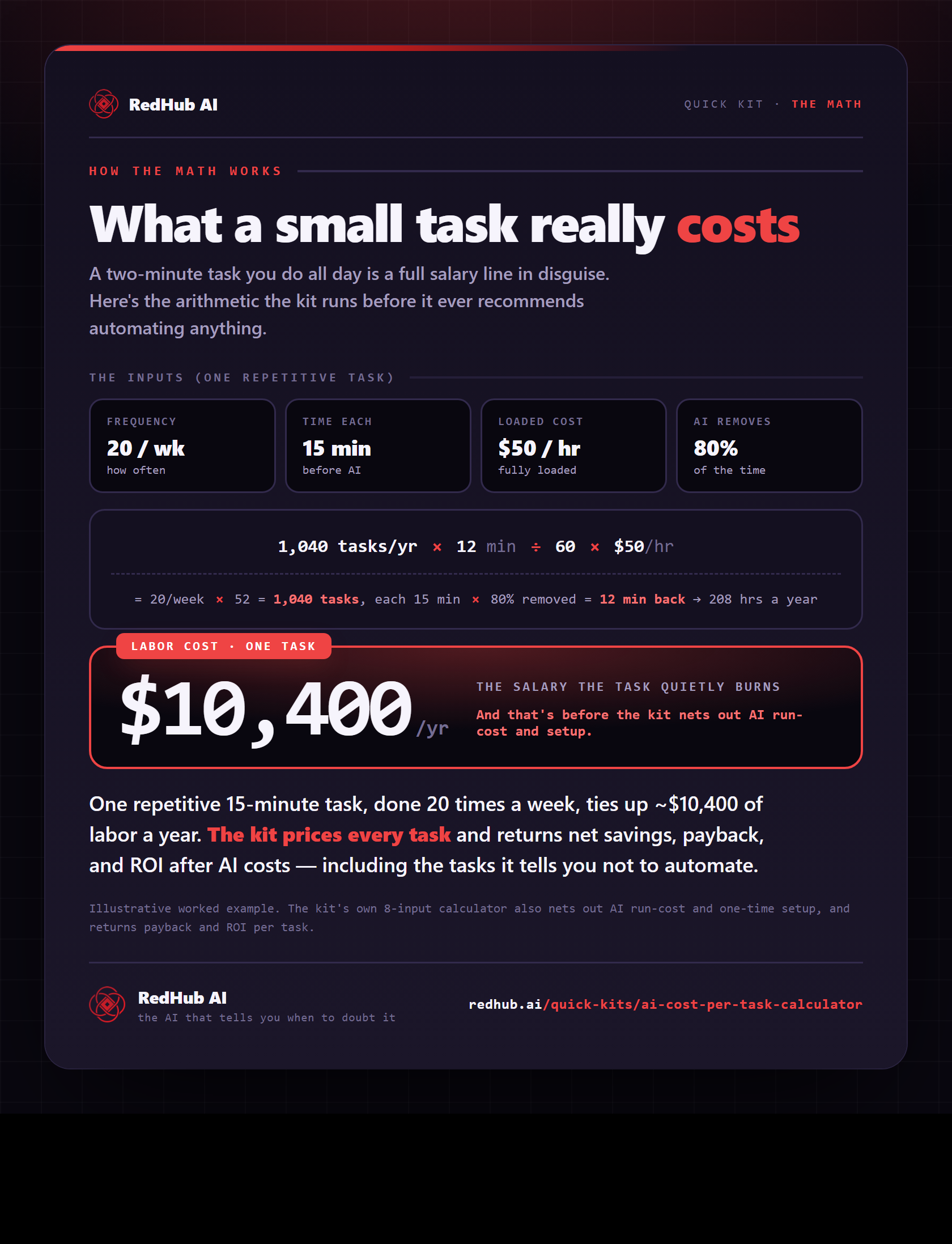
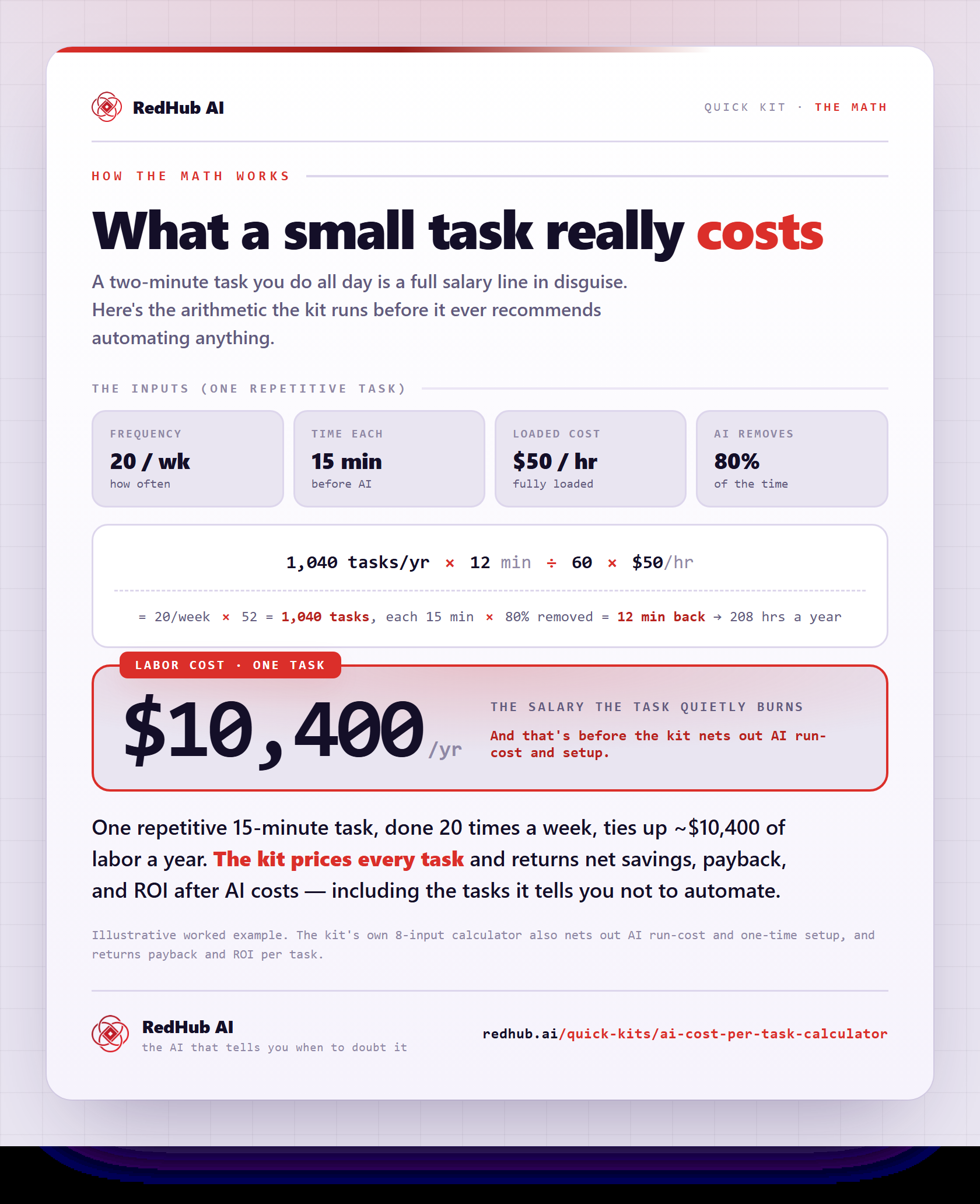
The gate this post refers to, drawn from the tool’s own logic. See the tool.