Non-Human Identity Security: Securing AI Credentials
RedHub AI Editorialupdated August 18, 20266 min read

Jump to a section10
- TL;DR
- What is non-human identity security?
- What is a non-human identity
- Why AI agents make the NHI problem worse
- What breaks: leaked, orphaned, and over-scoped credentials
- The compounding risk: credentials meet injection and memory poisoning
- How to grade your agent's credential posture
- What a credential gate does — and doesn't do
- Decision Guide
- FAQ
TL;DR
- What it is: non-human identity security means grading the API keys, tokens, and service accounts an AI agent runs on — credentials that rarely get the review a human login does.
- Who it's for: teams whose agent calls third-party APIs or tools with its own credentials — see the Non-Human Identity & Credential Sprawl Gate.
- How it works: agents multiply credentials fast and run without a human at the keyboard to notice misuse, so a leaked, orphaned, or over-scoped key is both reachable and hard to kill fast.
- Bottom line: whatever else goes wrong with an agent, its credentials decide how much damage that failure can do.
What is non-human identity security?
Non-human identity (NHI) security is the practice of managing and grading the credentials a piece of software runs on — API keys, tokens, service accounts, and machine-to-machine trust — as distinct from managing a human's login. For an AI agent, this matters because agents often run with standing, long-lived, and broadly scoped credentials that nobody reviews as carefully as a human's password, so a leaked or orphaned key can be both reachable by an attacker and hard to shut off quickly.
Best for: teams running an agent that holds its own API keys, tokens, or service accounts — grade the posture with the Non-Human Identity & Credential Sprawl Gate.
Non-human identity security is the surface that decides how bad an incident gets, even if it's not where the incident starts. An agent can be tricked by a prompt injection or connected to a bad MCP server — but what it can actually do with that compromise comes down to the credentials behind it. This guide covers what a non-human identity is, why agents make this problem worse than a typical app, and how to grade your agent's credential posture.
What is a non-human identity
A non-human identity is any credential that authenticates a piece of software instead of a person — an API key, an OAuth token, a service account, or the trust one agent extends to another. A human identity usually comes with multi-factor login, a directory entry, and a security team that notices when it behaves oddly. A non-human identity is often a static string in an environment variable, created once, rarely rotated, and inventoried nowhere in particular.
Why AI agents make the NHI problem worse
An agent multiplies this problem instead of just having it. Every tool it connects to often gets its own key. Keys get scoped generously at setup time because it's easier than fine-tuning permissions later, and nobody revisits that scope once the agent is working. And because the agent runs autonomously — sometimes around the clock — there's no human "at the keyboard" whose absence would be the tell that something is wrong. A compromised human account often gets noticed through odd login times or a locked-out user complaining. A compromised agent credential can keep working exactly as designed, just for someone else's purpose.
What breaks: leaked, orphaned, and over-scoped credentials
| Failure mode | Why it matters |
|---|---|
| Leaked key | A credential exposed in a log, a repo, or a compromised tool becomes reachable by an attacker |
| Orphaned key | The person or project that created it is gone, but the key is still live and unmonitored |
| Over-scoped token | The agent holds more access than the task actually needs, widening the blast radius of any compromise |
| Un-revocable secret | A hardcoded or shared credential with no clean rotation path, so shutting it off breaks something else too |
The compounding risk: credentials meet injection and memory poisoning
Credentials rarely fail in isolation. An indirect prompt injection or a poisoned memory only becomes a real breach once it reaches something the agent can actually do damage with — and that reach is entirely a function of the credentials behind it. See Prompt Injection: What It Is and How to Stop It and AI Agent Memory Poisoning for the two most common ways a credential ends up being used against you.
Key insight: a single catastrophic credential fault should fail the whole grade, even if everything else about the agent looks fine. A weak link in the credential chain is the one place where "mostly good" isn't good enough.
How to grade your agent's credential posture
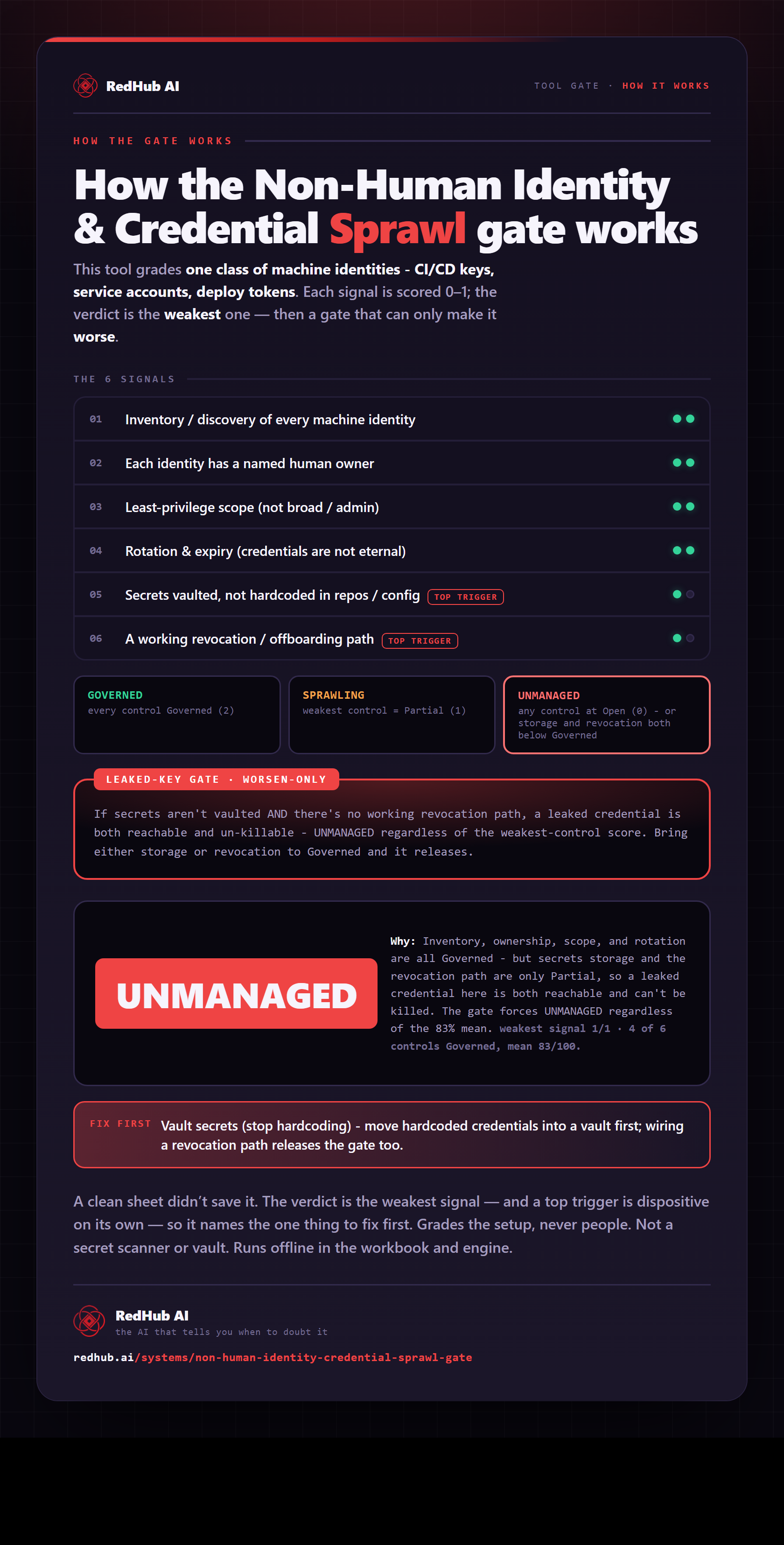
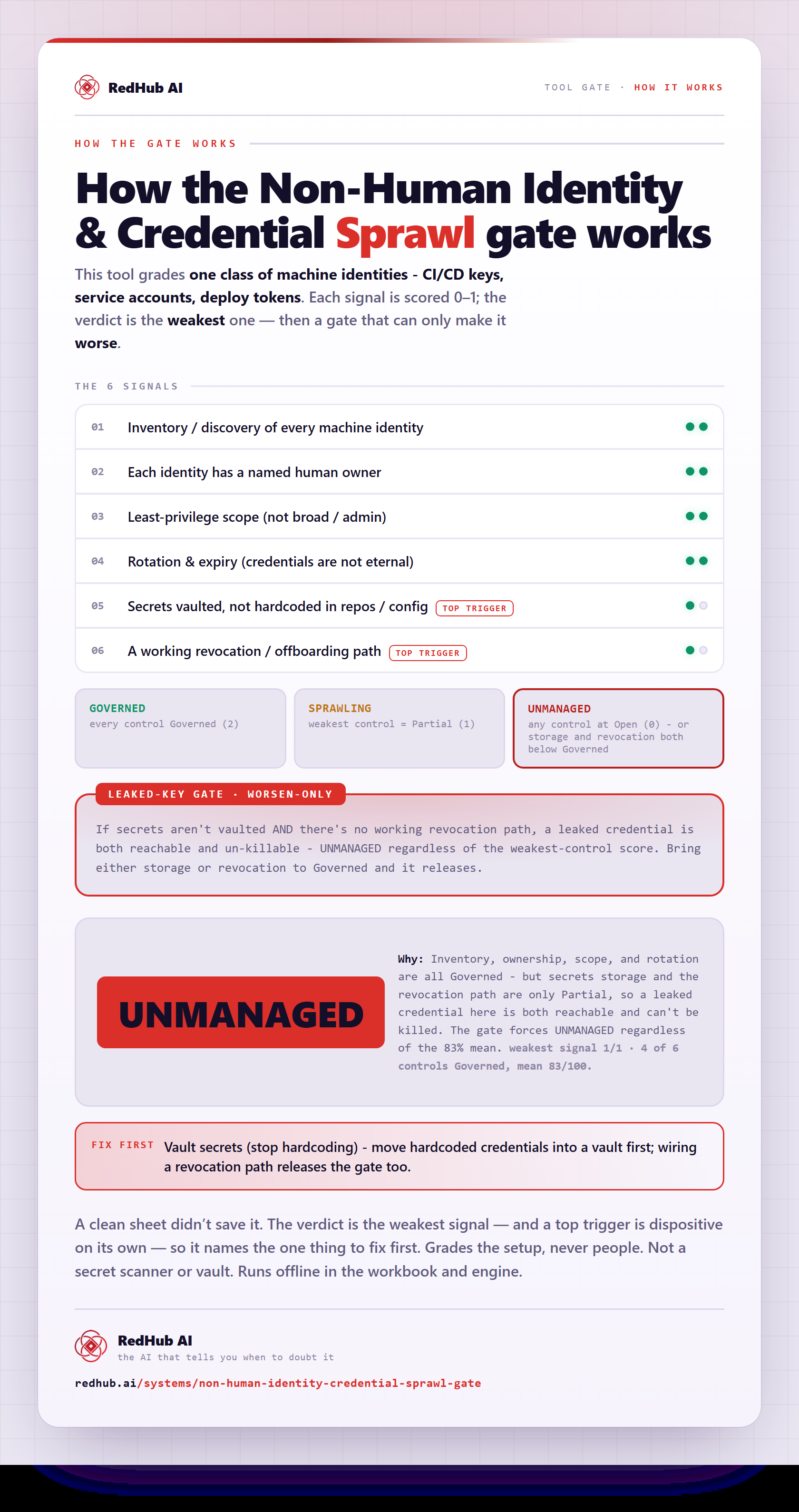
The scoring approach that holds up is the same weakest-link logic used across every agentic security surface: don't average a catastrophic fault down to a passing score. If credentials are both broadly scoped and hard to revoke, that's the finding — regardless of how well everything else about the agent is built. A grading gate names that single control to fix first, rather than a general "looks fine" verdict that hides the one thing that actually matters.
What a credential gate does — and doesn't do
What it does
- Grades the service accounts, keys, and tokens behind an agent
- Flags a single catastrophic fault instead of averaging it away
- Names the one control to fix first where a control is short
What it isn't
- Not an IAM platform or automatic key-rotation tool
- Not a live scan of your secrets manager
- Not a guarantee a credential can never be misused
Credentials are one half of blast radius. The other is whether you could stop and undo what one did, and the free AI Agent Security Audit (opens in a new tab) returns UNBOUNDED whenever neither route back is a real control, however well the rest scores — an agent scoring 85 still reads UNBOUNDED. Self-declared, and nothing is touched.
Grade what your agent can actually reach
The Non-Human Identity & Credential Sprawl Gate scores the service accounts, API keys, and tokens behind your agent — so a leaked or orphaned secret isn't both reachable and un-killable when it matters.
Get the Non-Human Identity Gate — $79 →If your agent also installs third-party tools, reads untrusted content, or keeps memory, credential posture is one of four surfaces worth covering together. See the Agentic AI Security pillar and the Agentic AI Security Bundle for all four.
Decision Guide
Gate this now if: your agent holds any API keys, tokens, or service accounts it uses without a human approving each call.
Lower priority if: every action your agent takes routes through a human-approved, short-lived credential with no standing access.
Best first step: inventory every credential your agent actually holds, then run the Non-Human Identity & Credential Sprawl Gate against that list.
FAQ
What is a non-human identity (NHI)?
Any credential that authenticates software instead of a person — an API key, an OAuth token, a service account, or agent-to-agent trust.
Why do AI agents need their own credential security?
Agents multiply credentials fast, often hold broader scope than they need, and run without a human at the keyboard to notice misuse — a different risk profile than a human login.
What's the difference between an orphaned key and a leaked key?
A leaked key has been exposed and is directly reachable by an attacker. An orphaned key is still live and functional, but nobody is monitoring or accountable for it anymore.
Should an agent's credentials ever be shared across tools?
Avoid it where possible. A shared credential means one compromise reaches every tool that uses it, and revoking it breaks everything at once instead of just the affected piece.
Does rotating keys fix the problem?
It helps, but it doesn't fix over-scoped permissions or an orphaned key nobody knows exists. Rotation is one control among several; a grading gate finds the ones rotation alone won't catch.
How does NHI security relate to prompt injection and memory poisoning?
Credentials are what turn an injection or a poisoned memory into real damage. The agent's reach — decided by its credentials — is the last link in the kill-chain.
Where do I start if I don't know what credentials my agents hold?
Start with an inventory. You can't grade or gate a credential you don't know exists — list every key, token, and service account first, then run the gate against the full list.
The gate this post refers to, drawn from the tool’s own logic. See the tool.