Management Reporting: Build a Report People Read
RedHub AI Editorialupdated September 7, 20265 min read

Jump to a section9
TL;DR
- What it is: management reporting is a monthly summary built for decisions, not a full set of financial statements built for a filing.
- Who it's for: founders, ops leads, and finance teams who want their monthly report actually read and acted on — see RedHub Systems.
- How it works: a short list of numbers that matter, plain-language notes on what moved and why, built on top of figures that already tie out.
- Bottom line: a report nobody reads is wasted effort — fewer, better-explained numbers beat more pages every time.
What Is Management Reporting?
Management reporting is a regular internal report — usually monthly — that summarizes a business's financial performance for the people who run it, in a form built for decisions rather than compliance. It's shorter than a full financial statement package, focused on the handful of numbers that actually change what someone does next, with plain-language notes explaining what moved and why.
Best for: founders and operators who want one report a month that people actually read, built on figures that have already been reconciled. See the Finance & Reporting Automation Kit.
A lot of management reporting fails for a boring reason: nobody reads it. Not because the numbers are wrong — because there are too many of them, with no explanation of what they mean, delivered too late to change anything. A good management report fixes all three problems at once.
Management Reporting Is Not the Same as Financial Statements
A full financial statement package — balance sheet, income statement, cash flow statement, with every line item and every footnote — exists for compliance, audits, and formal review. It's thorough by design, and that thoroughness is exactly why almost nobody outside finance reads the whole thing.
Management reporting serves a different purpose: giving the people making decisions the few numbers that actually change what they do next. It draws from the same underlying, reconciled figures — it just presents a small, decision-relevant slice of them instead of the full statement set.
The Few Numbers That Matter
A management report doesn't need every line from the general ledger. It needs the small set of numbers that a founder or department head would actually use to make a call this month. That list is different for every business, but it usually includes:
- Revenue, and how it compares to plan.
- Gross margin, and whether it's trending in the right direction.
- The two or three expense lines most likely to swing month to month.
- Cash position, at a glance — not a forecast, just where things stand today.
- Any single metric that's specific to the business's model (bookings, utilization, churn — whatever actually drives the numbers above it).
Everything else belongs in the full financial statements, available on request — not crammed into the report someone's supposed to read in five minutes.
Plain-Language Variance Notes
A number moving by itself doesn't tell anyone anything. "Marketing spend was 18% over plan" is a fact. "Marketing spend was 18% over plan because we ran an extra campaign that pulled forward next quarter's leads" is useful — it tells the reader whether to worry, and what to do, if anything.
The habit worth building: every number that moved more than your normal range gets one sentence explaining why, in plain language, next to it. No jargon, no assumption that the reader already knows the backstory.
Key insight: a management report earns trust the same way a self-checking workbook does — by being honest about what moved and why, instead of only showing the numbers that look good.
Build It on Numbers That Already Tie Out
A management report is only as trustworthy as the figures underneath it. If the reconciliation hasn't happened yet — if a sub-ledger hasn't been checked against the GL, or cash hasn't been confirmed against the bank — a variance note explaining "why revenue moved" might really be explaining a reconciliation error, not a real business change.
That's why management reporting is the last step in a close, not the first. Reconcile, then report — see how to make account reconciliation self-checking and how to run a faster, repeatable month-end close for the steps that come before this one.
Report from numbers you can trust
The Finance & Reporting Automation Kit's self-checking workbook confirms your figures tie out before you write a single variance note — plus a Finance Prompt Pack to help draft commentary without ever inventing a number.
Get the Finance & Reporting Automation Kit — $129 →Where AI Helps — and the One Rule
A model can help draft the plain-language explanation of a variance, summarize a P&L in a paragraph, or QA a report for clarity before it goes out. It should never be the source of the numbers themselves. Give it real, reconciled figures and ask it to explain or summarize them — never ask it to produce or adjust a number. That line matters more in finance than almost anywhere else.
Once monthly reporting is running cleanly, a natural next step for growth-stage businesses is turning those same reconciled numbers into board- or investor-facing metrics — a separate, deeper layer than a standard management report.
Decision Guide
Use a lean management report if: your current report is long, technical, and mostly unread — or you can't remember the last decision it actually influenced.
Skip it if: you need a full, audit-ready financial statement package — that's a compliance document, not a management report, and it still has its place.
Best first step: list the five numbers a decision-maker at your business actually uses, and build the report around only those — add more only if it earns its place.
FAQ
What is management reporting?
A regular internal report, usually monthly, that summarizes business performance for decision-makers — shorter and more focused than a full financial statement package.
How is management reporting different from financial statements?
Financial statements are complete and built for compliance and formal review. Management reporting is a smaller, decision-relevant slice of the same underlying numbers, built to be read quickly.
How many numbers should a management report include?
As few as actually change a decision — usually revenue vs. plan, gross margin, the two or three expense lines that swing most, cash position, and one business-specific metric.
Should every variance get an explanation?
Every number that moved more than your normal range should get one plain-language sentence on why — the reader shouldn't have to guess or dig for context.
Can I use AI to help write the report?
Yes, to draft commentary, summarize, or QA the writing — but never to produce or change the underlying numbers. Give it reconciled figures and ask it to explain, not invent.
Does the report need to be reconciled first?
Yes. A management report built on unreconciled figures risks explaining a reconciliation error as if it were a real business change. Reconcile first, then report.
Is this financial advice?
No. This is guidance on building a clearer internal report, not accounting, tax, or financial advice. Figures, filings, and financial decisions remain yours and your accountant's responsibility.
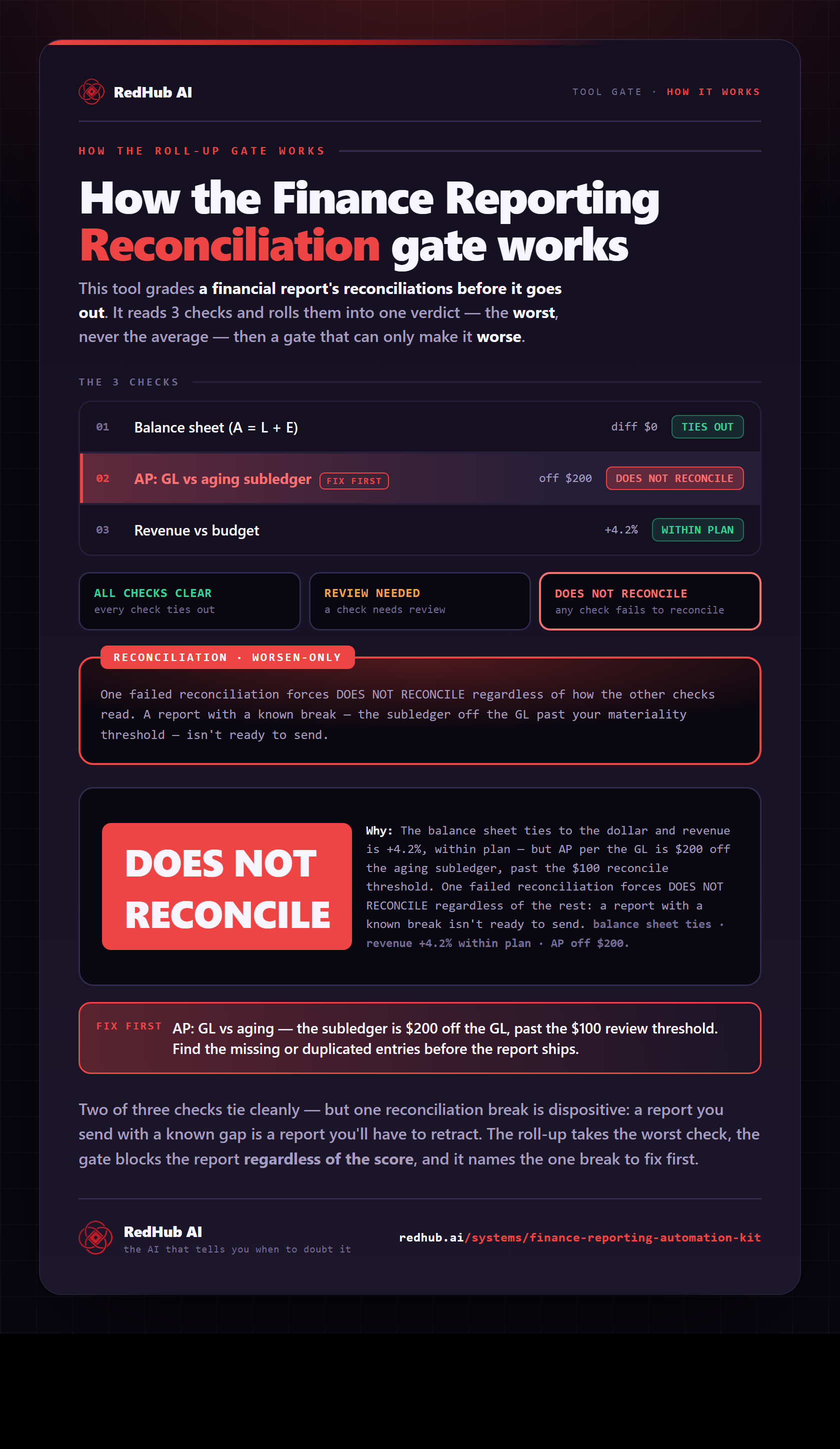
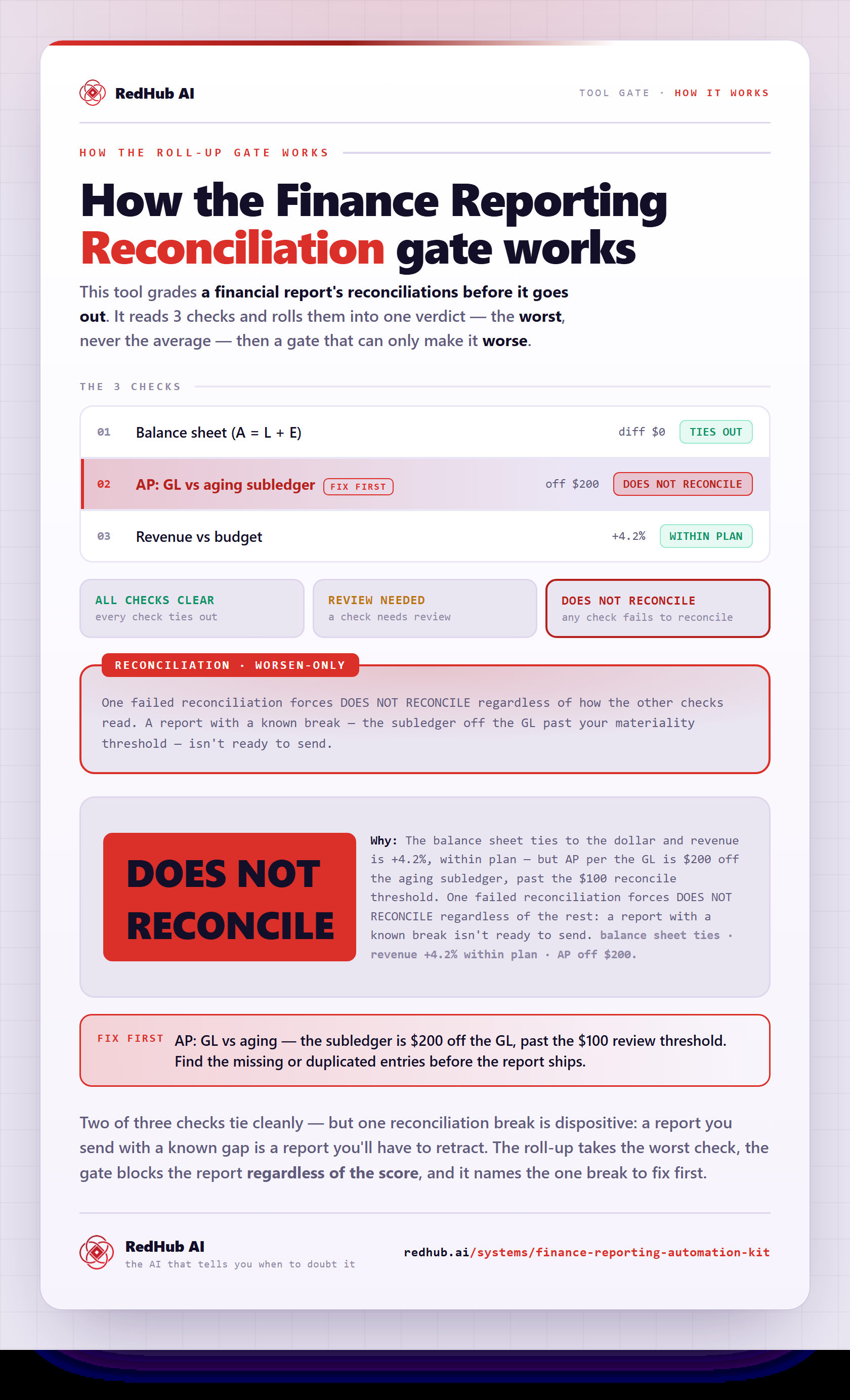
The gate this post refers to, drawn from the tool’s own logic. See the tool.