Marketing Attribution Explained (and Why the Numbers Never Add Up)
RedHub AI Editorialupdated September 20, 20264 min read

Jump to a section6
Marketing attribution is the attempt to assign credit for a sale to the marketing touches that led to it — and the numbers never add up because every platform measures a different, overlapping slice of the same customer journey. Your ad platform, your email tool, and your CRM will each claim more credit than the others, and none of them are wrong. They're just incomplete.
TL;DR: Attribution models (first-touch, last-touch, multi-touch, linear) each answer a slightly different question and will each give you a different number for the same deal. No model is "the truth" — each is a lens. The fix isn't a better model; it's picking one model, applying it consistently, and treating the output as a directional weighting, not an exact accounting.
What Attribution Is Actually Trying to Answer
At its core, attribution asks: "of everything this prospect saw or did before buying, which touches deserve credit, and how much?" That's a reasonable question. The problem is that a real buyer's journey — an ad seen but ignored, a colleague's recommendation, three blog posts read over two months, a direct visit that finally converts — doesn't come with a ledger. Attribution models are approximations layered on top of incomplete data.
The Four Common Models, and What Each One Assumes
- First-touch: 100% of the credit goes to whatever brought the person into your world first. Good for measuring top-of-funnel awareness spend, bad for anything that happens after.
- Last-touch: 100% of the credit goes to whatever happened right before conversion. Good for measuring closing-motion spend, bad for anything earlier in the journey — including the channel that actually created the interest.
- Linear: Credit is split evenly across every touch. Fair in theory, but treats a passive ad impression the same as a 30-minute demo call.
- Multi-touch (weighted): Credit is split unevenly based on a rule set you define. More realistic, and also the most arguable — the weights are a judgment call, not a measured fact.
Why the Platforms Disagree With Each Other
Your ad platform tracks its own click and view windows. Your CRM tracks whatever a rep logs, often manually and inconsistently. Your analytics tool uses its own session and cookie logic, some of which browsers now actively restrict. Each system is honestly reporting what it can see — none of them can see the whole path, so summing their numbers will always overcount the true total.
What to Do Instead of Chasing a Perfect Model
- Pick one attribution model and apply it consistently across every channel and every report.
- Treat the output as a weighting for where to invest more, not a court-admissible ledger.
- Sanity-check the model against a few known deals — does the story it tells match what your sales team remembers actually happening?
- Revisit the model only when your sales motion changes meaningfully, not every time a number looks off.
When "Good Enough" Attribution Is Actually Good Enough
For a lean team, the bar isn't a perfect model — it's a consistent one you trust enough to shift budget based on it. If switching $2,000 from one channel to another based on your attribution read would make you meaningfully nervous, that's a sign to sanity-check the model, not to keep adding complexity to it.
Pairs well with Pipeline Commander for tracking what happens to a lead after marketing hands it off, and the AI Overview Traffic-Loss Diagnostic if a chunk of your first-touch credit is coming from organic search that may be quietly eroding.
More in this guide
Can any tool give me perfect attribution?
No — every attribution model is an approximation built on incomplete, overlapping data from different platforms. The goal is a defensible, directional read, not a number that will ever add up to exactly 100%.
Which attribution model should a small team use?
Whichever one matches the decision you're making most often — last-touch if you're evaluating closing motions, first-touch if you're evaluating awareness spend — applied consistently rather than switched around.
Why do my ad platform and CRM report different conversion numbers?
Because each system tracks a different slice of the journey using its own windows and logic — the disagreement is structural, not a sign of a tracking bug.
Is multi-touch attribution more accurate than last-touch?
It's more nuanced, not more accurate — the weights you assign each touch are a judgment call, so it trades one kind of imprecision for another.
How often should I change my attribution model?
Rarely — only when your sales motion changes meaningfully. Switching models every time a number looks off makes trend comparisons meaningless.
How does the AI Marketing Measurement Kit help with attribution?
It walks a lean team through picking one honest attribution approach, applying it consistently, and reading the output as a weighting tool rather than an exact ledger.
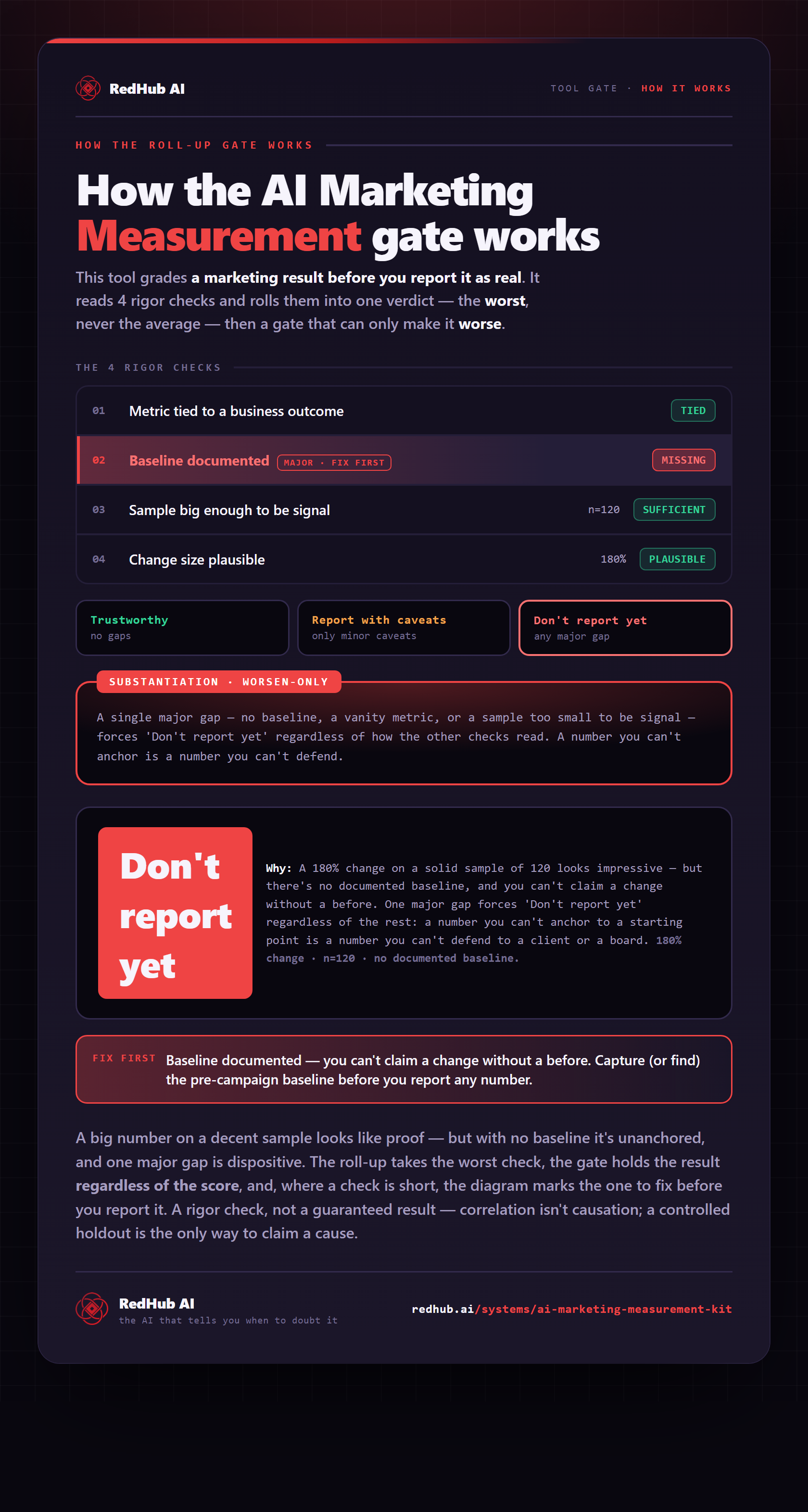
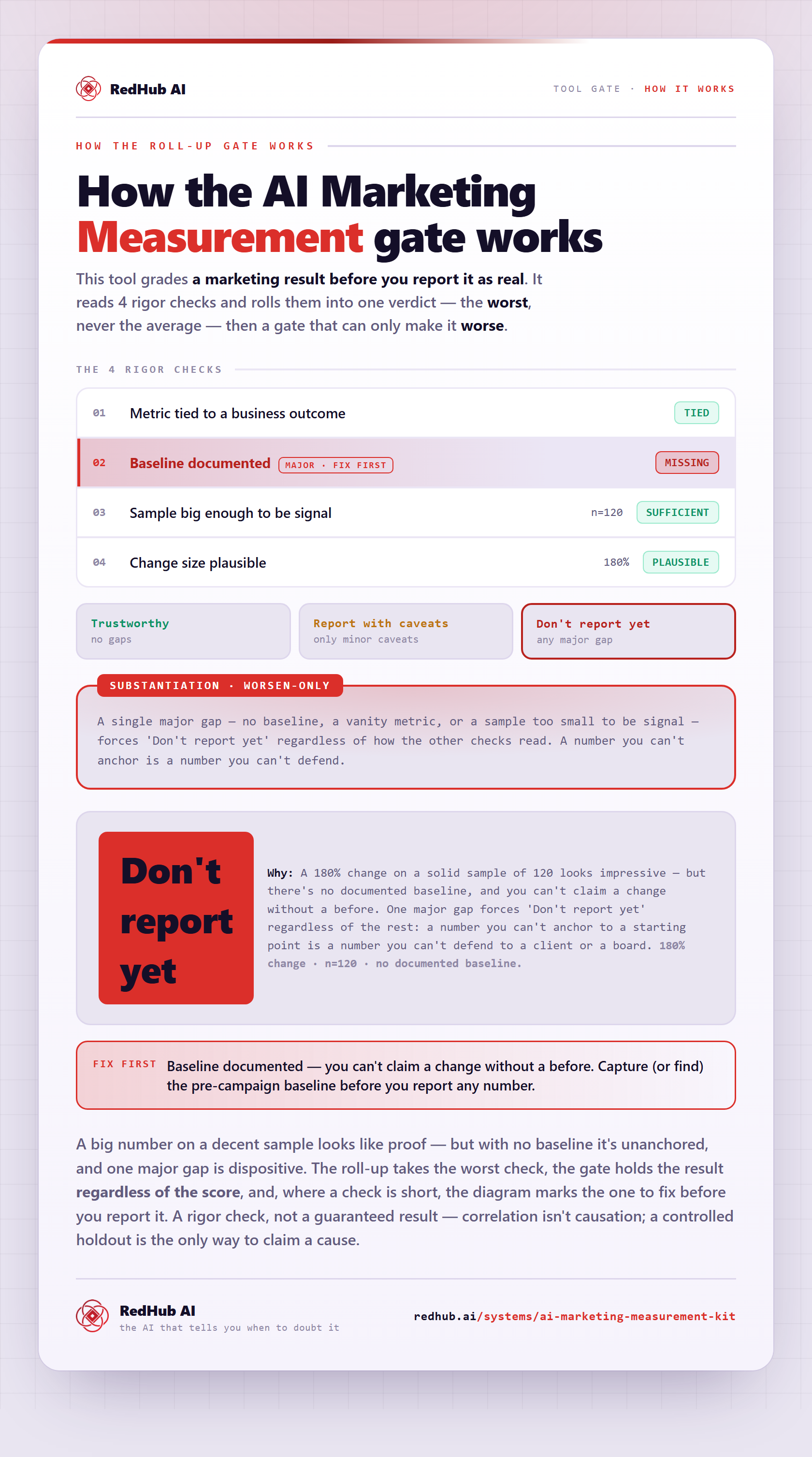
The gate this post refers to, drawn from the tool’s own logic. See the tool.