Ransomware and AI-Outage Recovery: How to Actually Be Ready
RedHub AI Editorialupdated October 5, 20266 min read

Jump to a section7
A ransomware recovery plan is ready when you can answer three questions before anything breaks: what you would restore from, who does what, and how long it would take. Most small businesses can answer the first one loosely and the other two not at all. They have a backup nobody has restored, a plan that lives in one person's head, and a recovery time nobody has measured. Readiness comes from proving the recovery works, and the only proof is a test. This guide covers two ways a business stops: ransomware that locks or wipes your data, and an outage of the AI and SaaS tools your work now runs through.
TL;DR: A ransomware recovery plan answers what you restore from, who does what, and how long it takes, before an incident and not during one. It covers two failures: data that is locked or wiped, and a critical AI or SaaS tool that goes down. The core is a tested restore, named roles, and a drill that finds the gaps. A drill improves your odds; it is not a guarantee or a certification. The Ransomware & AI-Outage Recovery Readiness Drill ($79) scores six recovery controls for each critical system. General information, not legal or security-certification advice.
Two failure modes, one readiness problem
The first failure is the familiar one: ransomware or data loss. Files get locked, encrypted or wiped, by an attacker or by a plain hardware failure. The second is newer: a critical tool outage. Your CRM, your payment processor or the AI model your support desk runs on stops answering, and half the operation stops with it, though nothing was hacked.
From the inside they feel the same. They don't share a fix. You can restore your own data. You can't restore someone else's service: when the AI provider is down, no backup brings it back, and what you need instead is a fallback, such as a second provider, a manual process or an agreed pause. Some tools have no good fallback at all, and for those the honest plan is knowing how long you can wait. The Readiness Drill treats the two as separate triggers for that reason. A system that has never had a timed restore, or a load-bearing AI dependency with no fallback, reads WOULD NOT RECOVER whatever its other marks.
The rest of this guide covers building a plan you've tested, backups that survive an attack, an AI outage playbook, and running a tabletop exercise.
The three questions readiness answers
- What do we restore from? A specific, tested backup, not "it's in the cloud somewhere." You know where it is, how recent it is, and that a restore works because you've done one.
- Who does what? Named roles for the first hour: who declares the incident, who calls the vendor or insurer, who talks to customers, who runs the restore. Each role has a backup person, because the primary might be on a plane.
- How long does it take? NIST SP 800-34, the federal guide to contingency planning, calls this the recovery time objective: how long a system can sit in recovery before the business starts to suffer. The useful version is a number measured in a drill, so you can tell customers and staff the truth instead of a hopeful guess.
What readiness is, and what it isn't
Overpromising here is its own risk, so the edges matter. A readiness drill makes you faster and calmer when something goes wrong. It does not make you un-hackable, and it is not a security certification, a compliance attestation or cyber insurance. It is also not prevention. Stopping attacks is a separate job with separate tools.
The Readiness Drill is honest about its own edge too. It scores the recovery posture you describe and never connects to your systems, so a mark you enter as "tested" is only as true as the test behind it. The drill names the gaps. Closing them is still a rehearsal you run yourself.
A word on the legal side
Recovery planning is operational: backups, roles, restore steps. A real incident can also raise legal questions, and those are a different kind of question. CISA's guide tells organizations to make sure their breach-notification procedures follow applicable state laws, and it points to the National Conference of State Legislatures, which reports that all 50 states, the District of Columbia, Guam, Puerto Rico and the Virgin Islands have laws requiring businesses to notify people of security breaches involving personally identifiable information.
Whether any of that reaches your incident depends on where you operate and where your customers are, what data was touched, and what your contracts and insurance policy say. This is general information, not legal advice. Line up counsel and your cyber insurer before an incident, so the first time you read the policy isn't during the crisis.
Start with the cheapest, highest-value move
If you do one thing after reading this, restore your most important system from your existing backup into a separate environment, and time it. It costs an afternoon. In the Readiness Drill's shipped sample, the Core ERP & file servers system scores 78 out of 100, which sits in the RESILIENT band, and still reads WOULD NOT RECOVER, because nobody has ever run a timed restore. The gate releases the moment that mark moves off zero. From there, work through how to build a ransomware recovery plan one step at a time.
Find out if you'd recover before you have to
The Ransomware & AI-Outage Recovery Readiness Drill scores six controls for each critical system, each marked 0, 1 or 2: a timed end-to-end restore, immutable isolated backups, a fallback for load-bearing AI dependencies, a recovery-time objective validated per system, an incident runbook, and a comms and notification plan. Each system reads RESILIENT, GAPS or WOULD NOT RECOVER, with the one control to drill first where a control is short. It ships as a Python engine, a workbook, a playbook, a drill-and-fix runbook and a six-system sample, and it connects to nothing.
Get the Recovery Readiness Drill — $79Pairs well with
The AI Incident Postmortem & Readiness Gate ($79) is the after-incident half: it grades a finished postmortem and returns CLEARED TO CLOSE AS DESCRIBED, FINISH ACTIONS or NOT CLOSEABLE, and any critical action still open forces NOT CLOSEABLE. The AI Vendor Reliability & Spend-Justification Scorecard ($79) grades the vendors your recovery leans on, and a business-critical vendor that fails any reliability dimension reads DO NOT RENEW. The Agentic AI Security Bundle ($269) covers prevention for AI agents: four Systems that gate what an agent installs, reads, remembers and can reach.
More in this guide
What does "recovery readiness" actually mean?
It means you can answer, before an incident, what you'd restore from, who does what, and how long recovery takes, and you know the answers are right because you've tested them. Buying more security tools doesn't get you there. A timed test restore does.
Does this cover AI-tool outages or just ransomware?
Both. It covers data being locked or wiped, and the critical AI, payment or SaaS tools your business depends on going down. The fixes differ: you restore your own data from a backup, but for someone else's service you need a fallback, because no backup brings a vendor back online.
Is a recovery drill a guarantee I won't get hit?
No. It improves how fast and calmly you recover. It doesn't make you un-hackable, and it is not a security certification, a compliance attestation or insurance. Prevention is a separate layer; recovery is what you reach for when prevention doesn't hold.
What's the single most valuable thing I can do?
A timed test restore of your most important system from your existing backup, into a separate environment. It costs an afternoon and shows whether your safety net is real. CISA's #StopRansomware Guide recommends regularly testing the availability and integrity of backups.
Do I have legal obligations after a ransomware attack?
Possibly. CISA's #StopRansomware Guide tells organizations to make sure breach-notification procedures follow applicable state laws, and the National Conference of State Legislatures reports that every US state has a breach-notification law covering personally identifiable information. Whether one applies depends on where you operate, what data was involved, and your contracts and insurance. This is general information, not legal advice. Line up counsel and your insurer before an incident.
Isn't this the same as antivirus or security software?
No. Antivirus and security software work on prevention, stopping attacks. Recovery readiness is about restoring when something gets through anyway. You want both; this guide covers the recovery half that many businesses never test.
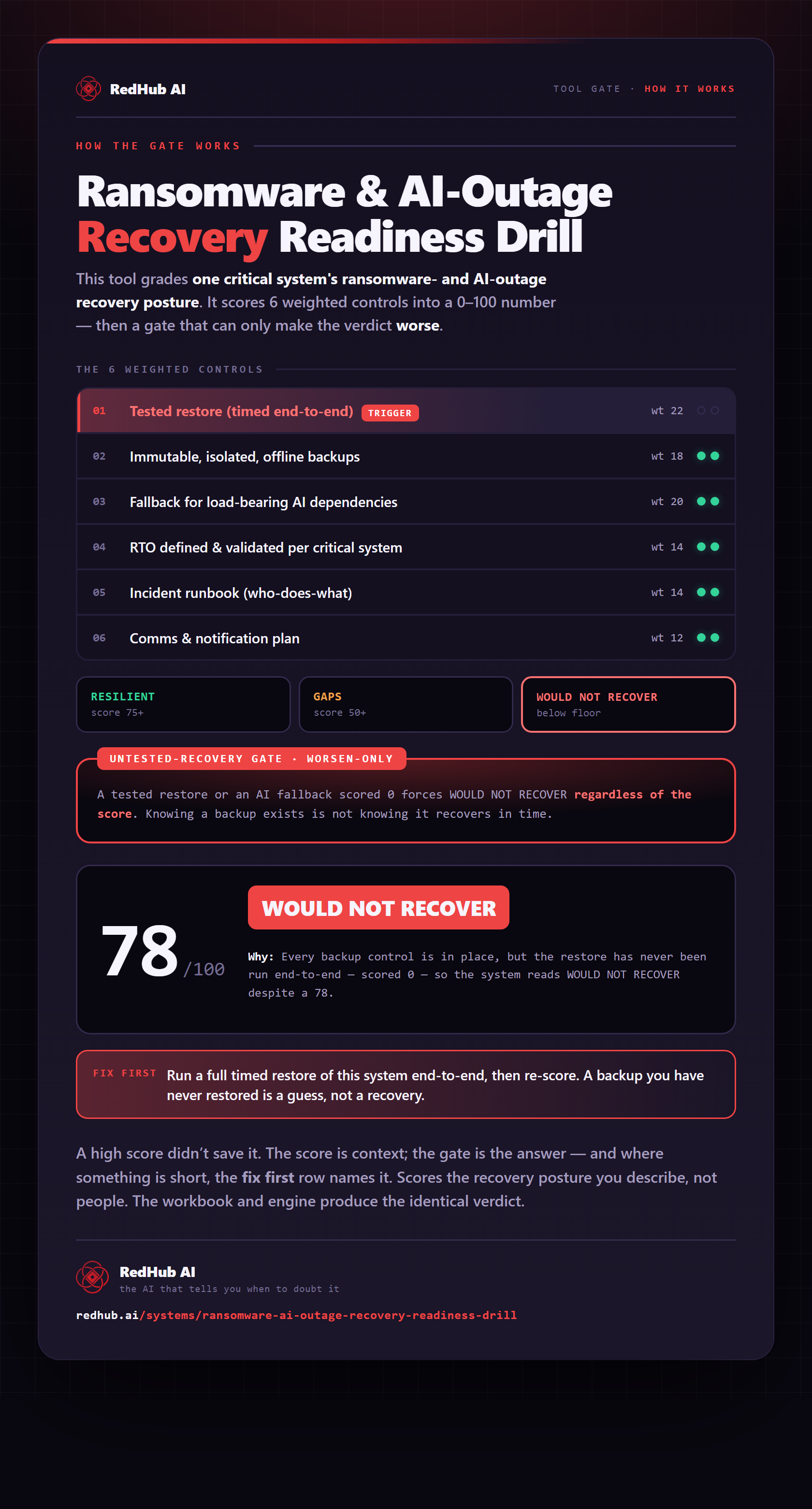
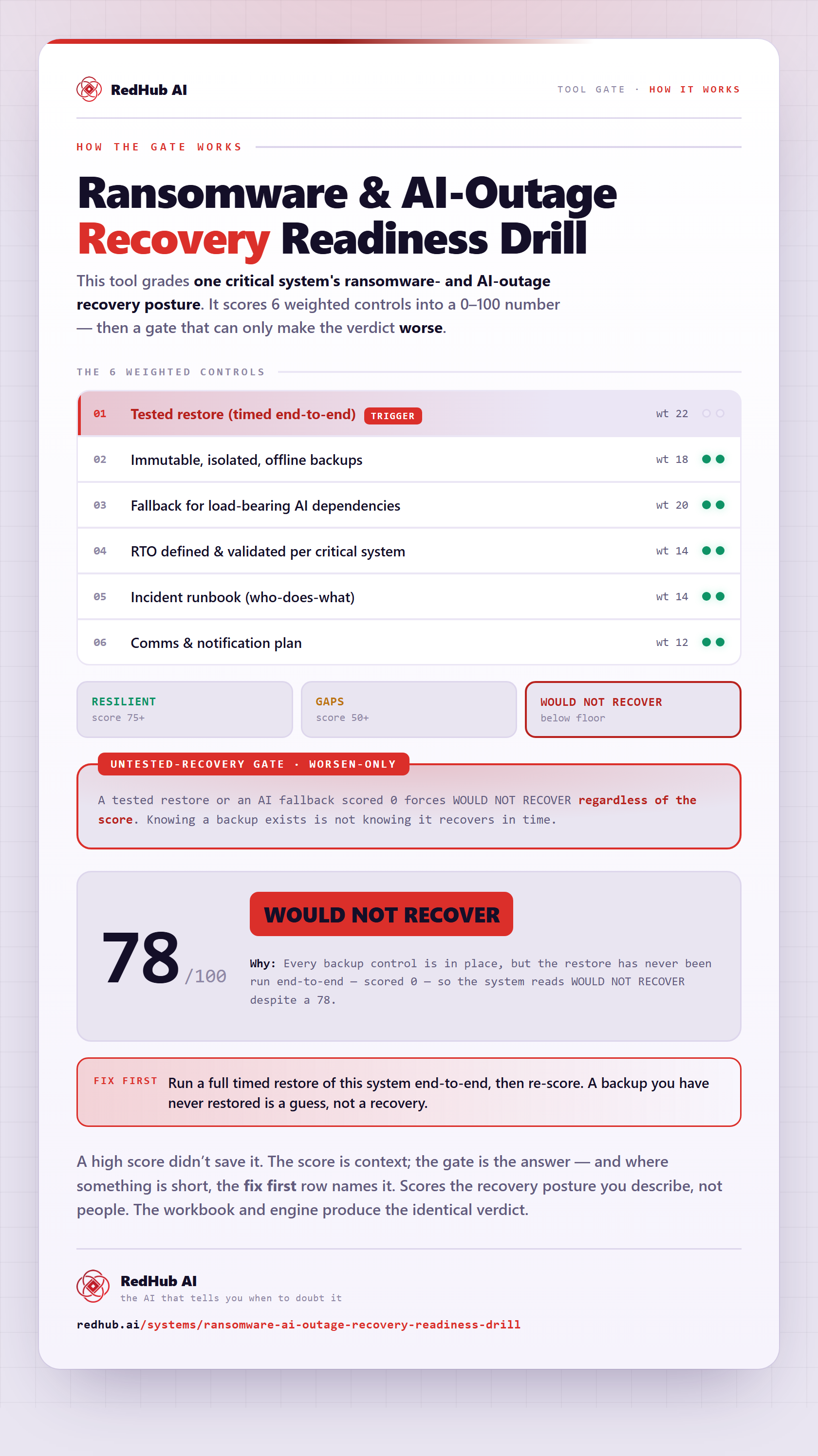
The gate this post refers to, drawn from the tool’s own logic. See the tool.