How to Actually Get Meeting Action Items Done
RedHub AI Editorialupdated October 4, 20266 min read

Jump to a section8
Meeting follow-through comes down to one rule, applied before anyone leaves the room: every action item gets one named owner and a real date, or it does not count as decided. Most teams treat follow-through as a willpower problem. They add reminders, try a new app, or ask sharper questions at the next meeting. Those help with items that were assigned properly. They do nothing for an item that was never anyone's in the first place, like "we should look at onboarding," which sounds like a commitment in the room and names nobody.
TL;DR: A task handed to a group tends to land on no one in particular. Write each item as one line with a person, a deliverable and a date, then check five things before the meeting ends: a named owner, a due date, the owner's acceptance, a place it is recorded, and what done looks like. The Meeting-to-Action Handoff Gate ($49) is a spreadsheet that scores those five checks and drops any item nobody owns.
Why a vague item belongs to nobody
When a decision goes to "the team" or "marketing," each person in the room can reasonably assume someone closer to the work will start it. Psychologists call this diffusion of responsibility. John Darley and Bibb Latané named it in a 1968 study of bystanders, and our post on why action items don't get done walks through what they found.
Take a weekly ops meeting with eight people. Someone says the office HVAC keeps failing and "someone should call the landlord." Eight people heard it. Each has a fair reason to think another one will make the call: the office manager, the person who sits nearest the vent, the founder who signed the lease. The item has no owner until one person says "I'll call Tuesday." Naming that person does more than clarify who's on the hook. It takes away the cover the other seven were standing behind.
A wish and a task sound the same in the room
"We should improve onboarding" and "Maria rewrites the onboarding doc and sends it to the team by Friday" both get nods. Only one of them is still alive on Monday. The second sentence has three things the first one lacks: a name, a thing to deliver, and a day. Take any of them out and you have a topic. Topics get "circled back to" until they drop off next week's agenda too.
The fix is a habit of rewriting before the topic changes. Every item becomes one line: [Owner] will [verb] [deliverable] by [date]. If the room can't fill in the brackets, the item isn't decided yet, and it should be recorded that way.
Does your last meeting's handoff pass?
Pull up the notes from your last meeting and check each open item against these five points.
- One person's name. Not a department, not "the team." One person who can be asked about it.
- A date on a calendar. Not "soon" or "next sprint." A day someone could check against.
- The owner said yes. A name the host typed in afterward is an assignment the owner may not know about. Acceptance means they agreed out loud or replied to the recap.
- It lives in a shared record. The tracker, the shared doc, the ticket queue: somewhere the owner and the person waiting on them can both open. Not the host's notebook.
- Done is defined. "Look into pricing" can never be finished. "Send Dana three pricing options" can. Our post on delegating with SOPs makes the same point about handing off whole processes.
These are the five checks the Handoff Gate scores. If an item fails the first one, nothing else on the list saves it.
The owner can be named and still be the wrong owner
A name on the line proves someone said yes. It doesn't prove they can do the work. When the room goes quiet, the person who volunteers can be the one least comfortable with silence, not the one with the time or the authority. A newer hire who takes "renegotiate the cleaning contract" may need sign-off from a director who wasn't in the meeting.
No checklist can see that. The Gate confirms that a handoff happened. Whether the right person took it is a judgment the room still has to make. The honest test is one more question, "Do you have what you need to do this by Thursday?", and it costs thirty seconds that a meeting running late rarely spends. We don't have a clean answer for that trade. Naming it beats pretending the five checks cover it.
Capture comes first, and it is a separate job
Someone has to produce the list before anyone can check it. The Meeting Intelligence System ($49) turns a transcript or rough notes into a summary, decisions, action items and follow-up emails, and it marks any item without a clear owner or due date as UNCONFIRMED instead of guessing one. That gives you the list. Follow-through starts there and asks whether each line will move.
Your task tool keeps its job too. The Gate doesn't send reminders or follow items across weeks. It checks the input before it reaches the tracker, which is why it works the same whether the tracker is a project app, a spreadsheet or a whiteboard. Whether the meeting was worth holding at all is a third question, covered in our post on meeting ROI.
What the Gate does with your list
The Meeting-to-Action Handoff Gate is one .xlsx with three tabs: Start Here, Dashboard and the Handoff Gate itself. You list the meeting's action items and mark the five checks for each. It reads nothing on its own, so the verdict comes only from your marks. Each item comes back TRACKED, CHASE or DROPPED, and an item with no named owner is DROPPED however complete the rest is.
The meeting then rolls up to ALL TRACKED, GAPS or HANDOFF BROKEN. One dropped item breaks the whole meeting, even when every other item is clean. That can feel harsh. It is on purpose, because an average would bury the single unowned decision, which is the item with nobody to rescue it. Where an item falls short, the sheet names the item and the check to fix first. It grades the handoff, never the people in the room.
Check the handoff before the meeting ends
Five checks per action item, an owner gate that drops any unowned item, and a meeting roll-up that won't average a gap away. One .xlsx that opens in Excel, Google Sheets or Numbers. You mark the checks, and it reads nothing automatically.
Get the Meeting-to-Action Handoff Gate — $49Pairs well with
Run the Meeting Intelligence System ($49) on the transcript first, so the Gate starts from a complete list with the unconfirmed owners already flagged. Once items land in someone's email, the Inbox-to-Done Engine ($129) triages each thread and keeps a waiting-on tracker that surfaces overdue follow-ups. For a founder who wants the whole week graded instead of one meeting, the Operating Cadence Engine ($299) sends a one-page report every Monday that rolls each tracked area up to STEADY, NEEDS ATTENTION or OFF PLAN.
More in this guide
How do I improve meeting follow-through?
Give each action item one named owner and one real date before the meeting ends, and have the owner agree to it out loud. Then record it somewhere the owner and the person waiting can both see, with a clear picture of what done looks like.
Why do action items get forgotten after a meeting?
Often they were never assigned to a person. An item given to "the team" or left without a date lets each person assume someone else will start it, a pattern called diffusion of responsibility. Naming one owner removes that cover.
Can "the team" own an action item?
No. An owner is one person who can be asked about the item. A group can do the work together, but one name has to be on the line so someone is accountable for moving it.
What if the person who volunteers isn't the right owner?
Ask before the meeting ends whether they have the time and the authority to finish it by the date. A checklist can confirm a name exists. It can't tell you whether it's the right name, so that question stays with the room.
Does the Handoff Gate replace my task manager?
No. It doesn't send reminders or track items over time. It checks each item at the end of the meeting so what goes into your task tool has an owner, a date, acceptance, a place it lives and a definition of done.
How is the Handoff Gate different from the Meeting Intelligence System?
The Meeting Intelligence System turns a transcript into a summary, decisions, action items and follow-ups. The Handoff Gate takes that list and grades whether each item was handed off, returning TRACKED, CHASE or DROPPED per item.
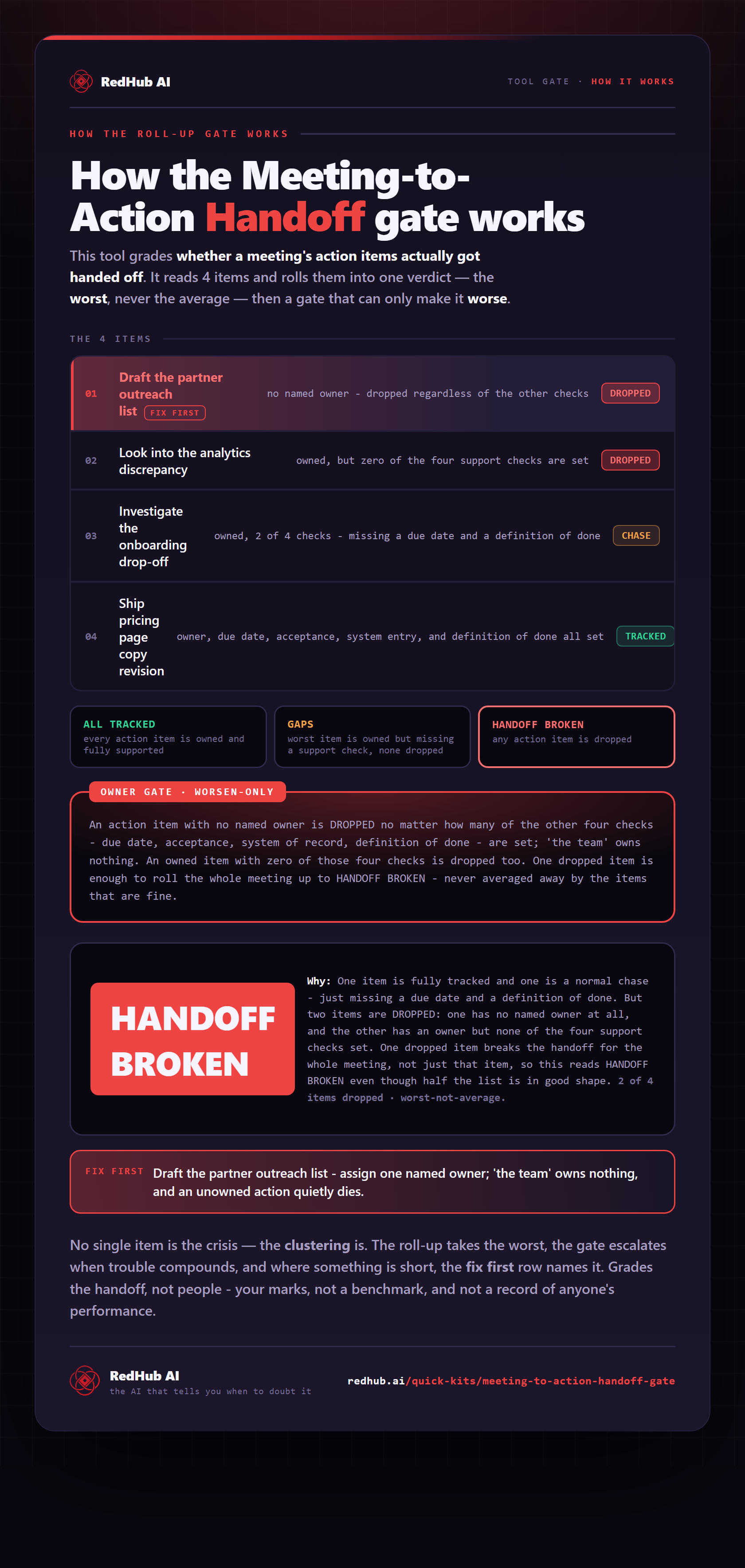
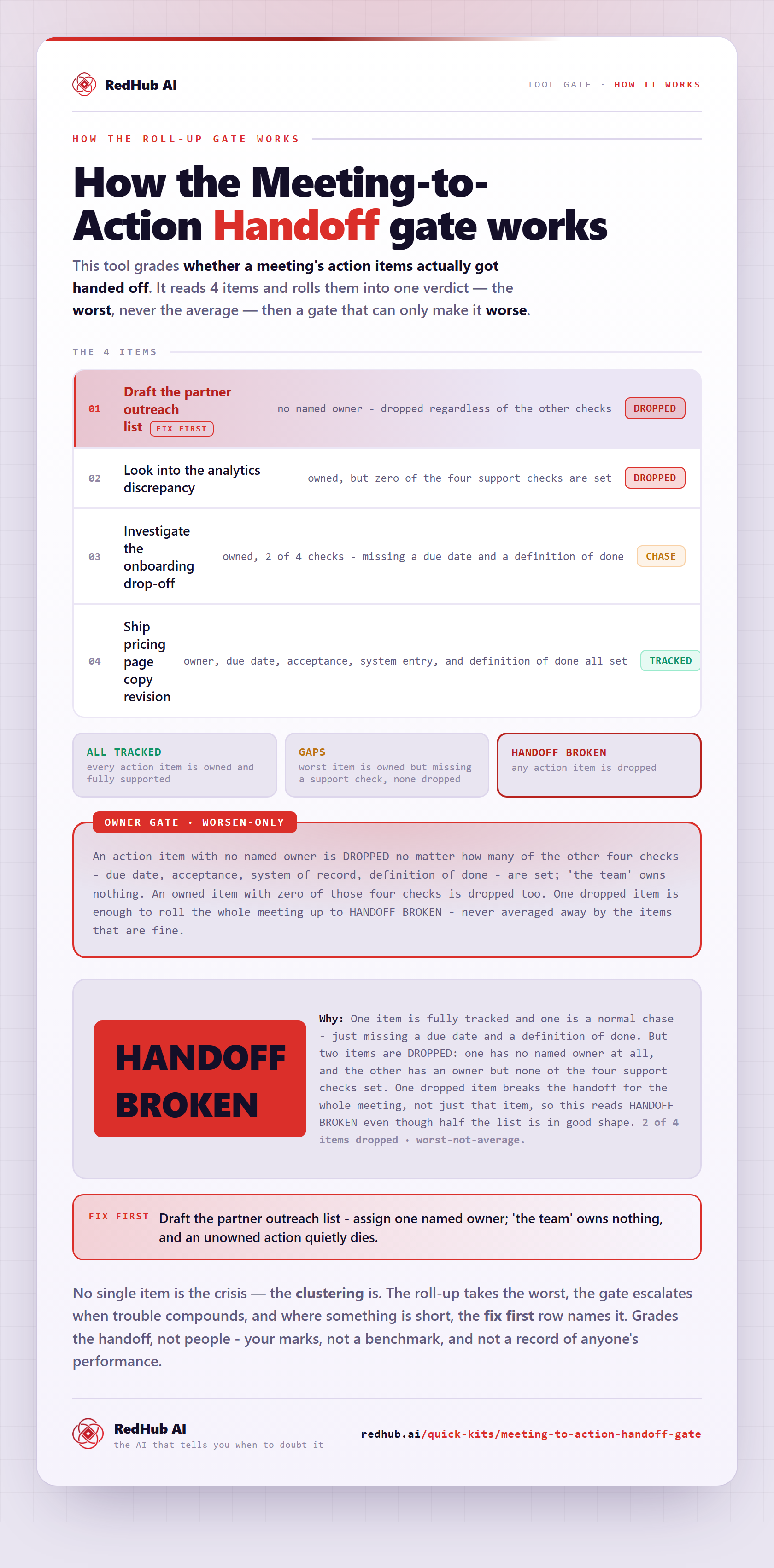
The gate this post refers to, drawn from the tool’s own logic. See the tool.